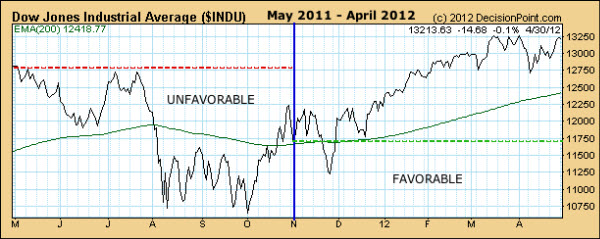
According to popular trading rules, May 1st marked the beginning of a 6-month period of unfavorable seasonality. This is often referred to as "Sell-In-May-and-Go-Away".
Research published by Yale Hirsch in the Trader's Almanac shows that the market year is often broken into two six-month seasonality periods.
From May 1 through October 31 seasonality is unfavorable, and the market most often finishes lower than it was at the beginning of the period.
The period from November 1 through April 30 is seasonally favorable, and the market most often finishes the period higher. (See Sy Harding's book, Riding the Bear, for an indepth discussion of this subject.)
While the statistical average results for these two periods are quite compelling, trying to ride the market in real-time in hopes of capturing these results is not always as easy as it sounds.
Below is the one-year chart that that shows the most recent two six-month periods. It begins on May 1, 2011 and ends on April 30, 2012.
The left half of the chart shows the unfavorable May through October period and the right half shows the favorable November through April period. The green line marks the beginning of the favorable period, the red line marks the beginning of the unfavorable period.
As you can see, the last two seasonality periods turned in textbook performance, with the unfavorable period closing lower, and the favorable period closing higher. However, every year is different and presents its own challenges … and there is no guarantee that any given period will conform to the average.
In addition, Swenlin asserts that bull and bear market pressures override seasonal tendencies more often than not.
With the election coming, we'll see whether things look better moving into the end of October.
Government and business leaders in the United States and around the world are rushing to build better defenses — and to prepare for the coming battles in the digital universe.
To succeed, they must understand one of the most complex, man-made environments on Earth: Cyberspace
It is naïve to ignore the risks of cyber-attacks. For someone to find something valuable, they just have to get lucky once; to stay safe, we have to be vigilant and good all the time.
I was showing my son a web video — and in less than a minute he was texting someone.
Let me make that more clear … it was Less-Than-A-Minute! … while he was standing with me … and he did it without hesitation, apology, or sense that shifting his attention to the phone was in any way a bad thing.
I know "get over it". He was probably texting before we spoke, anyway; right?
You're probably seeing similar behavior more often too.
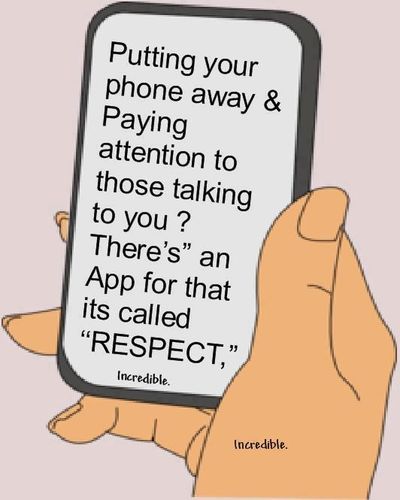
It is scary to realize how easy it is to focus on a phone, iPad or e-mail rather than a person.
Upon reflection, we spend a lot of time alone together.
There is a difference between physical presence and being present.
Focus can be pretty fragile if it isn't a conscious choice.
To demonstrate this, here is a seemingly easy challenge … simply listen to a favorite song.
The challenge is how you can truly do that without losing focus and having other thoughts intrude (for example, without thinking about your to-do list or other songs that you like, or who you're going to meet with later in the day, etc.)? For me, the answer was not that long.
Sometimes it feels like modern life causes attention deficit disorder.
Attention Deficit Can Be Dangerous If You Aren't Aware of It.
Yet, losing focus while trading, in business, or even during a simple conversation – can have serious consequences.
When you are not aware of your focus, I bet it wanders. Mine does; I get distracted easily.
It didn't take long for me to realize that this happened to me while talking to my wife, while listening to a telephone call, even when ordering food at a restaurant. How can I lose focus on the waitress while I was ordering? Apparently, quite easily.
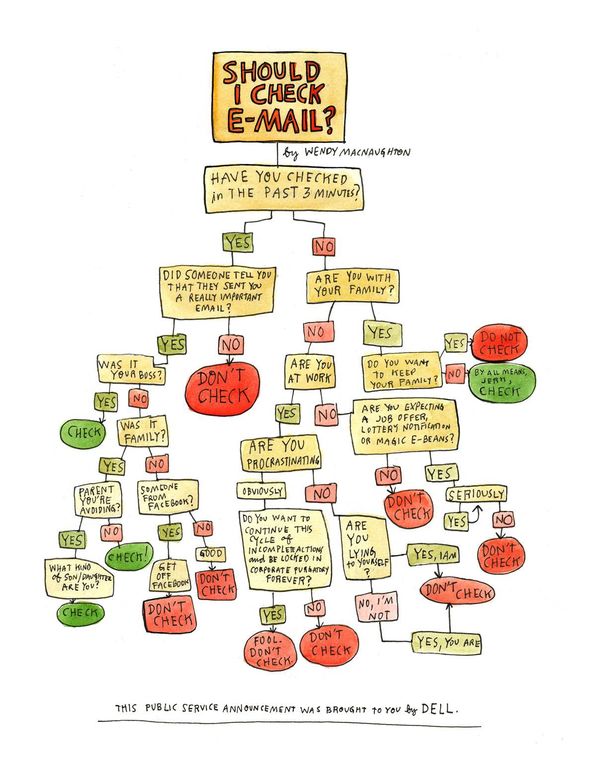
How about you? When you're listening to someone talk to you, are you really listening to them – or are you checking e-mail, texting, browsing a website, watching TV, playing a game, or thinking about what you're going to say?
Be honest with yourself; how often are you fully present? For me, the answer was not nearly enough.
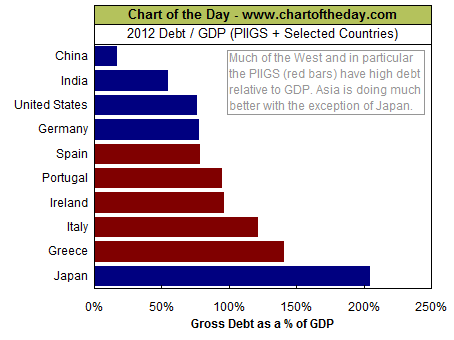
For some perspective on the European sovereign debt crisis, this chart illustrates the forecasted 2012 debt to GDP ratio for each of the PIIGS (red bars) plus a handful of today's major economies (blue bars).
While the PIIGS are currently enduring relatively high debt loads, it is noteworthy how some of the relatively safe nations/bond markets (e.g. United State and Germany) are not far behind.
These relatively high debt loads are of concern as they could lead to higher taxes sometime in the future and can risk fiscal crises if bond holders sense an increasing risk of default.
The current crisis in Europe provides a clear example of the bond market's reaction (i.e. higher bond yields) to increased default fears.
This leads to a very interesting case study that is Japan. With a debt to GDP ratio of over 200%, the Japanese 10-year bond yield is a relatively low 0.83%. Why? At the moment, the bond market feels that the Japanese have the ability to repay their debts — in part due to Japan's perceived ability to raise taxes. To that end, Japanese Prime Minister Yoshiko Noda just won opposition support for the doubling of the nation's sales tax to 10% by 2015.
So it's not just the amount of debt but also convincing your banker that you are good for it.
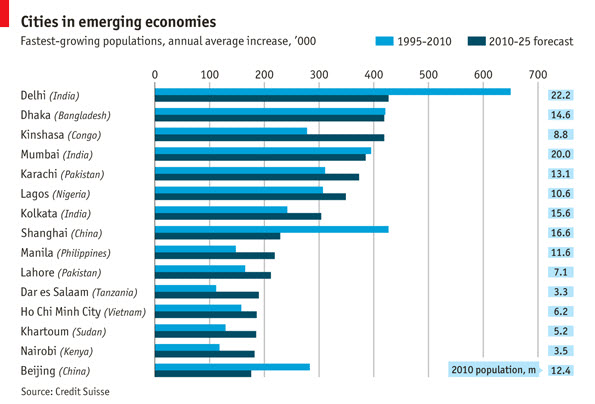
According to the Economist, currently, 52% of the world’s population currently live in urban areas. By 2025, this should increase to 58%. Nearly all this growth will take place in emerging-market economies, particularly Asia, as migrants from the countryside move in search of jobs.
Today, these emerging-market city-dwellers account for more than 60% of the world’s GDP growth.
In the past 15 years Delhi’s population has grown by 10m; it will add another 6m (a Miami's worth) in the next 15.
Over the next two decades urban areas in emerging economies will account for about two-thirds of worldwide infrastructure spending. Most will go on building homes. China and India together will add 16 trillion square meters of housing over this period, to accommodate half a billion extra people.
On a related note, here is an interesting video about India's growth.
Enounce is updating their terrific video and audio accelerator again.
They just released a beta of the 4.0 version of their MySpeed plug-in for Flash, YouTube and other video sites.
Think how much content you consume over the Internet. From news stories to seminars to training videos … the amount of streaming media use is skyrocketing.
Now imagine how much time you could save by watching at 1.5x to 2x the normal speed.
Use MySpeed to adjust the content to your preferences.
Take control and watch video at the speed you choose. The Enounce MySpeed plug-in adds a speed control slider that will allow you to change the playback rate of Audio/Video content. Patented Signal Processing keeps audio sounding natural (not "chipmunked") at all speeds; and allows listeners to comprehend and remember the information.
Here is a demo.
MySpeed is a great time-saver. More importantly, it makes things more exciting and easier to remember. It makes sense. You probably read a lot faster than most people talk. Well, after getting comfortable watching at 1.5x, going back to "normal" is painful.
I've used their products for years. MySpeed works great for audio and video. If you listen to business or training sessions, then this is a must-have. Check it out at Enounce.




 via