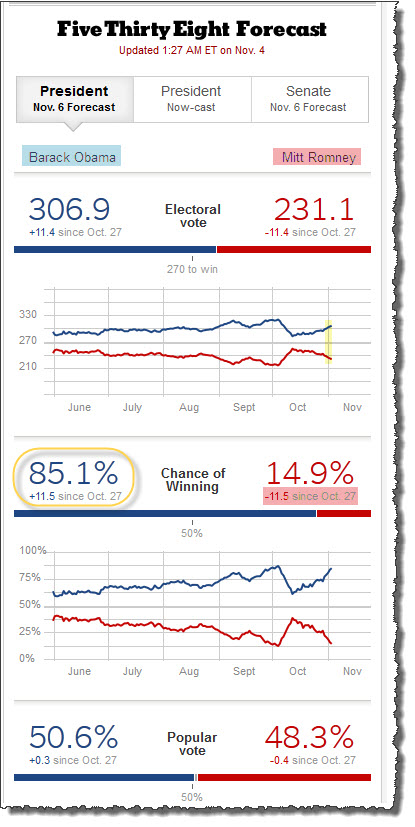
With two days to go, Obama's odds of winning re-election have reached 85%, their highest level, according to the Five Thirty Eight forecast.
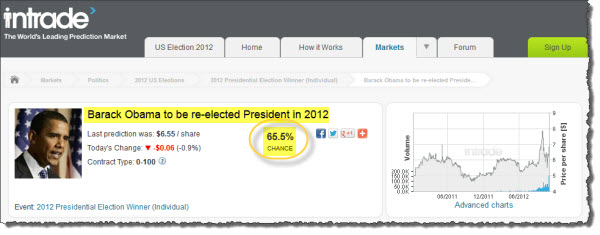
Prediction market, Intrade, also has the President maintaining a solid lead, with a 65% chance of winning.
The difference between the national polls and these results, is that the
national polls focus on the popular vote, whereas Nate Silver's Five
Thirty Eight forecast focuses on state-by-state polls aimed at
determining the winner of the electoral college and, with it, the
Presidency. Nate Silver's model also averages hundreds of polls.
Nonetheless, it is a close race, and what you see depends on where you look … Some polls still seem favorable for Romney (especially on Fox).
But, as election day approaches, and we continue to get bombarded by both sides, remember to take it with a grain of sand and a smile while you remember they are just doing their job.
Mark Twain said it many years ago: "Don't ever let the facts spoil a good story."
Doing the same things, the same ways, has predictable results. Sometimes it is important to do things differently.
Here is a photo of me at the National Society of Black Engineers' Professional Development Conference, where I had the opportunity to present and participate in several panel discussions.
I'm neither black, nor an engineer, and they aren't traders; so why would they ask me to present… and why would I say yes?
Value is often added at the edges. Likewise, good things often happen when you travel outside your comfort or habit zone.
I gained a lot from the experience. For example, I had a discussion with the nuclear physicist who talked about how they use computer simulations to model the effects of a nuclear explosion. That gave me great ideas about how to measure the effect of a particular trading system or algorithm on a market.
Luck does favor the prepared. That conversation could just as easily have been me simply saying 'hello,' shaking hands, and moving on to the next person. To some extent, the ability to take advantage of opportunities comes from the intent to find them.
Is Luck Something That You Can Maximize, Or Would You Consider It Random?
It's possible that luck is both random and something you can maximize.
Here is an example. Many people consider the stock market to be random. Nonetheless, there
are groups of people who consistently beat the market and trade
profitably. How is that possible?
To explain, let's examine the
decision to purchase Apple Computer stock. Regardless of whether that
decision was based on gut instinct, fundamental analysis,
or a technical chart pattern … whether price moves up or down the
moment after that purchase is for the most part random.
However, if you
make 10,000 trades over time, then your ability to make and keep money is about how you manage risk and opportunity. At that point, your
system is not necessarily random. Consequently, it is something that you can
improve.
Transform Results By Getting Un-Stuck.
Improvement means getting better and different results. And, as you already know, it doesn't make sense to continue to do the same thing, yet to expect different results. So, a key skill is learning to recognize when things are "stuck" in rut.
The trouble with many "ruts" is that you don't know you're in one, while you're in one. Consequently, it often takes a different perspective to become aware of new possibilities, opportunities, or best next steps.
Implications.
The interesting thing that this implies is that those opportunities were always there … they just weren't there for you in your current state of awareness.
Similarly, recognize that many of the processes that we rely-on limit our "luck" or opportunities precisely because they limit our choices. When this is done consciously it can be helpful. However, when it's an unconscious act, it can be dangerous.
In general, you can categorize many tools as either being multipliers or diminishers. Neither one is good or bad in and of itself. The trick is to recognize that you have a choice, and that not choosing is still a choice.
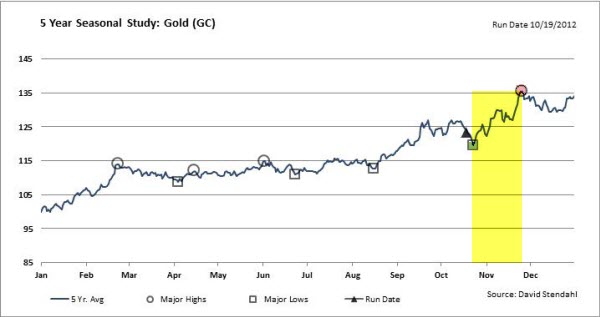
Gold is entering a seasonally strong period. The chart below shows the
predicted turning points based on the past five years of historical
data.
History does not typically repeat itself, exactly; but it often
rhymes. So, it makes sense to keep seasonal tendencies in mind. With
that said, some things potentially different this year include that this
is an election year and world governments are coordinating central bank
stimulus actions.
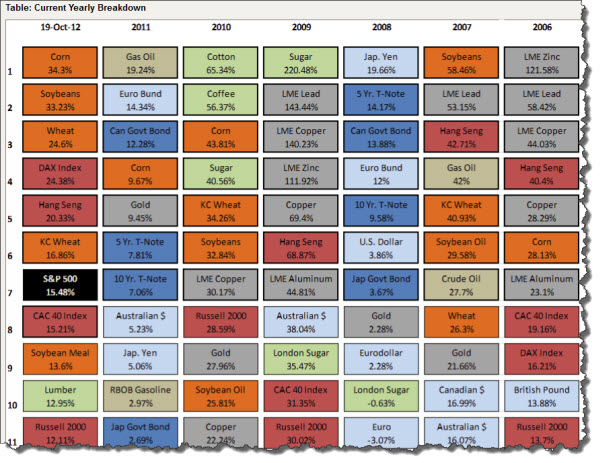
However, the chart below should serve as a reminder that there a lot other markets worth trading too. For starters, Corn is up 34.3% so far this year.
The chart shows the top-ten performing markets, ranked by yearly
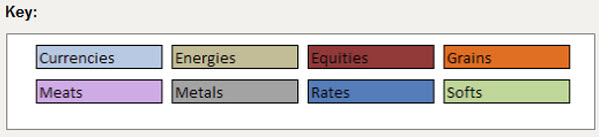
performance, for the past few years. The data is color coded based on
sector. The first column posts the current year's open performance
followed by six columns of closed yearly market performance.
Note how much diversification there has been in the top-ten throughout the years. Click the chart to see an expanded version of this data (showing 40 global futures markets).
That is the funny thing about markets … something is always working. The trick is finding it while it's working.
The Euro Zone is safe; at least someone is propping up the euro.
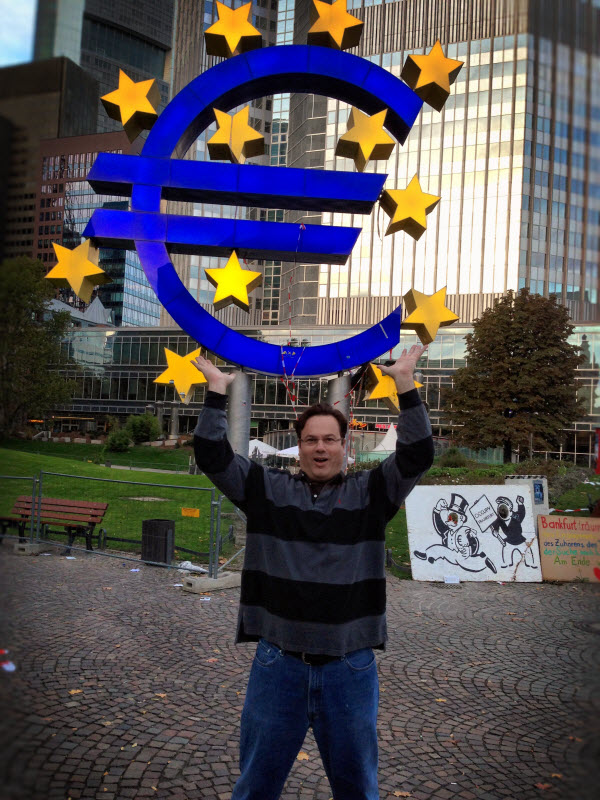
The picture was taken last week in the financial center of Frankfurt, Germany. The handmade signs in the foreground are part of the Occupy Frankfurt movement, which is still active a year after it started.
This visit to Germany prompted some questions. While my observations are not scientific (nor statistically relevant) I'll share a
few of them with you anyway.
First, there seemed to be a pervading sense of
wariness and weariness. I heard many people express concerns about the economy
and the future. "Zeitgeist" is a German word that means spirit of the
times … and the spirit here seems somewhat dampened, despite a 24% gain in the German DAX Index this year.
Second, native
Germans are not having babies at the rate they used to. This would
typically result in an aging population. However, it seems to have
triggered a major influx of immigrants from other countries in the
region, like Turkey, but also from Pakistan, Afghanistan and other Muslim nations.
Third, while stereotypical, my sense is that the German national identity
was somewhat tied to "craftsmanship". But as their economy
manufactures less, it's as if the nation struggles to figure out what it
will become.
Fourth, while America may be a melting pot, historically Germany hasn't been. So, it isn't hard to imagine the cognitive dissonance felt by a Germans who don't know how to respond to a Germany that is becoming less "German".
As a result, this newly diverse population is struggling to
decide how to allocate resources.
I'm reminded of the warning flight
attendants give you on an airplane; if the oxygen masks are deployed,
make sure you use them yourself first, before trying to help someone
else, because it's tough to help somebody else if you're incapacitated.
By
many measures, Germany is the strongest nation in its region. However,
the burdens of a new economy and a new world order are hard to ignore.
It may pay to remember the saying: "Pigs get meaner as troughs get smaller."
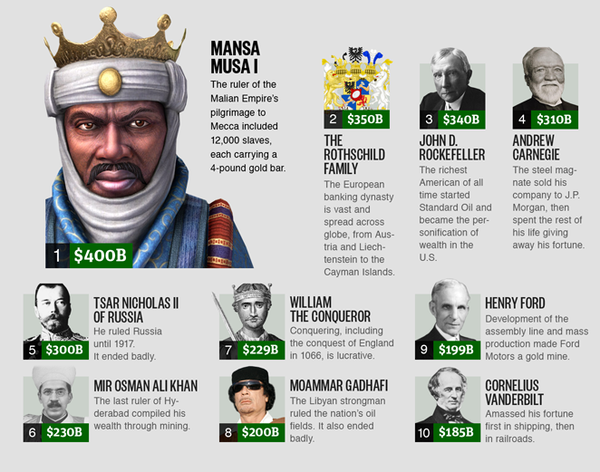
Topping the list is Mansa Musa I, ruler of the Malian Empire until 1337. His net worth of $400 billion was amassed through his empire’s production of more than half of the world’s supply of gold and salt.
Many of the others on the list will be more familiar. Interesting.
Perspective is everything. Here is a great quote about that: “We can complain because rose bushes have thorns, or rejoice because thorn bushes have roses.”
So, are you a glass half-empty or half-full type of person?
Here are some of the posts that caught my eye. Hope you find something interesting.