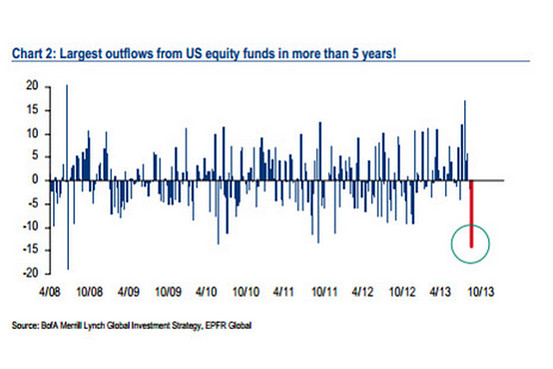
Think of it as a flight to cash as retail investors dump risk assets.
The question is whether this marks the beginning of a new trend, or just nimble trading in the face of perceived danger?
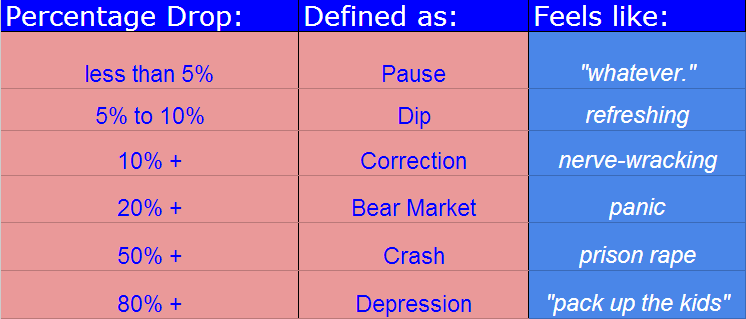
Joshua Brown, who blogs under the moniker "The Reformed Broker," tries to put things in perspective with this handy guide to market pull-backs.
With less than a five percent pull-back, it is a little early to trot out words like "correction."
As to whether we could see a correction (or worse, a bear market or even a crash), the answer is that it is always possible. Nonetheless, most corrections do not become crashes, and over time, every single one of them turned out to have been great buying opportunities.
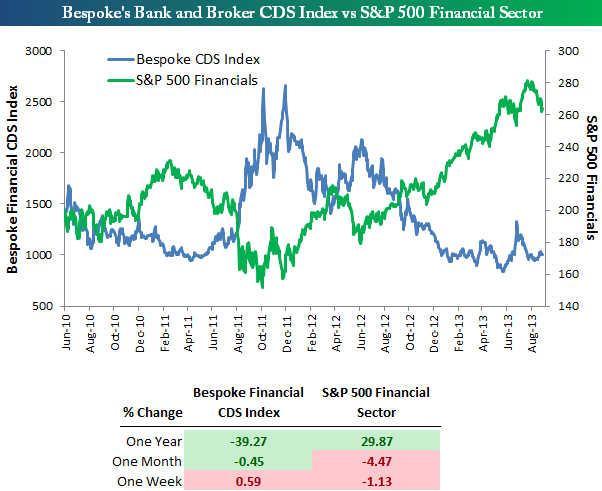
The chart below measures default risk for the major financial firms around the world. Default risk for the financials typically spikes when stocks fall and vice versa.
Throughout 2013, the credit markets have become as comfortable with financial stocks as they've been since before the financial crisis of 2008/09. During the stock market pullback we saw in June, default risk picked up a bit, but during the most recent pullback, we've seen default risk trade sideways. Over the last month, the S&P 500 Financial sector is down 4.47%, but Bespoke's CDS Index is actually down 0.45% as well. So, for whatever the reason, the credit markets don't think there's reason to be concerned just yet.
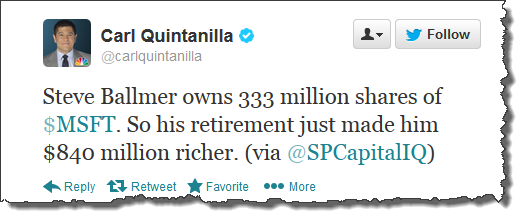
As we head into Labor Day, think about Steve Ballmer … By retiring (or the Market's response to the announcement of his retirement), he made himself nearly $1 billion richer. Nice job.
Here are some of the posts that caught my eye. Hope you find something interesting.
Generous means to help others long before – and after
– you need their help.
Expert means to be very competent in one or more
areas that others value. It also means that whenever you take on a new task, do
your best.
Trustworthy means to take ownership of your words and
actions, and recognize that you live in a world in which they will increasingly
be recorded, remembered, analyzed, and replayed.
Clear means to know what you want and to be able to
communicate it effectively.
Open-minded means no matter how expert or successful
you become, never stop listening and learning.
Adaptable means to keep your options open, so that
when the world surprises you, it won’t be that surprising.
Persistent means to keep trying, even when times are
tough and you are tempted to quit.
Present means that although you should learn from the
past and be prepared for the future, you should pay close attention to the
present moment as it unfolds – otherwise, you will miss a great deal.
When you hear a reference to how the market is doing on the news, it is pretty common for the report to reference the performance of the Dow Jones Industrial Average. The Dow is a price-weighted measure of 30 U.S. blue-chip
companies. It covers all industries with the exception of
transportation and utilities. While this index is not as broad a representation of the US economy as the S&P 500, the Dow's performance typically tracks the S&P 500 pretty closely.
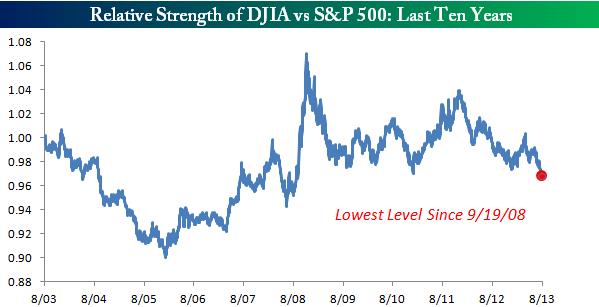
Recently, however, the blue-chip Dow has been a notable laggard compared to the broader S&P 500.
The chart below shows the relative strength of the DJIA vs. the S&P
500 over the last ten years. When the line in the chart is rising it
indicates the DJIA is outperforming, and when the line is falling the
DJIA is lagging.
As you can see, in the last several months the DJIA has been underperforming to such a large degree that the relative strength vs. the S&P 500 is at its lowest levels since the depths of the Financial Crisis.
Do you take that as a bullish sign for the broader market, or early indicator that we are in for a lull before the next move up?
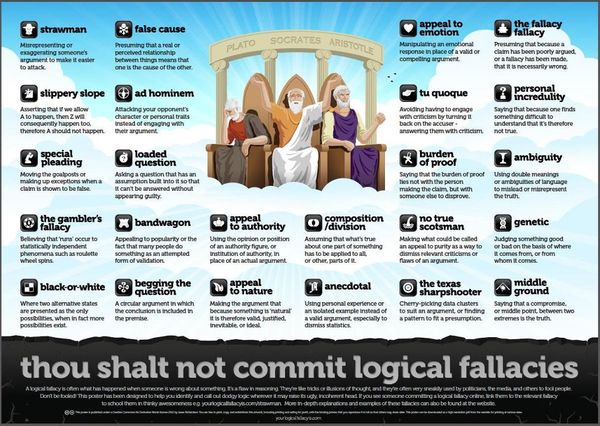
Sometimes business feels like a debate. Other times, dinner conversation or a family discussion takes a contentious turn. In any case, here is a quick primer on logical fallacies.
A logical fallacy is a flaw in reasoning. In other words, logical fallacies are like tricks or illusions of thought. Consequently, they are
often used by politicians and the media.
It is fun to identify which of these certain people (including yourself) use when arguing.
TWENTY LOGICAL FALLACIES:
They fall into three main types: Distraction (10); Ambiguity (5); and Form (5).
A. Fallacies of Distraction
1. Ad baculum (Veiled threat): "to the stick": DEF.- threatening an opponent if they don’t agree with you; EX.- "If you don’t agree with me you’ll get hurt!"
2. Ad hominem (Name-calling; Poisoning the well): "to the man": DEF.- attacking a person’s habits, personality, morality or character; EX.- "His argument must be false because he swears and has bad breath."
3. Ad ignorantium (Appeal to ignorance): DEF.- arguing that if something hasn’t been proved false, then it must be true; EX.- "U.F.Os must exist, because no one can prove that they don’t."
4. Ad populum: "To the people; To the masses": DEF.- appealing to emotions and/or prejudices; EX.- "Everyone else thinks so, so it must be true."
5. Bulverism: (C.S. Lewis’ imaginary character, Ezekiel Bulver) DEF.- attacking a person’s identity/race/gender/religion; EX.- "You think that because you’re a (man/woman/Black/White/Catholic/Baptist, etc.)"
6. Chronological Snobbery DEF.- appealing to the age of something as proof of its truth or validity; EX.-"Voodoo magic must work because it’s such an old practice;" "Super-Glue must be a good product because it’s so new."
7. Ipse dixit: "He said it himself": DEF.- appealing to an illegitimate authority; EX.- "It must be true, because (so and so) said so."
8. Red herring (Changing the subject): DEF.- diverting attention; changing the subject to avoid the point of the argument; EX.- "I can’t be guilty of cheating. Look how many people like me!"
9. Straw Man: DEF.- setting up a false image of the opponent's argument; exaggerating or simplifying the argument and refuting that weakened form of the argument; EX.- "Einstein's theory must be false! It makes everything relative–even truth!"
10. Tu quoque: "You also" DEF.- defending yourself by attacking the opponent; EX.- "Who are you to condemn me! You do it too!"
B. Fallacies of Ambiguity
1. Accent: DEF.- confusing the argument by changing the emphasis in the sentence; EX.- "YOU shouldn’t steal" (but it’s okay if SOMEONE ELSE does); "You shouldn’t STEAL" (but it’s okay to LIE once in a while); "You SHOULDN’T steal (but sometimes you HAVE TO) ."
2. Amphiboly: [Greek: "to throw both ways"] DEF.- confusing an argument by the grammar of the sentence; EX.- "Croesus, you will destroy a great kingdom!" (your own!)
3. Composition: DEF.- assuming that what is true of the parts must be true of the whole; EX.- "Chlorine is a poison; sodium is a poison; so NaCl must be a poison too;" "Micro-evolution is true [change within species]; so macro-evolution must be true too [change between species]."
4. Division: DEF.- assuming that what is true of whole must be true of the parts; EX.- "The Lakers are a great team, so every player must be great too."
5. Equivocation: DEF.- confusing the argument by using words with more than one definition; EX.- "You are really hot on the computer, so you’d better go cool off."
C. Fallacies of Form
1. Apriorism (Hasty generalization): DEF.- leaping from one experience to a general conclusion; EX.- "Willy was rude to me. Boys are so mean!"
2. Complex question (Loaded question): DEF.- framing the question so as to force a single answer; EX.- "Have you stopped beating your wife yet?"
3. Either/or (False dilemma): DEF.- limiting the possible answers to only two; oversimplification; EX.- "If you think that, you must be either stupid or half-asleep."
4. Petitio principii (Begging the question; Circular reasoning): DEF.- assuming what must be proven; EX.- "Rock music is better than classical music because classical music is not as good."
5. Post hoc ergo propter hoc (False cause): "after this, therefore because of this;" DEF.- assuming that a temporal sequence proves a causal relationship; EX.- "I saw a great movie before my test; that must be why I did so well."
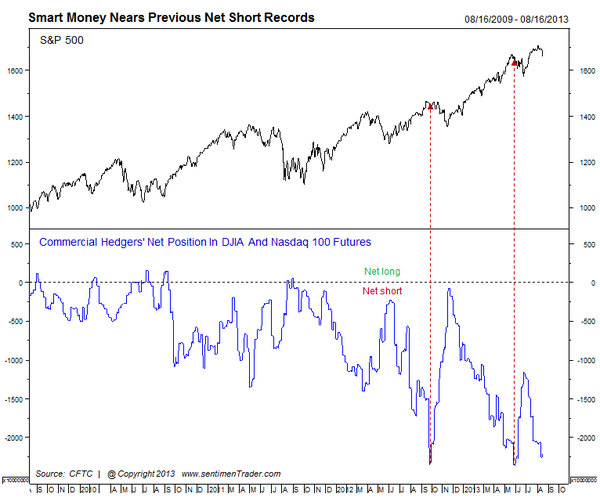
According to SentimenTrader, extremes in
hedgers' positions in the futures have been good clues to the future
prospect for stocks in the intermediate-term.
For example, the chart below shows that there were heavy short positions last September, immediately
preceding a correction. In addition, there was a near net long position last November,
immediately preceding a rally. Finally, look at the record net short in
May right before another rough few weeks for stocks.
Obviously, we are close to those levels again.
Neither of the recent record short positions by commercials marked a major market peak. At its worst point during the next 4-8 weeks, the S&P 500 lost 4% – 6% before recovering … painful but not damaging.
Still, it is prudent to notice these kind of early indicators. However, remember that the trend has been bullish recently. Price is the primary indicator, and until it breaks down, expect dips to be met with buying.
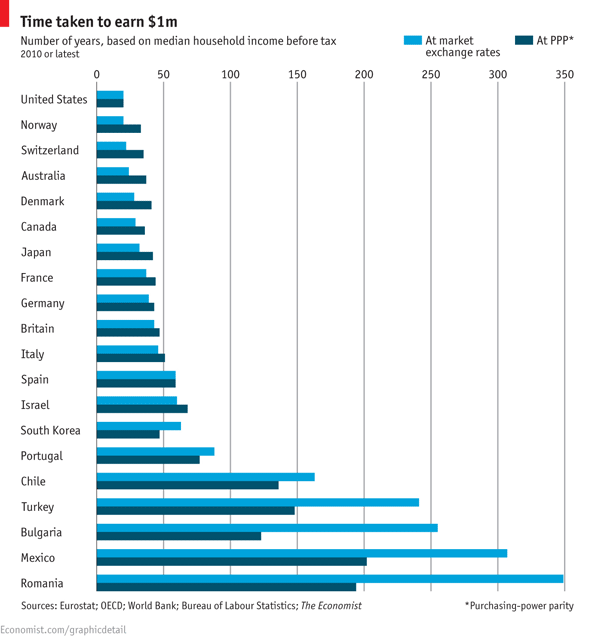
How long would it take for an average person to earn a million dollars?
To find out, the Economist looked at how much the main breadwinner in an average household makes each year (before tax).
On this measure, America creates the swiftest millionaires, and also the most (around 5m households, or 4% of the total). South of the border, Mexicans can expect to work for three centuries to earn the same amount.