|
|

|
|
|
|
|
|
|
|
|
|
|
|
|
|
|


Thoughts about the markets, automated trading algorithms, artificial intelligence, and lots of other stuff
Apparently, Trump has been asking lawyers if he's able to pardon himself from the Russia Investigation. No president has ever attempted it, so it will be interesting to see how it plays out. Clever.

Here are some of the posts that caught my eye. Hope you find something interesting.
The pace of AI progress is awe inspiring.
We are entering a golden age of innovation, disruption, and new possibilities.
Here is a small example. It's not the first time computers have learned to walk, but Google's DeepMind taught itself to walk with no human interaction.
Here is a video.
With very little structure around their knowledge, it's interesting to see how they developed movement – and where it seems distinctly artificial.
For a more instructional video, you can check out "Flexible Muscle-Based Locomotion for Bipedal Creatures" from 2013. It shows the generational differences between their bots as well.
AI is getting smarter, faster. Soon it'll have knowledge that we don't understand. And that will still only be the beginning.
Cool stuff!
There are over 1 billion websites on the internet, and it is constantly growing.
In fact, Google only indexes about 16 percent of the surface Web – and misses all of the Deep Web.
Not surprisingly, the most popular sites comprise the majority of internet usage.
The list of the top 100 trafficked sites was somewhat surprising (and not just because there were only three porn sites that made the cut).
Before looking, who do you think made the list?
Here is an infographic that shows who rules the Internet.

Leading the pack – Google, YouTube, and Facebook top the list (with Google, itself, getting an astonishing 28 billion visits per month) … For scale, that's over 500 times more visits than #100 site on this list.
Pretty insane!
Science, Art, or "PooPoo De Toro"…
Here are some of the posts that caught my eye. Hope you find something interesting.
I just got back from an economic summit in Wyoming where I spent some time with Paul McCulley. He is an economist and former managing director at PIMCO.
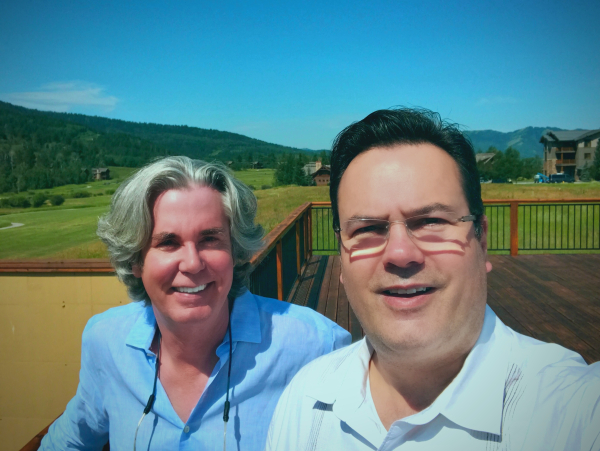
He is the guy that coined the terms "Minsky moment" and "shadow banking system".
Recently, he put together this explanatory cartoon about the relationship between Trump & The Fed.
Truth, Humor, and a Unique Perspective … Worth a watch.
Ultimately, he is fairly bullish … but cautious. He says: "After eight good years on Wall Street, it's bound to end soon. Don't be greedy."
As I get older, I've noticed how much more often my mental perception of myself, and the physical realities are incongruent.
I remember routinely being the youngest guy in the room. Obviously, that isn't true anymore (unless I'm at Denny's at 4pm).
I remember running around the park (without stopping). And I certainly remember enjoying working out with my son.
Things that used to be easy (or at least routine) now cause me stress.
But age affects everyone – and while my 24-year-old can still eat like a pig and lift heavily, those days are behind me.
I recently shared an article on "Conditioning Yourself To Take The Next Best Step," and I talked about getting back in shape … the mentality it takes, and the habits I carried with me from my days as an athlete
One of the hardest lessons for me to learn has been that I can't work out how I used to … or I injure myself.
It is not too far a leap to go from that – to thinking about mortality.
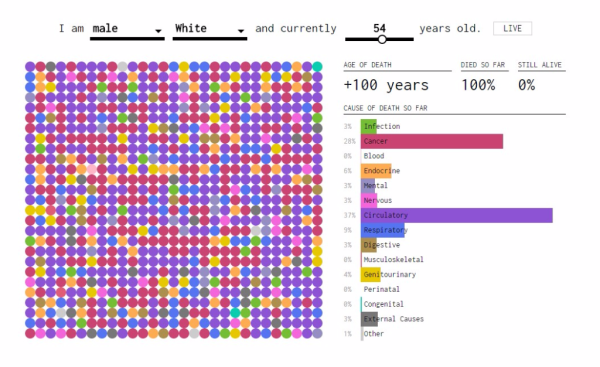
This interactive graphic, below, shows how people of different ages die. Click the image to try it yourself.
 via FlowingData
You can see what average mortality looks like (by plugging in "0" as your age) … or plug in your current age, sex, and race to see what's most likely to kill you (based on you having survived to now).
Unsurprisingly, congenital issues stop having high mortality around 10, and circulatory/respiratory issues become more prevalent as you get older.
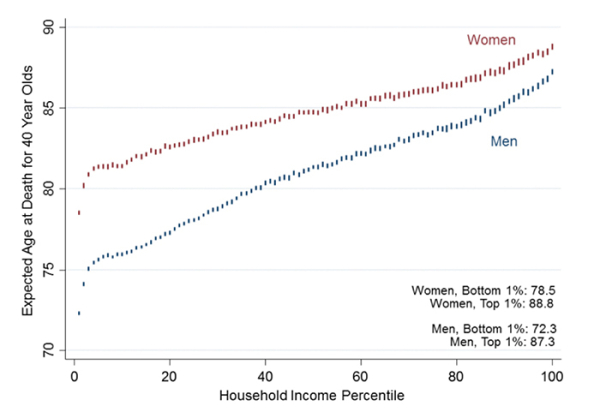
Sure, this is based on averages – but it's interesting to see how locale and income play a role in your life expectancy.
According to a Harvard-run study, people live longer in more educated and affluent areas even if they're less well-off, and that's taking even after taking into account labor market, social connectedness, and other factors.
As well, the richest Americans live approximately 10-15 years longer than the other end of the spectrum as seen below.
via Harvard Gazette
Live Long and Prosper! … Or is it prosper and live long?
When it comes to American pastimes, many people focus on the big 3 sports: Football, Basketball, and Baseball. Nevertheless, there are a lot of different ways people spend their time. It is interesting to see what they watch – and what they actually play.
Nevertheless, there are a lot of different ways people spend their time. It is interesting to see what they watch – and what they actually play.
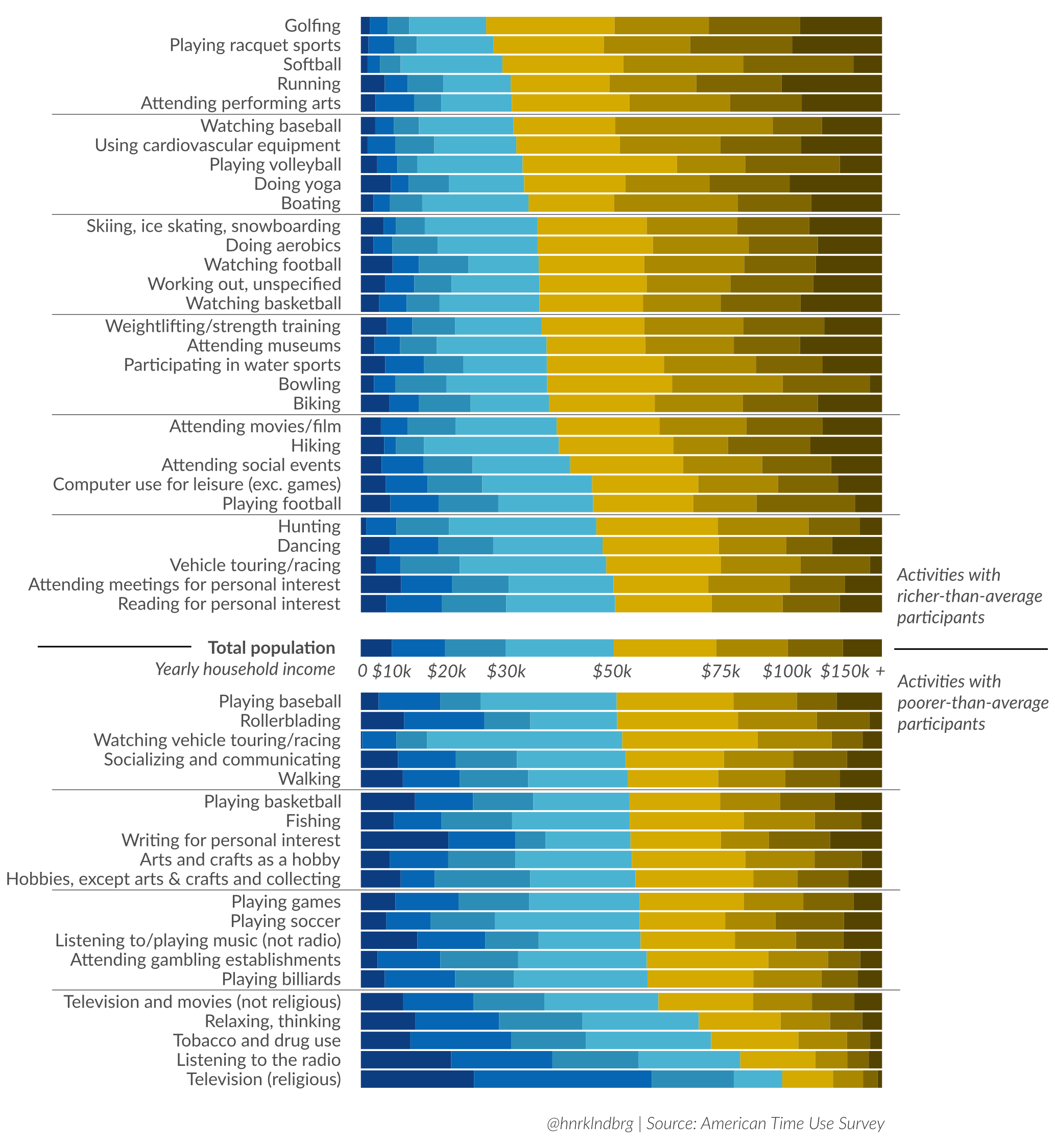
There is also a big difference based on income distribution. Here is an infographic.
via VisualCapitalist
Apparently, rich people like golfing, yoga and racquet sports … while poorer people disproportionately liked relaxing, writing for personal interest, and having hobbies.
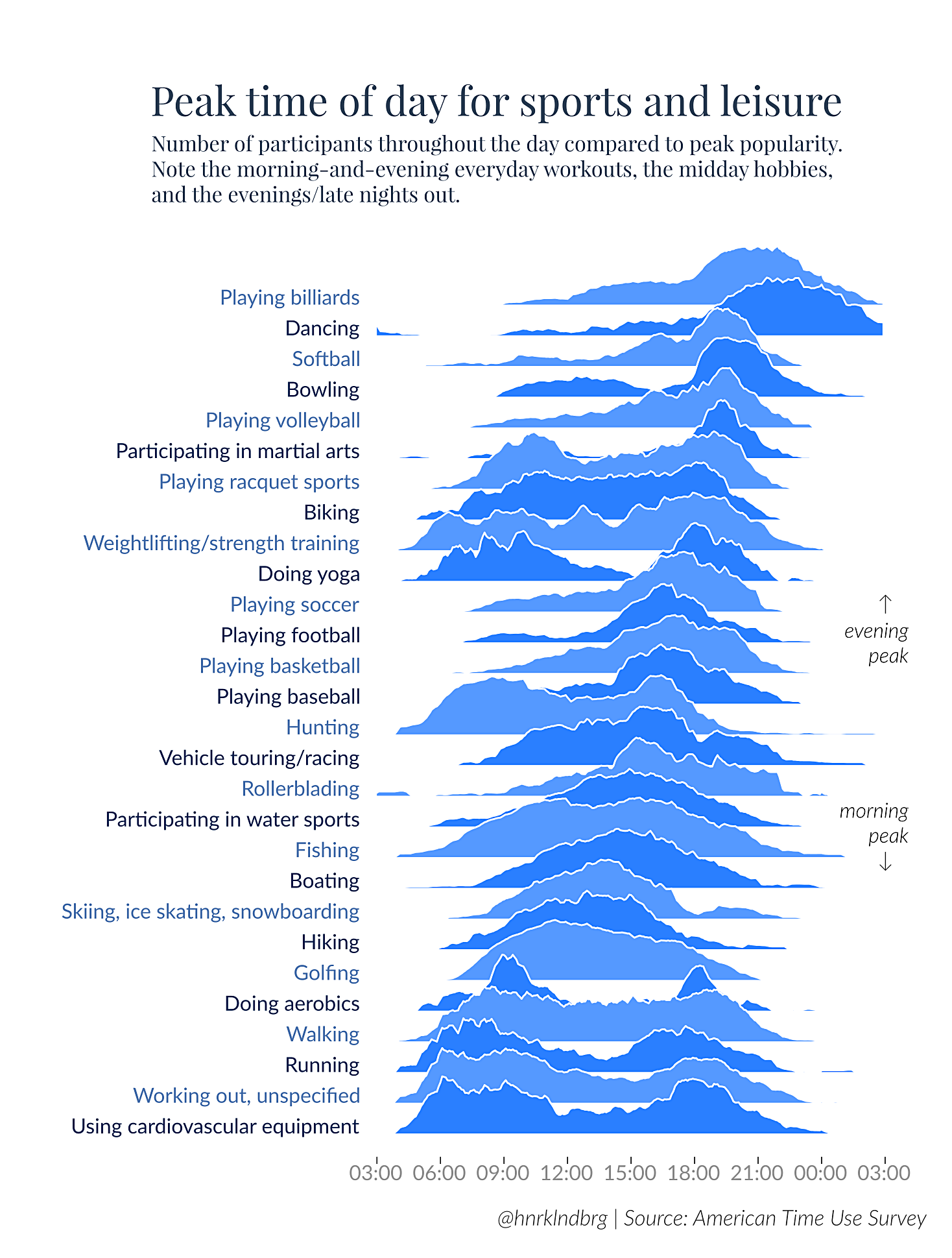
It is also kind of interesting to see when people tend to do certain activities. Here is a chart showing the peak time for various sports and activities.
via Henrik Lindberg
You could build a business around data like that.
Interesting?