|
|
|
|
|
|
|
|
|
|
|
|
|
|
|
|

Thoughts about the markets, automated trading algorithms, artificial intelligence, and lots of other stuff
Here are some of the posts that caught my eye recently. Hope you find something interesting.
Human's can't do a lot of things. Honestly, the fact that we're top of the food-chain is pretty miraculous.
We're slow, we're weak, and we're famously bad at understanding large numbers and exponential growth.
Our brains are hardwired to think locally and linearly.
It's a monumental task for us to fathom exponential growth … let alone its implications.
Think how many companies have failed due to that inability … Radioshack couldn't understand a future where shopping was done online and Kodak didn't think digital cameras would replace good ol' film. Blockbuster couldn't foresee a future where people would want movies in their mailboxes, because "part of the joy is seeing all your options!" They didn't even make it long enough to see "Netflix and Chill" become a thing.
via Diamandis
Human perception is linear. Technological growth is exponential.
There are many examples. Here is one Diamandis calls "The Kodak Moment."
In 1996, Kodak was at the top of its game, with a market cap of over $28 billion and 140,000 employees.
Few people know that 20 years earlier, in 1976, Kodak had invented the digital camera. It had the patents and the first-mover advantage.
But that first digital camera was a baby that only its inventor could love and appreciate.
That first camera took .01 megapixel photos, took 23 seconds to record the image to a tape drive, and only shot in black and white.
Not surprisingly, Kodak ignored the technology and its implications.
Fast forward to 2012, when Kodak filed for bankruptcy – disrupted by the very technology that they invented and subsequently ignored.
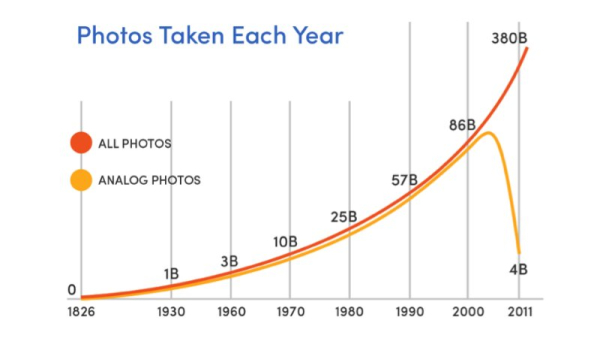
via Diamandis
Innovation is a reminder that you can't be medium-obsessed. Kodak's goal was to preserve memories. It wasn't to sell film. Blockbuster's goal wasn't to get people in their stores, it was to get movies in homes.
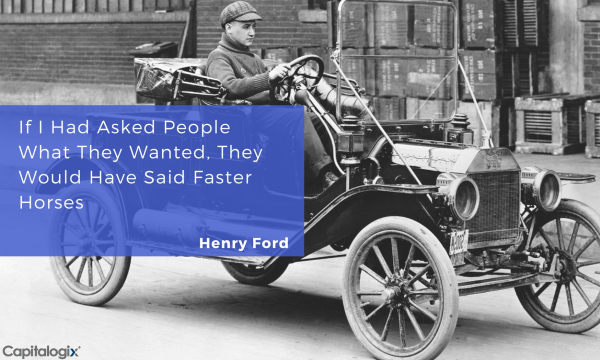
Henry Ford famously said: “If I had asked people what they wanted, they would have said faster horses.” Steve Jobs was famous for spending all his time with customers, but never asking them what they wanted.
Two of our greatest innovators realized something that many never do. Being conscientious of your consumers doesn't necessarily mean listening to them. It means thinking about and anticipating their wants and future needs.
Tech and A.I. are creating tectonic forces throughout industry and the world. It is time to embrace and leverage what that makes possible. History has many prior examples of Creative Destruction (and what gets left in the dust).
Opportunity or Chaos … You get to decide.
Onward!
The leadership in your company is often the difference between a good company and a great company.
Leadership (not just the boss, but the top-level managers as well) can make or break a company.
Am I hands-on or hands-off? Am I encouraging my team to grow? Have I made our company objectives and values inherent?
These are all questions that we – as leaders – need to be asking.
As you answer those questions, you can also be thinking about what leader archetype you follow …
Or you can check out this less serious flowchart to see which fictional boss you are.
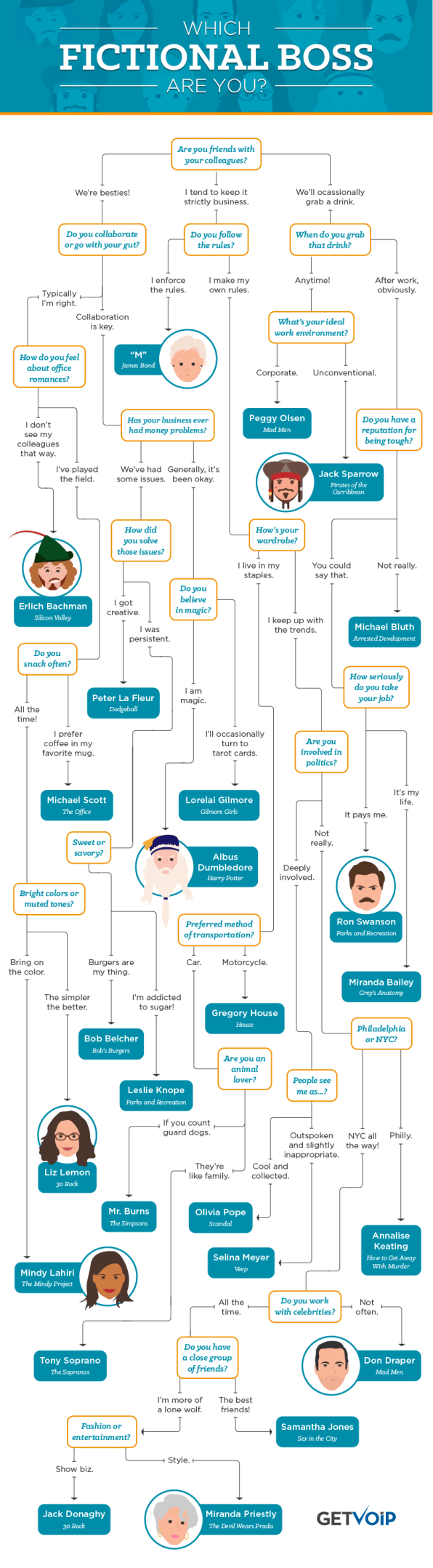
via FastCompany
I just saw the new Star Wars with my family.
It's a bit crazy to think about what percentage of my life occurred since the original came out
I can still remember watching the first one.
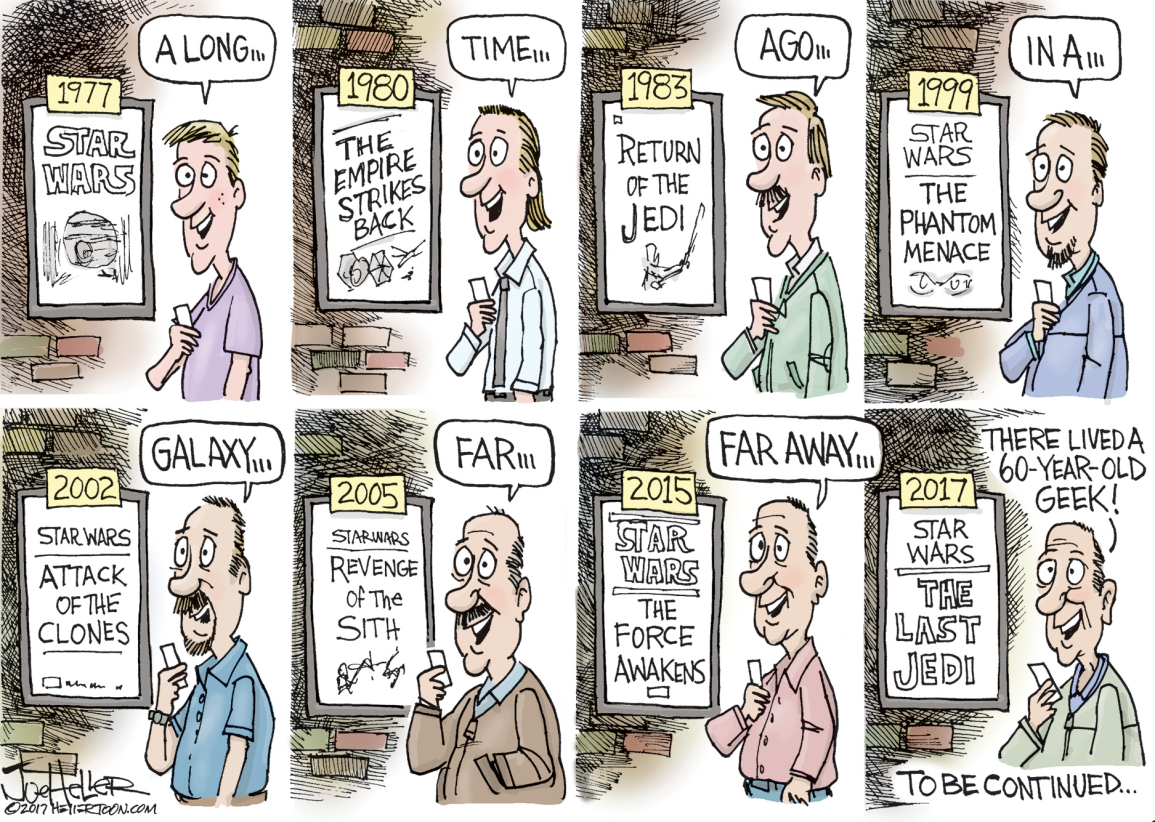
BTW, I'm not 60 yet … but, I am pushing double nickels.
Here are some of the posts that caught my eye recently. Hope you find something interesting.
I was out of the office last week for a series of meetings and strategic planning sessions.
I love getting away from the business to work on the business. That means stepping back from day-to-day issues, to look at the bigger picture. It also means getting back in-touch with mission, values, goals, and intent.
In a sense, the process acts like a compass, which sets the general direction for the journey.
In addition, preparing for a series of meetings, like this, is a lot like working on a business plan.
Personally, I've found that that one of the primary benefits of creating a business plan has almost nothing to do with the plan itself. Working on the plan, immersing yourself in the ideas and possibilities, and ultimately choosing what stays-in – versus what's filtered out … there's magic in that.
Yes, the plan is important. But it is the planning that takes you from thinking … to feeling … to knowing. That's where you capture the real benefit of business planning.
A Good Sign.
Sometimes you hear a question and it takes the air out of an idea. Other times, a question helps you make a new distinction or consider an alternate and better course of action.
A great planning session creates an environment ripe with pushing, pulling, probing, and deep thought … yet, the result is momentum.
How to Tell You Are On the Right Track.
I tend to be analytical. Yet, over time, I've come to believe that one of the best tools to measure whether you are on the right track is how you feel.
Have you ever gotten a phone call from someone, and when you saw or heard that it was from them, you wilted? In contrast, have you ever become more animated and energized while interacting with someone else? It is easy to recognize the difference.
Each person has different thoughts, people, or situations that trigger these positive and negative states.
In sports, this positive state is often referred to as being "in-the-Zone". It is also called "Flow". It happens when someone is fully immersed in what they are doing, has a feeling of energized focus or awareness, full involvement, and success in the process of their activity.
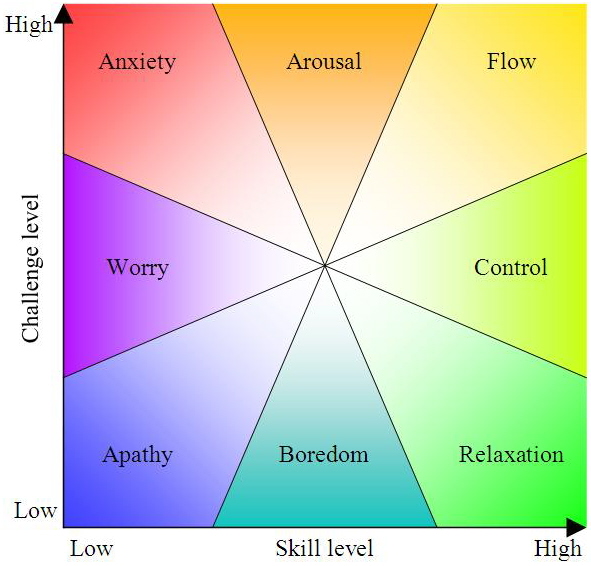
Being in Flow feels good. On some level, when you are in Flow, you know you're on the right track.
Are you on the right track?
We often talk about Artificial Intelligence's applications – meaning, what we use it for – but we often forget to talk about a more crucial question:
How do we use AI effectively?
Many people misuse AI. They think they can simply plug in a dataset, press a button, and poof! Magically, an edge appears.
Most commonly, people lack the infrastructure (or the data literacy) to properly handle even the most basic algorithms and operations.
That doesn't even touch machine learning or deep learning (where you have to understand math and statistics to make sure you use the right tools for the right jobs).
Even though this is the golden age of AI … we are just at the beginning. Awareness leads to focus, which leads to experimentation, which leads to finer distinctions, which leads to wisdom.
Do you remember Maslow's Hierarchy of Needs? Ultimately, self-actualization is the goal … but before you can focus on that, you need food, water, shelter, etc.
In other words, you most likely have to crawl before you can walk, and you have to be able to survive before you can thrive.
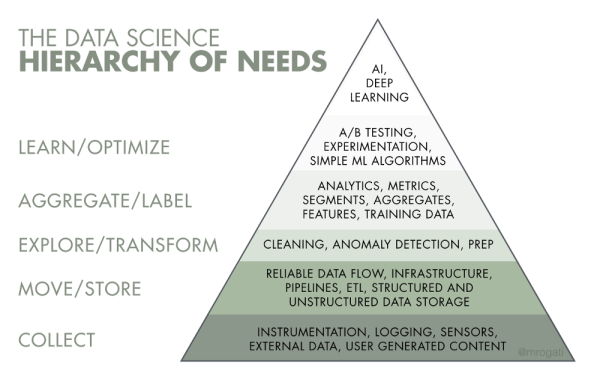
Artificial Intelligence and Data Science follow a similar model. Here it is:
First, there's data collection. Do you have the right dataset? Is it complete?
Then, data flow. How is the data going to move through your systems?
Once your data is accessible and manageable you can begin to explore and transform it.
Exploring and transforming is a crucial stage that's often neglected.
One of the biggest challenges we had to overcome at Capitalogix was handling real-time market data.
The data stream from exchanges isn't perfect.
Consequently, using real-time market data as an input for AI is challenging. We have to identify, fix, and re-publish bad ticks or missing ticks as quickly as possible. Think of this like trying to drink muddy stream water (without a filtration process, it isn't always safe).
Once your data is clean, you can then define which metrics you care about, how they all rank in the grand scheme of things … and then begin to train your data.
Compared to just plugging in a data set, there are a lot more steps; but, the results are worth it.
That's the foundation to allow you to start model creation and optimization.
The point is, ultimately, it's more efficient and effective to spend the time on the infrastructure and methodology of your project (rather than to rush the process and get poor results).
If you put garbage into a system, most likely you'll get garbage out.
Slower sometimes means faster.
Onwards.
Artificial Intelligence has already been used to compose various pieces of music, but they're not replacing real "stars" anytime soon.
A New Zealand musician, Nigel Stanford, released a video with an imagined collaboration between himself and a team of crane-armed robots.
He spent about a month programming the robots.
Check it out.
This was sent to me this week. What do you think?
Here are some of the posts that caught my eye recently. Hope you find something interesting.