Artificial intelligence has moved from the edges of education to the center of it (in many respects, faster than expected).
What started as a tool for efficiency is now reshaping how students learn, how teachers teach, and how institutions operate.
The question isn’t whether AI belongs in education — that ship has sailed. The real question is simpler and harder: Is AI making students better thinkers, or just faster ones? The answer depends almost entirely on how it’s used. AI doesn’t change education so much as it amplifies it — raising the ceiling for motivated learners while lowering the floor for disengaged ones.
The Upside: More Access, More Personalization, More Speed
At its best, AI expands what education can be.
The Microsoft 2025 AI in Education report highlights a shift from AI as a “time-saver” to a tool that increases student agency, giving learners more control over how they engage with material.
That shows up in a few key ways:
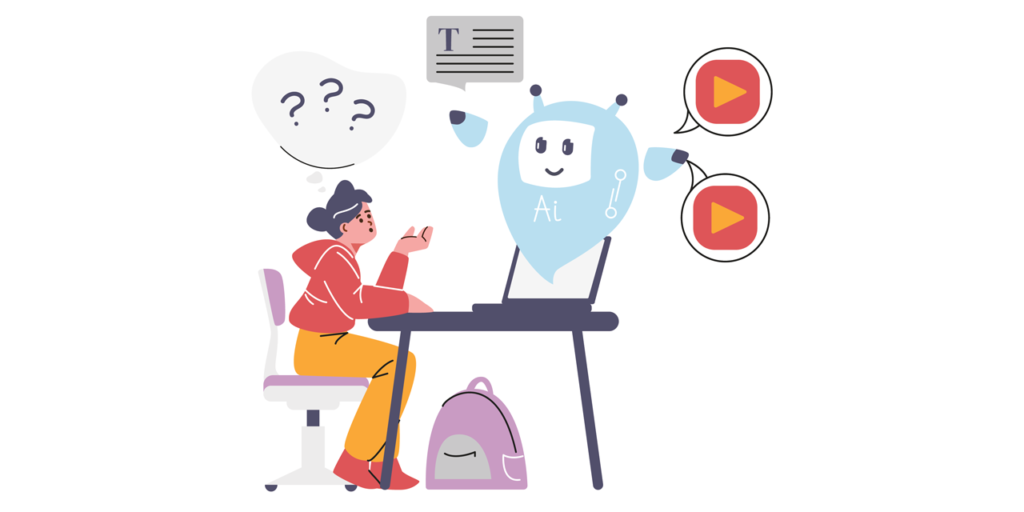
- Personalized learning: AI systems adapt content, pacing, and feedback to individual students, improving outcomes and engagement. When a child is stuck, having an AI tool to work with can be the difference between learning and being left behind.
- Accessibility: Translation, transcription, and text-to-speech tools make content available to more learners, including those with disabilities or language barriers.
- Immediate feedback: Students can learn at their own pace and iterate more quickly, closing gaps in understanding as they arise. And individual students can receive customized responses when they need or want them, even as teachers are assigned more students.
- Operational efficiency: Schools are using AI to streamline administrative work, allowing them to focus more on teaching. AI isn’t just for students; it’s for teachers as well.
Adoption reflects this value. Roughly 86% of education organizations are already using generative AI, making it one of the fastest-adopting sectors.
Students, unsurprisingly, are already ahead of institutions — and often ahead of policy.
The Downside: Dependency, Shortcuts, and Skill Erosion
But the same strengths that make AI powerful also introduce real risk.
A consistent theme across research is that AI doesn’t just make learning easier; it can make it shallower. Students themselves often describe AI-assisted work as “too easy,” which may sound like efficiency but can come at the cost of effort, original thinking, and the character-building struggle that fosters understanding and the ability to do hard things. Over time, that convenience can turn into dependence. Tasks get completed faster, but with less depth, and core skills like critical thinking, creativity, and problem-solving begin to erode.
There are structural concerns as well:
- Academic integrity: AI-generated work blurs the line between assistance and substitution.
- Accuracy and trust: AI systems can hallucinate or provide incorrect information.
- AI literacy gap: Even as usage rises, fewer than half of educators and students feel confident using it effectively.
In other words, adoption is outpacing understanding. As a result, you end up with potential for worse long-term outcomes for at-risk students.
Education has always aimed to do more than just teach children literacy and numeracy. It focuses on critical thinking and developing skills that apply in the real world. As AI becomes more widespread, it’s important to balance teaching these skills with recognizing how the “real world” continues to evolve.
The Reality: A Tool That Amplifies Intent
The emerging consensus is less about “AI is good” or “AI is bad,” and more about AI is amplifying whatever learning behaviors already exist.
Used well, it deepens understanding … helping students explore ideas, iterate faster, and engage more meaningfully. Used poorly, it becomes a shortcut that replaces the very thinking education is meant to build.
Even the research reflects this duality: with intentional design and guidance, AI can deepen learning rather than replace it.
AI in education isn’t a binary shift. It’s a leverage point.
It raises the ceiling for what motivated, curious students can achieve. It also lowers the floor for disengaged students to bypass learning entirely.
The same dynamic playing out in classrooms is also appearing in workplaces.
- AI is making the least curious people less curious, but it is also allowing creative people to do more and expand possibilities.
- AI isn’t going to steal your job, but a smart person with impactful usage of AI tools will.
That gap will widen. And the differentiator won’t be access to AI, but how it’s used, taught, and governed.
Education has always been about more than answers.
AI just makes that distinction impossible to ignore.
Leave a Reply