
Well, I hope you took my reminder to heart and voted last week.
And like many elections, I’m sure many are surprised and unhappy with the results.
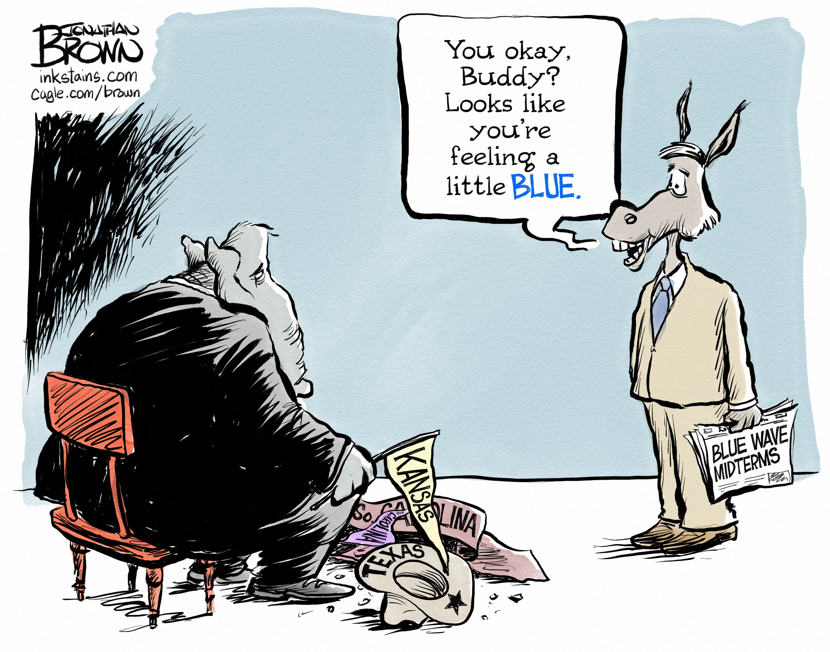
The 2026 midterm elections delivered a decisive victory for Democrats, who took control of both the House and the Senate. Republicans lost states they had carried comfortably for many elections, and several races produced seemingly outlandish results … but were they really?
Jonathan Brown via Cagle
Most surprisingly, Texas and Kansas flipped.
Texas hadn’t been blue since the early ’90s, and Kansas hadn’t since the Wizard of Oz was in theaters.
It’s tempting to interpret an election like this as a dramatic shift in the political identity of the country. Democrats will undoubtedly celebrate it as a mandate, while Republicans will spend the coming weeks trying to understand what went wrong. Thankfully, many pundits on both sides are trying to bring the commentary back down to earth.
For me, that’s actually less important. Media inflammation and election volatility are par for the course.
What this represents to me is potentially a bigger shift, not in what Americans believe … but in what they’re willing to tolerate.
A Referendum on Promises
In many ways, this election was a referendum on the Republican Party’s ability to deliver on its promises in the past 2 years.
Republicans entered the cycle controlling the White House and both chambers of Congress. They had campaigned on affordability, economic growth, reducing government waste, and keeping America out of expensive foreign conflicts. Those messages were compelling, especially for voters who felt the previous administration had lost touch with their everyday concerns.
But governing is different from campaigning.
The economy is a good example. Stock market performance, corporate earnings, and headline economic growth can all paint an encouraging picture. But those numbers don’t necessarily reflect the financial reality of the average household. People aren’t measuring economic success by the S&P 500 if they’re struggling to pay their electricity bill or put groceries on the table.
Spam is flying off the shelves for a reason.
This was one of the more interesting points in Senator Ted Cruz’s post-election commentary. Even as he defended the broader Republican economic philosophy, he acknowledged that his party had failed to connect its accomplishments and economic messaging with the experiences of everyday Americans.
It’s a fair criticism, and one that extends beyond Republicans.
Economic policy isn’t particularly meaningful to voters if they don’t feel its benefits.
Then there’s the Iran war.
A significant part of the Republican political appeal in 2024 was the promise of putting America first and avoiding another prolonged international conflict. The decision to engage militarily with Iran created an uncomfortable contradiction for a portion of that coalition; it only worsened as the war dragged on.
What’s particularly interesting is that opposition wasn’t limited to Democrats. Exit polling showed that most Americans believed military action was the wrong decision, including roughly one in four Republican voters.
We’re also seeing a willingness among some Republican voters to break with their party’s leadership on other issues, including executive power, government accountability, and the priorities of Congress.
In fact, some of the most interesting criticism following the election has come from the right itself.
Conservative commentators, including Jesse Watters, Laura Ingraham, and Ben Shapiro, have questioned the party’s direction. Some have pointed to the war and trade policies. Others have criticized congressional Republicans for failing to accomplish more despite having the political opportunity to do so.
They’d argue this isn’t a rejection of conservatism. It’s a recognition that voters expected certain things from their elected officials and didn’t feel they got them.
The Republican Party now has to decide whether it wants to treat this election as an unfortunate setback or an indication that something within its coalition needs to change.
Markets will spend the next few weeks asking the same question about every policy promise, in every sector — which ones were real, and which ones were theater.
The Next Gen is Paying Attention
Another important story from this election is how many young voters participated and which way they voted.
Tufts University’s CIRCLE estimates that 27% of eligible young Americans voted in the midterms, making this the second-highest youth turnout in a midterm election in the past 30 years. Approximately 66% of voters between 18 and 29 supported Democratic House candidates.
That’s a substantial shift from 2024, when Donald Trump made considerable gains with younger voters, particularly young men.
Why the change?
The economy is undoubtedly part of the answer. Younger Americans worry about housing affordability, job opportunities, healthcare, and whether they’ll be able to build the kind of financial future previous generations enjoyed.
But there’s another issue worth considering: foreign policy.
Younger Americans have grown increasingly skeptical of military intervention and prolonged foreign conflicts. They watched the wars in Iraq and Afghanistan unfold, and now they’re watching another generation of political leaders navigate conflict in the Middle East.
The promise of keeping America out of unnecessary wars resonated with younger voters across the political spectrum. When that promise appeared to fall by the wayside, it created an opportunity for Democrats to win back voters they had struggled to connect with in 2024.
However, I wouldn’t dismiss the Republican gains among young voters from the previous election as meaningless. This generation doesn’t necessarily have a permanent political home. They’re still figuring out what they truly believe as they wrestle with where their beliefs meet reality.
And that brings us to another interesting development: the candidates themselves.
Politics Has a New Language
James Talarico in Texas, Jon Ossoff in Georgia, and Abdul El-Sayed in Michigan are three candidates worth watching.
They have different backgrounds, different political philosophies, and different approaches to campaigning. But they share something that has become increasingly important in modern politics: an ability to communicate with today’s youth.
Talarico has demonstrated an impressive ability to combine thoughtful, eloquent messaging with social media fluency. His campaign reportedly generated more than three billion organic video views. Ossoff has built a national following through his speeches, measured delivery, and ability to turn congressional moments into widely shared content. El-Sayed has embraced internet culture, humor, and a much more informal approach to political communication.
All three are being lauded for cutting through the noise.
I think the bipartisan win here is that the public is pushing back hard against negative campaign ads that avoid the actual issues.
People seem open to an articulate presentation of an idea, challenge, or an explanation that helps them process a complicated issue in a way that feels understandable and believable. Unfortunately, in today’s terms, that means they likely want to hear it on TikTok after the fact.
There’s something refreshing about candidates who can communicate with conviction without relying entirely on outrage.
Of course, being a compelling communicator doesn’t make someone a good legislator. Social media popularity isn’t a substitute for policy experience or the ability to build consensus and reach across the aisle to make a lasting impact.
But the ability to capture attention is increasingly a prerequisite for political success. Both parties would be wise to recognize that the next generation of political leadership may look and sound very different from the one we’re accustomed to.
What Will Democrats Do With Their Victory?
Democrats have won the House and Senate. They have a mandate to govern, or at least a significant opportunity to influence the country’s direction.
But what will they actually do with it?
For years, the vocal left has criticized Democratic leadership for being too passive, too accommodating, and too ineffective at advancing its own agenda. Progressive voters have frequently expressed frustration that Democratic politicians campaign on ambitious promises only to compromise or retreat when it comes time to deliver. As Ted Cruz pointed out, they often overreach only to fail before the finish line.
Now they have a new chance to see what happens when their party has the numbers and an audience clearly unhappy with the status quo.
Will Democrats take decisive action on affordability, healthcare, government accountability, and the issues that helped them win?
Or will they spend the next two years consumed by investigations, political retaliation, Trump hatred, and attempts to undo everything the previous administration accomplished?
There is a legitimate place for congressional oversight, but voters are going to expect more than investigations and press conferences.
They want results.
Then there’s the question of how far left the party will move.
Is It Woke 3.0?!
Republicans have spent considerable time warning that a Democratic victory would usher in a wave of far-left extremism. Some fear aggressive taxation, expanded government intervention, radical social policies, and a dramatic departure from the economic principles that have driven American growth.
But how much of that is a realistic concern, and how much is political fear used to mobilize voters?
We have watched similar predictions play out in the other direction. Democrats spent years warning about what a second Trump presidency would mean for American institutions and democracy.
… Hopefully, it won’t surprise you to learn America hasn’t fallen, and won’t with the blue tsunami either.
A Democratic victory doesn’t mean every progressive policy proposal suddenly has the support of the American electorate. The party contains a wide range of political perspectives, from moderates to democratic socialists, and those differences don’t disappear simply because they share an election victory.
The question is whether Democratic leadership can balance those competing interests and produce a governing agenda that appeals to more than its most enthusiastic supporters.
They have two years to demonstrate that they can.
Signal, Not Sentiment
For those of us watching the markets, this transition introduces another layer of uncertainty, and we’ve already seen AI companies take a hit as a result.
A change in congressional control can influence everything from tax policy and government spending to trade, energy, regulation, and the broader business environment.
The moves that disturb the most people are often the ones that end up mattering most.
In the short term, it’s rarely the news itself that moves markets — it’s how everyone reacts to it. And even that reaction doesn’t always mean what you’d expect, because markets aren’t nearly as logical as we’d like them to be.
If markets were logical, the smartest people in the room would always be the richest. They’re not.
That’s the same noise every systematic trader is trained to filter out — the first move is rarely the real one. And corrections often come when you least want them. Experienced traders realize that markets have to disturb the most people in order to trigger trades … and that often means the most painful move is most likely.
The important thing is not to confuse political drama with economic consequences.
As we discussed last week, a story’s volume doesn’t necessarily reflect its importance. Political coverage often rewards the most dramatic interpretation, while the actual consequences take considerably longer to understand.
What’s signal? What’s noise?
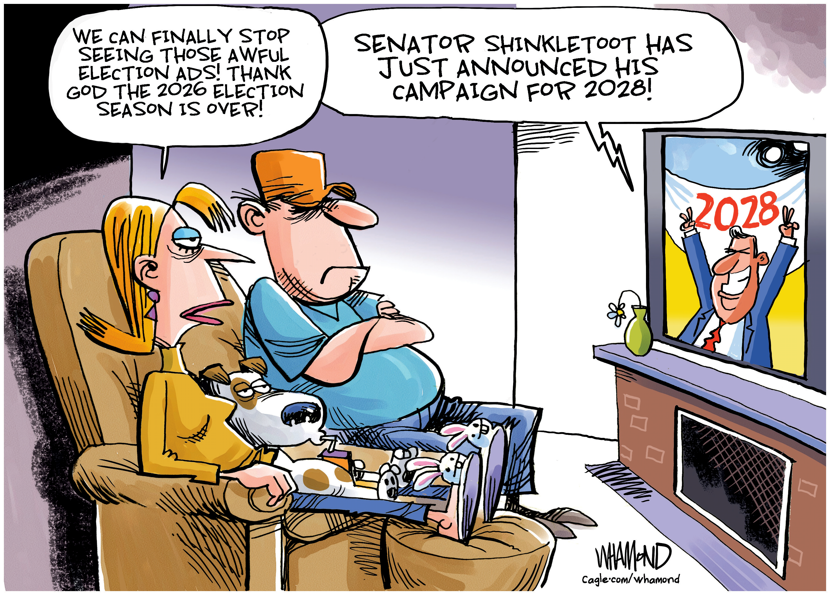
And then there’s 2028
Perhaps the biggest question coming out of this election isn’t what happens over the next few weeks. It’s what happens over the next two years.
Dave Whamond via Cagle
The Democratic Party now has an opportunity to establish a new identity and develop its next generation of national leadership. Candidates like Talarico, Ossoff, and El-Sayed have shown an appetite for new voices and new approaches to political communication.
But will Democrats move toward the center to capitalize on their broader coalition, or will their progressive wing push the party further left?
Republicans face an equally important decision. Will they double down on the Trump movement, or begin building a political identity that extends beyond him? Will JD Vance emerge as the natural successor, or will another candidate reshape the party?
Ultimately, this election is another reminder that political power is temporary, public sentiment is constantly evolving, and neither party should mistake winning an election for the game being over, or the battle being won.
The next two years will tell us a lot about both parties’ direction, the strength of the American economy, and what voters actually want from their government.
When the next presidential election arrives, we’ll have another chance to decide which direction we want to take.
There are more questions than answers right now, and anyone who tells you otherwise has something to sell you. As always, the best next step is to stay focused “on the main thing” and plan for a bigger future, not a smaller one.
Hope that helps.
If you want a cleaner read on where things are headed than cable news offers, prediction markets like Polymarket and Kalshi increasingly bridge the gap between financial markets and our interpretation of what’s happening in the world.
So, two years from now, who do you expect to see sitting in the Oval Office — and how many people will that surprise?
Leave a Reply