
I often say, “Standing still is moving backward,” and “You’re either growing or dying.”
So when I hear people resist new technologies, I can’t help but cringe a little. Smart people don’t avoid innovation and new technologies — they find ways to harness them.
On the other hand, we’ve certainly seen countless businesses get so distracted by innovation that they lose sight of what they’re supposed to be optimizing for.
With Nike getting delisted from the S&P 100, I thought it was worth a short revisit. For a more comprehensive article, check this out. While these frameworks focus on technology, you can replace the word technology with anything, e.g., data, the internet, new laws, etc.
Step 1: Start With Why
Before you can get the right answers, you have to ask the right questions.
Simon Sinek popularized a concept called “Start with Why.” His 2009 Ted Talk “How Great Leaders Inspire Action,” which remains one of the most-viewed TED Talks ever, with almost 70 million views.
This talk introduced his core framework: The Golden Circle, the concept that catapulted him to fame. It is a simple but powerful model for understanding why some leaders and organizations inspire while others don’t. It consists of three concentric circles, like a bullseye. At the center is Why, the middle ring is How, and the outermost ring is What.
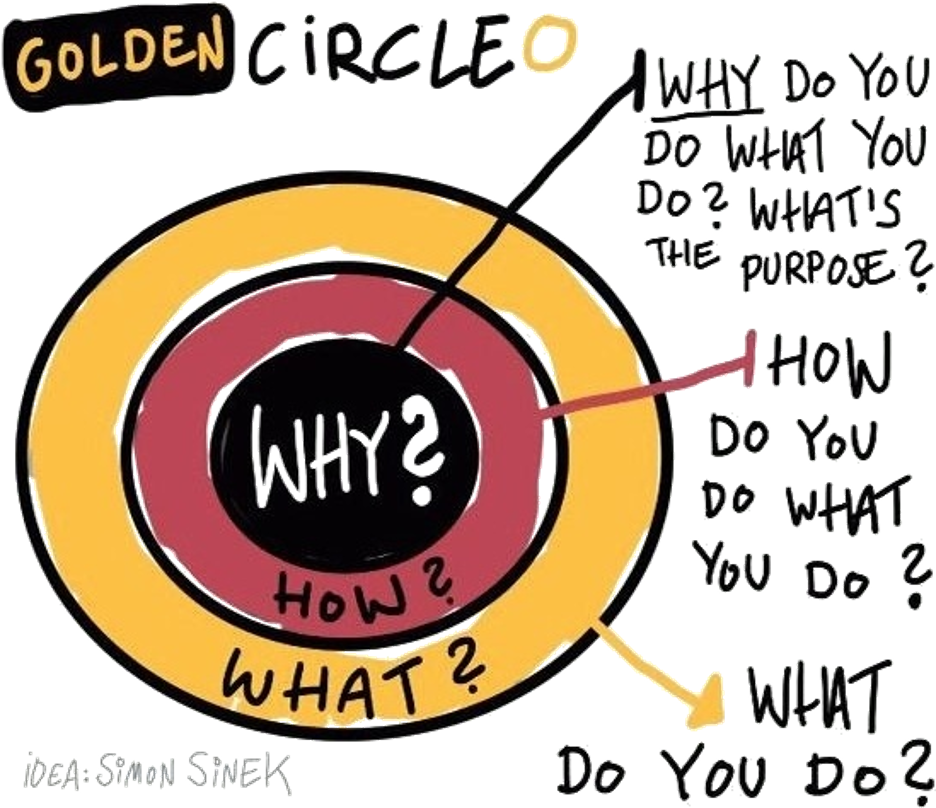
When most people and organizations start trying to innovate to keep up, they start with the outermost circle first, and they lose sight of the innermost circle.
Why Start With Why
Here’s an analogy: Think of a magnet. The strongest force comes from its core. Similarly, in leadership and business, the Why is your core—it’s what attracts people to you. It’s not just about selling a product; it’s about sharing a belief or vision that resonates emotionally with others.
For example:
- Apple doesn’t just sell computers (What). They believe in challenging the status quo and thinking differently (Why). Their How—innovative design and user-friendly technology—flows naturally from this belief.
- Martin Luther King Jr. didn’t say, “I have a plan.” He said, “I have a dream.” His Why inspired millions because it connected with their values and emotions.
When new opportunities arise, filter whether they’re a step in the right direction through your “why”.
Pragmatically, your why is also your differentiator. It’s what makes your business unique, which makes it part of your moat… and you have to protect your moat.
Step 2: Adapting to Technology the Right Way
It’s similar to Maslow’s Hierarchy of Needs: you have to address things like food and shelter before you can tackle higher-level needs like affiliation or self-actualization.
The Improve phase is crucial because if you don’t pass this stage, you don’t get to the stuff beyond it. Said simply, the first stage is about helping somebody do what they already do, just better. Doing this increases efficiency, effectiveness, or certainty … buying you time and space to focus on what comes next. It’s also a way to show you’re making progress in the right direction, increasing capabilities, and building confidence (the fuel you need to keep making progress). In this phase, you’re really still doing exactly what you were already doing … just better.
Once people have tested the waters and seen results, they tend to jump straight to transformation, but that’s a mistake.
Transform is the big, hairy, audacious goal that you want to make possible. It’s the mountain top you’re trying to climb. It’s helpful to know what that is. But when trying to climb the mountain, you still have to take the steps in front of you.
The first step on the mountain is to innovate. It’s about what you could do, and what you should do – instead of what you’re already doing.
Redefine is where you start climbing the mountain and adding new capabilities to your arsenal. You’re now at a stage where you can imagine a bigger future and grow your vision to match your new capabilities. In a sense, you’re playing the same game, but at a different level and with different expectations.
When you finally make it to Transform, you are playing a new game (often on a different playing field), and you’re likely influencing not just your company but other companies. At this point, former competitors often approach you with ideas and resources, seeking to collaborate.
Another distinction I make about transform is that it’s very different from change. Change is about bringing the past forward and hoping that minor adjustments yield desired outcomes. Transform is about committing to the outcome and accepting the fact that the process may change dramatically.
Another key mistake entrepreneurs make is pivoting to something completely new. When you’re charting a path up a new mountain, you will find unstable ground or insurmountable peaks. At that point, many people give up and look for something new. They start wandering in different directions. That’s a lot of wasted movement.
My rule at Capitalogix is “This … or something better.” When we hit a roadblock, we’re allowed to go around it, but only if it improves our current situation, expectations, or goals.
Playing The Right Game
If you keep sight of your why, and you innovate with purpose and direction, you start to build a playbook for long-term success.
Innovation becomes an exciting next step rather than a scary specter on the horizon.
And, best of all, you start to compete only at your expertise, which makes every space a blue ocean.
Nike risks making its brand a commodity instead of an identity because it’s starting to innovate in the wrong direction.
It’s not enough to play with AI. That becomes a distraction.
Leave a Reply