
While we celebrate America’s 250th birthday, I thought it would be fitting to take a look at a few recent charts on America in 2026. These charts reveal how concentrated our economic power has become, how heavily we rely on services economically, and how unevenly the world now views that strength.
America’s $31 Trillion Economy By State
via visualcapitalist
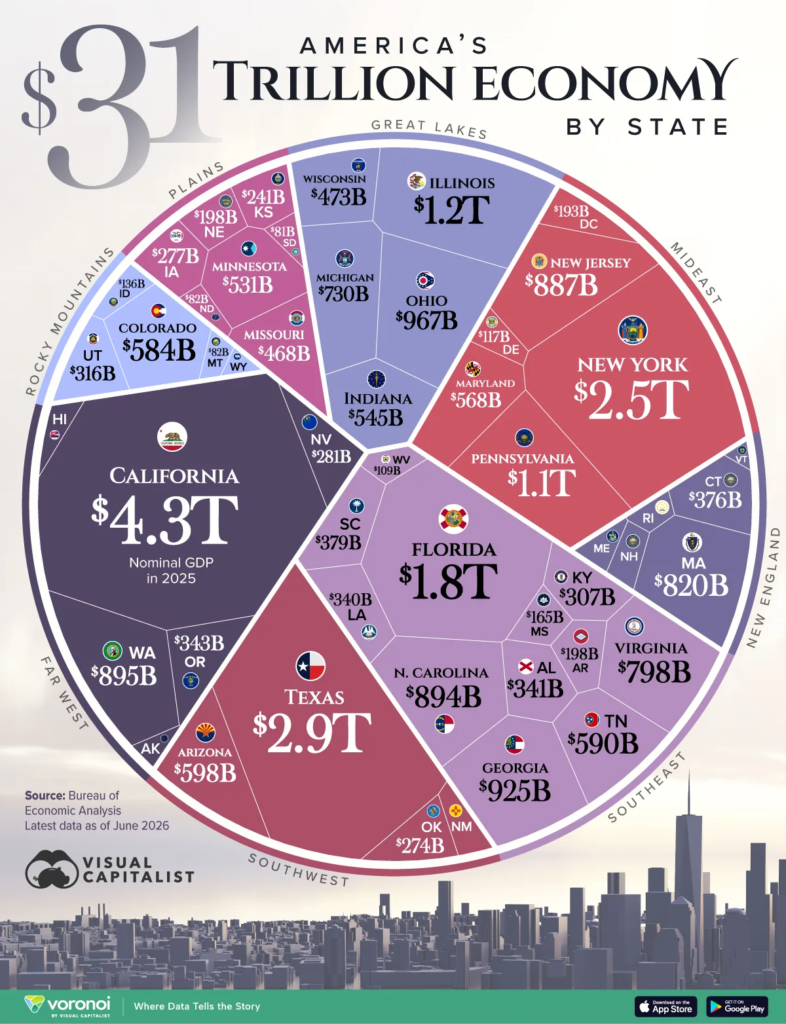
We recently compared national GDPs and saw how dominant it was on the national stage, but what about the GDP of the individual states?
California continues to have the largest state economy in the U.S., with a GDP of $4.3 trillion, accounting for nearly 14% of the national output. Currently, only six states surpass $1 trillion in annual economic activity, and collectively, these states account for nearly half of the U.S. economy.
If California were an independent country, it would have the world’s fourth-largest economy. Beyond California, five other states have a GDP exceeding a trillion dollars as of 2025: Texas, New York, Florida, Illinois, and Pennsylvania.
Zooming out from where economic output is located to what actually drives it paints an even clearer picture of America’s strengths and vulnerabilities.
America’s Economy By Industry
via visualcapitalist
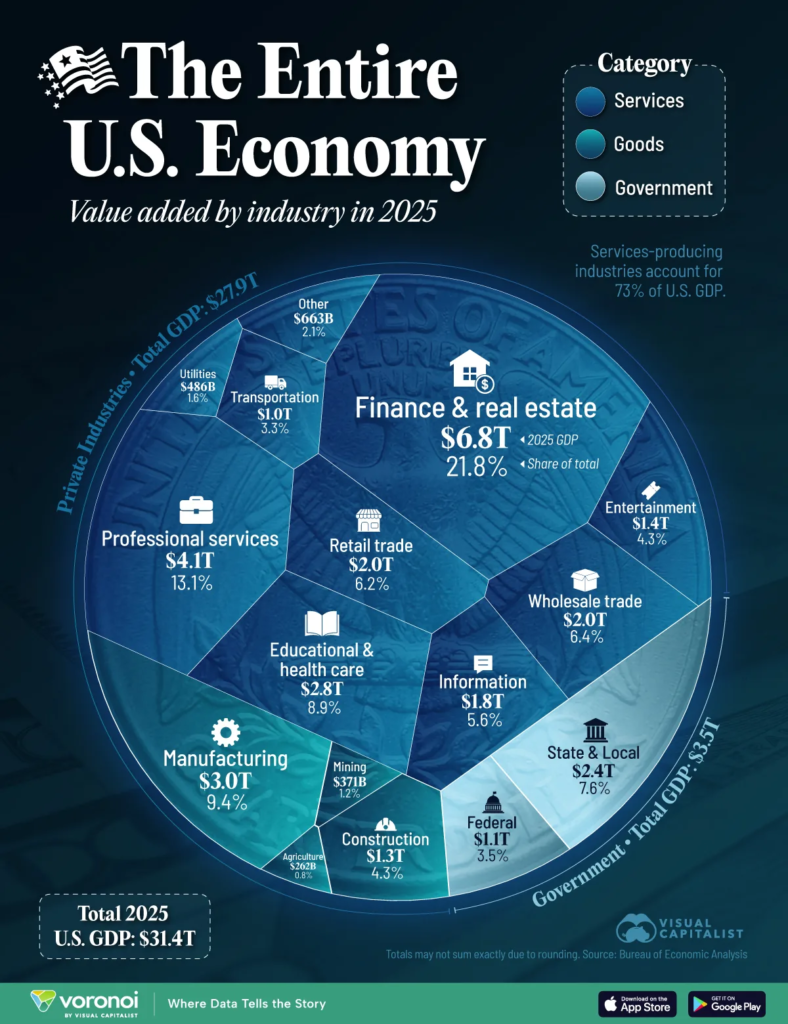
Finance, real estate, insurance, rental, and leasing (this is considered one industry) led all industries at $6.8 trillion in output, accounting for more than one-fifth of the entire economy … and nothing else really came close.
Professional services came in 2nd, and the rest are even further behind. Together, the top two sectors accounted for nearly 35% of all economic output, underscoring the growing importance of knowledge-based and service-oriented activities in the modern economy.
If you really dive into the numbers, you realize nearly 73% of our country’s economy is service-based. That service bias is great for knowledge workers and asset‑light businesses but could leave us exposed when physical infrastructure, manufacturing, or supply chains become chokepoints.
Of course, economic strength is only half the story. How the rest of the world sees that strength and sees our populace shapes the alliances and opportunities that follow.
How The World Views Us
via visualcapitalist
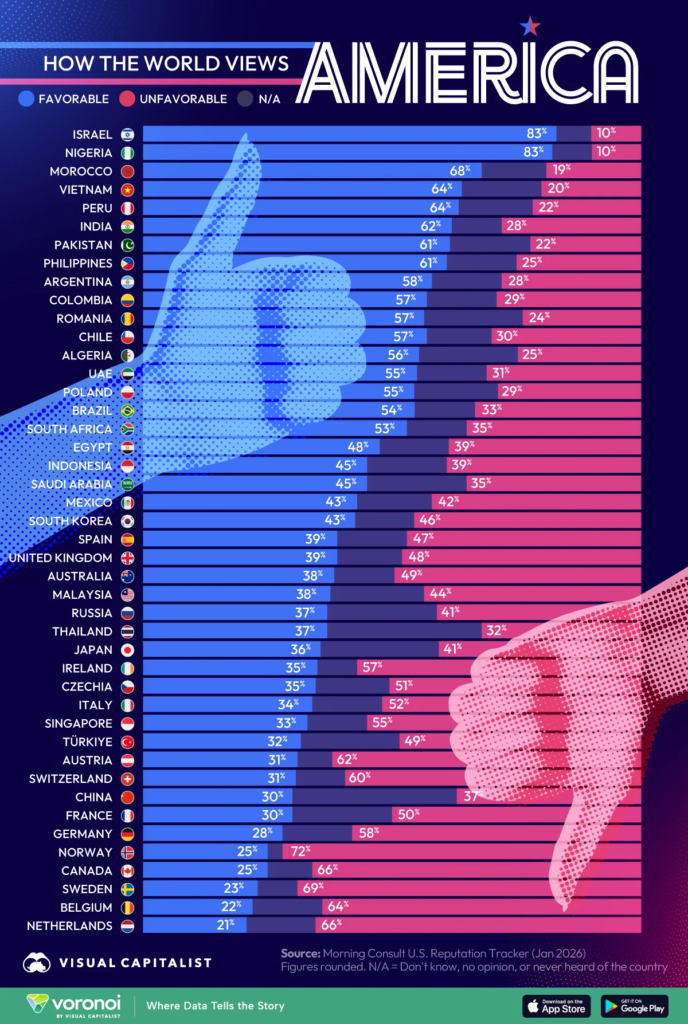
Emerging economies such as Vietnam, India, and the Philippines have higher rankings than many Western nations. Israel and Nigeria top the list, with 83% of respondents expressing favorable views of America. Notably, nine of the ten lowest favorability ratings are from longtime U.S. allies in Europe and North America.
High favorability in emerging economies suggests growing opportunities for trade and investment, even as skepticism among traditional allies complicates policy and capital flows in the near term.
While America remains arguably the most influential country, it’s clear public opinion is changing and varies wildly.
Trade disputes and rising political tensions have weighed heavily on America’s image among many of its traditional allies. So have the tariffs on Canada and Europe, criticism of NATO, and Trump’s other divisive decisions (who wants Greenland?)
Interestingly, despite the back-and-forth between China and America, they rank higher than many of our long-term allies.
Food For Thought
Perhaps that’s the challenge of the moment. A nation can’t neglect its own foundation — strong finances, competitive industries, secure borders, and resilient supply chains are prerequisites for long-term prosperity.
At the same time, America’s influence has always rested on more than the size of its economy. Our alliances, our reliability, and our ability to lead on the world stage have been strategic assets for generations. The most successful path forward is unlikely to be choosing one over the other, but rather finding a balance between strengthening our position at home and preserving the trust and partnerships that have amplified American leadership abroad.
If we can do both, the next chapter of the American story may prove even stronger than the last.
Onwards!
Leave a Reply