
For most of human history, a trillion dollars wasn’t just an unimaginable amount of money — it wasn’t even a meaningful concept. Entire kingdoms, empires, and national economies operated on scales far smaller than what we now describe with a single twelve-digit number.
This week, Elon Musk has become the world’s first trillionaire of the modern era, crossing a financial milestone that once seemed impossible even for the wealthiest individuals on Earth. Most people struggle to distinguish between a million and a billion; a trillion exists on an entirely different scale. Yet Musk’s fortune—built through his stakes in technology, transportation, energy, artificial intelligence, and space exploration—has now surpassed that once-unthinkable threshold.
Musk’s Milestone
This historic milestone was propelled by the market debut of his aerospace company, SpaceX.
SpaceX officially went public on the Nasdaq, with shares opening at $150 and valuing the company at over $2 trillion. Musk owns roughly 42% of SpaceX’s equity. When combined with his existing stake in Tesla (worth around $280 billion), his total paper wealth hit ~$1.1 trillion … greater than the national GDP of countries like Sweden, Ireland, and Taiwan, and exceeding the combined wealth of the world’s next five richest billionaires.
Of course, Musk is not necessarily the richest person who has ever lived. Historians often point to Mansa Musa, the 14th-century ruler of the Mali Empire, whose vast gold holdings may have made him wealthier than any modern billionaire. Others cite industrial magnates like John D. Rockefeller, whose fortune represented an extraordinary share of the American economy. But comparing wealth across centuries is more art than science. Different currencies, economic systems, and standards of living make direct comparisons nearly impossible. What makes Musk’s achievement unique is that it occurred in the transparent, measured framework of the modern global economy. His trillion-dollar net worth is not a historical estimate or academic reconstruction—it is a fortune calculated, tracked, and recognized in contemporary dollars. And that raises an obvious question: just how much money is a trillion dollars?
1,2,3,4,5….. Nine-Hundred-and-Ninety-Nine Billion, Nine-Hundred-and-Ninety-Nine Million, Nine-Hundred-and-Ninety-Nine-Thousand, Nine-Hundred-and-Ninety-Nine
Humans struggle to grasp large number magnitudes because our brains evolved to handle small, practical numbers essential for daily survival, such as counting food items or group members, rather than abstract, massive quantities. The human brain processes small numbers with an innate “number sense,” which becomes much less precise as numbers get larger, relying on a mental number line that tends to compress and approximate rather than distinctly represent high values.
Here are a couple of ways to help you understand a trillion dollars. First, let’s look at it in terms of physical money and the space it takes to store it.
We’ll start with a $100 bill, currently the largest U.S. denomination in general circulation, and pretty handy to have and hold.
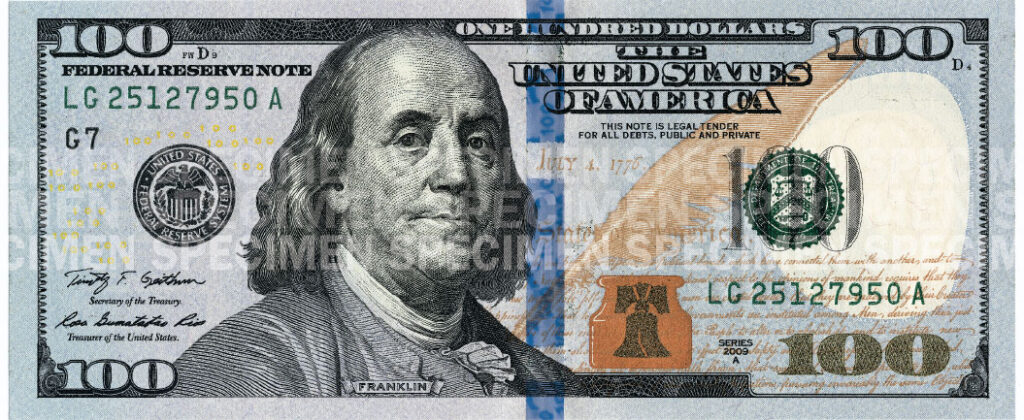
The image below follows the progression. A packet of one hundred $100 bills (totaling $10,000) is less than half an inch thick — and small enough to fit in your pocket. The next pile shown is worth $1 million (100 packets of $10,000 each). You could stuff that into a duffel bag and walk around with it. By the time you get to $100 million, it starts to look more impressive … but it still fits neatly on a standard pallet. Skipping forward to $1 trillion, well, it’s a million million. It’s a thousand billion. It’s a one followed by 12 zeros. In the final image below, notice that those pallets are double-stacked and would fill a stadium.
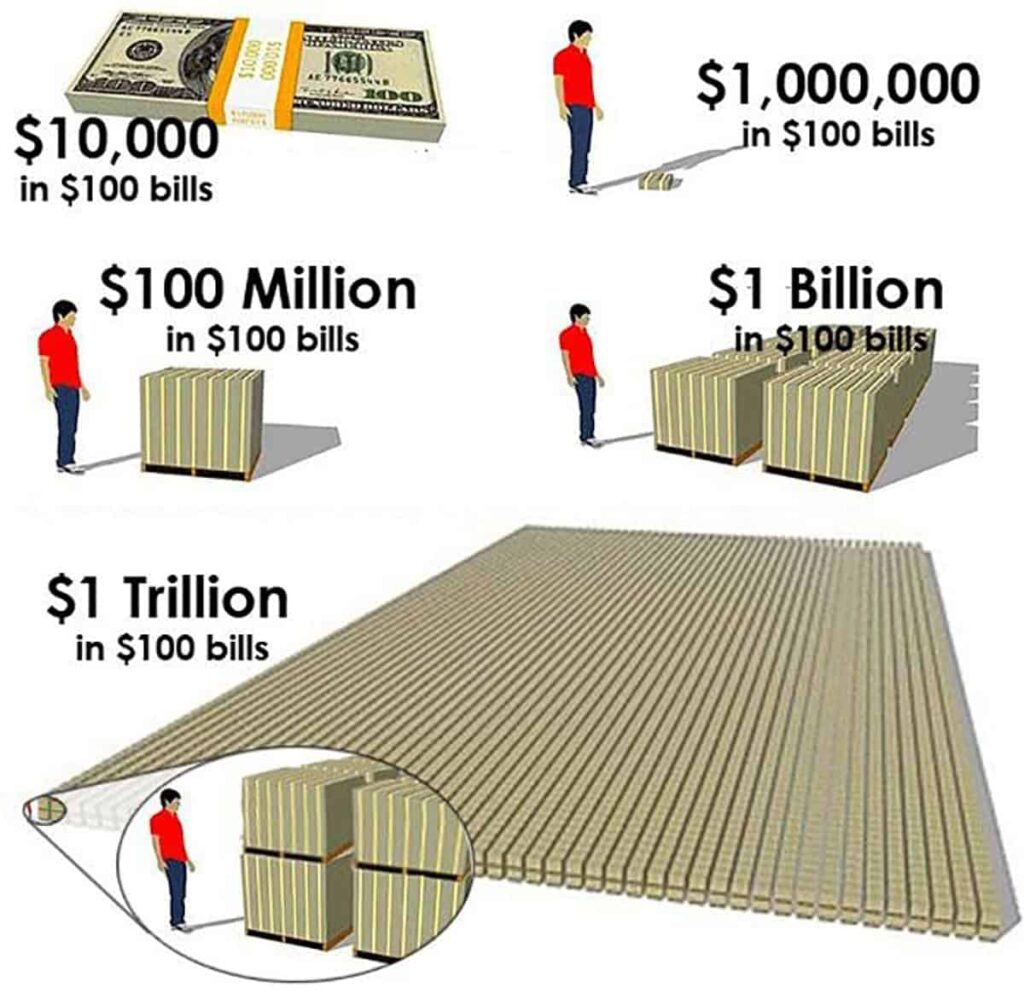
Visualizing How Big Is a Trillion.
Next, let’s look at spending over time. Here’s a simple example. If you were to spend a dollar every second for an entire day, you would pay $86,400 each day. With a million dollars, you could spend $1 every second for about twelve days. With a billion dollars, you can do that for over 31 years. With a trillion dollars, you can do that for 31,000+ years.
I’m sure many of you make over six figures a year. But, it would still take you 10 million+ years – if you spent none of it – to make $1 trillion.
Let’s try explaining it, using time, in a different way. One hundred thousand seconds is just over a day. A million seconds was 11 days ago. A billion seconds ago from today? That was in 1994. One trillion seconds is … slightly over 31,688 years. That would have been around 29,689 B.C., which is roughly 24,000 years before the earliest civilizations began to take shape.
Pretty crazy!
Leave a Reply