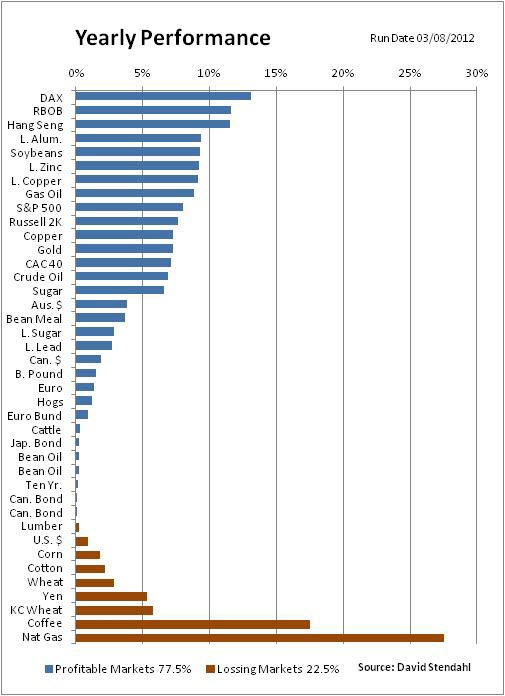
Here's a breakdown of forty global futures based on year-to-date performance.
It might be interesting to compare how your favorite market stands up to this list of various markets?
Other Performance Breakdowns:


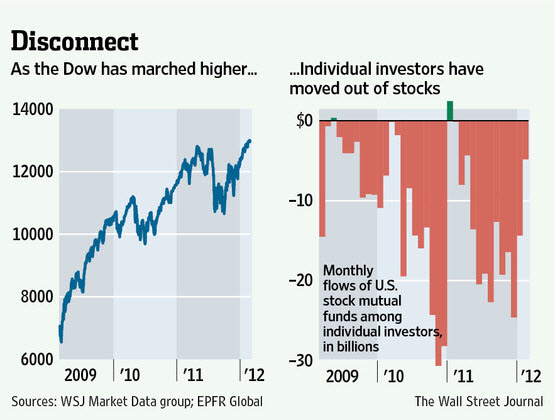
There has been a disconnect. Individual investors don't seem to care that the market continues to rally.
Here is a chart showing continued investor out-flows, even as the Dow Jones Industrial Average hits multi-year highs.
History seems to be on the Bulls' side. Here is a Bespoke chart showing what has happened after the S&P 500 Index rallies 15% (or more) in a three-month period.
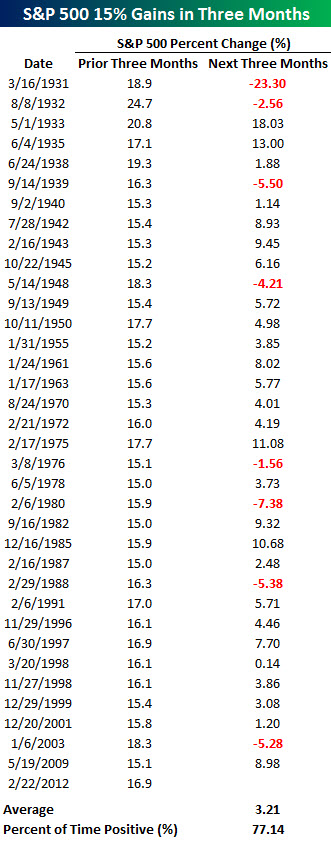
It has been a pretty bullish indicator.
Moreover, sentiment is not not so frothy since the rally has been so widely ignored by individual investors. As a result, traders don't expect much panic-selling on a move down.
In addition, the Markets have been resilient through some scary news cycles recently.
The question is: can it continue?
Well, if the Market can't shake-out some sellers, the next surprise could very well be another move higher.

There has been a disconnect. Individual investors don't seem to care that the market continues to rally.
Here is a chart showing continued investor out-flows, even as the Dow Jones Industrial Average hits multi-year highs.
History seems to be on the Bulls' side. Here is a Bespoke chart showing what has happened after the S&P 500 Index rallies 15% (or more) in a three-month period.
It has been a pretty bullish indicator.
Moreover, sentiment is not not so frothy since the rally has been so widely ignored by individual investors. As a result, traders don't expect much panic-selling on a move down.
In addition, the Markets have been resilient through some scary news cycles recently.
The question is: can it continue?
Well, if the Market can't shake-out some sellers, the next surprise could very well be another move higher.
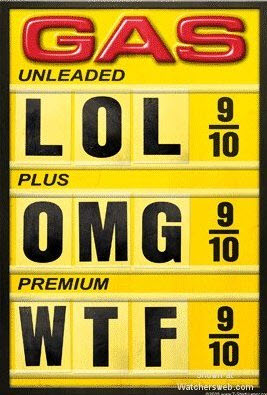
You don't have to look hard to find prices going up.
Here are some of the posts that caught my eye. Hope you find something interesting.
You don't have to look hard to find prices going up.
Here are some of the posts that caught my eye. Hope you find something interesting.
Is This Market Rally Too Overbought to Trust?
While the optimists, pessimists and realists argue about whether the rally has gone too far (or is 'fake' because of government intervention) … opportunistic traders have enjoyed the ride.
So how far and long has this rally really come? Despite all the worrying, objects in the rear-view mirror may be closer than they seem.
The graphic (below) from Chart of the Day, puts over a century of market rallies in context.
As the Dow Jones Industrial Average flirts with post-financial crisis rally highs (and the 13,000 level), it may seem as if the current market rally has grown long-in-the-tooth …
Nonetheless, history says rallies can go much longer and higher than this.
To provide some perspective to the current Dow Jones market rally that began back in early October 2011, all major market rallies of the last 111 years are plotted on this chart. Each dot represents a major stock market rally as measured by the Dow.
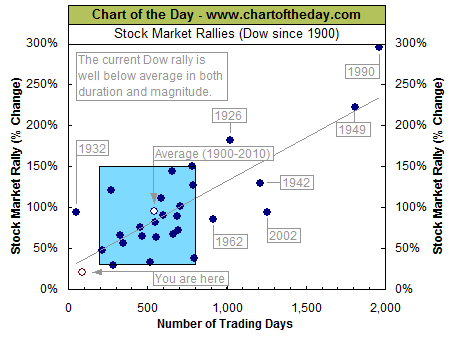
As the chart above illustrates, the Dow has begun a major rally 28 times over the past 111 years which equates to an average of one rally every four years.
Also, most major rallies (78%) resulted in a gain of between 30% and 150% (29.8% to 150.5% to be exact) and lasted between 200 and 800 trading days (9.5 months to 3.2 years) — highlighted in this chart with a light blue shaded box.
As it stands right now, the current Dow rally (hollow blue dot labeled you are here) would be classified as well below average in both duration and magnitude.
Interesting.

Is This Market Rally Too Overbought to Trust?
While the optimists, pessimists and realists argue about whether the rally has gone too far (or is 'fake' because of government intervention) … opportunistic traders have enjoyed the ride.
So how far and long has this rally really come? Despite all the worrying, objects in the rear-view mirror may be closer than they seem.
The graphic (below) from Chart of the Day, puts over a century of market rallies in context.
As the Dow Jones Industrial Average flirts with post-financial crisis rally highs (and the 13,000 level), it may seem as if the current market rally has grown long-in-the-tooth …
Nonetheless, history says rallies can go much longer and higher than this.
To provide some perspective to the current Dow Jones market rally that began back in early October 2011, all major market rallies of the last 111 years are plotted on this chart. Each dot represents a major stock market rally as measured by the Dow.
As the chart above illustrates, the Dow has begun a major rally 28 times over the past 111 years which equates to an average of one rally every four years.
Also, most major rallies (78%) resulted in a gain of between 30% and 150% (29.8% to 150.5% to be exact) and lasted between 200 and 800 trading days (9.5 months to 3.2 years) — highlighted in this chart with a light blue shaded box.
As it stands right now, the current Dow rally (hollow blue dot labeled you are here) would be classified as well below average in both duration and magnitude.
Interesting.
Sometimes reading a chart is simple.
Here is the obvious question: Will the the S&P 500 Index be able to stay above its 2008 to 2012 resistance line (marked by red arrow on this weekly chart)?
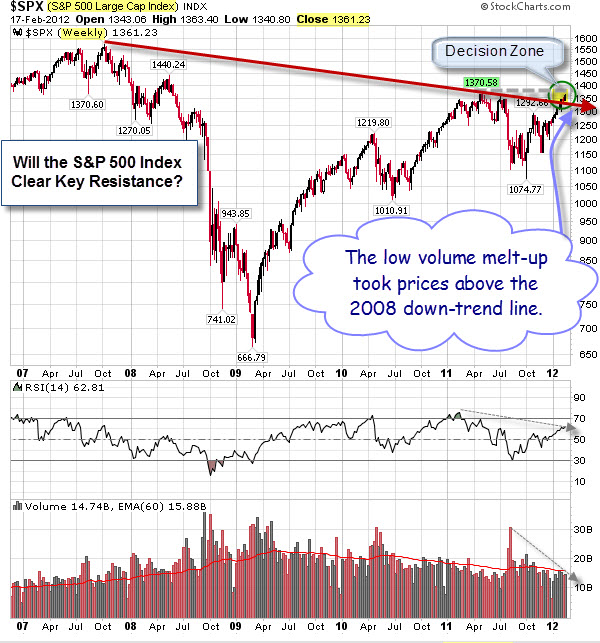
The recent highs (at 1370) are directly overhead. A move above that would be decidedly bullish.
Nonetheless, the recent rally is extended and happened on low volume.
Bears will note that there are many negative divergences, too.
However, the key indicator is the price action … and it has been un-relentingly higher (despite many logical reasons for it not to have happened).

Did you see the Clint Eastwood "It's Halftime America" video that ran during halftime of the Super Bowl?
It starts with Clint Eastwood's voice and an image of a lone man casting a big shadow as he walks down a darkened football stadium corridor.
"It's halftime … Both teams are in their locker room discussing what they can do to win this game in the second half. It's halftime in America, too."
Well, it got noticed … and it's causing a controversy in some circles.
So much so that SNL made fun of the issue in this spoof.
"I don't care if Obama runs the ball, or Romney throws a touchdown, or Ron Paul kicks a field goal with his tiny little chicken legs," Hader-as-Eastwood warns. "I tell you right now, though, I ain't puttin' Santorum in the game. He can stand on the sideline doin' cheers in his little sweater vest."
Sometimes it seems that we become so focused on pointing fingers and finding fault that we forget our real purpose.
To paraphrase Freud, sometimes an ad is just an ad.
And in this case, it could simply be an inspiring ad paid for by Chrysler (perhaps to say " we faced some hard times, but showed resiliancy and resolve … and the best is yet to come.")
On a related note, check-out Bob Buford's book, Halftime: Moving from Success to Significance. It is about making the second half of your life better than the first.
In Halftime, Buford focuses on 'transition'—the time when, he says, a person moves beyond the first half of the game of life. It's a time of revitalization and for catching a new vision for living the second half, the half where life can be lived at its most rewarding. Halftime doesn't have to be a time of crisis. It can be a catalyst for purpose, impact, and growth. It can be about setting a new course away from mere success to true significance—and something better.
This message applies to the market and our economy as well. What if we are half-way there? What do you really want? Where are you committed to go? What adjustments are needed? What do you want to do more of? What do you want to do less of? What do you need to start doing?
It's half-time, and the best is yet to come.
