Trading

  • The 2.9 Trillion Dollar Drop

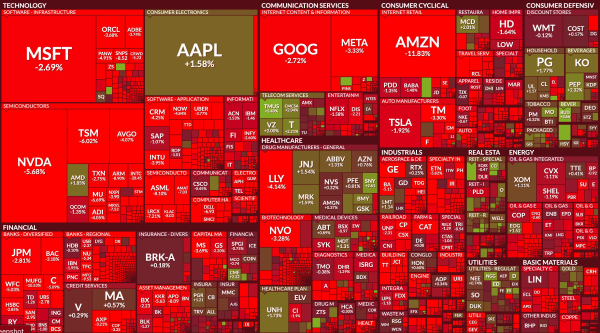
    Last Friday was the stock market’s worst day since COVID. 

    The media says weak job reports and recessionary fears fueled it.  Geopolitics might have played a part, too.

    Over 2.9 Trillion Dollars got wiped out. 

    To visualize what happened, here is a market heatmap of the S&P 500 index stocks categorized by sectors and industries.  Size represents market cap.  There was very little green in a sea of red.


    GT-7K3CWMAEKsfY

    via FinViz

    Last year, I asked if we would see a recession in 2024?  Here is an excerpt from that post:


    I want to remind people that the U.S. is resilient, and it seems like public sentiment is moving in a positive direction. 

    That said, 84% of CEOs and 69% of consumers think we're headed toward a recession. Meanwhile, the Fed is positive we won't … and banks are almost positive we won't. 

    It seems like they know something we don't … or maybe vice versa. 

    To lend some credence to the bullish sentiment, consumer spending is still high despite inflation and interest rates. In addition, Retailers are still posting solid earnings.

    Unfortunately, we're increasingly seeing consumers resort to borrowing (including short-term lending options) to pay for goods. Household debt has hit a record high of $17 trillion in March.

    Are We Going To See A Recession In 2024?, October 2023

    Yes, last week was potentially alarming.  Even the ordinarily resilient tech giants took a hit. 

    With the unemployment rate reaching 4.3% in July, the three-month moving average is at least 0.5 percentage points above the minimum of the previous 12 months’ averages.  This triggers the Sahm rule, which supposedly signals a recession.  According to the rule, reaching the 0.5% threshold indicates a recession.  When the jobless rate rises quickly, it suggests the economy is slumping.

    But, even the inventor of the rule, Claudia Sahm, says the doomsday narrative may be overblown. 

    I’m not here to tell you that everything is sunshine and roses, but I am here to remind you that no indicator exists in a vacuum.  While the negative performance is real, household income is still growing, and consumer spending and business investment remain resilient.

    Not to mention that with graduation, there’s a massive increase in the workforce, which also impacts the numbers. 

    Recessions can build slowly – but come quickly – but as they build, there is time to react … and even better – there is time to not ‘react’ but ‘respond’. 

    AI will likely impact the workforce, business, and eventually … the economy. 

    I’ve learned that the market often feels random because you can’t predict events like global pandemics, threats, assassinations, or cybersecurity outages.

    Over time, I’ve focussed less on guessing what will happen and more on responding faster and better to what happens.

    With that said, I do have an opinion here.  It’s an election year, and I suspect the government will push every button and pull every lever to boost the market leading into November.  Even though markets and the economy are not the same thing, many voters believe they are.  So, I would say this correction is perfectly timed … and I anticipate a steady ramp-up so that people feel as good as possible about the economy when they vote.

    What do you think is going to happen?

  • The Power Of Assessments

    Over the years, I've used a number of different assessment tests on myself and our team. It's a great way to help people better understand each other and the various forms of communication and problem-solving styles we use.

    Here are several of the tests that have proven themselves time and again:

    1. Kolbe measures how individuals naturally approach problem-solving and execute tasks when free to be themselves.
    2. Predictive Index (PI) – helps organizations make data-driven, objective hiring decisions by providing insights into a candidate's personality traits and cognitive abilities in relation to their perceived role.
    3. StrengthsFinder: helps people discover their natural talents and develop them into strengths they can leverage for personal and professional success.

    On top of these, it's always fun to see what else is available and how it might provide new and useful insights. 

    For example, Ray Dalio recently created a personality assessment called PrinciplesYou that you can take for free. This tool breaks down personality traits into three areas: how you think, engage with others, and apply yourself. I've seen several articles praising PriciplesYou and its insights.

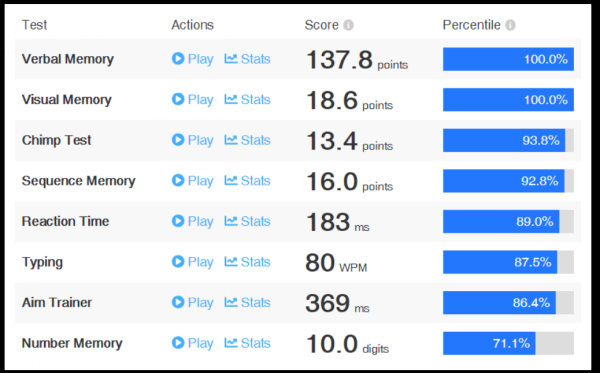
    Less meaningful, perhaps (but still fun), I also found a website called Human Benchmark that lets you test your performance on various reaction and memory tests. I'm unsure how scientific it is, but it was an interesting use of 10 minutes nonetheless. Here are my son's results from that one.

    Image-2via Human Benchmark

    Progress starts by telling the truth … most often to yourself.  

    What assessments have you found particularly helpful?

  • Lessons From The CrowdStrike Outage …

    Last Friday, CrowdStrike experienced a significant issue with a content update for its Falcon sensor on Windows hosts, causing widespread IT outages affecting customers worldwide, including airlines, banks, shops, and broadcasters.
     
    This outage dominated the news. Here are links to stories from Google and Bing search.
     
    Surprisingly, I didn't hear about this until one of my employees told me. But that is probably because I use a Mac – and the outage didn't affect me.
     
    So, when my son decided we should write an article about it … I asked Perplexity.AI, "Can you explain the issue with CrowdStrike?

    Perplexity is an AI chatbot-powered research and conversational search engine that answers queries using natural language predictive text. I've been quite impressed with it. If you haven't tried it yet, I highly recommend checking it out.

    Here is an excerpt of what it told me about the incident:
     
    Character of the problem:
    • A defect was found in a single content update for CrowdStrike's Falcon sensor on Windows hosts.
    • This caused Windows machines to crash, resulting in a "blue screen of death" (BSOD) and getting stuck in a restarting state.
    Scope of the impact:
    • Only Windows hosts were affected; Mac and Linux systems were not impacted.
    • The issue affected various organizations globally, including banks, airlines, and other businesses.
    CrowdStrike's response:
    • The company quickly identified and isolated the issue.
    • A fix was deployed, and the problematic update was pulled.
    • CrowdStrike is actively working with affected customers to resolve the problem.
    Important clarifications:
    • This was not a security incident or cyberattack.

    Click here to see the whole perplexity.ai response.

    The scope of the outage was surprising. 

    United, American, and Delta all called complete ground stops. Microsoft was hit. Public displays around the world showed the blue screen of death. 

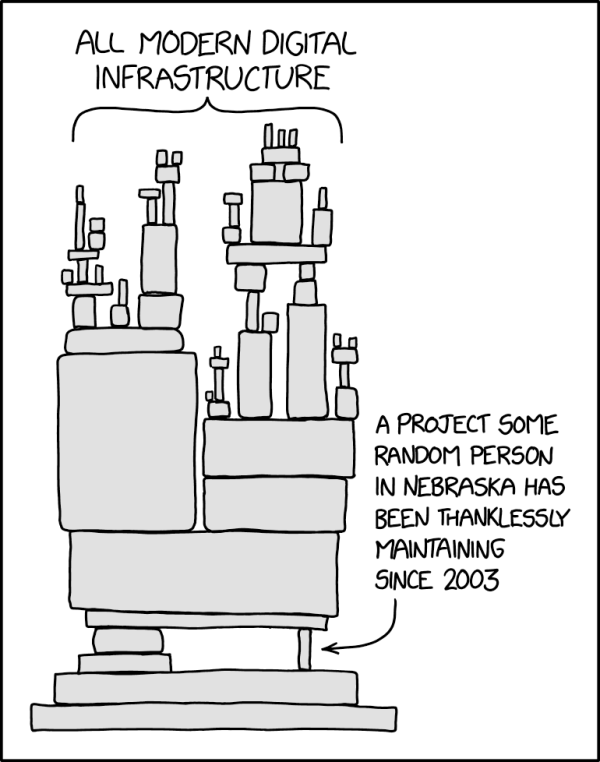
    All because CrowdStrike pushed a global update. That patch caused every computer with CrowdStrike to crash. Even worse, these computers can only be fixed in person by an IT professional. Because it involves a Blue Screen of Death, IT can't just remote in to fix it.  

    It's probably the largest outage in history and has caused untold damage. It affected emergency services in some states and countries. 

    Even after a patch is issued, it may take days for things to return to normal, as each endpoint requires individual attention, and some systems might have suffered complete failures.

    Dependency_2x

    via XKCD

    It's a healthy reminder that our 'robust' infrastructure isn't always so robust … and that tech consolidation and concentration can have consequences.

    While there are a seemingly infinite number of tech companies now, the infrastructure has consolidated into the hands of very few. We need to think about our digital resilience, not just in the systems we run, but in the globally connected systems and in the growing Internet of Things. 

    Does your business have all of its eggs in one basket? Does it have failsafes in case of an emergency?

    As I observe the growing adoption of AI, I notice that people tend to emphasize its capabilities over its potential failures. In our increasingly interconnected and automated world, ensuring business continuity is more crucial than ever.

  • 2024 Update: What Happens In An Internet Minute

    The Internet is both timeless and timely in an interesting way.  While what's popular changes seemingly instantly, and what we're capable of doing on it continues to grow exponentially.  Ultimately, the Internet is the digital town square of a global village, where all types and professions gather. 

    In 2011, I first wrote about what happens in 60 seconds on the Internet. 

    I've since updated the article a few times.

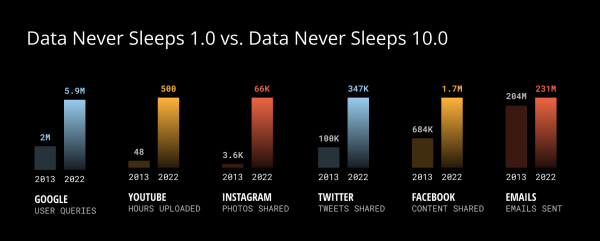
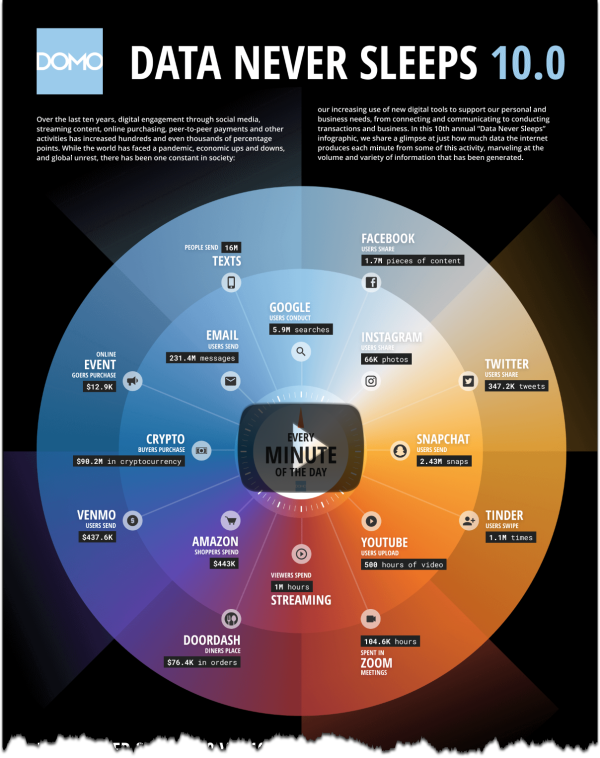
    Each time I write the article, I'm in awe at the amount of data we create and how much it has grown.  For example, looking back to 2011, I was amazed that users created 600+ new videos and 60 new blog posts each minute.  Those numbers seem quaint today. 


    Screenshot 2024-06-30 at 3.29.32 PMvia DOMO

    Shortly after I started sharing the articles, Data Never Sleeps started standardizing the data, which is helpful. 

    Today, the Internet reaches 5.4 billion people.  Most of them also use social media. 

    Screenshot 2024-06-30 at 3.44.18v2 PM

    To add some more perspective, 

    • In 2008, 1.4 billion people were online; in 2015, we were at 3 billion.  Now, that number has almost doubled again. 
    • In 2008, Facebook only had 80 million users, and Twitter (now X) had 2 million users.
    • In 2008, there were 250 million smartphones, and now there are almost 7 billion of them!

    It is mind-blowing to consider what happens each minute on the Internet today.  For example, the 104,000 hours spent on Zoom represents a significant societal shift … and the over 500 hours of video uploaded to YouTube highlights the incredible amount of content that's being created to share. 

    In 2023, the world created approximately 120 zettabytes of data … which breaks down to approximately 337,000 petabytes of data a day.  Broken down even further, it calculates to more than 15 Terabytes of new data created per person. 

    The calculations about what happens in an Internet minute will change rapidly again because of AI.  Consider the amount of computing power and data it takes to power all of these new GPTs. Now, imagine the amount of new data that AI is creating.  Then, try to imagine the challenge we'll have figuring out what's real, what's made up, and what is simply wrong or intentionally misleading.

    In addition, as more devices and digital WHOs start creating and sharing data, it's hard to fathom the ramifications and sheer increase in data. 

    I'm curious about what the next five years have in store for us as we approach the 40th anniversary of the World Wide Web. 

  • Cognitive Biases & The Consequences of Labeling

    “Words can be twisted into any shape. Promises can be made to lull the heart and seduce the soul. In the final analysis, words mean nothing.
    They are labels we give things in an effort to wrap our puny little brains around their underlying natures,
    when ninety-nine percent of the time the totality of the reality is an entirely different beast.
    The wisest man is the silent one. Examine his actions. Judge him by them.”

    ― Karen Marie Moning

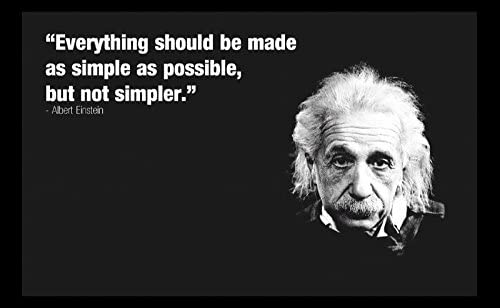
    Continuing with the theme of cognitive biases, the upcoming election has me thinking about the consequences of labeling things, creating boxes, and simplifying ideas into news-ready headlines.

    With more news sources than ever and less attention span, you see ideas packaged into attention-grabbing parts.  The focus isn't on education or the issues, but on getting the click, making your stay on their page longer, and sending you to a new article utterly unrelated to why you clicked on the page.

    Complex issues are simplified – not even into their most basic forms – but instead into their most divisive forms … because there's no money in the middle.

    200705 Einstein's Simplicity Quote

    via Quote Investigator

    The amplified voices are those on the fringe of the average constituents' beliefs – precisely because those are the ones who are often the most outspoken.  We might think that because they're the voices we hear, these fringe messages fairly represent what people like us believe or think … but they rarely do. 

    Issues that should be bipartisan have been made "us" versus "them," "liberal" versus "conservative," or "right" versus "wrong." The algorithms many of our information sites use create echo chambers that increase radicalization and decrease comprehension. 

    Identity politics have gotten so strong that you see families breaking apart and friend groups disintegrating … because people can't imagine sharing a room with someone with whom they don't share the same values. 

    In psychology, heuristics are mental models that help you make decisions easier.  They're a starting point to save mental bandwidth, allowing you to spend more brain cycles on the important stuff.

    That's a great use of "boxes" and "simplification"… but it shouldn't eliminate deeper and more nuanced thought on important issues. 

    Most situations are nuanced, and the "correct" answer changes as you change your vantage point.

    In an ideal world, we'd consider every angle.  I recognize that's not realistic.

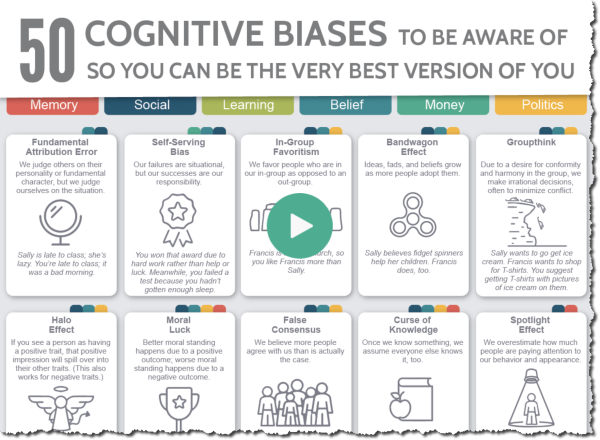
    Instead, I encourage you to remember to continue to think and learn … even about things you already know.  And, if you become familiar with the most common cognitive biases, you can hopefully identify them in your thinking and decision-making.

    Confirmation Bias is one of the more common forms of cognitive bias.  Here is an infographic that lists 50 common cognitive biasesClick to explore further.


    200705 50 Cognitive Biases Small

    via VisualCapitalist

    Important issues deserve more research.  New insights happen between the boundaries of what we know and don't.  Knowledge comes from truly understanding the border between what you are certain and uncertain about. 

    I challenge you to look beyond the headlines, slogans, and talking points you like most.  Look for dissenting opinions and understand what's driving their dissent.  Are they really blind or dumb (or are their value systems just weighted differently)?

    Not everything needs to be boxed.  Not everything needs to be simple.  You should explore things and people outside of your comfort zone and look to see things from their point of view … not your own. 

    Recently, I've started using a website and news app called Ground News.  They claim to be a news platform that makes it easy to compare news sources, read between the lines of media bias, and break free from algorithms. 

    As discussed above, online news and ad-driven algorithms have made it profitable for news outlets to embrace a position on the bias spectrum to target specific consumers.   That bias in the media affects everything from what events receive coverage to how a news outlet frames those events in their reporting.

    As media outlets narrow their perspective and range of coverage, I use Ground to help me get a well-rounded view of important issues and become aware of my blind spots.

    Applying This Lesson  

    “I am ashamed to think how easily we capitulate to badges and names, to large societies and dead institutions.”
    ― 
    Ralph Waldo Emerson, Self-Reliance

    I love learning a lesson in one space and applying it to other spaces.  It's one of the cool things about AI.  An algorithm can learn rules in the construction space that may help in the medicine or trading space.  Everything's a lesson if you let it be.

    In that vein, the lesson on labeling also applies to yourself and your business.  Don't get me wrong – naming things is powerful.  It can help make the intangible tangible.  However, don't let the label (or your perception of the label) stop you from achieving something greater. 

    Many things are true because we believe them to be, but when we let go of past beliefs, the impossible becomes possible, and the invisible becomes visible.  

    Hope that helps. 

  • The Law (And Flaw) Of Averages

    The law of averages is a principle that supposes most future events are likely to balance any past deviation from a presumed average.

    Take, for example, flipping a coin.  If you happen to get 5 "Heads" in a row, you'd most likely assume the next one should be "Tails" … even though each flip has a 50/50 chance of landing on either. 

    Even from this example, you can tell it's a flawed law.  While there are some reasonable mathematical uses of the law of averages, in everyday life, this "law" mostly represents wishful thinking. 

    Crisis-of-2008

    It's also one of the most common fallacies succumbed to by gamblers and traders. 

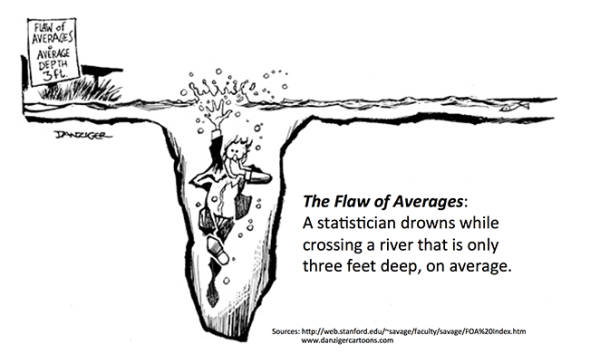
    The concept of "Average" is more confusing and potentially damaging than you might suspect.

    Perhaps you heard the story about how the U.S. Air Force discovered the 'flaw' of averages by creating cockpits based on complex mathematics surrounding the average height, width, arm length, etc., of over 4,000 pilots.  Despite engineering the cockpit to precise specifications, pilots crashed their planes on a too-regular basis. 

    The reason?  With hindsight, they learned that very few of those 4,000 pilots were actually "average".  Ultimately, the Air Force re-engineered the cockpit and fixed the problem. 

    It's a good reminder that 'facts' can lie, and assumptions and interpretations are dangerous.  It's why I prefer taking decisive action on something known, rather than taking tentative actions about something guessed. 

    via ReasonTV

    Our Brains and the Illusion of Balance

    Our brains are wired to find patterns, even in random events.  This tendency, known as apophenia, can lead us to see connections where none exist.

    The Misleading Law of Averages

    It's this very tendency that fuels the misconception of the law of averages.  We expect randomness to "even out" because we see patterns in short sequences.  This can be tempting to believe, especially when dealing with chance events.

    The law of averages is a common idea that suggests future events will even out past results to reach some average outcome.  For instance, going back to our earlier coin-flipping example,  after getting five heads in a row, it's natural to assume the next flip is "due" to be tails.  However, that's not how probability works.  Each coin flip is an independent event (with a 50% chance of landing on heads or tails), regardless of previous flips.  The coin doesn't "remember" what happened before.

    Apophenia isn't limited to coin flips.  For instance, you might see your lucky number appearing repeatedly throughout the day, leading you to believe it has a special meaning – even though each instance is completely independent.

    This natural desire for order and predictability can lead us astray when dealing with chance events.

    Why is it Flawed?

    The law of averages often leads to a misconception called the gambler's fallacy.  This fallacy is the belief that random events can somehow "correct" themselves to reach an average.  In reality, every coin flip, roll of the dice, or spin of the roulette wheel is a fresh start with its own discrete probabilities.  The odds remain the same no matter how long the losing streak persists.

    Are there ever times when it applies?

    It's important to distinguish the law of averages from the law of large numbers, a well-established statistical principle.  The law of large numbers states that as the number of random events increases, the average outcome gets closer to the expected probability.  This applies in situations where many trials happen, and while past results of individual events are independent, the law describes the behavior of averages over a large number of trials.  For instance, the average weight of a large sample of apples will likely be close to the expected average weight of an apple, even if some individual apples are heavier or lighter than expected.

    However, in everyday situations (with a limited number of events), the law of averages is generally not a helpful way to think about chance or probabilities.

    Understanding these misconceptions can help us make better decisions and avoid false expectations based on flawed reasoning.

    Psychological Reasons Behind the Belief

    Human decision-making suffers from a range of tendencies and biases.

    Earlier, we discussed the tendency to find patterns, even where none exist.  Next, we will consider cognitive bias.  In our coin-flipping example, it is the representativeness heuristic that makes us assume that small samples should resemble the larger population they come from.

    Emotional factors also play a role.  The desire for control in uncertain situations can make us latch onto the law of averages as a comforting notion.  Believing that things will "even out" gives us a sense of predictability and fairness in an otherwise random world.

    Additionally, social influences can reinforce these beliefs.  Stories and anecdotes about streaks ending or luck changing often circulate among friends and family, further embedding the misconception into our collective consciousness.

    Understanding these psychological reasons helps explain why the law of averages persists despite its flaws.  Recognizing these biases can empower us to think more critically about probability and chance events.

    Improving Decision-Making in Gambling and Investing

    Recognizing the fallacy of the law of averages can significantly enhance decision-making, particularly in gambling and investing.  Understanding that each event is independent can help participants make more rational choices.  Instead of chasing losses with the hope that a win is "due," savvy speculators understand their odds remain constant and may choose to walk away or set strict limits on their betting behavior.

    In investing, this knowledge is equally crucial.  Many factors influence markets.  Nonetheless, believing that a stock "must" rebound after a series of declines too often leads to poor investment decisions.  Investors who grasp that past performance does not dictate future results are better equipped to evaluate investments based on fundamentals rather than emotions or flawed expectations.

    By dispelling these misconceptions, you can approach gambling or investing with a clearer mindset, reducing the risk of substantial losses driven by erroneous beliefs about probability and chance.

    You can also eliminate fear, greed, and discretionary mistakes by relying on algorithms to calculate realtime expectancy scores and take the road less stupid.  Take a different kind of chance.  Just ask our AI Overlords; they'll tell you what to expect!

  • Correlation Between Market Crashes & Oreos?!

    During the Robinhood & Gamestop debacle in 2021, I wrote an article about r/WallStreetBets where I essentially said that most of the retail investors that frequent the site don’t know what they’re doing … Occasionally, however, there are posts that present the type of solid research or insights you might see from a respected Wall Street firm.

    With Gamestop and AMC both surging recently, I thought this was a topic worth revisiting. 

    As an example of good research done by the subreddit, here’s a link to a post where a user (nobjos) analyzed 66,000+ buy and sell recommendations by financial analysts over the last 10 years to see if they had an edge.  Spoiler: maybe, but only if you have sufficient AUM to justify the investment in their research. 

    Some posts demonstrate a clear misunderstanding of markets, and the subreddit certainly contains more jokes than quality posts.  Nevertheless, I saw a great example of a post that pokes fun at the concept that correlation does not equal causation. 

    I’ve posted about the Super Bowl Indicator and the Big Mac Index in the past, but what about Oreos?  Read what’s next for mouth-watering market insights.

    The increasingly-depraved debuts of Oreos with more stuffing indicate unstable amounts of greed and leverage in the system, serving as an immediate indicator that the makings of a market crash are in place. Conversely, when the Oreo team reduces the amount of icing in their treats, markets tend to have great bull runs until once again society demands to push the boundaries of how much stuffing is possible.

    1974: Double Stuf Oreo released. Dow Jones crashes 45%. FTSE drops 73%.

    1987: Big Stuf Oreo released. Black Monday, a 20% single-day crash and a following bear market.

    1991: Mini Oreo introduced. Smaller icing ratios coincide with the 1991 Japanese asset price bubble, confirming the correlation works both ways and a reduction of Oreo icing may be a potential solution to preventing a future crash.

    2011: Triple Double Oreo introduced. S&P drops 21% in a 5-month bear market

    2015: Oreo Thins introduced. A complete lack of icing causes an unprecedented bull run in the S&P for years

    2019: The Most Stuf Oreo briefly introduced. Pulled off the shelf before any major market damage could occur.

    2021: The Most Stuf Oreo reintroduced. Market response: ???

     - LehmanParty via Reddit

    It’s surprisingly good due diligence, but it’s also clearly just meant to be funny.  It resonates because we crave order and look for signs that make markets seem a little bit more predictable.

    Funny-mealso-me-meme-about-making-healthy-choices-but-also-eating-crap-like-all-stuf-oreos

    The problem with randomness is that it often appears meaningful. 

    Many people on Wall Street have ideas about how to guess what will happen with the stock market or the economy.  Unfortunately, they often confuse correlation with causation.  At least with the Oreo Indicator, we know that the idea was supposed to be thought-provoking (but silly) rather than investment advice to be taken seriously.

    More people than you would hope or guess attempt to forecast the market based on gut, ancient wisdom, and prayers.

    While hope and prayer are good things … they aren’t reliably good trading strategies.

    Consider this a reminder that even if you do the work, you’ll likely get a bad answer if you use the wrong inputs. 

    Garbage in, garbage out. 

    Onwards!

  • Some Timeless Wisdom From Socrates

    Small distinctions separate wise men from fools … Perhaps most important among them is what the wise man deems consequential. 

    This post discusses Socrates' Triple Filter Test, which involves checking information for truth, goodness, and usefulness.  It also explores how this concept applies to decision-making in business and life by focusing on important information and filtering out the rest.  The key to making better choices and staying focused is to avoid damaging or irrelevant information.

    Socrates' Triple Filter

    In ancient Greece, Socrates was reputed to hold knowledge in high esteem.  One day an acquaintance met the great philosopher and said, "Do you know what I just heard about your friend?"

    "Hold on a minute," Socrates replied. "Before telling me anything, I'd like you to pass a little test. It's called the Triple Filter Test."

    "Triple filter?"

    "That's right," Socrates continued.  "Before you talk to me about my friend, it might be a good idea to take a moment and filter what you're going to say. That's why I call it the triple filter test.

    The first filter is Truth.  Have you made absolutely sure that what you are about to tell me is true?"

    "No," the man said, "Actually I just heard about it and…"

    "All right," said Socrates. "So you don't really know if it's true or not. Now let's try the second filter, the filter of Goodness.  Is what you are about to tell me about my friend something good?"

    "No, on the contrary…"

    "So," Socrates continued, "You want to tell me something bad about him, but you're not certain it's true.  You may still pass the test though, because there's one filter left.  The third filter is Usefulness.  Is what you want to tell me about my friend going to be useful to me?"

    "No, not really."

    "Well," concluded Socrates, "If what you want to tell me is neither true, nor good, nor even useful … then why tell it to me at all?"

    With all the divisiveness in both media and in our everyday conversations with friends, family, and strangers … this is a good filter for what you say, what you post, and even how you evaluate markets, the economy, or a business opportunity. 

    How Does That Apply to Me or Trading?

    The concept of Socrates' Triple Filter applies to markets as well.

    When I was a technical trader, rather than looking at fundamental data and scouring the news daily, I focused on developing dynamic and adaptive systems and processes to look at the universe of trading algorithms to identify which were in phase and likely to perform well in the current market environment.

    That focus has become more concentrated as we've transitioned to using advanced mathematics and AI to understand markets. 

    Filter Out What Isn't Good For You.

    In contrast, there are too many ways that the media (meaning the techniques, graphics, music, etc.), the people reporting it, and even the news itself appeal to the fear and greed of human nature.

    Likewise, I don't watch the news on TV anymore.  It seems like story after story is about terrible things.  For example, during a recent visit with my mother, I listened to her watch the news.  There was a constant stream of "oh no," or "oh my," and "that's terrible".  You don't even have to watch the news to know what it says.

    These concepts also apply to what you feed your algorithms.  Garbage in, garbage out.  Just because you can plug in more data doesn't mean that data will add value.  Deciding what "not to do" and "what not to listen to" is equally as important as deciding what to do. 

    Artificial intelligence is exciting, but artificial stupidity is terrifying. 

    What's The Purpose of News for You?

    My purpose changes what I'm looking for and how much attention I pay to different types of information.  Am I reading or watching the news for entertainment, to learn something new, or to find something relevant and actionable?


    Socrates_quote_to_move_the_world_we_must_first_move_ourselves_5420


    One of my favorite activities is looking for new insights and interesting articles to share with you and my team.  If you aren't getting my weekly reading list on Fridays – you're missing out.  You can sign up here

    By the way, I recently found a site, Ground News, that makes it easy to compare news sources, read between the lines of media bias, and break free from the blinders the algorithms put on what we see.  I'd love to hear about tools or sites you think are worth sharing.

    Getting back to Socrates' three filters and business, I often ask myself: is it important, does it affect our edge, or can I use it as a catalyst for getting what we want?

    There's a lot of noise out there competing for your attention.  Stay focused. 

    Onwards!

  • Nvidia In Perspective

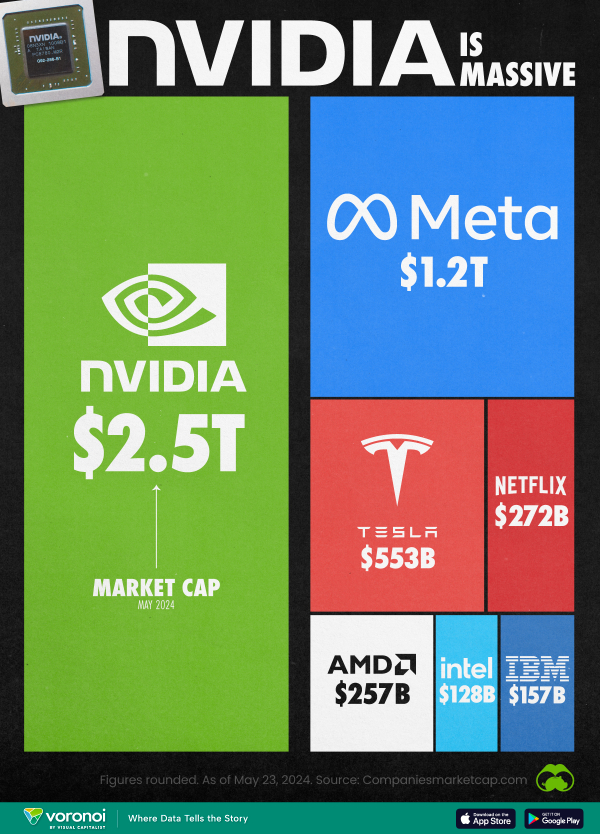
    In June of last year, Nvidia passed a Trillion-Dollar Market Capitalization. 

    Here’s where it stands a year later

    Nvidia-Market-Cap-May-2024_Website_05242024via visual capitalist

    Did you know that Nvidia is now the third most valuable company in the world?  It sits behind only Microsoft and Apple (though it’s nearing Apple). 

    These figures are even more impressive when you consider that at the beginning of 2020, Nvidia was valued at $145 billion.

    Nvidia’s growth was built largely on the back of AI hype.  Its chips have been a mainstay of AI and data science technologies, benefitting a litany of AI projects, gaming systems, crypto mining, and more.  It has successfully moved from a product company to a platform

    Do you think it’s going to continue to grow?  I do.

    We’ve talked about hype cycles … nevertheless, Nvidia’s offerings seem to be for the type of technology that will continue to be the underpinning of future progress.  So, while we’re seeing disillusionment toward AI, it may not affect Nvidia as intensely.

    This week, I saw an article in the WSJ titled “The AI Revolution Is Already Losing Steam,” – claiming that the pace of innovation in AI is slowing, its usefulness is limited, and the cost of running it remains exorbitant.

    This is ridiculous!  We are at the beginning of something growing exponentially.  It’s hard for most people to recognize the blind spot consisting of things they can’t conceive of … and what’s coming is hard to conceive, let alone believe is possible!

  • A Few Graphs On The State of AI in 2024

    Every year, Stanford puts out an AI Index1 with a massive amount of data attempting to sum up the current state of AI. 

    In 2022, it was 196 pages; last year, it was 386; now, it’s over 500 … The report details where research is going and covers current specs, ethics, policy, and more. 

    It is super nerdy … yet, it’s probably worth a skim (or ask one of the new AI services to summarize the key points, put it into an outline, and create a business strategy for your business from the items that are likely to create the best sustainable competitive advantages for you in your industry). 

    For reference, here are my highlights from 2022 and 2023.

    AI (as a whole) received less private investment than last year – despite an 8X funding increase for Generative AI in the past year.

    Even with less private investment, progress in AI accelerated in 2023.

    We saw the release of new state-of-the-art systems like GPT-4, Gemini, and Claude 3.  These systems are also much more multimodal than previous systems.  They’re fluent in dozens of languages, can process audio and video, and even explain memes. 

    So, while we’re seeing a decrease in the rate at which AI gets investment dollars and new job headcount, we’re starting to see the dam overflow.  The groundwork laid over the past few years is paying dividends.  Here are a few things that caught my eye and might help set some high-level context for you. 


    Technological Improvements In AI   
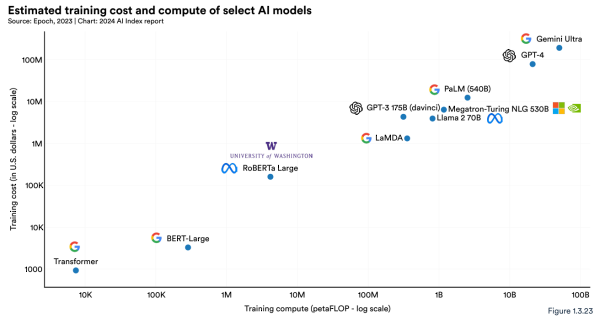
     

    Training Cost By Training Compute

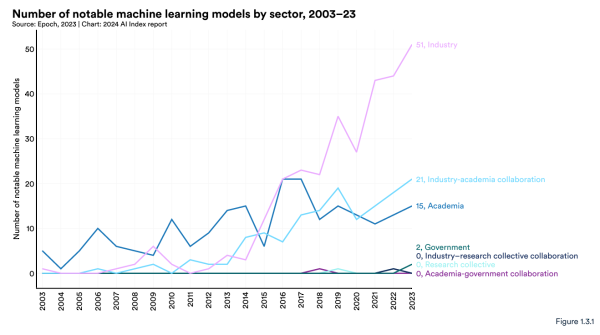
    Number of Machine Learning Models

    via AI Index 2024

    Even since 2022, the capabilities of key models have increased exponentially.  LLMs like GPT-4 and Gemini Ultra are very impressive.  In fact, Gemini Ultra became the first LLM to reach human-level performance on the Massive Multitask Language Understanding (MMLU) benchmark.  However, there’s a direct correlation between the performance of those systems and the cost to train them. 

    The number of new LLMs has doubled in the last year.  Two-thirds of the new LLMs are open-source, but the highest-performing models are closed systems. 

    While looking at the pure technical improvements is important, it’s also worth realizing AI’s increased creativity and applications.  For example, Auto-GPT takes GPT-4 and makes it almost autonomous.  It can perform tasks with very little human intervention, it can self-prompt, and it has internet access & long-term and short-term memory management. 

    Here is an important distinction to make … We’re not only getting better at creating models, but we’re getting better at using them.  Meanwhile, the models are getting better at improving themselves. 

    • Researchers estimate that computer scientists could run out of high-quality language data for LLMs by the end of this year, exhausting low-quality language data within two decades, and use up image data by the late 2030s.  This means we’ll increasingly rely on synthetic data to train AI systems.  The call to rely on Synthetic data can be compelling, but when used as the majority of a data set, it can result in model collapse. 
    • With limited large datasets, fine-tuning has grown increasingly popular.  Adding smaller but curated datasets to a model’s training regimen can boost overall model performance while also sharpening the model’s capabilities on specific tasks.  It also allows for more precise control over behavior. 
    • Better AI means better data, which means … you guessed it, even better AI.  New tools like SegmentAnything and Skoltech are being used to generate specialized data for AI.  While self-improvement isn’t possible yet without intervention, AI has been improving at an incredible pace. 


    The Proliferation of AI 

    First, let’s look at patent growth.
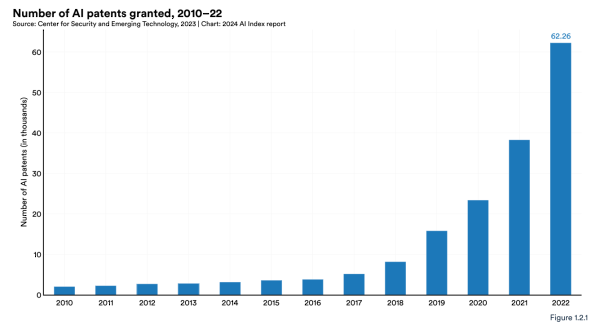
    Number of AI Patents

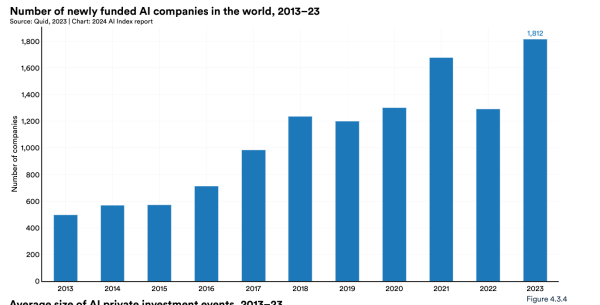
    Number of Newly Funded AI companies

    via AI Index 2024

    The adoption of AI and the claims on AI “real estate” are still increasing.  The number of AI patents has skyrocketed.  From 2021 to 2022, AI patent grants worldwide increased sharply by 62.7%.  Since 2010, the number of granted AI patents has increased more than 31 times.

    As AI has improved, it has increasingly forced its way into our lives.  We’re seeing more products, companies, and individual use cases for consumers in the general public. 

    While the number of AI jobs has decreased since 2021, job positions that leverage AI have significantly increased.  

    As well, despite the decrease in private investment, massive tranches of money are moving toward key AI-powered endeavors.  For example, InstaDeep was acquired by BioNTech for $680 million to advance AI-powered drug discovery, Cohere raised $270 million to develop an AI ecosystem for enterprise use, Databricks bought MosaicML for 1.3 Billion, and Thomson Reuters acquired Casetext – an AI legal assistant. 

    Not to mention the investments and attention from companies like Hugging Face, Microsoft, Google, Bloomberg, Adobe, SAP, and Amazon. 

    Ethical AI
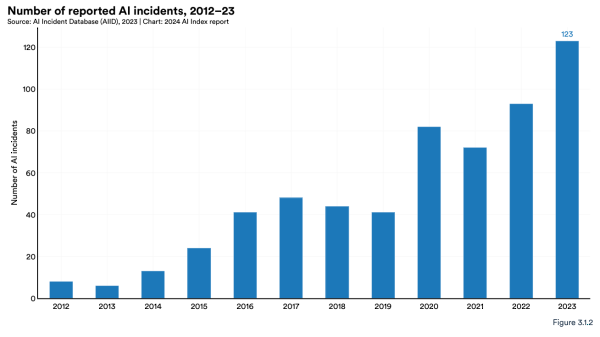
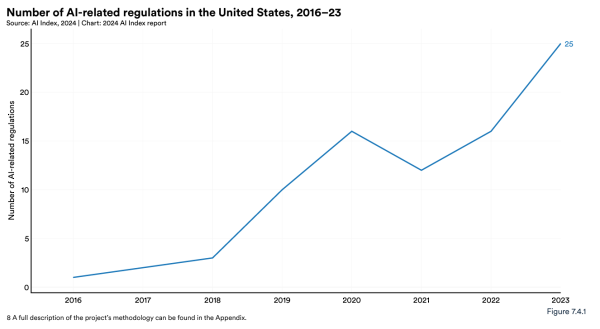
    Number of AI Incidents Number of AI Regulations

    via AI Index 2024

    Unfortunately, the number of AI misuse incidents is skyrocketing.  And it’s more than just deepfakes, AI can be used for many nefarious purposes that aren’t as visible, on top of intrinsic risks, like with self-driving cars.  A global survey on responsible AI highlights that companies’ top AI-related concerns include privacy, data security, and reliability.

    When you invent the car, you also invent the potential for car crashes … when you ‘invent’ nuclear energy, you create the potential for nuclear weapons. 

    There are other potential negatives as well.  For example, many AI systems (like cryptocurrencies) use vast amounts of energy and produce carbon.  So, the ecological impact has to be taken into account as well.

    Luckily, many of today’s best minds are focused on creating bumpers to rein in AI and prevent and discourage bad actors.  The number of AI-related regulations has risen significantly, both in the past year and over the last five years.  In 2023, there were 25 AI-related regulations, a stark increase from just one in 2016.  Last year, the total number of AI-related regulations grew by 56.3%.  Regulating AI has become increasingly important in legislative proceedings across the globe, increasing 10x since 2016. 

    Not to mention, US government agencies allocated over $1.8 billion to AI research and development spending in 2023.  Our government has tripled its funding for AI since 2018 and is trying to increase its budget again this year. 

    Conclusion

    Artificial Intelligence is inevitable.  Frankly, it’s already here.  Not only that … it’s growing, and it’s becoming increasingly powerful and impressive to the point that I’m no longer amazed by how amazing it continues to become.

    Despite America leading the charge in AI, we’re also among the lowest in positivity about the benefits and drawbacks of these products and services.  China, Saudi Arabia, and India rank the highest.  Only 34% of Americans anticipate AI will boost the economy, and 32% believe it will enhance the job market.  Significant demographic differences exist in perceptions of AI’s potential to enhance livelihoods, with younger generations generally more optimistic.

    We’re at an interesting inflection point where fear of repercussions could derail and diminish innovation – slowing down our technological advance. 

    Much of this fear is based on emerging models demonstrating new (and potentially unpredictable) capabilities.  Researchers showed that these emerging capabilities mostly appear when non-linear or discontinuous metrics are used … but vanish with linear and continuous metrics.  So far, even with LLMs, intrinsic self-correction has shown to be very difficult.  When a model is left to decide on self-correction without guidance, performance declines across all benchmarks. 

    If we don’t continue to lead the charge, other countries will … you can already see it with China leading the AI patent explosion.

    We need to address the fears and culture around AI in America.  The benefits seem to outweigh the costs – but we have to account for the costs (time, resources, fees, and friction) and attempt to minimize potential risks – because those are real (and growing) as well.

    Pioneers often get arrows in their backs and blood on their shoes.  But they are also the first to reach the new world.

    Luckily, I think momentum is moving in the right direction.  Last year, it was rewarding to see my peers start to use AI apps.  Now, many of them are using AI-inspired vocabulary and thinking seriously about how best to adopt AI into the fabric of their business. 

    We are on the right path.

    Onwards!


    1Nestor Maslej, Loredana Fattorini, Raymond Perrault, Vanessa Parli, Anka Reuel, Erik Brynjolfsson, John Etchemendy, Katrina Ligett, Terah Lyons, James Manyika, Juan Carlos Niebles, Yoav Shoham, Russell Wald, and Jack Clark, “The AI Index 2024 Annual Report,” AI Index Steering Committee, Institute for Human-Centered AI, Stanford University, Stanford, CA, April 2024.  The AI Index 2024 Annual Report by Stanford University is licensed under Attribution-NoDerivatives 4.0 International.