There are a lot of commonalities between successful tech companies. Pretty much all of them attempt to leverage software to do jobs that would be too expensive, too boring, or virtually impossible to do otherwise.
Obviously, technology is a huge force factor impacting the success of a company. As a result, there is an arms race to get to "next" …
Research and Development has always been a key in growing companies. Now, that is truer than ever. As tech improves faster and more dramatically, technologies become relevant and irrelevant faster than ever.
Challenging … sure, but a great problem to have.
What a great time to be an entrepreneur!
Good luck with your 2018 plans. I'd love to hear what you are focusing on next year.
Today's investors have access to data and information that would have been unheard of 10 years ago … and unfathomable 20 years ago. In the past, investors relied on information and experience from their real lives, from counterparties, and from fastidious attention to CNBC and stock tickers.
While the games, the rules, and the players have all changed, the goal hasn't … more alpha … more money … more reliably.
What's Changed?
Algorithmic trading isn't new, but there is a shift in who's making the algorithms. For example, you can crowdsource development through Quantopian … or let machines do the heavy lifting through A.I.-based firms like Sentient.
But I'd argue that's only true if you look at the same data, the same way.
The Future of Trading
One of the reasons A.I. is a great option for trading is that it takes away the human element of fear, greed, and discretionary mistakes.
Sentient's founder says:
"For me, it's scarier to be relying on those human-based intuitions and justifications than relying on purely what the data and statistics are telling you." – Babak Hodjat
In addition, people tend to get similar results because they do things similarly. As A.I. matures (and more researchers become better versed in what's possible) solutions will evolve.
It won't be a Ph.d. writing an algorithm … it will be machines and code trying unthinkable combinations and finding edges that otherwise would remain invisible and unused.
Currently, most people train their algorithms on markets, or with human intervention, but there are more data sets that can be used to build more robust models.
Alternative Data
Alternative data, to most, means tracking Twitter and Facebook sentiment, but confining your definition to that limits potential alpha.
New sources of data are being mined everywhere, and are letting investors understand trends "before they happen".
For example, mobile devices, low-cost sensors, and a host of new technologies have led to an explosion of new potential data sources to use directly for predictive insight or indirectly to help improve models.
In addition, private company performance, logistics data, and satellite imagery are becoming popular data sets in a data scientist's alpha creation toolbox.
There are often concerns about the cost and completeness of these datasets, but as we get better at creating and using them, both will improve.
Finding more ways to train algorithms on new data can help traders once again find an edge on their competition.
The thing about "sustainable alpha" is that while one might be able to achieve it, you can't expect to have it doing the same thing everyone else, or that you've always done.
Markets change, and what worked yesterday won't necessarily work today or tomorrow. Trading is a zero-sum game, and as we move toward the future, this only gets more apparent.
Behavioral Game Theory shows that human choices don't necessarily reflect the benefits they expect to receive. That's no longer the case with algorithms.
For more on Big Data and its potential, here's access to the full panel discussion I participated in recently at The Trading Show in New York.
Genius Network is a business group that also serves as an advisory board, counselor's office, and idea factory.
It brings brilliant minds and industry transformers together in a forum focused on innovation, creative disruption, and possibility.
Peer groups, like this, help you set (and raise) standards.
They help bring new capabilities, but also new possibilities, new found energies and a reconnection to your purpose, mission, and values.
This is a great place to meet extraordinary people.
Buck Joffrey is one of them. He is a doctor, an international best selling author, member of Genius Network, and host of WealthFormula (which is a podcast where he educates professionals on how to build lasting wealth).
Buck recently interviewed me for WealthFormula. We talked about old-world trading versus new-world trading … and where I think A.I and Machine Learning have the best opportunities to add alpha and help investors make and keep more money.
You can listen to it below (or subscribe to his podcast on iTunes, Android, or RSS).
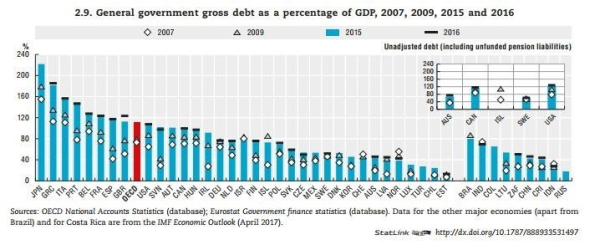
According to the World Economic Forum, if the Japanese wanted to pay off their national debt, each individual would owe approximately $90,345. For comparison, US citizens would owe $61,539 a person.
It's also worth noting that lower debt levels don't translate to safety on a global scale. Yugoslavia had very low government debt until its breakup.
If you want to see an updated, interactive version of the U.S. Debt Clock, just click here. It is worth spending a little time to watch the pace the numbers turn.
There's a lot of "hype" these days. Social media and tools like Kickstarter would have you believe that every new idea is the "next big new thing".
In contrast, Gartner's Hype Cycle Report is a considered analysis of market excitement, maturity, and the benefit of various technologies. It aggregates data and distills more than 2,000 technologies into a succinct, contextually understandable, snapshot of where various emerging technologies sit on the hype cycle.
Understanding this hype cycle framework enables you to ask important questions like "How will these technologies impact my business?" and "Which technologies can I trust to stay relevant in 5 years?"
What's a "Hype Cycle"?
As technology advances, it is human-nature to get excited about the possibilities we imagine … and then to get disappointed when those expectations aren't met.
At its core, the Hype Cycle tells us where in the product's timeline we are, and how long it will take the technology to hit maturity.
This year, according to Gartner, there are three overarching "mega-trends" to watch.
AI Everywhere shows the transition towards a ubiquitous AI experience, from self-driving cars, to machine learning, and to smart robots. Consider the impact on traffic/accidents with the adoption of autonomous vehicles, or the ability of machine learning to process more data faster.
Transparently Immersive Experiences shows our transition towards human-centric contextual and fluid technological experiences. – like Connected Homes or Virtual Reality. Consider the impact of Augmented Reality on advertisements or gamification.
Digital Platforms shows the transition of emergent platforms into adoption. Platforms like Blockchain, IoT, and Quantum Computing. Consider the effects of bitcoin and other blockchain initiatives, as well as the opportunity for new business models centered around these platforms.
Here is the chart. You can click the image to see it larger.
The hype cycle gives us an idea of which of these technologies will likely survive the market hype and have a potential to become a part of our daily life.
Peak of Inflated Expectations (Success stories through early publicity),
Trough of Disillusionment (waning interest),
Slope of Enlightenment (2nd & 3rd generation products appear), and
Plateau of Productivity (Mainstream adoption starts).
Which technologies do you think are over-hyped … and which ones might survive the hype?
I find this stuff fascinating. Consider some of the interesting technologies just starting their hype cycle:
Human Augmentation has the potential to enhance our bodies and minds using electrical currents, chips, or exoskeletons, but also raises ethical and legal questions.
Smart Dust opens up the possibility of monitoring essentially everything by creating a vast network of minuscule sensors that can detect various inputs.

 via
via 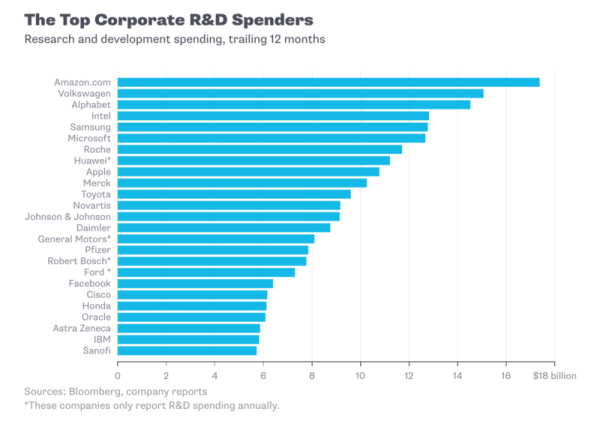 via
via