Trading

  • Is AI Making You And Your Team Smarter?

    At the core of Capitalogix’s existence is a commitment to systemization and automation. 

    At first, the goal was to eliminate fear, greed, and discretionary mistakes from trading.

    Over time, we’ve worked hard at making countless things easier. Much like math, we found that the best practice is to simplify complex processes before trying to automate them.

    I’m surprised by how many times I have had the same realization … Less is more.

    Likewise, I’ve learned the hard way that a great strategy is useless if people don’t get it. That is part of the reason that frameworks are so important.

    Ultimately, the process, the system, and the automation should follow this basic recipe if you want it to succeed:  Simple, Repeatable, Consistent, and Scalable.

    Finding ways to automate sounds great. Increasing efficiency, effectiveness, and certainty sounds great, too  … but, routines and habits become ruts and limits when they become un-measured, un-managed, or forgotten

    A practical reality of increasing automation and constant progress is that it becomes increasingly important to have expiration dates on decisions, systems, components, and automations. We need to shine a light on things to make sure they still make sense or to determine whether we have a better option.

    Freeing humans to create the most value sounds great, too … but, as the pace of technological progress increases, the importance of freeing people to do more diminishes if they don’t actively rise to the occasion.


    My Use of Technology

    I got my first computer in 1984. It was the original Macintosh. That means I’ve been searching for and collecting technology tools to make business and life easier and better since the mid-80s.

    It has been a long and winding road. These days,  it seems like I’m constantly looking for new ways to use AI in my life.

    As you might guess, I “play” with a lot of tools. Of course, I think of it as research, discovery, and skill-building … rather than playing. Why? Because it is something I’m good at, it produces value – and it gives me energy … so, I make sure to reserve a place for it in my routine.

    While most of what I explore doesn’t make it into my “real work” routine, I now have a toolbox of dozens of tools that I use for everything from research, notetaking, brainstorming, writing, and even relaxing. 

    It’s a little embarrassing, but my most popular YouTube video is an explainer video on Dragon NaturallySpeaking from 13 years ago. It was (and still is) dictation software, but from a time before your phone gave you that capability. 

    As I focus on systemization, I also have to focus on optimization. 

    Using generative AI tools for daily research has fundamentally changed how I approach information gathering. What began as a meditative practice—slowly reading, digesting, and reflecting on material—has evolved into a faster, more expansive process. With AI, I can now scan and synthesize a much broader set of sources in far less time. The quality of the summaries and takeaways is high, enabling me to deliver more value to others. I can write better articles, share timely insights with fellow business owners, and keep my team well-informed. The impact on others has grown — but something subtle has shifted in my own learning.

    The tradeoff is that if I’m not as careful as I used to be while doing the research, and I don’t engage with the material in the same way I did before. When I did the research manually, I was “chewing and swallowing” each idea, pausing to make connections, reflecting on implications, and wrestling with the nuance. That process was slower, but it etched ideas more deeply into memory.

    As a result, my favorite articles of the week or month would show up in how I spoke on stage, what I wrote about, and how I worked through roadblocks with employees. Now, I notice that although I’m exposed to more information, it doesn’t have the same weight or impact. I’m consuming more at scale … but retaining less, or perhaps less deeply (at least in my head). In contrast, I store much more, both in terms of quantity and depth, in my second brain (meaning, the digital repositories available for search when needed).

    This brings up a fundamental distinction between knowledge storage and knowledge retrieval. Storage is about accumulating information, while retrieval is about quickly accessing and using the correct information at the right time. It requires digestion. 

    It’s kind of like Amazon. Amazon has made buying books and getting them on my shelves easier than ever. I’ve got 1000s of books with answers to many of life’s questions. But, I’d estimate that I’ve really only read around half of the books I currently have on my shelf. The point is that having a book on your shelf with the answer to a problem is not the same as having the answers. 

    I now have many thousands of articles in my Evernote. There are probably over a hundred of them about better “prompt engineering” or using “prompting techniques better”… but I can’t pretend that each article has made me better at those things. I have gotten better at thin-slicing and knowing what I want to store to improve the quality of the raw material I search for.

    So now, I’m exploring how to maintain a balance. I still want to leverage AI’s value, while reintroducing a layer of slowness and reflection into the process. Maybe that means manually summarizing some articles. Maybe it means pausing to journal about what I’ve read, or discussing it with someone. The goal is not to abandon the efficiency — but to ensure that efficiency doesn’t come at the cost of depth.

    The priority is making sure I’m optimizing on the right thing. It’s not progress if you’re taking steps in the wrong direction.

    Let me know what you think about that … or what you are doing that you think is worth sharing.

    Onwards!
  • The World Is Getting Older … You Are Too

    We're on the cusp of a major demographic shift. 

    Fertility rates are dropping and life expectancy is rising, basically across the globe. On the surface, not explicitly bad. It's great that improvements in healthcare, technology, and quality of life are resulting in a larger senior population. 


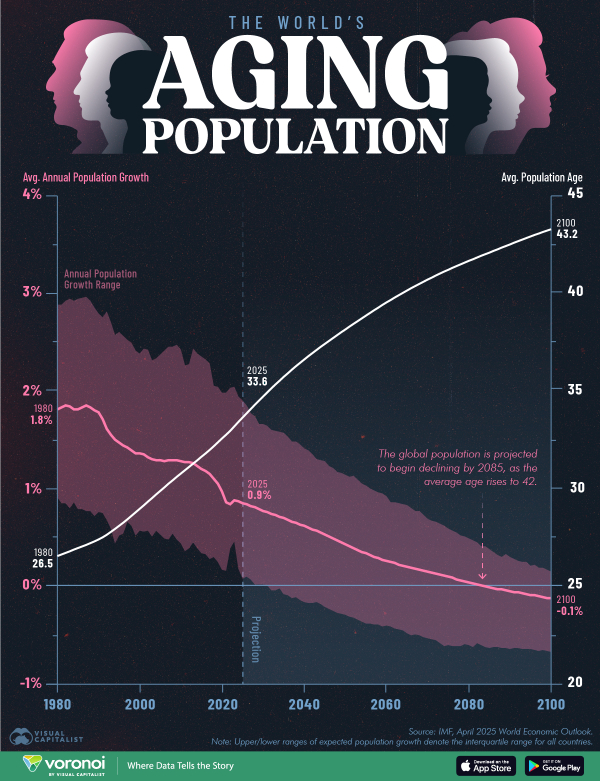
    Aging-Population_04-webvia visualcapitalist

    In 1980, the average person was 26.5 years old. Today, the average person is 33.6 years old. 

    Meanwhile, population growth has halved in the same time period. 

    Based on this chart, the global population would start declining in 2085, as the average age rises to 42. By 2100, the global population will begin declining. 

    Of course, there's variation depending on the country. 

    Most countries are thinking about how to increase fertility rates. If fertility rates decline, and your population lives longer, you end up with a larger percentage of the population that cannot or does not work anymore. That results in more expenditure – especially in pension and healthcare systems -  without an accompanying increase in GDP or productivity. 

    It seems unlikely that something won't dramatically affect these trends over the next 60 years.

    Even if expenditure becomes a non-issue, countries are unlikely to be happy with declining population growth, in part because of declining production resources and tax income, but also because of diminished global power. 

    What do you think? 

  • What Do You Do When AI is Better Than You?

    When Beethoven was at the peak of his career, several of his contemporaries struggled to deal with the realization that they may never create anything that lived up to his creations. Brahms, for example, refused to make a symphony for 21 years. Schubert is quoted as saying, “Who can ever do anything after Beethoven?”

    We’re seeing the same effect as a result of Artificial Intelligence. 


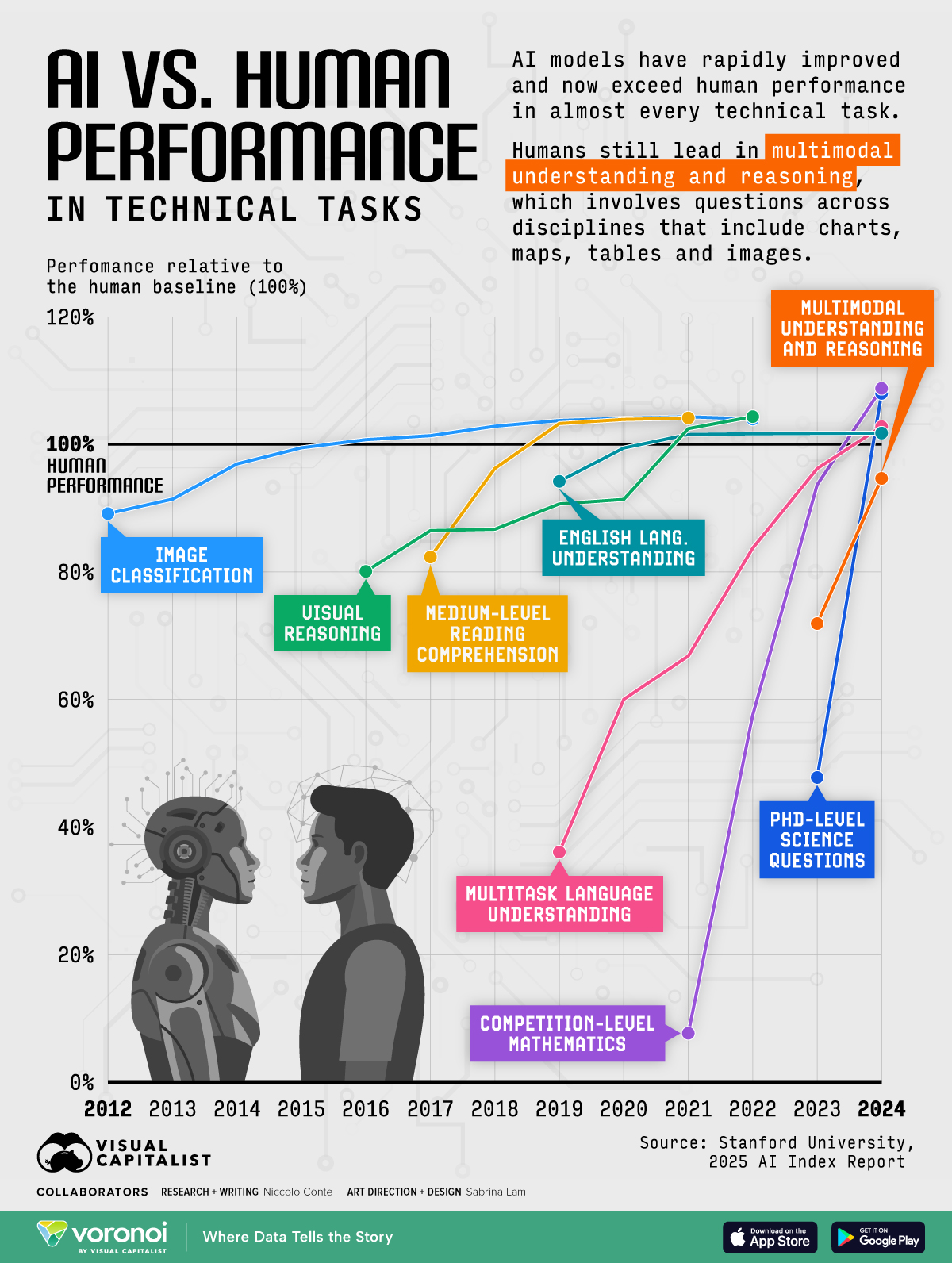
    A line chart showing AI vs human performance in various technical tasks

    via visualcapitalist

    The gap between human and machine reasoning is narrowing fast. I remember when AlphaGo, an AI program created by Google’s DeepMind, finally got better than humanity at Go. It was a big deal, and it prompted us to think seriously about competition in a post-AI world. If you can’t be the best, is it still worth competing? To one former Go champion, it wasn’t. He retired after “declaring AI invincible.” 

    Over the past few years, AI systems have advanced rapidly, surpassing humans in many more tasks. Much like Beethoven, AI is discouraging competition. 

    Was Lee Sedol, the former Go champ, wrong to quit? It’s hard to say … but as AI gets better at more activities, it’s an issue we’ll encounter more often.

    There’s always someone (or something) better. Taking a purely utilitarian approach isn’t always necessary or productive. It often helps to take a longer view of the issue.

    Sometimes, it's okay to just do something because you enjoy doing it.

    Sometimes you have to “embrace the suck” and be willing to put in the work to learn, grow, and progress.

    Sometimes, you need to invest effort in understanding a process better to determine whether others (or automation) are achieving the right results.

    The most successful people I know don’t try to avoid things with powerful potential. Instead, they leverage those things to achieve more and become better.

    I advocate intelligently adopting AI, in part, because I expect the scale of AI’s “wins” will skyrocket. That means I know AI will soon be better than I am at things I do now.

    It doesn’t mean I should give up. It means I have to raise the bar to stay competitive.

    I have another belief that helps here. What if you believed, “The game isn’t over until I win …”? With that belief in place, I won’t let a 2nd place ceiling stop me if something gives me energy. AI may change how I play the game … or even what game I choose to play … but I will still choose to play.


    Dc-Cover-652ovhkibhg82kh6on274ihkn1-20180128034206.Medi


    What Happens to Human Work When Machines Get Smarter?

    AI is changing the playing field at work, too. 

    As a result, some say that AI-driven job displacement is not a future threat but a present reality.

    This past week, several prominent  CEOs publicly mandated AI use, marking a shift to “AI-first” work culture, which prioritizes and integrates AI into the core of an organization’s strategy, operations, and overall culture.

    Here is what I think (and you've probably heard me say this before): 

    At this point, AI won't likely replace you … but someone who uses AI better might.

    Let’s face it, doing more with less is a core goal and strategy in business.

    But that doesn’t mean humans are doomed. There are lots of historical parallels between AI integration and past technological revolutions. If you think about AI as a transformative force, you can hear the echoes of historical shifts that redefined work practices and intellectual labor (like the printing press, the calculator, or the internet).

    We’re seeing significant changes in how we work. Instead of just having a mix of people working from home or the office (a hybrid workplace), we’re moving to a situation where people are working alongside smart computer programs, called AI agents (a hybrid workforce).
     
    The rise of the hybrid workforce signifies a transformative shift in workplace dynamics. Gartner predicts that one-third of generative AI use cases will involve AI agents by 2028.

    In the age of AI, success doesn’t come from battling technology — it comes from embracing our uniquely human powers and building systems that let those powers shine.

    AI is coming – but it doesn’t have to be joy-sucking. Ideally, it should free you up to do MORE of the things that bring you joy, energy, and satisfaction. 

    Onwards!

  • The Next Gilded Age … This Generation’s Carnegies, Rockefellers and Vanderbilts

    Wealth is fascinating to those who have it, those who want it … and even those who don’t.

    Billionaires have always controlled significant amounts of wealth compared to the general population. However, now we’re seeing substantial wealth differences grow within the billionaire population itself. The very richest are getting much richer compared to just “wealthy” people. 

    When Forbes published its first World’s Billionaire List in 1987, 140 billionaires accounted for a total of $295 billion in global wealth. Topping that list was Yoshiaki Tsutsumi from Japan, with $20 billion. A lot has changed since then. Elon Musk topped this year’s Forbes List and is now worth over $342 billion. His wealth is about 21 times more than Tsutsumi’s … and over two million times more than the average American family’s.

    A New Gilded Age

    In 2017, The Guardian released an article stating that the world’s super-rich held the greatest concentration of wealth since the turn of the 20th century. According to The Guardian, 1,542 billionaires held approximately $6 trillion in collective wealth, which would put them as the fifth largest GDP at the time. 

    Last year, less than a decade since the Guardian’s article, Forbes estimated that 2,781 billionaires had a combined net worth of over $14 trillion. For a little more context, some estimate that the world’s richest 1% own more than 43% of global financial assets

    Currently, the world’s super-billionaire population is primarily made up of entrepreneurs who made their money in the tech sector, or whose industry was catapulted to new levels by technological advances. Six of the top ten wealthiest individuals on the Forbes list fall into that category.

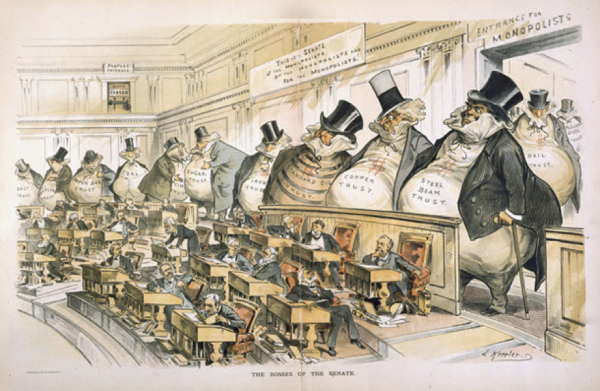
    In comparison, the first Gilded Age was established by a few entrepreneurs controlling monopolies in US rail, oil, steel, and banking.


    Gildedage

    The image is “Bosses of the Senate”.

    The Vanderbilts amassed $185 billion (adjusted for inflation) from their railroad empire. Andrew Carnegie made $309 billion from his steel empire. John D. Rockefeller made $336 billion from an oil empire (that controlled about 90% of the American oil business). They were the stars of the Gilded Age … and their control over major industries led to some of the largest individual fortunes in American history compared to the average population. 

    It’s interesting to look at the transition from the richest in the late 1800s to the richest in 2025 … the transition from industries like Steel, Oil, and Rail, into companies like Amazon, Microsoft, Tesla, and Walmart. While they certainly dominate the spaces they’re in, it is a far cry from the monopolies of the 1800s. 

    While there are more “super-rich” individuals today than before, our wealthiest individuals still manage to have some impressive stat lines. As of the end of 2024, Bernard Arnault was worth an estimated $233 billion. Elon Musk was worth around $195 billion, and Jeff Bezos was right behind at $194 billion. Today, Bernard is sitting at $178 billion, Elon is up to $342 billion, and Jeff is up to $215 billion. Arnault is a clear example of how Trump’s tariff announcement impacted billionaires

    With the AI gold rush in full swing, it will be interesting to see who gets added to the list in the coming years. 

    Let me know when your name makes that list. I’ll do the same.

  • Why Don’t We See Aliens?

    So, if the math says it's likely that there are aliens … why don't we see them?

    In 2020, I mentioned Israeli officials who claimed they had been contacted by Aliens from a Galactic Federation – and that not only is our government aware of this, but they are working together.

    There are many stories (or theories) about how we have encountered aliens before and just kept them secret. Here are some links to things you might find interesting if you want to learn more about this.

    So, while some may still believe aliens don't exist – I think it's a more helpful thought experiment to wonder why we haven't seen them. 

    For example, the Fermi Paradox considers the apparent contradiction between the lack of evidence for extraterrestrial civilizations and the various high-probability estimates for their existence. 

    To simplify the issue, billions of stars in the Milky Way galaxy (which is only one of many galaxies) are similar to our Sun. Consequently, there must be some probability that some of them will have Earth-like planets. It isn't hard to conceive that some of those planets should be older than ours, and thus some fraction should be more technologically advanced than us. Even if you assume they're only looking at evolutions of our current technologies, interstellar travel isn't absurd. 

    Thus, based on the law of really large numbers (both in terms of the number of planets and length of time we are talking about) … it makes the silence all the more deafening and curious. 

    If you are interested in the topic "Where are all the aliens?"  Stephen Webb, a particle physicist, tackles that in his book and this TED Talk.   

    via TED

    In the TED talk, Stephen Webb covers a couple of key factors necessary for communicative space-faring life. 

    1. Habitability and stability of their planet
    2. Building blocks of life 
    3. Technological advancement
    4. Socialness/Communication technologies

    But he also acknowledges the numerous confounding variables, including things like imperialism, war, bioterrorism, fear, the moon's effect on climate, etc. 

    Essentially, his thesis is that there are numerous roadblocks to intelligent life, and it's entirely possible we are the only planet that has gotten past those roadblocks. Even if there were others, it's entirely possible that they're extinct by now. 

    E23

    What do you think?

    Here are some other links I liked on this topic. There is some interesting stuff you don't have to be a rocket scientist to understand or enjoy. 

    To Infinity and Beyond!

  • Are We Alone In The Universe?

    Last week, Astronomers announced the discovery of the most promising "hints" of life on an exoplanet, K2-18, 124 light years away. 

    While it would only be signs of phytoplankton and other microscopic marine life, it would still be a massive finding. 

    I tend to read a lot across a wide variety of sources. Recently, I've noticed a significant uptick in stories about aliens, UFOs, non-human intelligence, and non-human technology. In addition, several of my seemingly sane friends claim to have direct knowledge of projects and groups (funded by well-known billionaires) close to making very public announcements about missions, research, and discoveries in these areas, they hope will result in discontiguous innovations and asymmetric capabilities.

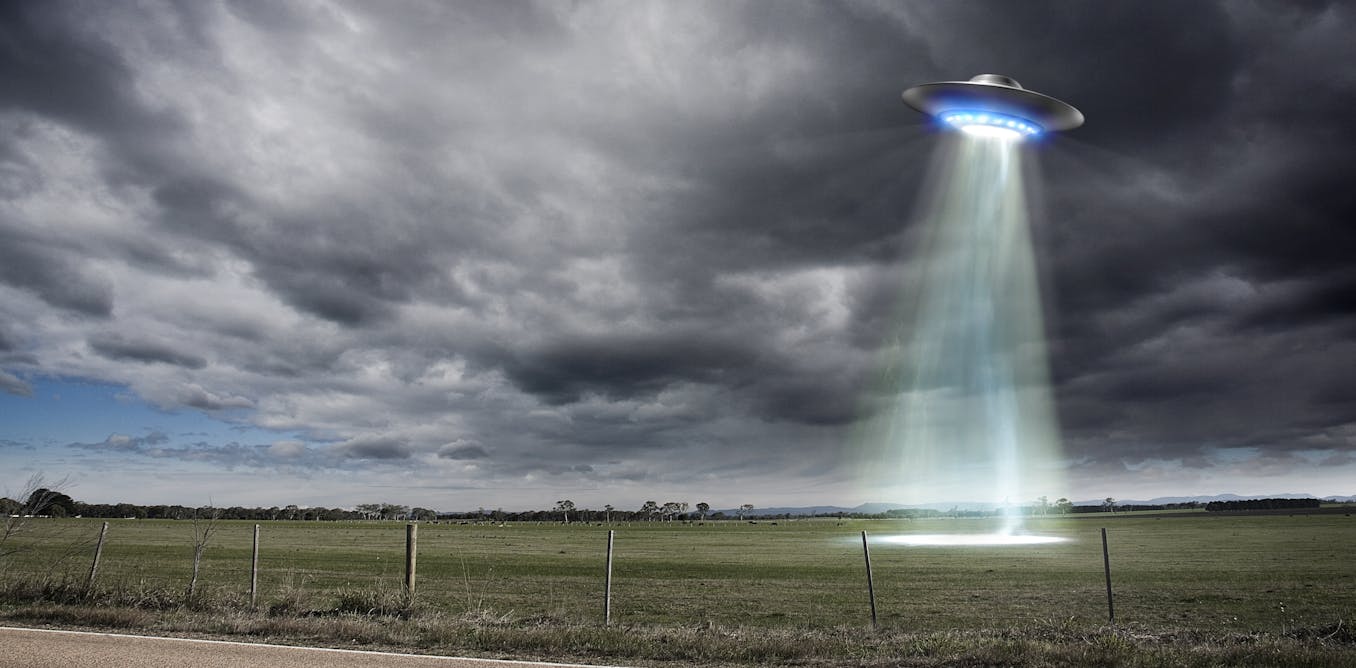
    I'm an astronomer and I think aliens may be out there – but UFO sightings  aren't persuasive

    While I believe it's naive to assume that there's no other form of life in a universe as vast as what we understand … I'm also highly skeptical of anyone who claims that they have specific knowledge or proof. With that said, I have seen enough stuff from people I trust to expect that our beliefs about these issues will shift massively in the very near future. As an example, check out Skywatch.ai, some of its videos, or this NewsNation broadcast.

    Since we live in a time where technologies are rapidly advancing, I thought it might be interesting to test out an AI-powered chatbot designed to debunk conspiracy theories through evidence-based conversations. It is a spin-out project with roots at MIT and other top universities. Research shows that many people doubted or abandoned false beliefs after a short conversation with the DebunkBot

    I first heard of this tool through these two articles: Meet DebunkBot, The AI Chatbot that Will Debunk Any Conspiracies You Believe and AI Chatbot Shows Promise in Talking People Out of Conspiracy Theories.

    Here is a link to the conversation I had with it about the belief  "Life likely exists elsewhere in the Universe due to its vastness and the repeated conditions that can give rise to life.To my surprise, this tool concluded that the belief is not a conspiracy theory and reminded me that:

    Science for the sake of knowing is one thing. Belief for the sake of hope, curiosity, or imagination is another. The search for "life" might actually help us discover something more valuable than what we thought we were searching for in the first place.

    You can test your beliefs against DebunkBot's AI. Let me know how it goes and whether you changed your mind.

    Meanwhile, Information Is Beautiful has an interactive data visualization to help you decide if we're alone in the Universe. 

    As usual, it's well done, fun, and informative. 

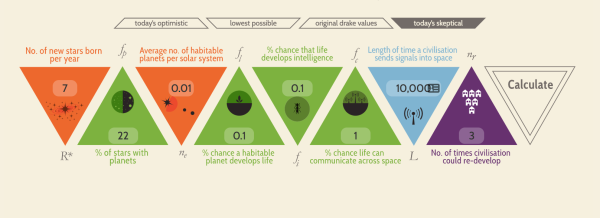
    For the slightly geeky amongst us, the model lets you adjust the estimate by playing with the Drake and Seager equations.

    The Drake equation estimates the number of detectable extraterrestrial civilizations in our galaxy and the universe. It factors in variables such as habitable planets, the likelihood of life, intelligent life, and the duration of time a civilization sends signals into space. 

    The Seager equation is a modern take on the equation, focusing on bio-signatures of life that we can currently detect – for example, the number of observable stars/planets, the % have life, and the % chance of detectable bio-signature gas. 

    Click here to play with the Are We Alone in the Universe infographic


    Screen Shot 2020-12-13 at 2.49.56 PMvia Information Is Beautiful

    For both equations, the infographic lets you look at various default options, but also enables you to change the variables based on your beliefs. 

    For example, the skeptic's default answer for Drake's equation shows 0.0000062 communicating civilizations in our galaxy, which is still 924,000 in the universe. The equivalent for Seager's equation shows 0.0009000 planets with detectable life in our "galactic neighborhood" and 135,000,000 planets in our universe. 

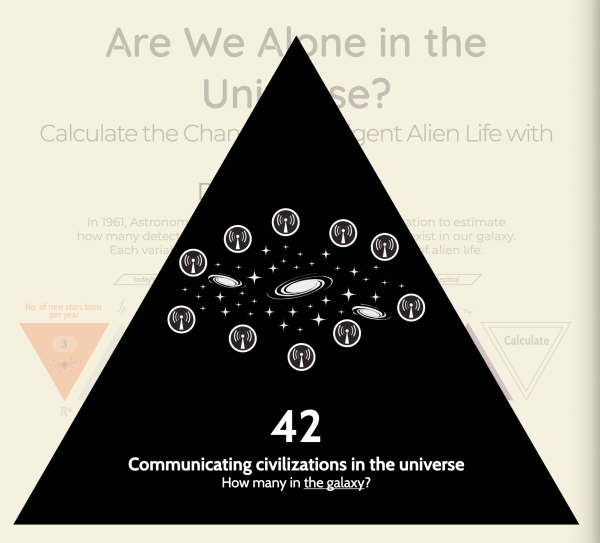
    Even with the "lowest possible" selection chosen, Drake's equation still shows 42 communicating civilizations (Douglas Adams, anyone?) in the universe.


    Screen Shot 2020-12-13 at 2.54.27 PMvia Information Is Beautiful

    One of the most interesting numbers (and potentially influential numbers for me) is the length of time a civilization sends signals into space. Conservative estimates are 420 years, but optimistic estimates are 10,000 or more. 

    One other thing to consider is that some scientists believe that life is most likely to grow on planets with very high gravity, which would also make escaping their atmosphere for space travel nigh impossible.

    If any aliens are reading this … don't worry, I won't tell. But we will find out who you voted for in the last election.

  • Are Billionaires Popular?

    We live in an interesting time. Many billionaires aren’t just business leaders – they’re also influencers, personalities, and public figures. 

    While countless billionaires go under the radar, several of today’s billionaires have become controversial figures – like Elon Musk. So, how do the top 10 richest Americans rank in this so-called “popularity contest?”

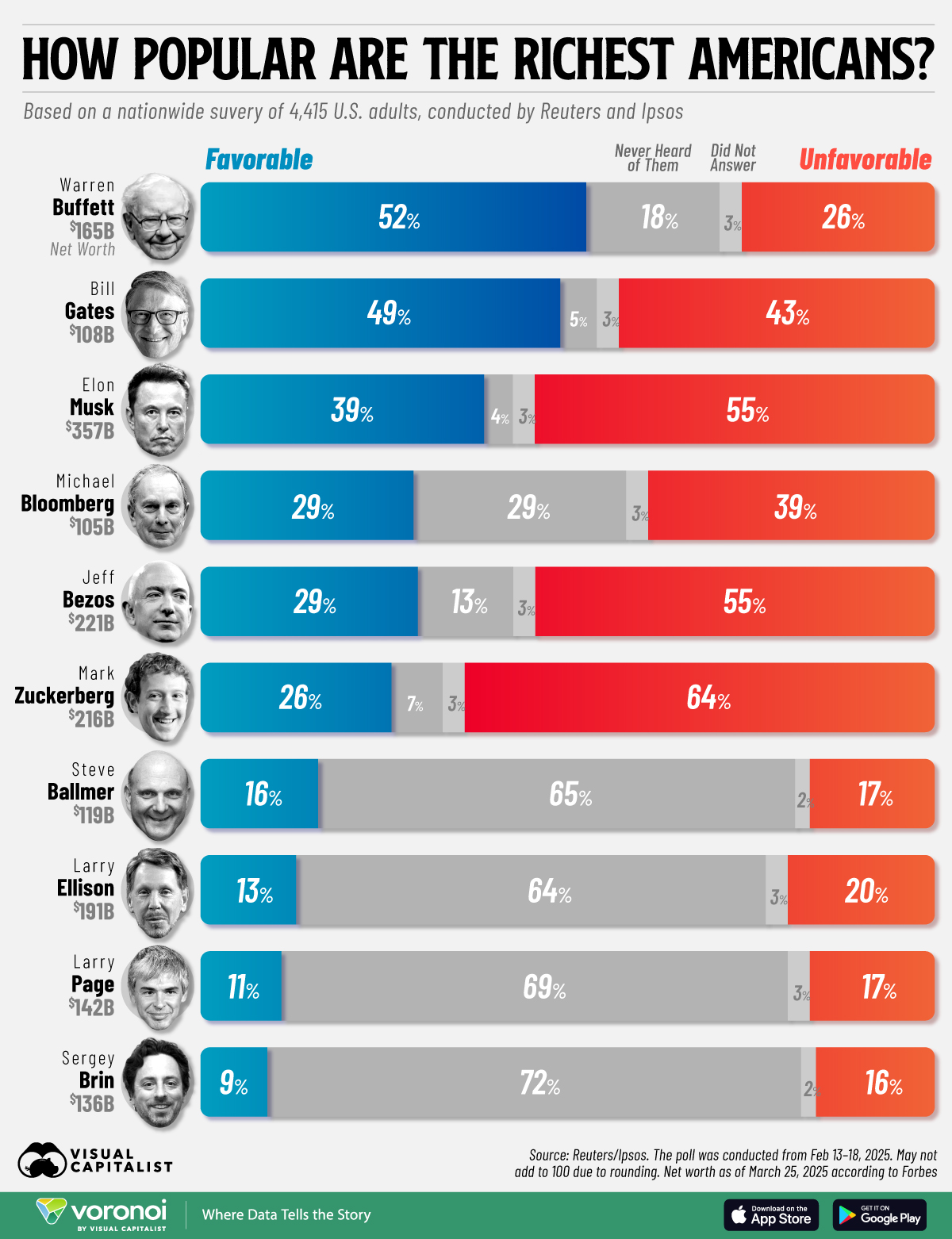
    This infographic ranks the 10 richest Americans by how popular they are, based on a nationwide survey of 4,415 U.S. adults.

    via visualcapitalist

    It’s interesting how many of the 10 wealthiest people in America are still flying relatively under the radar. In my head, names like Sergey Brin or Larry Page should still be household names. 

    On the other side of this scale, the three richest billionaires have primarily unfavorable ratings … with Mark Zuckerburg being the most disliked of the bunch. 

    Meanwhile, Warren Buffett and Bill Gates have predominantly positive ratings – though Bill is more polarizing than Buffett. 

    As an aside, the world’s richest lost over $200 billion in a single day as news of Trump’s tariffs rocked markets. For context, that drop is the fourth-largest one-day decline in the Bloomberg Billionaires Index’s 13-year history.

  • How Are You Feeling About The Tariffs?

    Trump announced his reciprocal tariffs this week, and the world went into an uproar and the market into a tailspin. As an immediate result, JP Morgan switched its economic prediction from "Solid Growth" to "Recession Risk"

    My take: Actions Have Consequences. More importantly,  we don't know all the actions … and we certainly haven't recognized all the consequences. This is the beginning of something bigger than it seems, and many of the outcomes are beyond our current expectations or comprehension.

    Sure, we saw some fundamental shifts last week … but know that we are in for more.

    The moves were big and fast enough that most people I know haven't had the time or brain cells to ponder things long and deep enough to form a well-reasoned opinion.

    The only thing I "know" is that I expect more volatility and big moves.

    With that in mind, here are some charts to help keep you informed as the consequences unfold. 


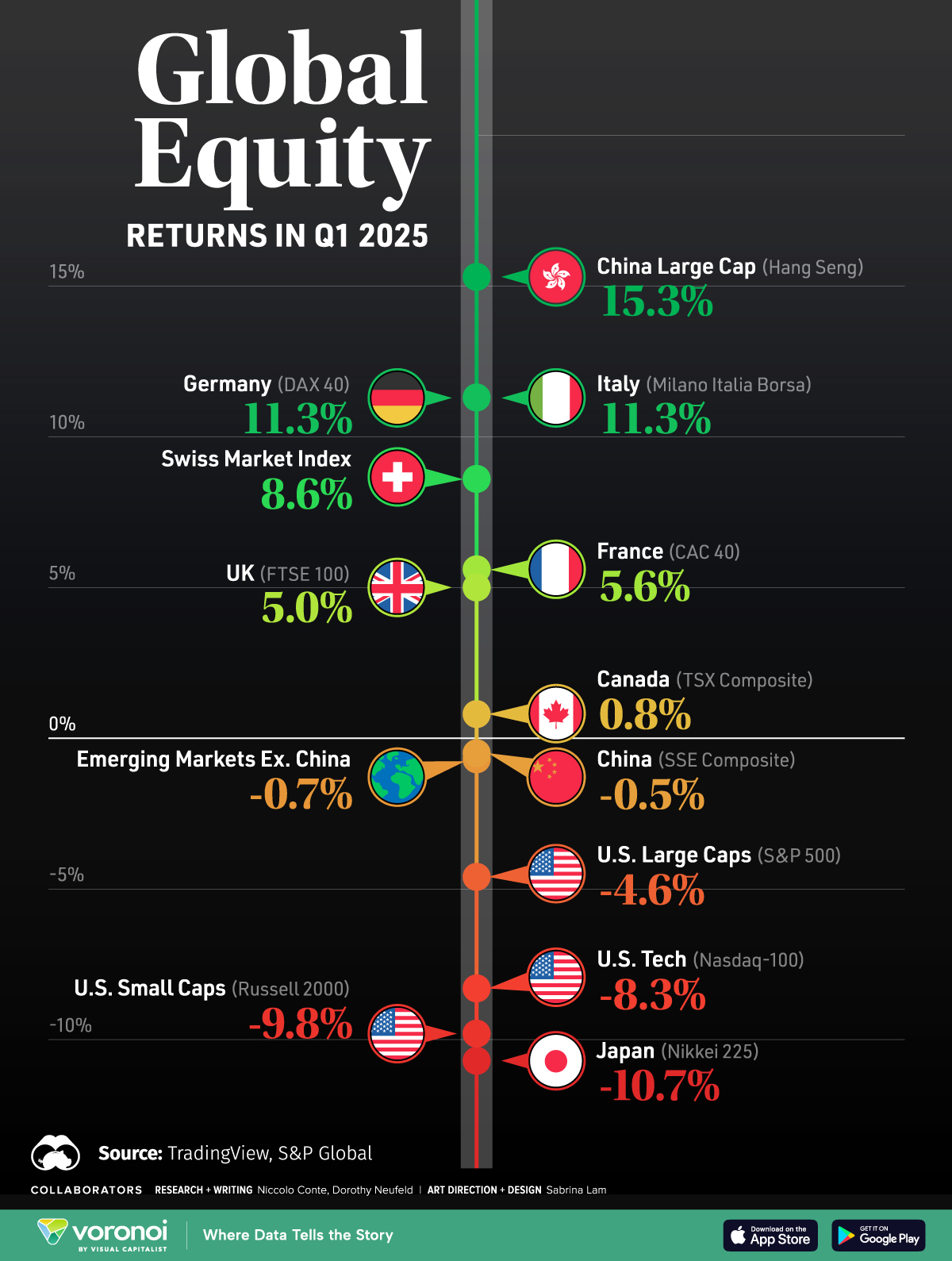
    Chart #1 – Global Stock Market Returns in Q1 of 2025

    via visualcapitalist

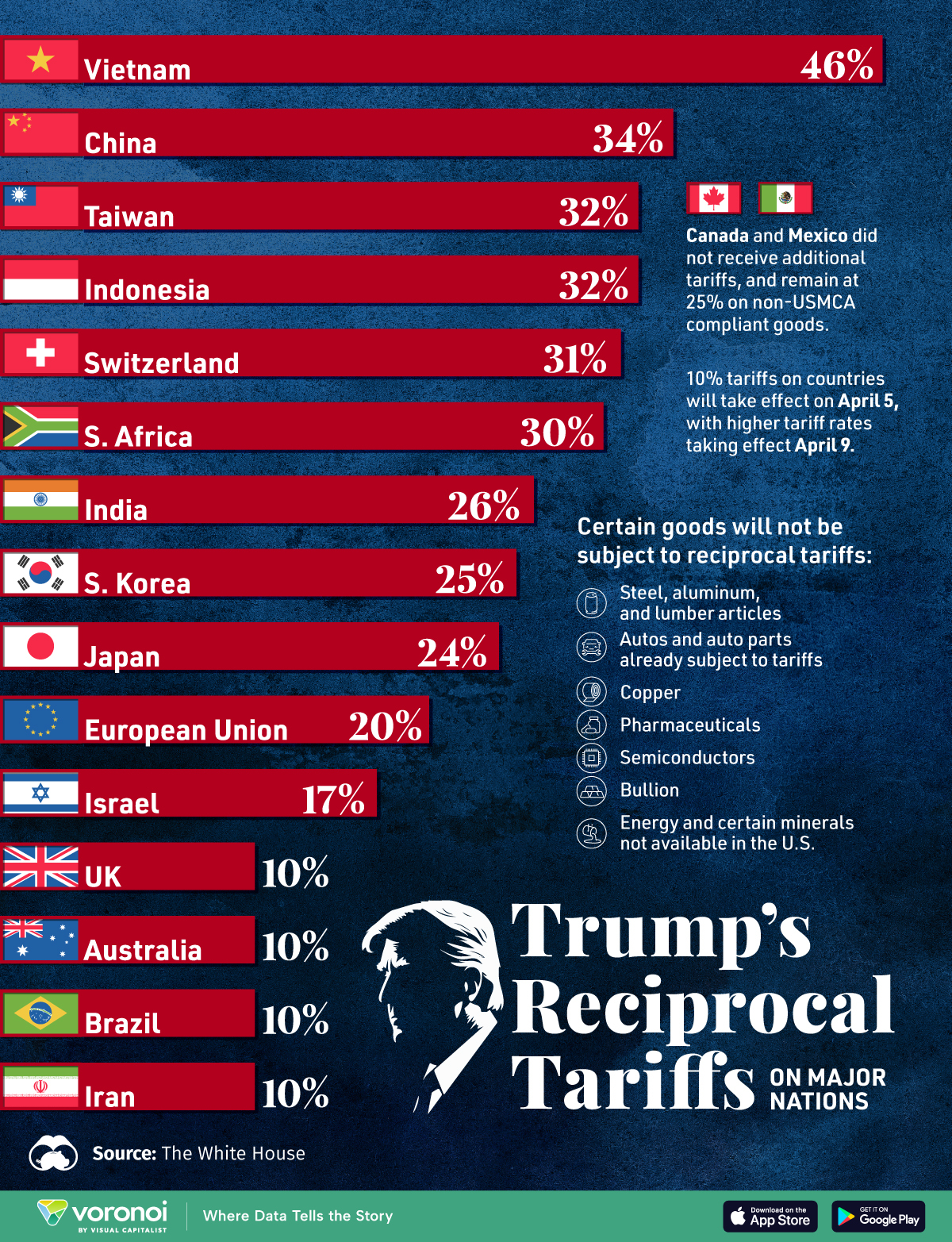
    Chart #2 – Trump's Reciprocal Tariffs on Major Nations

    Chart of U.S. President Trump's Reciprocal Tariffs on Countries

    via visualcapitalist

    Chart #3 – Tariff Shock Wipes $5.3 Trillion Off S&P 500: Index Falls 10.5% in Two Days

    📈 Tariff Shock Wipes $5.3 Trillion Off S&P 500: Index Falls 10.5% in Two Days

    via visualcapitalist

    Looking at the first chart, it's clear that prior to this announcement, there was a U.S. sell-off, perhaps caused by concerns about inflation and slower GDP growth. As a result, more investment was moving toward Chinese and European stocks. 

    After Trump's announcement, many things happened, including a joint response from China, Japan, and Korea – something I never thought I'd see. Also, many internet netizens started to plug questions into AI LLMs and receive similar results as Trump's tariffs. Contrary to a more complex equation, it appeared as if the tariff rates were calculated by dividing the deficit and imports of a country. Ultimately, this math was confirmed by the White House Deputy Press Secretary, Kush Desai. 

    It will be interesting to see what is walked back and what is doubled down on over the next few weeks. 

    Do you have faith?  Do you have an opinion?  I'd love to hear it!

  • Understanding the Shape of Change

    Change is the only constant in life, yet it rarely unfolds in ways we expect. While we sense its approach, its shape — whether sudden and disruptive or slow and subtle — often defies our predictions. As the pace and scale of change accelerate, understanding its patterns becomes more crucial than ever.

    The World Government Summit put together a helpful interactive website where you can test your knowledge on the trajectory of key statistical indicators for the development of society over the past decade. Here is the text from their opening screen.


    Can we estimate how much the world has changed in a decade? Or do our own experiences impact the perception of progress? This work challenges the assumptions we make about how key statistical indicators regarding Health, the Environment, or Education evolve through the years. 

    The Shape of Change via the World Government Summit

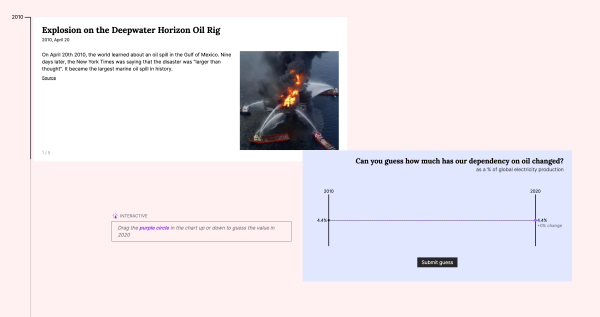
    The first part of the process was designed to be like a guessing game where you try to predict the direction and the rate of change of key issues shaping the world (like oil dependency, pollution,  literacy, economic freedom, etc.) by answering some questions at "The Shape of Change." It is simple, easy-to-use, and has a nice interface … but answering the questions was more challenging than expected. Try it here


    Screen Shot 2023-05-19 at 2.34.04 PM

    The Shape of Change via the World Government

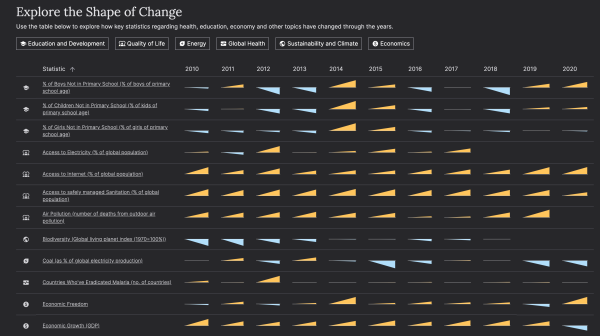
    The second part of the experiment lets you explore the year-over-year changes in key statistics regarding health, education, economy, and other topics.


    Screen Shot 2023-05-19 at 2.38.55 PM
    The Shape of Change via the World Government

    If you want to explore this further, I asked Perplexity to give me a broad overview of the project and its key insights. Here is the link.

    The data is interesting. But, perhaps, your reaction to the data is more important. 

    Were there any numbers that surprised you?