Traders whose only investment strategy is to buy stocks may be subjecting themselves to unnecessary risks.
There is always something working in the Markets. So, if you limit yourself to looking solely at U.S. Equities, you might be missing something.
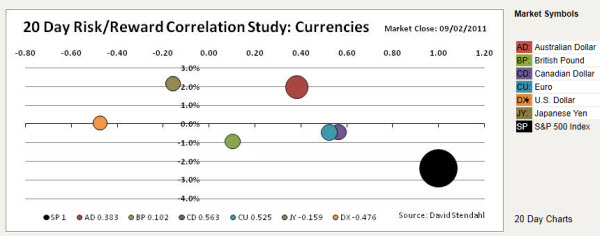
For example, here is a chart (from David Stendahl) comparing the risk and reward of trading various Currencies to the performance of the S&P 500 Index.
Notice that each of these markets recently did better, while also having a very low correlation with the S&P (shown by the big black dot in the lower right of the chart).
The point is that there are many other markets and products you can use to diversify your portfolio and improve your risk-to-reward ratio.
Wherever there is danger, opportunity lurks, and vice versa The two are inseparable … but they don't have to be equal.
What About the S&P 500?
History doesn't usually repeat itself exactly, but it often rhymes.
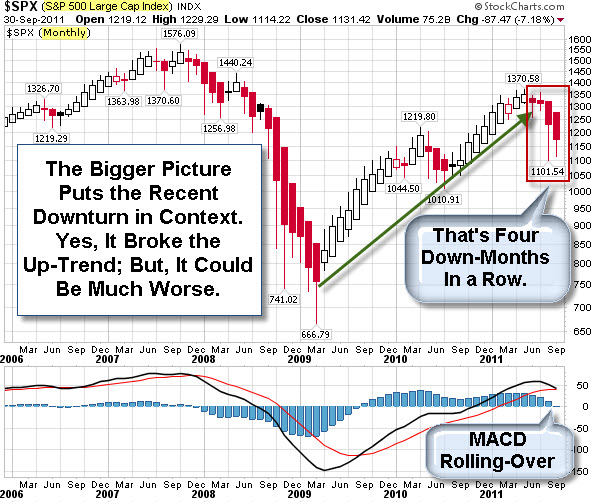
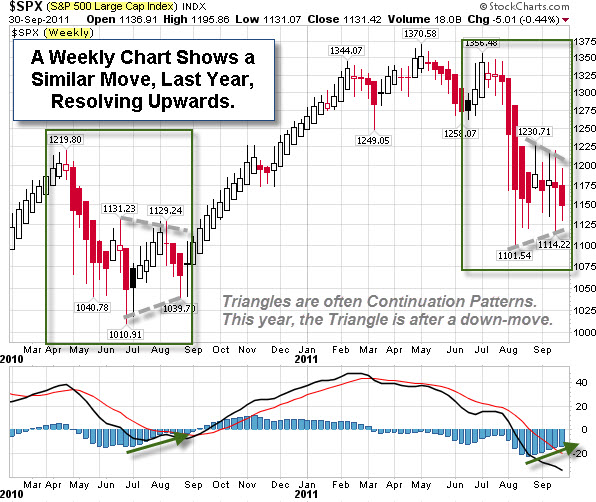
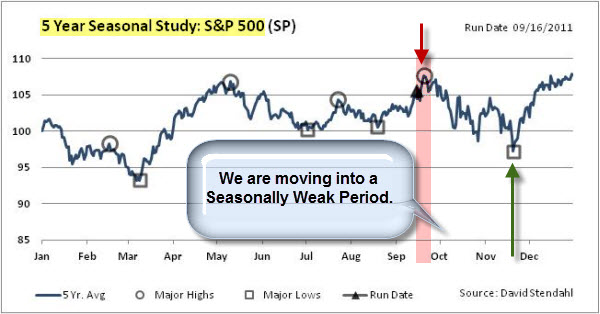
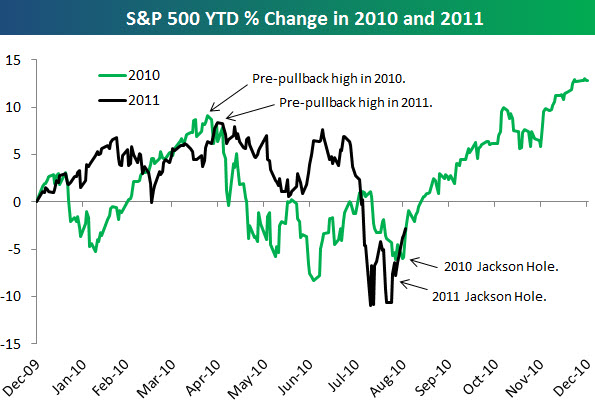
Take a look at Bespoke's comparison of the S&P 500's price chart in 2010 to this year's price chart. It is easy to see why people are hoping that we get something even remotely similar to what happened last year.
Here is what Bespoke had to say:
Last year, the S&P 500 made its pre-correction high in late April, and it wasn't until Bernanke's Jackson Hole speech in late August that the market broke out of its summer funk.
As shown above, the S&P 500 also made its pre-correction high in late April of this year, and people are hoping that we made a short-term bottom at the end of August right around the time of this year's Jackson Hole speech.
In 2010, the S&P 500 was down 3.12% on September 1st, and it closed the year up 12.8% after pretty much going straight up over the last four months of the year.
As we enter this September, the S&P currently sits down just under 3%. If history repeats itself, the country will surely end the year in a much better mood than it's in now.
German Chancellor Angela Merkel sent a pretty clear message to the Markets this weekend – that Europe's leaders will not be bullied into action just because the markets are throwing a fit about the speed of their actions.
Other highlights of her recent comments include:
“At this time — we’re in a dramatic crisis — euro bonds are precisely the wrong answer.”
“They lead us into a debt union, not a stability union. Each country has to take its own steps to reduce its debt.”
“Politicians can’t and won’t simply run after the markets.”
“The markets want to force us to do certain things. That we won’t do."
Cullen Roche, from Pragmatic Capitalism, says: if you’re a market speculator you can basically read her comments as such: “We are in no rush whatsoever to solve the crisis in Europe. We will not be swayed by market crashes or panics.” Interesting, because the markets are sending them a very clear message. There is a very serious risk of a banking crisis in Europe.
It's Not Just Europe.
The world continued its sell-off last week. The table on the right shows the damage done to seven major markets.
The DAX was the biggest loser, down 8.63%. It's also the index that has slipped the furthest into bear territory, down 27.20% from its interim high set on May 2nd.
In fact, five of the seven are now in cyclical bear territory, down 20% or more from their interim highs: The DAX, Nikkei, Hang Seng, Shanghai, and the BSE Sensex.
The FTSE and S&P 500 remain above the traditional bear boundary, vying for the dubious designation as top performer during this world-wide correction.
How Do The Moves in Once Country Compare to Others?
Here is a chart, from Doug Short, showing the comparative performance of World Markets since March 9, 2009.
It has been a tough few weeks for just about everyone.
Laszlo Birinyi adds that stock correlation is also soaring. The average 50-day correlation of S&P 500 members to the index has risen to the highest levels since the market bottomed in 1987.
Are 'fat tails' are more likely to happen at the end of a crisis? If so, we might see a bottom soon. It bears watching to notice which sectors will break out as new leaders.
German Chancellor Angela Merkel sent a pretty clear message to the Markets this weekend – that Europe's leaders will not be bullied into action just because the markets are throwing a fit about the speed of their actions.
Other highlights of her recent comments include:
“At this time — we’re in a dramatic crisis — euro bonds are precisely the wrong answer.”
“They lead us into a debt union, not a stability union. Each country has to take its own steps to reduce its debt.”
“Politicians can’t and won’t simply run after the markets.”
“The markets want to force us to do certain things. That we won’t do."
Cullen Roche, from Pragmatic Capitalism, says: if you’re a market speculator you can basically read her comments as such: “We are in no rush whatsoever to solve the crisis in Europe. We will not be swayed by market crashes or panics.” Interesting, because the markets are sending them a very clear message. There is a very serious risk of a banking crisis in Europe.
It's Not Just Europe.
The world continued its sell-off last week. The table on the right shows the damage done to seven major markets.
The DAX was the biggest loser, down 8.63%. It's also the index that has slipped the furthest into bear territory, down 27.20% from its interim high set on May 2nd.
In fact, five of the seven are now in cyclical bear territory, down 20% or more from their interim highs: The DAX, Nikkei, Hang Seng, Shanghai, and the BSE Sensex.
The FTSE and S&P 500 remain above the traditional bear boundary, vying for the dubious designation as top performer during this world-wide correction.
How Do The Moves in Once Country Compare to Others?
Here is a chart, from Doug Short, showing the comparative performance of World Markets since March 9, 2009.
It has been a tough few weeks for just about everyone.
Laszlo Birinyi adds that stock correlation is also soaring. The average 50-day correlation of S&P 500 members to the index has risen to the highest levels since the market bottomed in 1987.
Are 'fat tails' are more likely to happen at the end of a crisis? If so, we might see a bottom soon. It bears watching to notice which sectors will break out as new leaders.
Kevin Slavin argues that we're living in a world designed for — and increasingly controlled by — algorithms.
In this thought-provoking talk from TEDGlobal, he shows how these complex computer programs determine: stock prices, espionage tactics, movie scripts, and architecture. And he warns that we are writing code we can't understand, with implications we can't control.