Market Commentary

  • Capitalogix Commentary for the Week of 04/12/10

    The Dow Jones Industrial Average traded above 11,000 for the first time since 2008. The real question is whether that is a sign of continued strength or that the rally has climbed too far, too fast?

    Smart Money – Dumb
    Money Confidence Index
    .

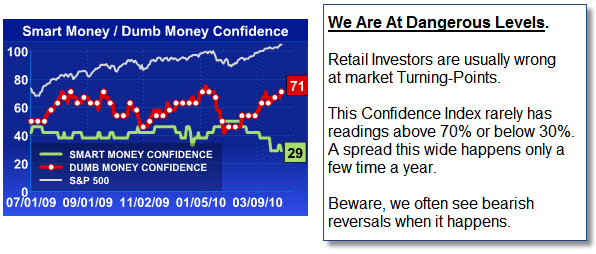
    The chart, below, compares the bets made by small traders (a.k.a. the "Dumb
    Money"), to those of large commercial hedgers (a.k.a. the "Smart
    Money").

    In practice, Confidence Index readings rarely get below
    30% or above 70% (they usually stay between 40% and 60%). When they
    move outside of those bands, it's time to pay attention.

    Even
    more noteworthy is when there is a wide confidence spread with bullish bets by the Dumb Money and bearish bets by the Smart Money. This type of
    sentiment
    spread only happens a few times a year. We
    often get substantial bullish reversals when that happens.
    100411 Smart Money Dumb Money Confidence Index

    Conventional trading wisdom says that Crowds are
    usually wrong at turning-points.  That doesn't mean they are wrong all
    the time (yet I take special notice when the Smart Money clearly disagrees).

    Consumer Credit Woes Adding Fuel to the Doubt Fires.

    Here is a chart from BusinessInsider showing the Fed's latest consumer credit reading. After starting to recover, total outstanding consumer credit had a massive month-over-month decline.
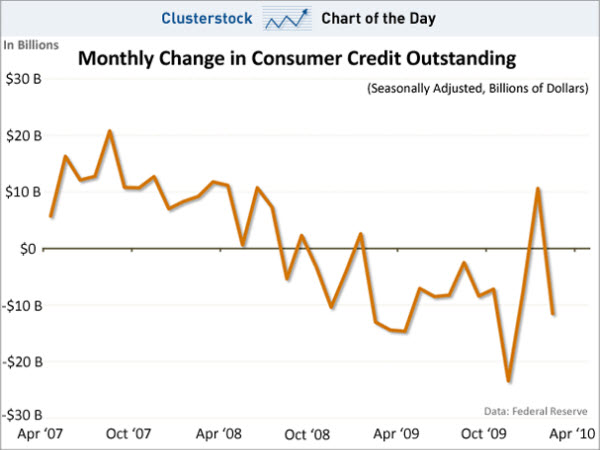
    100411 Monthly Change in Consumer Credit Outstanding

    It is tough to stage a lasting recovery without consumers. 

    So Where Is the Money Coming From?

    U.S. Federal debt has increased rapidly.
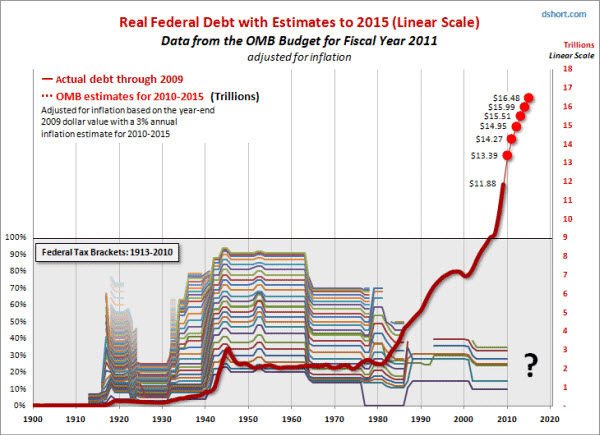
    100411 Federal Debt Estimate

    In a related chart, Doug Short created an
    inflation-adjusted view of the debt and an overlay of the tax brackets.  With the 2001 and 2003 tax cuts expiring this year, the question is whether the gross
    federal debt will be a factor in determining the direction of future tax
    rates? Perhaps, like a young household with good jobs buying a home, the
    US can afford the rising level of debt?  What do you think?

    Speaking of Debt-Laden Countries.

    European governments on Sunday offered debt-laden Greece a rescue package worth as much as 45 billion euros ($61 billion) at below-market interest rates as they try to end Greece's fiscal crisis and restore confidence in the euro.
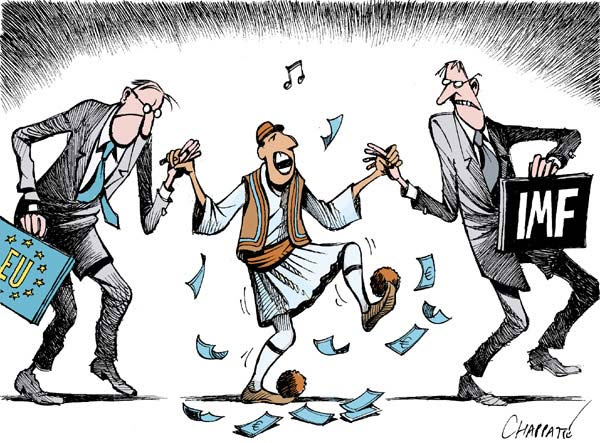
    100411 Greece Gets Loan

    Business Posts Moving the
    Markets
    that I Found Interesting This Week
    :

    Lighter Ideas and
    Fun Links

    that I Found Interesting This Week

    Reblog this post [with Zemanta]
  • Capitalogix Commentary for the Week of 04/12/10

    The Dow Jones Industrial Average traded above 11,000 for the first time since 2008. The real question is whether that is a sign of continued strength or that the rally has climbed too far, too fast?

    Smart Money – Dumb
    Money Confidence Index
    .

    The chart, below, compares the bets made by small traders (a.k.a. the "Dumb
    Money"), to those of large commercial hedgers (a.k.a. the "Smart
    Money").

    In practice, Confidence Index readings rarely get below
    30% or above 70% (they usually stay between 40% and 60%). When they
    move outside of those bands, it's time to pay attention.

    Even
    more noteworthy is when there is a wide confidence spread with bullish bets by the Dumb Money and bearish bets by the Smart Money. This type of
    sentiment
    spread only happens a few times a year. We
    often get substantial bullish reversals when that happens.

    100411 Smart Money Dumb Money Confidence Index

    Conventional trading wisdom says that Crowds are
    usually wrong at turning-points.  That doesn't mean they are wrong all
    the time (yet I take special notice when the Smart Money clearly disagrees).

    Consumer Credit Woes Adding Fuel to the Doubt Fires.

    Here is a chart from BusinessInsider showing the Fed's latest consumer credit reading. After starting to recover, total outstanding consumer credit had a massive month-over-month decline.

    100411 Monthly Change in Consumer Credit Outstanding

    It is tough to stage a lasting recovery without consumers. 

    So Where Is the Money Coming From?

    U.S. Federal debt has increased rapidly.

    100411 Federal Debt Estimate

    In a related chart, Doug Short created an
    inflation-adjusted view of the debt and an overlay of the tax brackets.  With the 2001 and 2003 tax cuts expiring this year, the question is whether the gross
    federal debt will be a factor in determining the direction of future tax
    rates? Perhaps, like a young household with good jobs buying a home, the
    US can afford the rising level of debt?  What do you think?

    Speaking of Debt-Laden Countries.

    European governments on Sunday offered debt-laden Greece a rescue package worth as much as 45 billion euros ($61 billion) at below-market interest rates as they try to end Greece's fiscal crisis and restore confidence in the euro.

    100411 Greece Gets Loan

    Business Posts Moving the
    Markets
    that I Found Interesting This Week
    :

    Lighter Ideas and
    Fun Links

    that I Found Interesting This Week

    Reblog this post [with Zemanta]
  • Capitalogix Commentary for the Week of 04/5/10

    The rally continues, and the S&P 500 has gotten back to new highs for the past year.  Pretty
    impressive on many fronts.  How does it compare to other markets
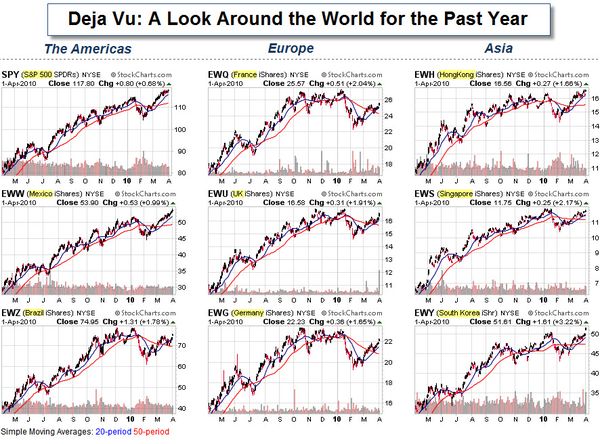
    though?  This chart shows how several other world markets have done in the past twelve months.

    100405 World Market Similarities

    This quick glance around the globe shows remarkably similar performance across the markets. Note how closely the price patterns and peaks and valleys are to each other.

    100405 global-markets related It brings up two questions:

    1. Are these countries each really doing the same things right and
      wrong?
    2. Are world-wide expectations and responses really this similar?

    To get a closer look for yourself, here is a link to the charts.

    Perhaps more importantly, it brings up a
    third question:
    What's really causing the markets to behave so
    similarly?

    Recognizing What Is Happening, Is the First Step to Profiting From It.

    To profit in trading, it's more important to recognize what's happening,
    rather than to understand what's happening.

    The strength of the rallies don't make sense to me based on logic.  However, trends don't depend on logic. So, I dusted-off my copy of Trend Following and will simply ride the bucking
    bronco.

    But I Still Want to Know Why … Don't You?

    Occam's Razor suggests that the simplest explanation is most likely to be correct. So, when markets move in a virtual lockstep (despite many unsettling global variables), let's look for simple explanations.

    Here are a few ideas (ranging from silly to plausible).

    •  After watching the movie 2012, world leaders decided the one who dies
      with the most toys wins.
    • Human nature is consistent across cultures.
    • The recession is over, and we have begun a new global bull market.
    • Something unusual is happening, and we just don't know what it is.
    • Who Controls the MarketsWith consumers mostly out of the market, institutions figured-out how to buy and sell from each other, making relatively easy profits with minimal risk.
    • Governments agreed to temporarily suspend speculating in each other's
      markets, other than in the normal course of business.
    • Governments and central banks agreed to cooperate. Don't fight the Fed, especially when it's a cartel of Feds.

    From a Traders Perspective …

    There are still many things to watch, from a trader's perspective, despite the strong correlation among markets. For example: divergence patterns can provide early indications of moves in either direction; relative strength comparisons can show which markets are more likely to over or under-perform; and volume spikes can indicate something unusual happening. Nonetheless, the simple observation is that markets are trending higher, so the safest assumption is that the trend continues until evidence proves otherwise.

    My grandfather used to say: "you can fool some people, some of the time; but you can't fool all of the people, all of the time." He was not an exceptionally well-educated man, but he was a professional wrestler … so he knew something about stagecraft.  My guess is that one of the actors breaks character soon.  That tends to happen in most cartels.

    Focus on the Global Economy as Debt Worries Rise.

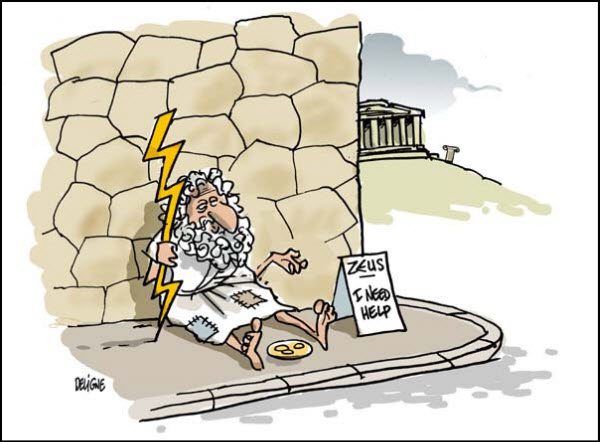
    Greece continues to stay in the news because a sustainable debt solution has not been agreed to and implemented. There are reports that smart-money is starting to bet against Greece.

    100405 Greece Still Needs a Handout

    America is not the next Greece, says Simon Johnson, MIT professor and former director of research for the IMF.

    Have a good week.

    Business Posts Moving the
    Markets
    that I Found Interesting This Week
    :

    Lighter Ideas and
    Fun Links

    that I Found Interesting This Week

    Reblog this post [with Zemanta]
  • Capitalogix Commentary for the Week of 04/5/10

    The rally continues, and the S&P 500 has gotten back to new highs for the past year.  Pretty
    impressive on many fronts.  How does it compare to other markets
    though?  This chart shows how several other world markets have done in the past twelve months.

    100405 World Market Similarities

    This quick glance around the globe shows remarkably similar performance across the markets. Note how closely the price patterns and peaks and valleys are to each other.

    100405 global-markets related It brings up two questions:

    1. Are these countries each really doing the same things right and
      wrong?
    2. Are world-wide expectations and responses really this similar?

    To get a closer look for yourself, here is a link to the charts.

    Perhaps more importantly, it brings up a
    third question:
    What's really causing the markets to behave so
    similarly?

    Recognizing What Is Happening, Is the First Step to Profiting From It.

    To profit in trading, it's more important to recognize what's happening,
    rather than to understand what's happening.

    The strength of the rallies don't make sense to me based on logic.  However, trends don't depend on logic. So, I dusted-off my copy of Trend Following and will simply ride the bucking
    bronco.

    But I Still Want to Know Why … Don't You?

    Occam's Razor suggests that the simplest explanation is most likely to be correct. So, when markets move in a virtual lockstep (despite many unsettling global variables), let's look for simple explanations.

    Here are a few ideas (ranging from silly to plausible).

    •  After watching the movie 2012, world leaders decided the one who dies
      with the most toys wins.
    • Human nature is consistent across cultures.
    • The recession is over, and we have begun a new global bull market.
    • Something unusual is happening, and we just don't know what it is.
    • Who Controls the MarketsWith consumers mostly out of the market, institutions figured-out how to buy and sell from each other, making relatively easy profits with minimal risk.
    • Governments agreed to temporarily suspend speculating in each other's
      markets, other than in the normal course of business.
    • Governments and central banks agreed to cooperate. Don't fight the Fed, especially when it's a cartel of Feds.

    From a Traders Perspective …

    There are still many things to watch, from a trader's perspective, despite the strong correlation among markets. For example: divergence patterns can provide early indications of moves in either direction; relative strength comparisons can show which markets are more likely to over or under-perform; and volume spikes can indicate something unusual happening. Nonetheless, the simple observation is that markets are trending higher, so the safest assumption is that the trend continues until evidence proves otherwise.

    My grandfather used to say: "you can fool some people, some of the time; but you can't fool all of the people, all of the time." He was not an exceptionally well-educated man, but he was a professional wrestler … so he knew something about stagecraft.  My guess is that one of the actors breaks character soon.  That tends to happen in most cartels.

    Focus on the Global Economy as Debt Worries Rise.

    Greece continues to stay in the news because a sustainable debt solution has not been agreed to and implemented. There are reports that smart-money is starting to bet against Greece.

    100405 Greece Still Needs a Handout

    America is not the next Greece, says Simon Johnson, MIT professor and former director of research for the IMF.

    Have a good week.

    Business Posts Moving the
    Markets
    that I Found Interesting This Week
    :

    Lighter Ideas and
    Fun Links

    that I Found Interesting This Week

    Reblog this post [with Zemanta]
  • Capitalogix Commentary for the Week of 03/22/10

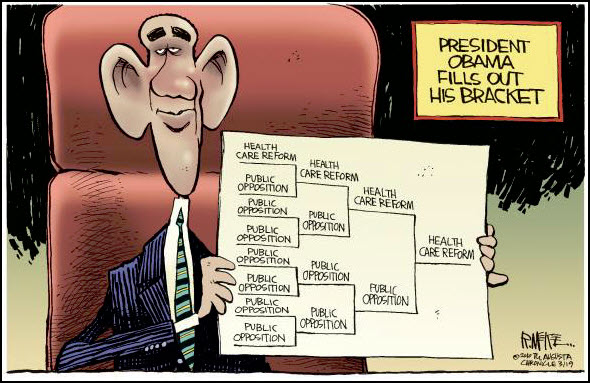
    March Madness is in full force.  What's a $ Trillion here, or a $ Trillion there?

    100321 Obama Fills Out His Bracket and Healthcare Wins

    A Look at the Markets.

    Most people consider it "bullish" when markets go up 14 of 16 days.  That should make people happy, right?

    Recently, though, I've had conversations with several "old-pro" traders who expressed a sense of frustration. They view the recent push higher with skepticism. Trading discipline is allowing them to make money on the upside, but it's not as satisfying as being "right".

    What do the Charts Show?

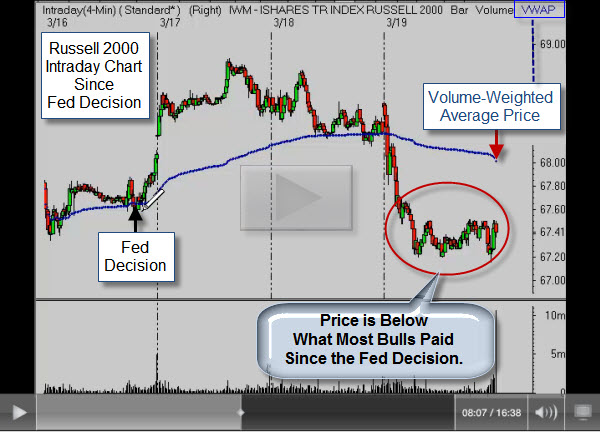
    Let's look beyond the obvious up-trend.  The following chart and video, from Brian Shannon's Alphatrends site, shows that price is now below the volume-weighted average price paid since Fed Decision to leave rates unchanged.

    100321 Russell 2000 Since Fed Decision Video

    There is now a lot of support under our recent highs, so many expect the market to correct a little, then resume its move higher.

    How Far Can the Rally Go?

    On a basic level, the recent market rally shows that there's more buying
    demand than selling pressure. However, when there is little selling
    pressure, it doesn't take much demand to keep prices going higher.

    At this point, the rally has gone on long enough that many of the participants who profited
    from the extended move up are now becoming defensive. 

    Also, some trading
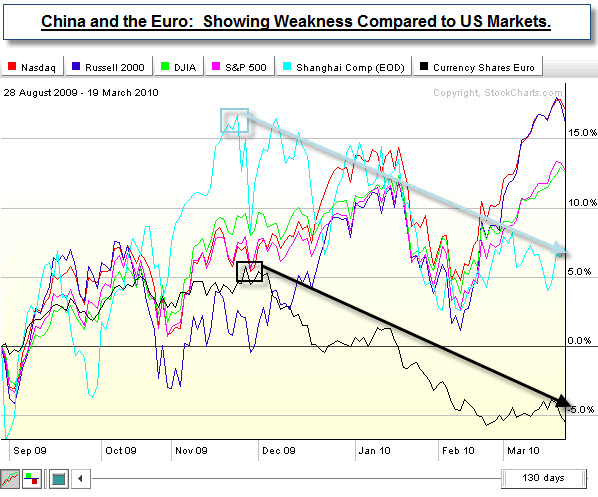
    relationships that tend to move together have decoupled. The following
    chart shows the recent weakness of the China Shanghai Index and the Euro
    in comparison to the U.S. Markets.

    100321 China and Euro Comparitive Weakness

    Some see the U.S. Market's continued relative strength as a precursor to a new leg of the bull market, while
    others see it as a temporary anomaly.

    Adding to the bearish case is that several sentiment indicators show
    very little fear. The VIX
    is moving back to the extreme levels of complacency. Odd-lot shorts
    recorded a 13 week low, indicating that the "little guy" has virtually
    given up on shorting. Likewise, the lack of fear is downright scary when
    you look at CBOE's
    Equity Put-to-Call
    Ratio
    . These readings are contrary indicators, meaning they often occur at
    turning points in the market.

    And with quad-witching
    expiration
    behind us, and an unpopular health-care issue in
    the news, the bears will have another chance to show their conviction … or lack of it. 

    We'll see what happens.  I hope you have a good week.

    Business Posts Moving the
    Markets
    that I Found Interesting This Week
    :

    • Nice Overview, Weighing the Decision on Health Legislation. (OldProf)
    • Polls Show Only 27% Believe U.S. Heading in Right Direction. (Rasmussen)
    • Federal Reserve Faces Challenges and Changes. (Atlantic)
    • Pandit Sees Revival of Citi’s Fortunes. (FT)
    • What Does the VIX Really Tell Us Here? (Minyanville)
    • More Posts
      Moving the Markets
      .

    Lighter Ideas and
    Fun Links

    that I Found Interesting This Week

    Reblog this post [with Zemanta]
  • Capitalogix Commentary for the Week of 03/22/10

    March Madness is in full force.  What's a $ Trillion here, or a $ Trillion there?

    100321 Obama Fills Out His Bracket and Healthcare Wins

    A Look at the Markets.

    Most people consider it "bullish" when markets go up 14 of 16 days.  That should make people happy, right?

    Recently, though, I've had conversations with several "old-pro" traders who expressed a sense of frustration. They view the recent push higher with skepticism. Trading discipline is allowing them to make money on the upside, but it's not as satisfying as being "right".

    What do the Charts Show?

    Let's look beyond the obvious up-trend.  The following chart and video, from Brian Shannon's Alphatrends site, shows that price is now below the volume-weighted average price paid since Fed Decision to leave rates unchanged.

    100321 Russell 2000 Since Fed Decision Video

    There is now a lot of support under our recent highs, so many expect the market to correct a little, then resume its move higher.

    How Far Can the Rally Go?

    On a basic level, the recent market rally shows that there's more buying
    demand than selling pressure. However, when there is little selling
    pressure, it doesn't take much demand to keep prices going higher.

    At this point, the rally has gone on long enough that many of the participants who profited
    from the extended move up are now becoming defensive. 

    Also, some trading
    relationships that tend to move together have decoupled. The following
    chart shows the recent weakness of the China Shanghai Index and the Euro
    in comparison to the U.S. Markets.

    100321 China and Euro Comparitive Weakness

    Some see the U.S. Market's continued relative strength as a precursor to a new leg of the bull market, while
    others see it as a temporary anomaly.

    Adding to the bearish case is that several sentiment indicators show
    very little fear. The VIX
    is moving back to the extreme levels of complacency. Odd-lot shorts
    recorded a 13 week low, indicating that the "little guy" has virtually
    given up on shorting. Likewise, the lack of fear is downright scary when
    you look at CBOE's
    Equity Put-to-Call
    Ratio
    . These readings are contrary indicators, meaning they often occur at
    turning points in the market.

    And with quad-witching
    expiration
    behind us, and an unpopular health-care issue in
    the news, the bears will have another chance to show their conviction … or lack of it. 

    We'll see what happens.  I hope you have a good week.

    Business Posts Moving the
    Markets
    that I Found Interesting This Week
    :

    • Nice Overview, Weighing the Decision on Health Legislation. (OldProf)
    • Polls Show Only 27% Believe U.S. Heading in Right Direction. (Rasmussen)
    • Federal Reserve Faces Challenges and Changes. (Atlantic)
    • Pandit Sees Revival of Citi’s Fortunes. (FT)
    • What Does the VIX Really Tell Us Here? (Minyanville)
    • More Posts
      Moving the Markets
      .

    Lighter Ideas and
    Fun Links

    that I Found Interesting This Week

    Reblog this post [with Zemanta]
  • Capitalogix Commentary for the Week of 03/15/10

    Breadth Continues to Expand.

    The Markets are showing signs of health and strength.  These charts, from Stockcharts.com, show the internal strength and breadth powering the move higher and supporting the current rally.

    100312zditcbreadth

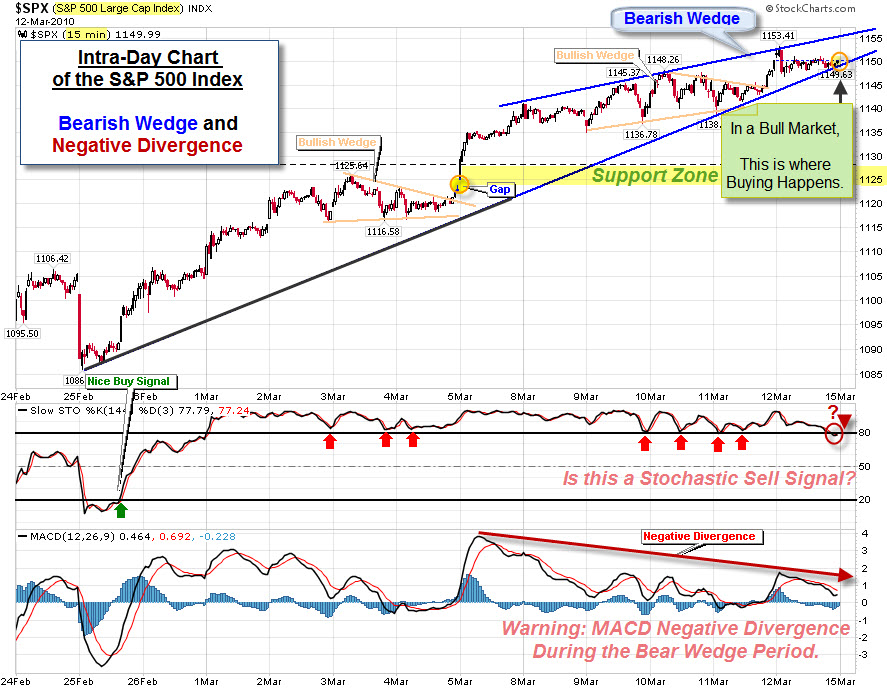
    Here is an intra-day chart of the S&P 500 Index for the past three weeks. It is a modified version of something I saw on Breakpoint Trades' site.  It shows the decision-point; price has pulled-back to the trend-line. 

    In bull markets, this is where Buyers tend to appear.  In contrast, Sellers probably see the bearish wedge and negative divergence as signs of waning momentum.  Add the potential sell-signal from over-bought stochastics, and we have an interesting set-up for next week.

    100311 SP500 Intra-Day Chart

    Even if the markets sell-off from here, there are now a number of support levels close by.

    The markets have continued to do well, what about the economy?  I think the Employment situation is a primary indicator.

    We Stand Out – With Respect to the Severity of our Under-Employment Situation.

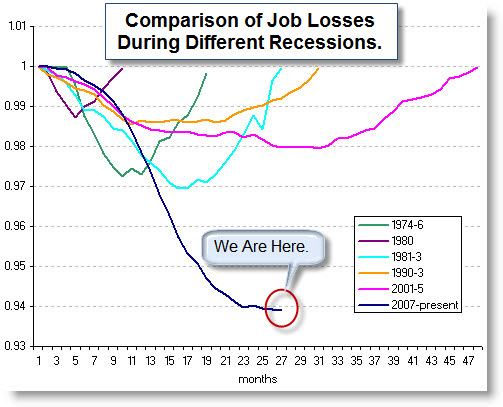
    There is disagreement about whether the recent jobs number was a positive sign.  Some are focusing on the slowing decline; others are focusing on the continued weakness … still others are focusing on the continued downwards adjustments.  Nonetheless, this chart makes something clear.  Compared to other recessions, the job losses (and lack of job gains), of this Recession are truly unprecedented.

    Job Losses Compared Across Recessions

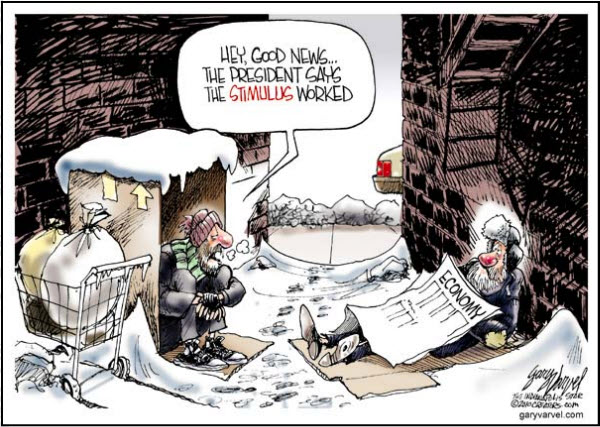
    Here is a different way to look at what that chart means.

    100314 Stimulus Worked Cartoon

    Business Posts Moving the
    Markets
    that I Found Interesting This Week
    :

    • A Gold Bubble? Sure, But Soros is Still In.(HedgeFundNet)
    • Increasing M&A Transactions are a Positive Sign of Recovery.  (MSNBC)
    • Betting It All On Growth – Will it Fix Unemployment, Deficits
      &
      the Credit Crisis? (WSJ)
    • The Double-Dip Watch. (FT)
    • What Warren Buffett's Annual Letter to Shareholders Didn't Say. (SeekingAlpha)
    • More Posts
      Moving the Markets
      .

    Lighter Ideas and
    Fun Links

    that I Found Interesting This Week

    Reblog this post [with Zemanta]
  • Capitalogix Commentary for the Week of 03/15/10

    Breadth Continues to Expand.

    The Markets are showing signs of health and strength.  These charts, from Stockcharts.com, show the internal strength and breadth powering the move higher and supporting the current rally.

    100312zditcbreadth

    Here is an intra-day chart of the S&P 500 Index for the past three weeks. It is a modified version of something I saw on Breakpoint Trades' site.  It shows the decision-point; price has pulled-back to the trend-line. 

    In bull markets, this is where Buyers tend to appear.  In contrast, Sellers probably see the bearish wedge and negative divergence as signs of waning momentum.  Add the potential sell-signal from over-bought stochastics, and we have an interesting set-up for next week.

    100311 SP500 Intra-Day Chart

    Even if the markets sell-off from here, there are now a number of support levels close by.

    The markets have continued to do well, what about the economy?  I think the Employment situation is a primary indicator.

    We Stand Out – With Respect to the Severity of our Under-Employment Situation.

    There is disagreement about whether the recent jobs number was a positive sign.  Some are focusing on the slowing decline; others are focusing on the continued weakness … still others are focusing on the continued downwards adjustments.  Nonetheless, this chart makes something clear.  Compared to other recessions, the job losses (and lack of job gains), of this Recession are truly unprecedented.

    Job Losses Compared Across Recessions

    Here is a different way to look at what that chart means.

    100314 Stimulus Worked Cartoon

    Business Posts Moving the
    Markets
    that I Found Interesting This Week
    :

    • A Gold Bubble? Sure, But Soros is Still In.(HedgeFundNet)
    • Increasing M&A Transactions are a Positive Sign of Recovery.  (MSNBC)
    • Betting It All On Growth – Will it Fix Unemployment, Deficits
      &
      the Credit Crisis? (WSJ)
    • The Double-Dip Watch. (FT)
    • What Warren Buffett's Annual Letter to Shareholders Didn't Say. (SeekingAlpha)
    • More Posts
      Moving the Markets
      .

    Lighter Ideas and
    Fun Links

    that I Found Interesting This Week

    Reblog this post [with Zemanta]
  • Capitalogix Commentary for the Week of 03/08/10

    Spider-Man Gets Fired You know Unemployment is becoming part of the cultural zeitgeist when Spider-Man gets fired

    Last week's employment report showed a fair number of other people got fired too.

    Apparently, though, not many people cared, because the markets rallied anyway.

    If you are interested, Barry Ritholtz put together a big picture look at employment charts

    Signs of Strength.

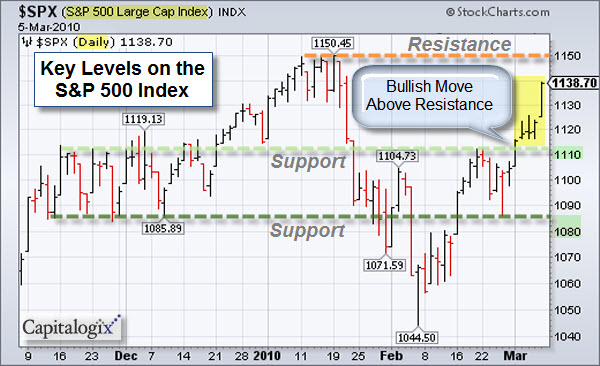
    The markets put on a show of strength this week, blasting through overhead resistance. The chart below shows the S&P 500 Index is approaching its recent highs, and now has two nice levels of support beneath it (marked by the light and dark green lines).

    As long as price is above these levels, it seems prudent to use
    bull-market techniques. That means to expect buying on dips.

    100308 Key Levels on the SP500

    On the other hand, trading often induces paranoia. So, there is some part of me looking for the next areas that would trigger the most stop-losses. Coincidentally, this weekend I talked to a money manager who told me they were going to exit their short positions if the markets get above the recent highs (marked by the orange line). That seems like a pretty widely followed level.  So, a spike above that … followed by a sharp reversal, might find some of the selling volume we've been missing lately.

    Could We Possibly Still Be in a Bear Market?

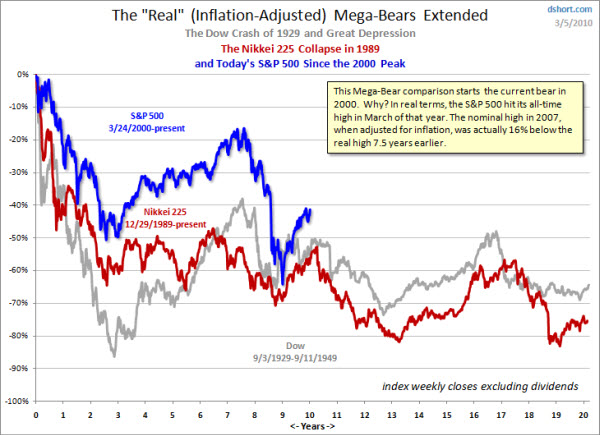
    A fresh view is often helpful. The next chart is not designed to be predictive. Instead, it simply provides an alternative context to view the recent price action in relation to historic market cycles.

    Below is an inflation-adjusted overlay of three secular bear markets put together by Doug Short. It aligns the current S&P 500 from the top of the Tech Bubble in March 2000, the Dow in of 1929, and the Nikkei 225 from its 1989 bubble high.

    100308 Inflation Adjusted Bear Market Comparisons

    The nominal all-time high in the index occurred in October 2007, but when adjusted for inflation, the "real" all-time high for the S&P 500 occurred in March 2000.

    There is a Lot of Deal-Making Going On.

    Increased merger and acquisition activity and the freeing-up of corporate assets (usually measured by increased corporate spending) are both typically bullish signs.  Why?  Both indicate that decision-makers are optimistic (or at least projecting optimism). There's been quite a bit of evidence showing that this is happening on a global corporate scale and all the way down to the local level.

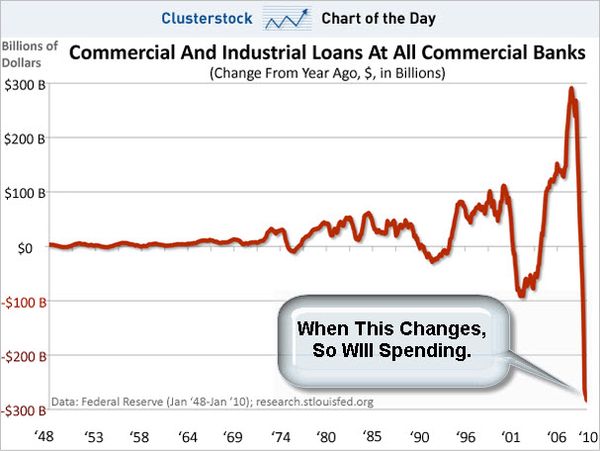
    One thing holding-back the optimism is the lack of lending.  Here is a look at that.

    Chart-of-the-day-commercial-and-industrial-loans-at-all-commercial-banks

    Nonetheless, companies with cash are starting to use it.

    Here's a story that is a bit humorous, though still shows those green shoots of growth.

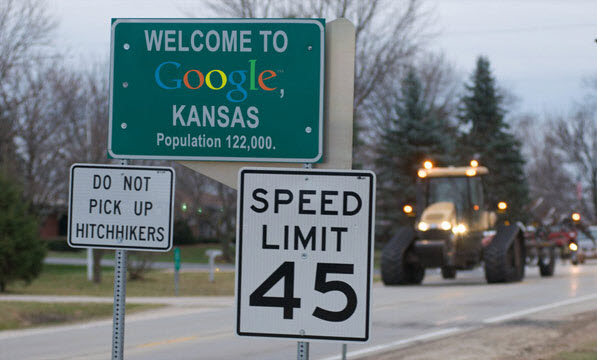
    In Kansas, the city of Topeka changed its name to Google. Supposedly part of a local effort to convince Google to make Topeka a test site for an ultra-fast Internet connection and set Topeka apart from other cities vying for Google's attention.

     Google Kansas Sounds Like Home

    Hope you have a good week, even if you used to live in Topeka.

    Business Posts Moving the
    Markets
    that I Found Interesting This Week
    :

    Lighter Ideas and
    Fun Links

    that I Found Interesting This Week

    Reblog this post [with Zemanta]
  • Capitalogix Commentary for the Week of 03/08/10

    Spider-Man Gets Fired You know Unemployment is becoming part of the cultural zeitgeist when Spider-Man gets fired

    Last week's employment report showed a fair number of other people got fired too.

    Apparently, though, not many people cared, because the markets rallied anyway.

    If you are interested, Barry Ritholtz put together a big picture look at employment charts

    Signs of Strength.

    The markets put on a show of strength this week, blasting through overhead resistance. The chart below shows the S&P 500 Index is approaching its recent highs, and now has two nice levels of support beneath it (marked by the light and dark green lines).

    As long as price is above these levels, it seems prudent to use
    bull-market techniques. That means to expect buying on dips.

    100308 Key Levels on the SP500

    On the other hand, trading often induces paranoia. So, there is some part of me looking for the next areas that would trigger the most stop-losses. Coincidentally, this weekend I talked to a money manager who told me they were going to exit their short positions if the markets get above the recent highs (marked by the orange line). That seems like a pretty widely followed level.  So, a spike above that … followed by a sharp reversal, might find some of the selling volume we've been missing lately.

    Could We Possibly Still Be in a Bear Market?

    A fresh view is often helpful. The next chart is not designed to be predictive. Instead, it simply provides an alternative context to view the recent price action in relation to historic market cycles.

    Below is an inflation-adjusted overlay of three secular bear markets put together by Doug Short. It aligns the current S&P 500 from the top of the Tech Bubble in March 2000, the Dow in of 1929, and the Nikkei 225 from its 1989 bubble high.

    100308 Inflation Adjusted Bear Market Comparisons

    The nominal all-time high in the index occurred in October 2007, but when adjusted for inflation, the "real" all-time high for the S&P 500 occurred in March 2000.

    There is a Lot of Deal-Making Going On.

    Increased merger and acquisition activity and the freeing-up of corporate assets (usually measured by increased corporate spending) are both typically bullish signs.  Why?  Both indicate that decision-makers are optimistic (or at least projecting optimism). There's been quite a bit of evidence showing that this is happening on a global corporate scale and all the way down to the local level.

    One thing holding-back the optimism is the lack of lending.  Here is a look at that.

    Chart-of-the-day-commercial-and-industrial-loans-at-all-commercial-banks

    Nonetheless, companies with cash are starting to use it.

    Here's a story that is a bit humorous, though still shows those green shoots of growth.

    In Kansas, the city of Topeka changed its name to Google. Supposedly part of a local effort to convince Google to make Topeka a test site for an ultra-fast Internet connection and set Topeka apart from other cities vying for Google's attention.

     Google Kansas Sounds Like Home

    Hope you have a good week, even if you used to live in Topeka.

    Business Posts Moving the
    Markets
    that I Found Interesting This Week
    :

    Lighter Ideas and
    Fun Links

    that I Found Interesting This Week

    Reblog this post [with Zemanta]