
Just for Fun

  • Tough Week?

    Last week I wrote that trading is often stressful; and learning how to handle the emotional and physiological response patterns is an important step toward long-term success.


    This week the markets were at their manic-depressive best, which can be tough for traders.  Investors were like hyperactive first graders playing musical chairs.


    Here are some funny videos of how some people handle their tough week.


    The first video shows a man beating his computer.  There is something primal about it that makes it memorable.  I saw this many years ago.  Yet I find myself thinking about this one from time-to-time.  So, I put it first.


    Here is the direct link.


    I saw this one on on the Huffington Post.  It has a lot going on; way too much to describe.  It is more fun to just watch, anyway.


    Here is the direct link.


    Finally, this one shows a man in a coffee shop freaking-out after his computer hangs, apparently he has a presentation to give in ten-minutes, so getting arrested seemed like a good idea.


    Here is the direct link.  (Hat-Tip to Gelflog)
  • Before He Trades Video

    This tongue-in-cheek music video, called "Before He Trades," re-makes a popular Carrie Underwood song as a trading reminder.


    Here is the direct link.  From John Carter.

  • New Imaging Tools Will Change How You Access Information

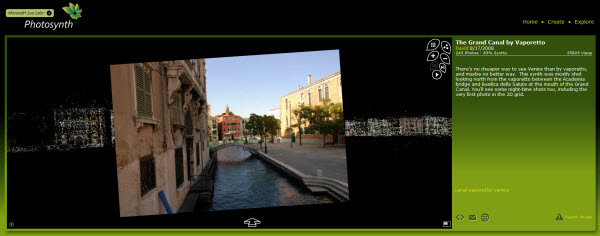
    Photosynth is a new technology from Microsoft
    It is software that could transform the way we look at digital images.
    Using still photos (and more), Photosynth builds a breathtaking new
    form of composite image, and lets us navigate them.  This service turns multiple photos of a scene or site — say, an art gallery or a building — into a 3-D scene you can virtually "walk" through on the Web.

    080829 Photosynth of Venice Canals 600p

    Ten-years ago I saw something like this; it was the interface to a game called Myst.  It was ground-breaking at the time.

    In the early phase of adoption for Photosynth, I expect to see things like the 3-D rendering of the Canals in Venice.  It is an easily accessible way to explore the concept.  Soon, however, this could evolve into a new way to hyper-link a wide range of data, meta-data, and business information.

    To get a better idea of what this can do, watch this video from the Ted Conference introducing Photosynth.

    Think about how much the web has already changed how you do research?  Also, because it is so easy to do now, think how much more research you do.  For example, I'm amazed at how often I search Google or Wikipedia. Similarly, I use sites like Digg, Technorati, Regator, and various blogs to find relevant information – even if I didn't know I was looking for it.

    Photosynth is different, and in some ways a step beyond, those research tools.  It is graphics-centric instead of text-centric.  And I can imagine a new type of front-end (a new framework) for accessing information stored virtually anywhere.  Consequently, I expect to see a lot more of this, and things like it.

    Click here to explore some interesting Synths.  You can make your own, too.  For example, here is a link to a Photosynth of, my son, Ben's dorm room at Duke.  It took him about a half-hour to make it.

    Note: you can use arrows on the screen to navigate a Photosynth image; and the "Space Bar" is helpful, too, because it jumps to the next cluster of 3-D images.

  • New Imaging Tools Will Change How You Access Information

    Photosynth is a new technology from Microsoft
    It is software that could transform the way we look at digital images.
    Using still photos (and more), Photosynth builds a breathtaking new
    form of composite image, and lets us navigate them.  This service turns multiple photos of a scene or site — say, an art gallery or a building — into a 3-D scene you can virtually "walk" through on the Web.

    080829 Photosynth of Venice Canals 600p

    Ten-years ago I saw something like this; it was the interface to a game called Myst.  It was ground-breaking at the time.

    In the early phase of adoption for Photosynth, I expect to see things like the 3-D rendering of the Canals in Venice.  It is an easily accessible way to explore the concept.  Soon, however, this could evolve into a new way to hyper-link a wide range of data, meta-data, and business information.

    To get a better idea of what this can do, watch this video from the Ted Conference introducing Photosynth.

    Think about how much the web has already changed how you do research?  Also, because it is so easy to do now, think how much more research you do.  For example, I'm amazed at how often I search Google or Wikipedia. Similarly, I use sites like Digg, Technorati, Regator, and various blogs to find relevant information – even if I didn't know I was looking for it.

    Photosynth is different, and in some ways a step beyond, those research tools.  It is graphics-centric instead of text-centric.  And I can imagine a new type of front-end (a new framework) for accessing information stored virtually anywhere.  Consequently, I expect to see a lot more of this, and things like it.

    Click here to explore some interesting Synths.  You can make your own, too.  For example, here is a link to a Photosynth of, my son, Ben's dorm room at Duke.  It took him about a half-hour to make it.

    Note: you can use arrows on the screen to navigate a Photosynth image; and the "Space Bar" is helpful, too, because it jumps to the next cluster of 3-D images.

  • iPhone App (Hoax?)

    This video is spreading quickly, and though speculation is that it is a mock-up, I found it to be quite compelling.  Somehow I get the sense that it demonstrates a sliver of what's to come.

    My guess is that we will start to see data visualization applications, using similar technologies, that will enable users to access data in powerful new ways.


    iHologram – iPhone application from David OReilly on Vimeo.

  • iPhone App (Hoax?)

    This video is spreading quickly, and though speculation is that it is a mock-up, I found it to be quite compelling.  Somehow I get the sense that it demonstrates a sliver of what's to come.

    My guess is that we will start to see data visualization applications, using similar technologies, that will enable users to access data in powerful new ways.


    iHologram – iPhone application from David OReilly on Vimeo.

  • Pilobolus: Things Aren’t Always What They Seem

    In trading, recognizing that things aren't always what they seem is a big part of the game. 

    Here is a clever video that plays on that concept. It is from Pilobolus, a talented dance and performance art troupe.

    Here is the direct link.

    And this one has an unexpected ending.


    Here is the direct link

    Also, here is a link to their performance at the TED conference. (TED)

    And here is an article about the "magic" of Pilobolus worth looking at. (CBS)

  • Pilobolus: Things Aren’t Always What They Seem

    In trading, recognizing that things aren't always what they seem is a big part of the game. 

    Here is a clever video that plays on that concept. It is from Pilobolus, a talented dance and performance art troupe.

    Here is the direct link.

    And this one has an unexpected ending.


    Here is the direct link

    Also, here is a link to their performance at the TED conference. (TED)

    And here is an article about the "magic" of Pilobolus worth looking at. (CBS)

  • Olympic Extra

    Beijing2008
    In China, "8" is believed to be a most powerful, and lucky, number.

    So it is not surprising that Chinese began the Olympics on 08-08-08 at 8:08 PM.

    Here is a link to Wikipedia's info page  and NBC's covering these Olympic games.

    And here is a link to Wired's coverage of the tech behind the games.

  • Olympic Extra

    Beijing2008
    In China, "8" is believed to be a most powerful, and lucky, number.

    So it is not surprising that Chinese began the Olympics on 08-08-08 at 8:08 PM.

    Here is a link to Wikipedia's info page  and NBC's covering these Olympic games.

    And here is a link to Wired's coverage of the tech behind the games.