With Thanksgiving coming this week, I thought this would help you get in the holiday spirit. In case you forgot, Thanksgiving is an annual tradition of observing how people used to communicate before the Internet.
With Thanksgiving coming this week, I thought this would help you get in the holiday spirit. In case you forgot, Thanksgiving is an annual tradition of observing how people used to communicate before the Internet.
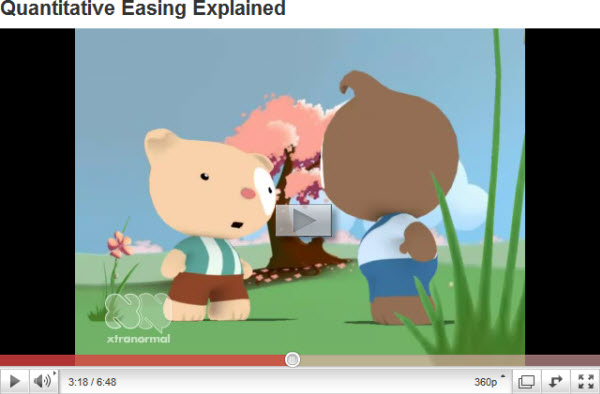
Even if you think you know what QE2 means, or don't believe that "'The printing money' is the last refuge of failed economic empires and banana republics, and the Fed doesn't want to admit this is their only idea" … Watch this humorous take on what the Federal Reserve is up to, and how we got here.
Like much humor, there is more than a grain of truth in it.
It was made with the Xtranormal text to movie engine.
Even if you think you know what QE2 means, or don't believe that "'The printing money' is the last refuge of failed economic empires and banana republics, and the Fed doesn't want to admit this is their only idea" … Watch this humorous take on what the Federal Reserve is up to, and how we got here.
Like much humor, there is more than a grain of truth in it.
It was made with the Xtranormal text to movie engine.
This video shows how narrow your focus can be. You'll have some fun, and what is revealed at the end is surprising. So pay attention as you watch the video. See what you notice.
It was done by pychologist, magician, and author Prof Richard Wiseman. Click here for background information about this video and the psychology behind it.
In part 1 of this post, we examined Change Blindness and how we can miss incredibly obvious things (right in front of us) if our attention is focused elsewhere.
In an information-rich environment, attention is a scarce and essential resource.
Think how often your focus blinds you to the obvious.
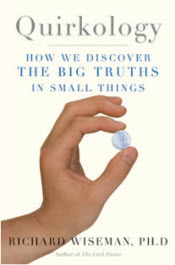
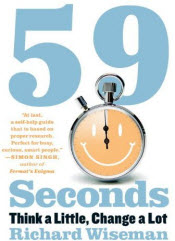
Here are two books written by Professor Wiseman. The first is called Quirkology, and it is about discoving big truths in small things. The second is called 59 Seconds, and it is about little things that make big differences.
This video shows how narrow your focus can be. You'll have some fun, and what is revealed at the end is surprising. So pay attention as you watch the video. See what you notice.
It was done by pychologist, magician, and author Prof Richard Wiseman. Click here for background information about this video and the psychology behind it.
In part 1 of this post, we examined Change Blindness and how we can miss incredibly obvious things (right in front of us) if our attention is focused elsewhere.
In an information-rich environment, attention is a scarce and essential resource.
Think how often your focus blinds you to the obvious.
Here are two books written by Professor Wiseman. The first is called Quirkology, and it is about discoving big truths in small things. The second is called 59 Seconds, and it is about little things that make big differences.
Daniel Simons' experiments on visual awareness have become famous. The primary conclusion drawn from his research is that we can miss incredibly obvious things, right in front of us, if our attention is focused elsewhere.
Test Your Awareness.
Watch this video and count how many passes the team in white makes.
This is worth doing so you experience it yourself.
Try to ignore the black team. Just focus on the white team, and see if you can accurately count how many times they pass the ball.
OK, click the video to do it now.
Did you get the right answer? Even though I knew what to expect, the result or effect was surprising.
By the way, there is a newer version of this video, here.
Think how often your focus blinds you to the obvious.
Change Blindness.
Missing an invisible gorilla or a moon-walking bear may seem strange. However, the next experiment may be more surprising.
This video demonstrates "change blindness". In an experiment, 75% of the participants didn't notice that the experimenter who bent under a counter was replaced by a different person.
If you liked that, here is a version done by Derrin Brown. It is quite clever and worth watching. It was even more surprising to me because it was done in public with "real people". How did people not notice a white male switching with a black guy (or an asian female) in the middle of a conversation?
Warning: Objects In Your Attention Span Are Fewer Than You Perceive.
Moment by moment, the brain selectively processes information it deems most relevant. Experiments, like these, show the limits of our capacity to encode, retain, and compare visual information from one glance to the next.
More importantly, this suggests that our awareness of our visual surroundings is far more sparse than most people intuitively believe. Consequently, our intuition can deceive us far more often than we perceive.
Clearly, in an information-rich environment, attention is a scarce and essential resource. So, pay attention (or automate the things you know need to be done right, every time).
Daniel Simons' experiments on visual awareness have become famous. The primary conclusion drawn from his research is that we can miss incredibly obvious things, right in front of us, if our attention is focused elsewhere.
Test Your Awareness.
Watch this video and count how many passes the team in white makes.
This is worth doing so you experience it yourself.
Try to ignore the black team. Just focus on the white team, and see if you can accurately count how many times they pass the ball.
OK, click the video to do it now.
Did you get the right answer? Even though I knew what to expect, the result or effect was surprising.
By the way, there is a newer version of this video, here.
Think how often your focus blinds you to the obvious.
Change Blindness.
Missing an invisible gorilla or a moon-walking bear may seem strange. However, the next experiment may be more surprising.
This video demonstrates "change blindness". In an experiment, 75% of the participants didn't notice that the experimenter who bent under a counter was replaced by a different person.
If you liked that, here is a version done by Derrin Brown. It is quite clever and worth watching. It was even more surprising to me because it was done in public with "real people". How did people not notice a white male switching with a black guy (or an asian female) in the middle of a conversation?
Warning: Objects In Your Attention Span Are Fewer Than You Perceive.
Moment by moment, the brain selectively processes information it deems most relevant. Experiments, like these, show the limits of our capacity to encode, retain, and compare visual information from one glance to the next.
More importantly, this suggests that our awareness of our visual surroundings is far more sparse than most people intuitively believe. Consequently, our intuition can deceive us far more often than we perceive.
Clearly, in an information-rich environment, attention is a scarce and essential resource. So, pay attention (or automate the things you know need to be done right, every time).