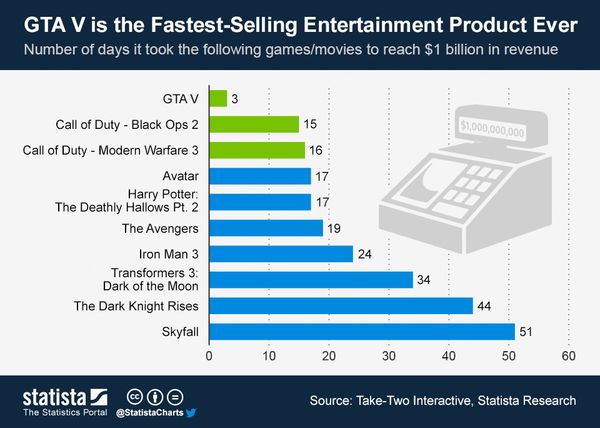
GTA V reached the billion-dollar revenue milestone faster than any other entertainment product in history.
Read that again … Not only does that make GTA the fastest game to reach that milestone, but the fastest-selling entertainment product of all time.
It took the game only three days to achieve what Avatar, no less than the most successful movie of all times, did in 17 days.
With an estimated production/marketing budget of $265 million, GTA V is not only the most expensive video game of all time, but also more expensive than most of today's Hollywood blockbusters.
The two highest-grossing movies in history, James Cameron's Titanic and
Avatar, both took considerably longer to pull in one billion.
For what it's worth, I think is also says something good about the economy and disposable income.
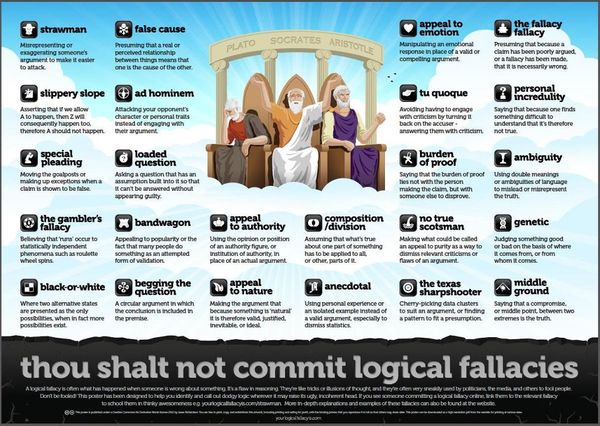
Sometimes business feels like a debate. Other times, dinner conversation or a family discussion takes a contentious turn. In any case, here is a quick primer on logical fallacies.
A logical fallacy is a flaw in reasoning. In other words, logical fallacies are like tricks or illusions of thought. Consequently, they are
often used by politicians and the media.
It is fun to identify which of these certain people (including yourself) use when arguing.
TWENTY LOGICAL FALLACIES:
They fall into three main types: Distraction (10); Ambiguity (5); and Form (5).
A. Fallacies of Distraction
1. Ad baculum (Veiled threat): "to the stick": DEF.- threatening an opponent if they don’t agree with you; EX.- "If you don’t agree with me you’ll get hurt!"
2. Ad hominem (Name-calling; Poisoning the well): "to the man": DEF.- attacking a person’s habits, personality, morality or character; EX.- "His argument must be false because he swears and has bad breath."
3. Ad ignorantium (Appeal to ignorance): DEF.- arguing that if something hasn’t been proved false, then it must be true; EX.- "U.F.Os must exist, because no one can prove that they don’t."
4. Ad populum: "To the people; To the masses": DEF.- appealing to emotions and/or prejudices; EX.- "Everyone else thinks so, so it must be true."
5. Bulverism: (C.S. Lewis’ imaginary character, Ezekiel Bulver) DEF.- attacking a person’s identity/race/gender/religion; EX.- "You think that because you’re a (man/woman/Black/White/Catholic/Baptist, etc.)"
6. Chronological Snobbery DEF.- appealing to the age of something as proof of its truth or validity; EX.-"Voodoo magic must work because it’s such an old practice;" "Super-Glue must be a good product because it’s so new."
7. Ipse dixit: "He said it himself": DEF.- appealing to an illegitimate authority; EX.- "It must be true, because (so and so) said so."
8. Red herring (Changing the subject): DEF.- diverting attention; changing the subject to avoid the point of the argument; EX.- "I can’t be guilty of cheating. Look how many people like me!"
9. Straw Man: DEF.- setting up a false image of the opponent's argument; exaggerating or simplifying the argument and refuting that weakened form of the argument; EX.- "Einstein's theory must be false! It makes everything relative–even truth!"
10. Tu quoque: "You also" DEF.- defending yourself by attacking the opponent; EX.- "Who are you to condemn me! You do it too!"
B. Fallacies of Ambiguity
1. Accent: DEF.- confusing the argument by changing the emphasis in the sentence; EX.- "YOU shouldn’t steal" (but it’s okay if SOMEONE ELSE does); "You shouldn’t STEAL" (but it’s okay to LIE once in a while); "You SHOULDN’T steal (but sometimes you HAVE TO) ."
2. Amphiboly: [Greek: "to throw both ways"] DEF.- confusing an argument by the grammar of the sentence; EX.- "Croesus, you will destroy a great kingdom!" (your own!)
3. Composition: DEF.- assuming that what is true of the parts must be true of the whole; EX.- "Chlorine is a poison; sodium is a poison; so NaCl must be a poison too;" "Micro-evolution is true [change within species]; so macro-evolution must be true too [change between species]."
4. Division: DEF.- assuming that what is true of whole must be true of the parts; EX.- "The Lakers are a great team, so every player must be great too."
5. Equivocation: DEF.- confusing the argument by using words with more than one definition; EX.- "You are really hot on the computer, so you’d better go cool off."
C. Fallacies of Form
1. Apriorism (Hasty generalization): DEF.- leaping from one experience to a general conclusion; EX.- "Willy was rude to me. Boys are so mean!"
2. Complex question (Loaded question): DEF.- framing the question so as to force a single answer; EX.- "Have you stopped beating your wife yet?"
3. Either/or (False dilemma): DEF.- limiting the possible answers to only two; oversimplification; EX.- "If you think that, you must be either stupid or half-asleep."
4. Petitio principii (Begging the question; Circular reasoning): DEF.- assuming what must be proven; EX.- "Rock music is better than classical music because classical music is not as good."
5. Post hoc ergo propter hoc (False cause): "after this, therefore because of this;" DEF.- assuming that a temporal sequence proves a causal relationship; EX.- "I saw a great movie before my test; that must be why I did so well."
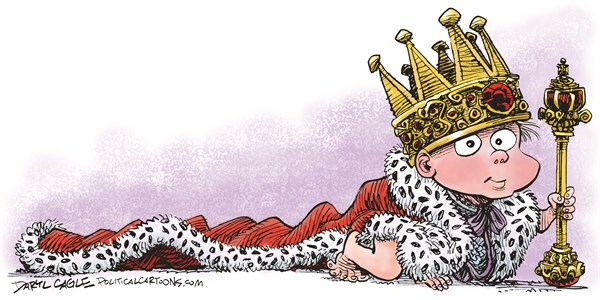
Summer time and lots of people have vacation on their minds. The royal baby certainly captured a lot of news cycles. The future king was born in England at 8 pounds. What's that, like $12.28 US dollars.
Here are some of the posts that caught my eye. Hope you find something interesting.
A San Francisco Fox affiliate, KTVU, is dealing with the fallout of a major error.
Their report on the deadly Asiana Airlines crash took a turn for the unintentionally offensive when they broadcast the names of pilots in charge of that flight. The mangled Asian-sounding names were, in fact, thinly-disguised expletives mocking the sentiments expressed by the crash victims and their families.
The supposed names of the crash victims broadcast on KTVU included "Sum Ting Wong," "Wi Tu Lo," "Ho Lee Fuk," and "Bang Ding Ow."
A KTVU anchor later apologized for the error. She said that the names were inaccurate in spite of the fact that a National Transpiration Safety Board spokesperson confirming them.
Here is a 'smart-ass' card one of my kids gave me.
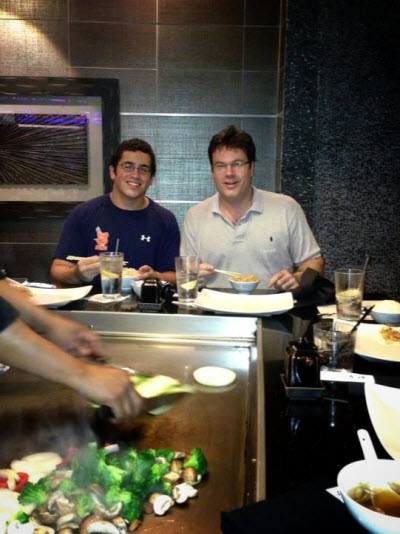
My son, Zach, and I ate a Hibachi restaurant.
As part of his Father's Day present, he didn't complain (much) about having vegetables on his plate or that different food items touched each other before getting to his stomach.
Hadfield is not only an astronaut, he is a social media star who invited the world to experience space differently by sharing the photos and videos he captured during his stay on the International Space Station.
With deference to the genius of David Bowie, here's Space Oddity, recorded on Station. A last glimpse of the World. youtube.com/watch?v=KaOC9d…
In the clip, Hadfield floats around the space station singing the 1969 track (with modified lyrics such as, “Ground control to Major Tom, lock your Soyuz hatch and put your helmet on,”) and playing an acoustic guitar while gazing at Earth from space.
or try this version (because the SNL link was down for a while).
The Google Glass Stare does not seem natural yet. Not sure how long it will take to get used to. For example, imagine having someone like this in a meeting dealing with sensitive data. A little creepy?