August 2026

  • Economic Superpowers … For Now

    Every once in a while, you come across a graphic that makes you stop scrolling.

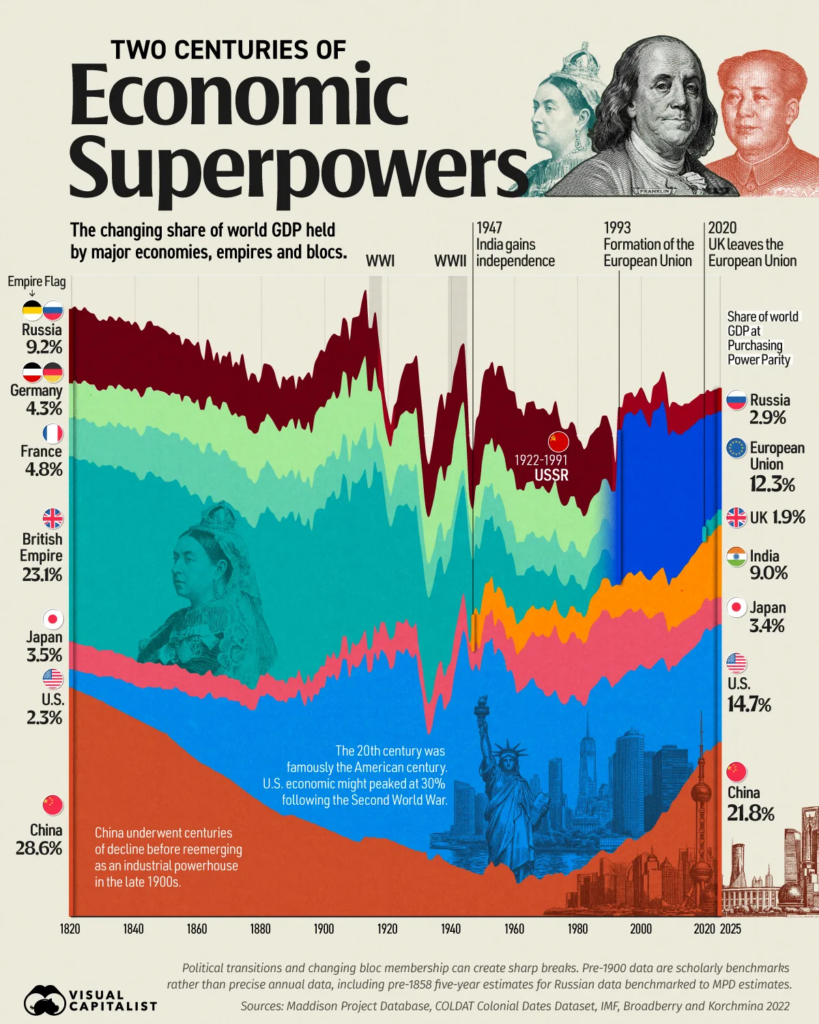
    This one from Visual Capitalist does that for me.

    It shows how the distribution of global economic power has changed over the past roughly 200 years. And while 200 years sounds like an incredibly long time, the graphic makes the shifts feel surprisingly fast.
    via visualcapitalist

    The first thing that jumps out is how different the world looks at different points along the timeline.

    In the early 1800s, China and India accounted for enormous shares of global economic output. Then the Industrial Revolution changed the picture. Britain rose. Europe expanded its share. The United States began its climb.

    And then, particularly in the decades following World War II, the U.S. became an extraordinary economic outlier.

    That dominance didn’t last forever, either.

    Japan emerged as an economic powerhouse in the second half of the 20th century. Europe consolidated some of its economic weight through the European Union. And, over the last few decades, China has experienced one of the most dramatic increases in its share of the economy.

    Look at the whole thing at once, and there’s something uncomfortable in it: There is no permanent winner.

    That’s easy to nod along with in the abstract. It’s harder if your portfolio, your career, and most of your working assumptions were formed during the one stretch of that chart where the U.S. was an outlier.

    The chart also comes with an important caveat regarding measurement. It uses purchasing power parity (PPP)- adjusted GDP, which is useful for comparing the real size of economies because it accounts for differences in price levels between countries. It isn’t the same as comparing market-value GDP, financial market capitalization, military power, or global influence. In other words, “economic power” is a useful shorthand here, not a single definitive measure.

    But that doesn’t make the chart less interesting. If anything, it makes it more interesting.

    Because we’re looking at how the economic center of gravity moves.

    It’s easy to look at a chart like this and focus on China. The rise is remarkable, and the time frame is remarkably short.

    But the level is the least useful thing on the chart. The useful question is what produced it — and whether those conditions still hold.

    It is also interesting to look for cycles and patterns within the larger ones (which is a fundamental part of algorithmic trading and fund management).

    Winning Is a State of Doing.

    The United States didn’t simply become the dominant economic power because it was destined to be so. Neither did Britain or Japan.

    Each one benefited from a particular combination of circumstances: technology, resources, demographics, institutions, geography, capital, trade, infrastructure, education, political decisions, and, sometimes, simply being in the right place at the right time.

    Britain had the Industrial Revolution.

    The United States had an enormous domestic market, abundant resources, expanding infrastructure, and technological innovation (which eventually enabled it to become an industrial and financial hub for the world).

    Japan’s postwar transformation turned it into a manufacturing and technology powerhouse.

    China’s rise has been built on an enormous labor force, industrialization, infrastructure investment, globalization, and decades of rapid productivity growth.

    The point isn’t that any one of these explanations is the explanation.

    It’s that economic leadership usually results from a system of reinforcing advantages.

    And systems can change.

    We tend to talk about countries, companies, and even industries as though their current position is an intrinsic characteristic.

    The chart is a good reminder that today’s structure is just a snapshot.

    The Snapshot is not the whole picture.

    An industry is growing, so we assume it will continue growing.

    An investment strategy has worked for the past decade, so we assume it will continue to do so.

    A country has dominated economically for generations, so we assume that dominance is simply part of the natural order.

    But those are all observations about a state.

    What really matters is the process that produced the state.

    That’s one of the reasons long-term charts can be so useful. They force us to stop looking at where something is and start asking how it got there.

    How Is The Game Changing?

    What conditions are being created today that might look obvious in hindsight 30 years from now?

    I’ll offer one. Every riser on that chart — Britain, the United States, Japan, China — converted the same basic inputs into output: labor, capital, and infrastructure, organized well enough and early enough to compound. The mix changed. The mechanism didn’t.

    That’s the assumption I’d watch out for. If AI genuinely decouples output from headcount, the engine that drew the last two hundred years of that chart stops being the engine. Population becomes less of an advantage. Installed compute, energy, and capital discipline become more of one.

    I don’t know if this will prove to be right … But it’s the kind of condition that’s invisible while it’s forming and obvious afterward — which is what every earlier transition on that chart looked like at the time.

    One data point in that direction: China’s share rose during a demographic dividend that has since reversed. The most recent line on the chart was drawn partly by a tailwind that is now a headwind.

    The world feels more permanent than it is. Every generation on that chart believed the arrangement they were born into was the natural order. Every one of them was looking at a snapshot.

    The uncomfortable part isn’t that positions change. It’s that they change slowly enough to ignore and fast enough to matter.

    So the question worth carrying isn’t who’s winning. It’s what you’re compounding — and whether the conditions that made it work are still the conditions you’re in.

    And when you get complacent, a lot can change!

    Hope that helps.

  • The Dead Internet Theory Isn’t the Story. The Audience Is.

    The Dead Internet Theory has been floating around the internet for years. In its simplest form, it claims that much of the internet isn’t really “people” anymore — that bots generate the content, interact with it, and influence what the remaining humans eventually see. The theory often goes further, suggesting coordinated efforts by governments or corporations to manufacture online consensus and shape public opinion.

    Whether or not you buy the conspiracy is almost beside the point.

    Like many enduring conspiracy theories, it gained traction because it gave people language for something they were already feeling. Social media started feeling repetitive. Comment sections became oddly homogeneous. Search results filled with articles that all seemed to say the same thing using slightly different words. You couldn’t always explain why, but it often felt like there was less humanity on the internet than there used to be, and it was more than just echo chambers.

    Recently, that conversation took an interesting turn. Fortune reported on Cloudflare data suggesting that automated agents now account for a majority of web traffic, driven by AI crawlers, assistants, and autonomous software rather than traditional search engines or human visitors (growing nearly 8000%). The web is increasingly being read, indexed, summarized, and interpreted by machines—not just people.

    Who’s Your Audience?

    The original theory may have gotten the “why” wrong.

    But it may have noticed the “what” before the rest of us did.

    The more interesting question isn’t whether the internet is dead; it’s who we’re talking to now.

    For most of the web’s history, publishing meant writing for another person. You wanted someone to read your article, visit your website, buy your product, or share your idea.

    Today, one of your readers is almost certainly an AI.

    Maybe it’s an assistant summarizing your article for someone who never visits your website. Maybe it’s a research agent deciding whether your work is worth citing. Maybe it’s an AI crawler building tomorrow’s foundation model. Increasingly, your content’s first audience isn’t a person at all.

    Part of the reason we’re even writing this article is that we’ve started adapting our writing.

    We’ve started writing with AI in mind.

    Not because we’re trying to “game” AI, but because AI has become part of the communication process. We think about whether an AI can correctly summarize an article. Whether the structure makes our argument easier to retrieve. Whether the key ideas are stated clearly enough that an AI won’t miss the point when someone asks about them six months from now.

    Every major communication technology has quietly changed how people communicate:

    • The printing press rewarded writers who could organize ideas across pages rather than in speeches.
    • Radio rewarded people who sounded conversational.
    • Television rewarded visual storytelling.
    • The web rewarded prioritizing hyperlinks.
    • Search engines rewarded discoverability.
    • Social media rewarded engagement.
    • Now AI rewards comprehension.

    When we first started this blog, our focus was primarily on introducing ideas in broad strokes and prompting readers to make connections and ask themselves questions they might not have asked before. Today, there’s a bit more scaffolding and a clearer takeaway. On the one hand, it’s a departure; on the other … wouldn’t you argue it makes articles more helpful for the average reader as well?

    Inversely, does optimizing content for AI legibility risk creating a new, more sophisticated version of the very “slop” problem it critiques — content perfectly structured for machine comprehension but hollow for human readers?

    Twenty years ago, businesses learned to write for search engines.

    Ten years ago, they learned to write for social media.

    Today, we’re learning to write so machines can accurately understand what we’re trying to say.

    While it feels different, it’s not really.

    Once you start looking at it that way, a lot of other trends suddenly make more sense.

    Slop-py Writing

    The explosion of AI-generated “slop” isn’t primarily a technology problem.

    It’s an incentive problem.

    Whenever the cost of producing something approaches zero, we get more of it.

    We didn’t invent spam because e-mail existed. We invented spam because sending one million e-mails cost almost nothing. The same is true for clickbait on the internet.

    AI didn’t invent mediocre content. It simply made mediocre content incredibly cheap.

    Markets generally don’t optimize for quality.

    They optimize for incentives, and the incentives have changed.

    Recursive & Fractal

    There’s another thought that’s been bothering us.

    AI learns from the internet.

    People increasingly use AI to produce content for the internet.

    Future AI systems will almost certainly learn from some of that AI-assisted content.

    The system is becoming recursive.

    Financial markets have always worked this way. Prices influence behavior, which influences prices. Recommendations influence demand, which influences future recommendations.

    Information is beginning to work the same way.

    The internet is no longer just where humans exchange ideas.

    It’s becoming an ecosystem where humans teach machines, machines organize information for humans, and machines increasingly teach other machines.

    Ironically, as content becomes abundant, something else becomes scarce.

    We’re rapidly approaching a world where almost any article, image, video, or podcast can be generated on demand.

    The scarce resource is intentionality. Experience. Judgment. Credibility.

    Those things don’t scale particularly well.

    And that’s exactly why they’ll become more valuable.

    There’s Still A Pulse …

    Perhaps that’s the real lesson hiding underneath the Dead Internet Theory.

    The internet isn’t dying, but it is evolving.

    The audience, participants, and economics are changing.

    The internet is no longer a discrete and relatively small ecosystem of websites built by uber-nerds. It’s now an ever-expanding universe filled with everything you could imagine and more.

    Yes, more bots are trying to influence you, trying to game you, and creating a lot of noise. But they haven’t replaced the people who post quality content or build cool things.

    The challenge isn’t figuring out whether the internet is dead.

    It’s learning how to create and find signal in a world that’s becoming increasingly good at generating noise.

  • Danger: Deepfakes & Data Breaches … The Future of Fraud

    Fraud isn’t new. But it is evolving.

    In May, we talked about social engineering and how far it had come. That’s only the tip of the iceberg.

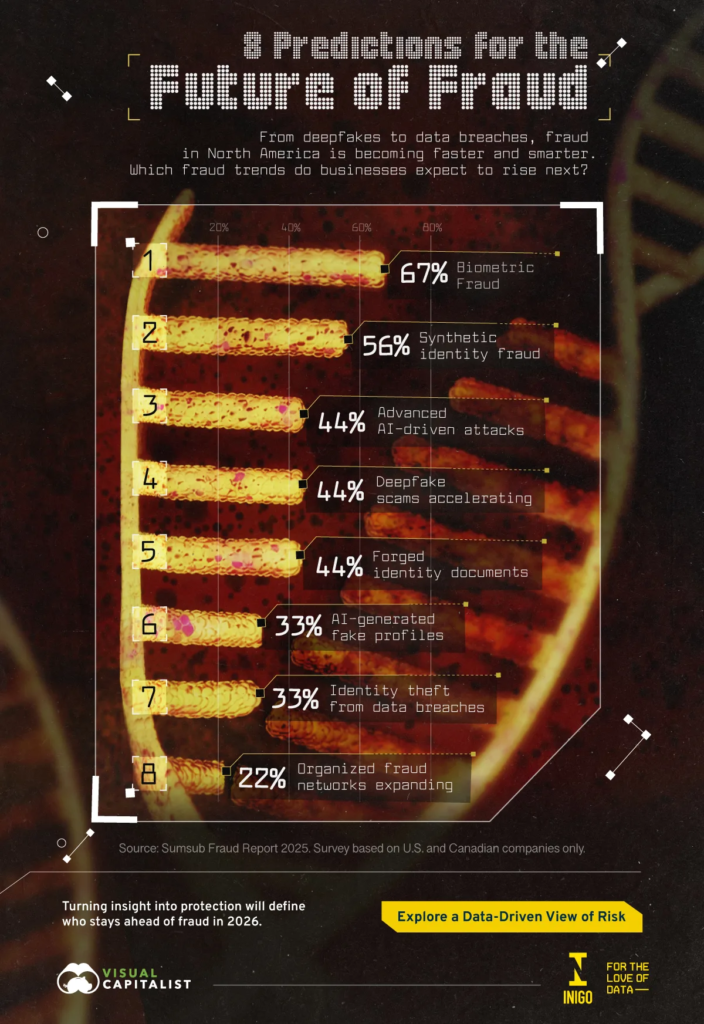
    Visual Capitalist put together a chart on the fraud trends businesses expect to shape the future of digital risk.

    You may think this isn’t important to you, but the costs of even one incident can be world-changing, especially to a small business.

    via Visual Capitalist

    Where The Risk Is Growing Fastest

    While many of these are associated with social engineering, it’s worth delving deeper into specific mechanisms and the risks they pose.

    • Biometric Fraud – The surveyed businesses anticipate the largest increase in biometric fraud, with 67% forecasting a rise. As organizations increasingly depend on facial recognition, voice authentication, and remote onboarding, bad actors are continuously discovering new methods to exploit these systems.
    • Synthetic Fraud – 56% of surveyed businesses expect a rise in this category. Synthetic identity fraud occurs when criminals combine real data, such as a stolen Social Security number, with fake details, such as a made-up name or address, to create a brand-new, non-existent persona. Fraudsters use this fake profile to open bank accounts, apply for credit cards, and build up a fake credit history before maxing out loans and disappearing.
    • AI-Driven Attacks and AI-Generated Fake Profiles – 33% of surveyed businesses expect a rise in AI-generated fake profiles, as fraudsters use generative tools to impersonate real users online. The mechanism: bad actors train AI on scraped photos, videos, and voice clips — pulled from social media, webinars, even a company’s own marketing content — to clone a real person’s face or voice convincingly enough to pass remote verification or authorize a transaction, or to fabricate an entirely synthetic persona from scratch.


    It’s no longer enough for most businesses to be reactive; real-time risk monitoring and active protection are necessary.

    From Reactive To Proactive

    Even as technology improves, the basics stay the same: data breaches and criminal networks are permanent fixtures of this ecosystem — they have to be accounted for, and they’ll keep posing major threats

    The first move isn’t a new tool — it’s an assumption change. Treat every biometric check, every new account, and every unsolicited video or voice call as unverified until proven otherwise. The businesses that build that assumption into their processes now will spend far less time (and money) cleaning up after the ones that don’t.

    Are you prepared? If not, what’s the first step you’ll take to safeguard your business and assets?