The pace of change is quickening.
I’m old enough to remember when:
- trading portfolios were rebalanced yearly.
- quarterly adjustments were controversial.
- having market data FedExed weekly felt like a big edge.
- switching from end-of-day trading data to intra-day data became necessary.
Read that list again, and you’ll notice it isn’t really about trading.
It’s about the interval — the time between knowing something and being able to act on it. Every step on that list shortened it. And every time it was shortened, the people who could operate at the new speed had an advantage over those who couldn’t, until everyone else caught up and the interval shortened again.
That’s the shape. It’s the same shape every industrial revolution has had. Look back, not for nostalgia, but to measure the collapse in the interval between decision and response.
The ability to ingest, analyze, interpret, adjust, recalibrate, and respond is creating a set of possibilities that were inconceivable even a short time ago … and it seems like it is happening everywhere all at once.
Almost every week we talk about some crazy new inflection point in Artificial Intelligence. But I have been the CEO of companies using AI since the early ’90s, so I have a bit of perspective here. It’s not just that change is happening faster. It’s that big changes, even discontinuous changes, are creating transformations at an unprecedented rate. It’s the part about exponential technologies that people get without truly getting … Even the transformations are becoming exponential.
We’re now deep in the 4th Industrial Revolution, in part because of better, more connected chips (semiconductors) and, of course, the massive leaps in generative AI.
A Look at Industrial Revolutions
The Industrial Revolution has two phases: one material, the other social; one concerning the making of things, the other concerning the making of men. — Charles A. Beard
Several turning points in our history changed the world forever. Former paradigms and realities became relics of a bygone era.
- First Industrial Revolution — Discovery of the steam engine and creation of factories. Work stopped following the seasons and started following a clock. The advantage went to whoever could finance a mill, and it held for the better part of a century.
- Second Industrial Revolution — Introduction of the assembly line and mass production. The unit of production went from a day’s work to a minute’s. The advantage went to whoever could organize at scale, and it held for decades.
- Third Industrial Revolution — The World Wide Web and computers connect the world, enabling the digital age. Information that took a week to move started moving instantly. The advantage went to whoever could aggregate attention — and much of it is still held.
Notice the pattern. Each one collapsed an interval. Each one handed a durable advantage to whoever adapted first. And each window of advantage was shorter than the one before it.
Since most of us remember the Third Revolution, let’s spend some time on that.
Here’s a map of the entire “internet” in 1973.
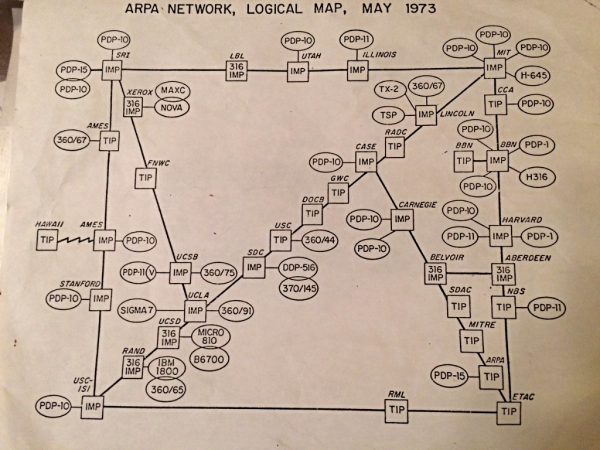
Reddit via @WorkerGnome.
Most of us didn’t use the internet at that point, but you probably remember Web1 (static HTML pages, a 5-minute download to view a 3 MB picture, and, of course, waiting for a website to load over a dial-up connection before you could read it). It was still amazing!
Then, Web 2.0 arrived, and with it everything we now associate with the internet.
But look at what actually happened to the interval. Web1 was slow and open — anyone could publish, but almost no one could reach anyone else. Web 2.0 made reach instant, and then a handful of companies captured what had just become instant. The capability got distributed. The control didn’t.
That’s worth sitting with, because it’s the part of the pattern people forget. A revolution doesn’t hand the new capability to everyone at once. It hands it to whoever is positioned to capture it, and then the rest of us spend a decade or two negotiating it back.
Where We Are and Where We Are Going
With AI agents, increasingly powerful chips, robotics, and the continued evolution of the internet, we’re in the middle of another major inflection point. The technology isn’t simply getting better; it’s beginning to change how work gets done. The game is changing, as are the rules, the players, and what it means to win.
I’ll add a caveat because I’ve been here before.
I’ve sat through more than one technology that was going to change everything and mostly didn’t — or did, but fifteen years later than the people selling it promised. Being early and being wrong feel identical while you’re in it. So I hold the timeline loosely even when I’m confident about the direction.
At moments like this, it’s easy to see fear, resistance, and a desire to preserve the way things have always been. Yet, time marches on. Much of the disruption that accompanies technological transitions isn’t caused by the technology itself but by our hesitation to adapt to it. The wave doesn’t stop because we’re not ready for it. We simply have to decide whether we’re going to ride it or get swept up in it.
Here’s what thirty years of this has actually taught me. The key to technology adoption is still people.
Every revolution so far has collapsed the interval between deciding and doing. Steam, the assembly line, and the network each made execution faster, cheaper, or more readily available. But a person still had to decide, and then direct.
This one is different in a specific way, and it took me a while to see it.
I’m noticing that people are starting to consider technology a “Who” rather than simply a “How” — increasingly, and even with higher-stakes decisions. That’s a bigger shift than it sounds like. You stop specifying how something gets done and start deciding who to hand it to.
And as human nature becomes less of a bottleneck, I expect a Cambrian explosion of capabilities to spread faster, and on a scope and scale most people will find hard to imagine, let alone predict.
So many of the systems we build are about control and trust. That changes when we believe a system like AI offers control that’s safer and more trustworthy than our own. Human nature is to exploit capabilities and underestimate costs.
The usual reassurance here is that human judgment still matters. I think that’s true, and I think it’s stated too softly.
When execution was expensive, judgment was rationed — you thought hard about a decision because acting on it cost you something. When execution approaches free, the constraint moves entirely to knowing which decisions are worth making. The interval collapses on the doing, and all the weight lands on the deciding.
That’s not a consolation prize for humans. It’s a harder job than the one we had. What we’re good at was never calculating faster than machines — it’s imagining possibilities that don’t exist yet, changing our minds, and deciding what’s worth pursuing in the first place.
So what do you do with a pattern like this?
Every previous revolution rewarded the people who moved before the interval finished collapsing — not the ones who predicted it correctly, and not the ones who waited until it was safe. The window between “this is interesting” and “this is table stakes” has been getting shorter every time, and there’s no reason to think this is the round where it stops.
Which is why I keep coming back to something Musk said:
“Stop being patient and start asking yourself, ‘How do I accomplish my 10-year plan in 6 months?’ You will probably fail, but you will be a lot further ahead than the person who simply accepted it was going to take 10 years.”
That sounds like a line about ambition. I read it as a line about intervals.
I started this by listing how long it used to take me to rebalance a portfolio. Yearly. Then quarterly. Then daily. Then continuously. At every step, the constraint wasn’t the technology — it was how long I was willing to wait before I stopped accepting the old cadence as normal.
That’s the entrepreneur’s real capability. Not predicting the shape. Refusing to move at the old speed while it’s still changing.
Onwards!