Today is Easter – and also part of Passover, the Jewish holiday that recounts the story of Exodus.
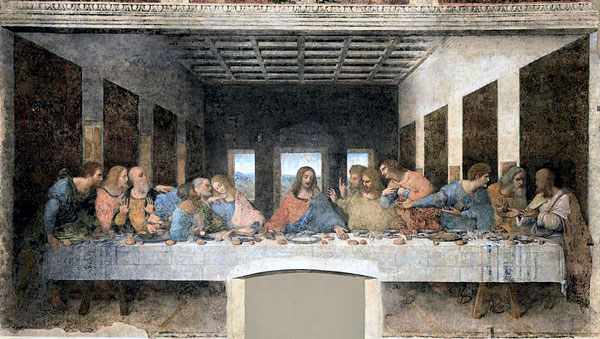
The overlap is evident in Da Vinci’s Last Supper, which depicts a Passover Seder (the traditional meal that commemorates the Exodus) and Jesus’s last meal before his crucifixion.
Part of the Passover Seder tradition involves discussing how to share the story in ways that resonate with different people, recognizing that everyone understands and relates to things differently. This echoes our previous discussion on happiness and how that feeling varies for each of us.
To do this, we examine the Passover story through the lens of four archetypal children — the Wise Child, the Wicked Child, the Simple Child, and the Child Who Does Not Know How to Ask.
The four children reflect different learning styles — intellectual (Wise), skeptical (Wicked), curious (Simple), and passive (Silent) — and highlight the need to adapt communication to the diverse personalities and developmental stages of our audience.
This seems even more relevant today, as we struggle to come to a consensus on what to believe and how to communicate with people (ormachines) who think differently.
On a lighter note, one of the memorable phrases from Exodus is Moses’ “Let my people go!” For generations, people assumed he was talking to the Pharoah about his people’s freedom. But after a week of eating clogging food like matzoh, matzoh balls, and even fried matzoh … for many Jews, “Let my people go” takes on a different meaning.
After Passover, and as we enter a new season, it’s a great time for a mental and physical ‘Spring Cleaning,’ and delve into your experiences to cultivate more of what you desire and less of what you don’t.
Here is to Spring, Re-Birth, and Spring Cleaning.
As a reminder, it doesn’t take a new year to start good habits.
I am often amazed at how little human nature has changed throughout recorded history.
Despite the exponential progress we’ve made in health, wealth, society, tools, and understanding … we still struggle to find meaning, purpose, and happiness in our lives and our existence.
We underestimate others’ kindness, but it’s more common than we think.
Community boosts happiness—eating and living with others matter. Social media is a poor replacement and can actually be hurting your sense of community.
Despair is falling globally, except in isolated, low-trust places like the U.S.
Hope remains—trust and happiness can rebound with connection and a sense of purpose.
That post didn’t attempt to define happiness. Instead, it categorized data on people’s reported feelings about happiness. This post will focus philosophically on the definition of happiness.
While it seems like a simple concept, happiness is complex. We know many things that contribute to and detract from it; we know humans strive for it, but it is still surprisingly challenging to give it a uniform definition.
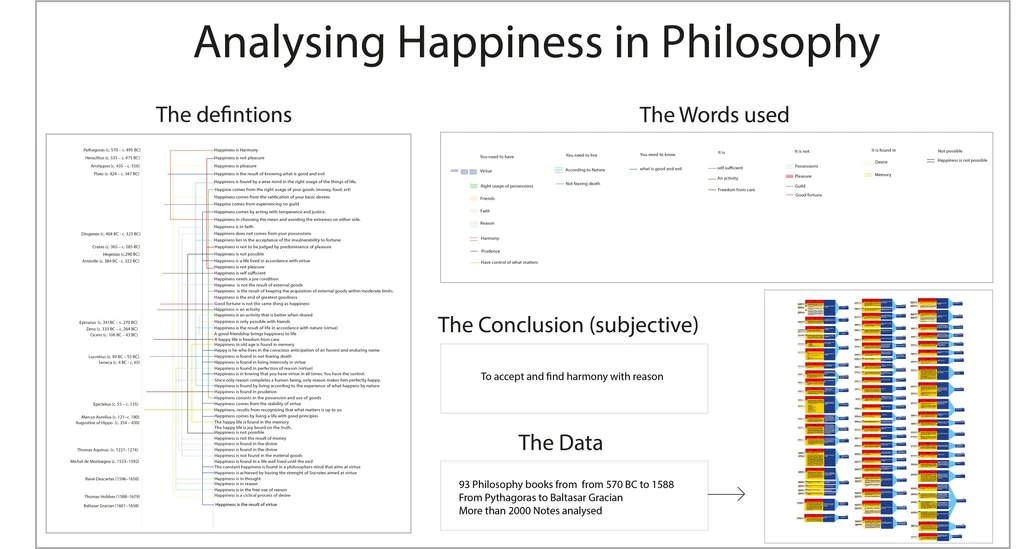
A few years ago, a hobbyist philosopher analyzed 93 philosophy books, spanning from 570 BC to 1588, in an attempt to find a universal definition of Happiness. Here are those findings.
It starts with a simple list of definitions from various philosophers. It does a meta-analysis to create some meaningful categories of definition. Then it presents the admittedly subjective conclusion that:
Happiness is to accept and find harmony with reason.
My son, Zach, pointed out that while “happiness” is a conscious choice, paradoxically, the “pursuit of happiness” often backfires. Why? Because happiness is a result of acceptance. However, when happiness is the goal, people often focus on what they lack … rather than what they already have or the progress they’ve made. That perspective shift drops them into the ‘Gap’ instead of letting the ‘Gain’ lift them.
Across centuries, philosophers have wrestled with a deceptively simple question: What does it mean to live a good life?
As entrepreneurs, investors, and leaders, we often chase performance, innovation, or edge — but underneath it all, there’s a quieter inquiry: Am I living well?
Happiness aside, across 93 influential philosophical texts spanning two millennia, one word consistently reappears: Eudaimonia. This is not happiness in the modern sense of pleasure, but a richer concept of human flourishing — a life filled with purpose, virtue, and meaning.
Ancient thinkers didn’t view happiness as just a passing feeling but as something deeper — a life lived in line with purpose and virtue. Some focused on developing strong inner character, while others believed it came from living in harmony with nature or a higher power. There has always been debate about how much external factors like wealth, luck, or relationships genuinely matter, and that question still isn’t fully settled. By the time the Renaissance arrived, the discussion began to shift more toward personal, subjective experience. But across all these perspectives and eras, one idea keeps recurring: happiness is something you nurture over time, not just something you consume.
Contradictions and Tensions
Thoughts on happiness contain paradoxes, contradictions, and tensions. Examining the boundaries between what you are certain of and what you are uncertain of is where insights occur.
Here are a few to get you started.
Virtue vs. External Goods: Aristotle acknowledges external goods (wealth, friends) as necessary for complete happiness, while Stoics claim virtue alone suffices. This tension challenges the simplicity of virtue-based happiness, suggesting a nuanced balance between inner character and outer circumstances.
Subjective vs. Objective Happiness: Ancient philosophers often defined Happiness as an objective state (living virtuously or intellectually flourishing), whereas modern definitions more often emphasize subjective satisfaction that varies from individual to individual. This tension probes whether happiness is a universal or personal experience.
Happiness as Pleasure vs. Happiness as Duty/Struggle: Epicureanism equates happiness with pleasure (the absence of pain), whereas Cynics and Stoics emphasize enduring hardship and discipline as the path to happiness, creating a paradox between comfort and resilience.
Three Metaphors To Help You Think About Happiness
As we’ve seen, trying to answer the question “what is happiness?” quickly leads to a mix of data, perspectives, and even contradictions — between internal and external factors, momentary feelings and lifelong fulfillment, control and circumstance.
To help make sense of that complexity, metaphors offer a useful kind of structure.
Think of the Stoic ship captain: you can’t control the ocean, but you can steer your ship, anchoring the idea that happiness is tied to how we manage our internal world amid external uncertainty. Or, Plato’s vision of the soul as a teamadds another layer: reason guides spirit and appetite, suggesting that happiness depends on internal alignment and self-governance. And Aristotle’s gardenreminds us that happiness isn’t a single outcome, but something cultivated over time, shaped by effort, environment, and care. Together, these frameworks don’t resolve every tension, but they give us a clearer way to navigate them … turning an abstract question into something we can actually work with.
Happiness Isn’t a Destination — It’s a Design
The philosophers didn’t agree on everything, but they aligned on one thing: happiness isn’t something you find. It’s something you build.
Perhaps happiness is less about chasing peaks and more about tending the kind of life you won’t regret.
I’m curious how this lands for you — especially if you’re building something big.
Reach out and let me know what happiness looks like from your vantage point.