March 2026

  • If We’re Not Alone In The Universe … Where Are The Aliens?!

    A lot is going on in our world, and some of that may not even be from our world.

    As an investor, I look at where capital and talent cluster. The renewed focus on space-tech, unidentified anomalous phenomena, and the potential of non-human intelligence isn’t just sci‑fi — it’s a signal (mixed with plenty of noise and misinterpretation).

    In this post, I’ll connect today’s disclosure headlines, the math behind extraterrestrial life, and what the Fermi Paradox suggests about our own future.

    Why Aliens Are Back in the News

    Trump has publicly ordered federal agencies to begin declassifying and releasing UFO/UAP and “alien”–related government files. He framed it partly as a response to Barack Obama’s recent podcast comments that “aliens are real”. When presidents from Trump to Obama nod at aliens, it signals that the topic has moved beyond late‑night jokes and into serious discourse.

    The disclosure process is just starting and will likely be slow, partial, and heavily filtered, at least at first.

    Experts note that many UFO/UAP files are classified less because of “aliens” and more because they contain sensitive data about sensors, intelligence methods, or military capabilities. Those portions will likely remain redacted.

    Said differently, many of the anomalous behaviors seen in videos are likely the result of military technologies from us or other nations.

    As a potentially related aside, retired U.S. Air Force Major General Neil McCasland recently went missing. His disappearance is drawing attention because of his past roles in highly classified space and UFO-related programs. Authorities have not publicly tied the case to any confirmed national security breach or conspiracy.

    As I look at markets and opportunities, I tend to focus on where energy, attention, and resources flow. So, even accounting for sensationalism and misinformation, it seems to me that this is an area worth paying attention to … even if just to figure out whether there’s something to pay attention to.

    So let’s dive into the crazy, at least a little bit.

    Capital Is Voting on Space

    I tend to read a wide variety of sources on an even wider variety of topics. Recently, I’ve noticed a significant uptick in stories about aliens, UFOs, non-human intelligence, and non-human technology. This has gone from fringe obsession, to cable‑news segment, and now to a Congressional hearing topic.

    In addition, several of my seemingly sane and highly credible friends claim to have direct knowledge that billionaires and hedge funds are quietly funding space tech and non-human intelligence bets because that’s where asymmetric advantage lives.

    Smart money is behaving as if the upside of being early to this frontier dwarfs the embarrassment risk of being wrong.

    While I believe it’s naive to assume that there’s no other form of life in a universe as vast as what we understand … I’m also highly skeptical of anyone who claims that they have specific knowledge or proof.

    With that said, I have seen enough stuff from people I trust to expect that our beliefs about these issues will shift massively in the very near future. As an example, check out Skywatch.aisome of its videos, or this NewsNation broadcast.

    Are We Alone? Turning Speculation Into Math

    Meanwhile, Information Is Beautiful has an interactive data visualization to help you decide if we’re alone in the Universe. 

    As usual, it’s well done, fun, and informative. 

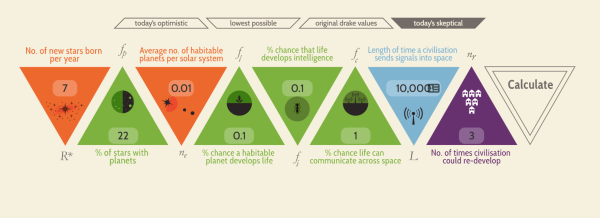
    For the slightly geeky among us, the model lets you adjust the estimate by playing with the Drake and Seager equations, which turn bar‑napkin speculation into math, estimating how many civilizations or life‑bearing worlds might actually exist.

    The Drake equation estimates the number of detectable extraterrestrial civilizations in our galaxy and the Universe. It factors in variables such as the number of habitable planets, the likelihood of life and intelligent life, and the duration over which a civilization sends signals into space. 

    The Seager equation is a modern take on the equation, focusing on bio-signatures of life that we can currently detect – for example, the number of observable stars/planets, the % have life, and the % chance of detectable bio-signature gas. 

    Even if you assume life is incredibly rare, the incredibly big numbers of planets mean ‘rare’ still translates to ‘many’. Click here to play with the Are We Alone in the Universe infographic

    via Information Is Beautiful

    For both equations, the infographic lets you view various default options and also enables you to change the variables based on your beliefs. 

    For example, the skeptic’s default answer for Drake’s equation shows 0.0000062 communicating civilizations in our galaxy, which is still 924,000 in the Universe. The equivalent for Seager’s equation shows 0.0009000 planets with detectable life in our “galactic neighborhood” and 135,000,000 planets in our Universe. 

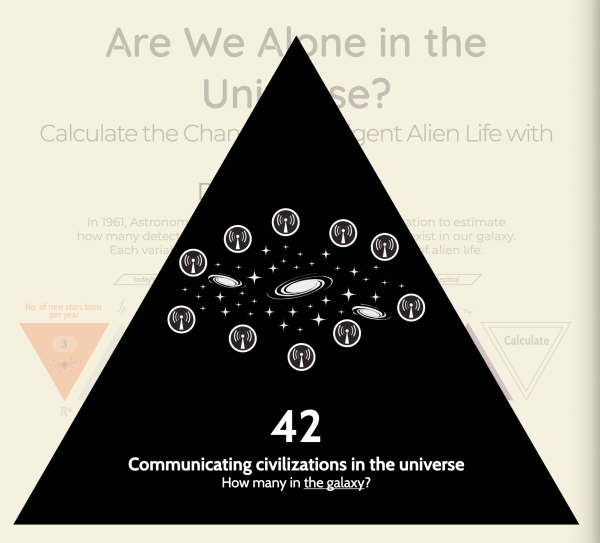
    Even with the “lowest possible” selection chosen, Drake’s equation still shows 42 communicating civilizations (Douglas Adams, anyone?) in the Universe.
    Screen Shot 2020-12-13 at 2.54.27 PM

    via Information Is Beautiful

    Even if the probability is tiny on any single planet, at scale it becomes almost inevitable — which is how many breakthrough bets work in markets as well.

    One of the most interesting numbers (and potentially influential numbers for me) is the length of time a civilization sends signals into space. Conservative estimates are 420 years, but optimistic estimates are 10,000 or more. 

    One other thing to consider is that some scientists believe that life is most likely to grow on planets with very high gravity, which would also make escaping their atmosphere for space travel nigh impossible.

    So, Where Are They?

    The Universe is loud on paper, but quiet in practice.

    So, if the math says it’s likely that there are aliens … why don’t we see them?

    In 2020, I linked to an NBC News article claiming that a former Israeli space security chief says extraterrestrials exist, and Trump knows about it.

    There are many stories (or theories) about how we have encountered aliens before and just kept them secret. Here are some links to things you might find interesting if you want to learn more about this.

    So, while some may still believe aliens don’t exist – I think it’s a more helpful thought experiment to wonder why we haven’t seen them. This matters not just to astronomers and conspiracy theorists, but to anyone thinking about risk, technology, and the fate of complex civilizations.

    For example, the Fermi Paradox addresses the apparent contradiction between the lack of evidence for extraterrestrial civilizations and the high-probability estimates of their existence. 

    When considering the key factors for a spacefaring civilization capable of communication, we think about habitability, life, technological progress, and social interaction. However, it’s possible that most civilizations die of self‑inflicted wounds (war, engineered plagues, or environmental collapse) long before they can shout across the galaxy. 

    If that is true, perhaps the real question isn’t ‘Are we alone?’ but ‘Can we master our own trajectory before we join the list of civilizations that disappeared in silence?

    Not to mention, even forgoing the numerous roadblocks to intelligent and communicative life, it’s entirely possible that other planets that surpassed these roadblocks existed a long, long time ago, in a galaxy far away …
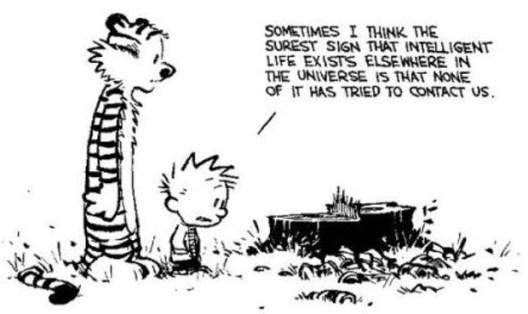
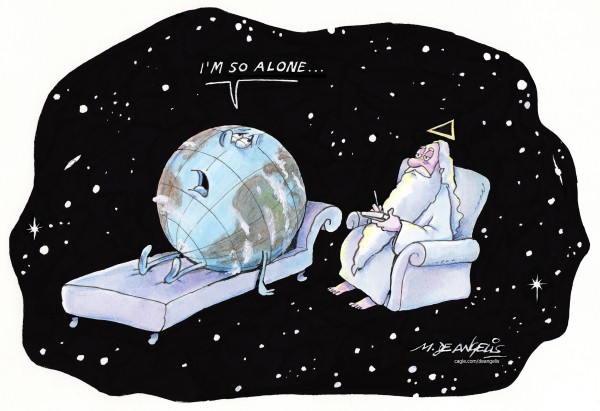
    If any aliens are reading this … don’t worry, I won’t tell. But we will find out who you voted for in the last election.

    What do you think?
  • Turning Friends Into Frenemies: A Powerful Prompting Framework

    If you’re reading this, you’re probably using AI more than you used to — but how has your use actually evolved?

    The more I use AI, the more I worry it agrees with me too much … or worse, that I agree with it too quickly.

    For me, as AI becomes more powerful, I’m using it in more places more often. It’s becoming a step in almost every process I do.

    At the beginning, my use was very simple. I would highlight a sentence and say, “Improve this.” I was often surprised by an LLM’s ability to take a jumble of words and distill something shorter and more meaningful. I’m sure many started to feel like they could put voice to their thoughts.

    Then, I was impressed by AI’s ability to turn long articles or collections of sources into tight summaries that made clear why they mattered and what to do next.

    Over time, I learned to use AI to help me do things I already did, to the point where it enhanced my ability to do it … or freed me up to do a little bit more.

    Now, if I’m doing something repeatedly and not using AI or automation, I assume that’s a problem.

    Not everyone feels that way.

    For example, this weekly commentary is still primarily written by humans (my son, Zach, and me). As AI becomes a larger part of the production process, Zach becomes increasingly dubious of how I use AI. He worries that AI-In-the-Loop processes impact our writing in ways that we quickly become desensitized to or stop noticing altogether(for example, logical patterns, word choices, common idiosyncrasies, or misplaced confidence).

    Too Much of Anything Isn’t Good — Even Agreement

    As amazing as AI tools are, it’s well-documented that they can be sycophantic, hallucinate & fabricate, and be surprisingly rigid in their process … if  you don’t have a good enough process in place to manage things like that.

    Meanwhile, prompt researchers found that making AI agents ruder resulted in better performance on complex reasoning tasks.

    So I wanted an AI that communicates with me like a sharp board member — not a flattering intern. That’s where prompts like the Frenemy Prompt come in.

    I saw this on Tech Radar. Here is the basic idea.

    Respond with direct, critical analysis. Prioritize clarity over kindness. Do not compliment me or soften the tone of your answer. Identify my logical blindspots and point out the flaws in my assumptions. Fact-check my claims. Refute my conclusions where you can.

    The Frenemy Fact-Check

    This prompt turns an AI into a hostile‑but‑useful executive reviewer that turns text into decision‑grade clarity by separating what’s said, what’s assumed, what’s missing, and what actually matters.

    It’s designed to:

    • Take a piece of text (an article, memo, thread, transcript)
    • Refuse to trust it
    • Separate what is actually said from what is assumed
    • Stress‑test it like a skeptical board member, and
    • End with a clear decision posture and a best next step

    A Fluff-Busting Example:

    If you’ve been a reader for a while, then you know I share a lot of links to a wide range of materials. What you see is the filtered list after I’ve read it, tagged it, ranked it, and decided what to share … but what I see is much broader. Some of it is AI slop, conspiracy theory madness, or aspirational thinking masquerading as strategic thinking. I wanted something that helped me sort, sift, and filter what comes across my screen. For example, this week I clicked on this article claiming that new experiments confirm the existence of parallel universes. If I simply asked AI to summarize the article, it would. But this prompt gives me something different. Its response started this way:

    Executive Brief:

    Posture: Probe — The piece argues that multiple experimental and theoretical threads make the many‑worlds / multiverse idea increasingly plausible; it’s an interpretive synthesis, not a proof.

    Biggest risk: Conflating interpretation and empirical demonstration — many claims are inference/speculation built on experimental results.

    Next action: Identify the article’s specific factual claims and separate which are quote-backed, which are inference, and which require verification.

    That prompt then goes on to identify all the different claims to verify, fluff to bust, and even makes it easy for me to expand the research or reconcile the language. Here is the output of the first step if you are curious.

    The point of this article isn’t to share a polished prompt. My production version is long, messy, and customized to my workflow and input sources. However, if you’re interested, here is a basic Frenemy Fact-Check Framework prompt that you can customize.

    I’m sharing the idea as a seed — useful on its own, but far more powerful once you make it simple, repeatable, consistent, and scalable.

    For context, my current version, 7.0, is over twice as long, has portions that a human won’t understand, and understands me and my needs much better than this seed.

    And it was AI that helped me iterate on the prompt until it reached that point.

    Creating a Production-Grade Process

    The way you do that is by analyzing what you’re doing, both in terms of what the audience sees (front stage) and what is required to reliably produce the front-stage experience (backstage).

    Most prompts focus on the front stage and don’t handle the backstage well enough to be reliable in production.

    Front Stage vs. Back Stage

    Front stage, it looks like: “AI reads something and gives a sharp executive review.”

    Backstage, it’s doing something much more important: It’s not focused on “smartness” or “creativity”… it is manufacturing reliability.

    Think of it like a restaurant:

    • The dining room is what customers see (front stage).
    • The kitchen is why the same dish comes out the same way every night (backstage).

    A professional-grade Frenemy prompt must include the kitchen spec for decision-grade analysis.

    Here are some high-level concepts to consider in a prompt like this.

    First Principles of the Prompt

    At its heart, the system enforces three laws:

    Law 1: Words ≠ Truth

    If it’s not quoted, it’s not solid.

    Anything not directly supported by text must be labeled:

    • Inference (reasonable but not stated)
    • Speculation (guessing)

    Law 2: Structure Beats Intelligence

    There is a difference between could be strengthened by briefly contrasting “clever but inconsistent” vs. “structured and reliable.” My production prompt doesn’t rely on the model being ‘smart.’ It relies on the structure we wrap around it.

    It relies on:

    • Rigid section definitions
    • Mandatory labels
    • Forced ordering
    • Hard cap limits

    This is why it’s long. But, it’s not verbosity — it’s scaffolding.

    Law 3: Decisions Are the Point

    Every run ends with:

    • A posture (Proceed / Pause / Probe / Pivot)
    • A biggest risk
    • A next action
    • A control panel that helps the user choose what happens next

    As AI makes analysis easier to generate, it becomes even more important not to automate “analysis for analysis’s sake.” This prompt framework was designed to encourage right actions.

    The longer the content and project you give AI, the more likely it is to break protocol and make mistakes. A production-grade prompt like this constrains the AI so it can’t “help” in the wrong way, and blocks hallucinations or fake precision by default. It turns raw text into structured evidence, labels ambiguity clearly, and keeps outputs consistent and stable—even under pressure or long inputs. Most importantly, it keeps humans in control through a clear command interface, which is why it’s far more reliable than the average prompt.

    I’d love to hear about ways you’re using AI to improve the quality of your output, enhance your performance, or expand what you believe is possible.

  • What Do Abraham Lincoln and Family Finance Have in Common? My Cousins.

    A few years ago, I brought my cousin, Matt Pinsker, an expert in Civil War history and Abraham Lincoln, to speak to an exclusive mastermind. He did an outstanding job of relating Lincoln’s letters and history to the entrepreneurial mindset. As a result, he also did a podcast with me, Dan Sullivan, and Steven Krein on the ultimate entrepreneurial president. Steven Krein is also my cousin, so it was a family affair. 

    Recently, he released a book called Boss Lincoln, exploring Lincoln’s expertise in party politics and his skillful navigation of treacherous partisan crosscurrents, helping build the Republican Party into a viable force.

    Not to mention, undertaking such actions with emancipation and the war’s outcome at stake, while facing severe criticism from all directions.

    Although Lincoln is one of the most celebrated Presidents in history, he faced immense challenges during his time. In private, he was clever and persistent, able to use skillful manipulation, straightforward intimidation, or thoughtful debate as required to accomplish his goals.

    Lessons from his presidency are still incredibly relevant today (if not more so).

    But he’s not the only cousin who has recently released a book.

    Photos of my Cousins Matt and Beth, with their books and a brief description of the books

    Don’t Wait. Plan Ahead.

    Beth is a financial-planning columnist at MarketWatch and has been a Certified Financial Planner™ since 2018. She won a SABEW Best in Business award in 2023 for commentary for a series of columns about caring for her mother, which she turned into the premise for this book.

    It includes some incredible anecdotes about their parents, as well as personal stories from many children and spouses of aging parents. More importantly, it’s a powerful handbook for everything you need to know about the complex world of end-of-life financial planning.

    Even though I grew up with them, I still learned things about the family I didn’t already know.

    Check Them Out

    If you want to purchase Matt Pinsker’s most recent book, Boss Lincoln, you can do so here: WW Norton | Amazon | Barnes & Noble

    If you want to purchase Beth Pinsker’s book, My Mother’s Money, you can do so here: Penguin Randomhouse | Amazon | Barnes & Noble

    And, if you want to listen to the podcast episode with Matt & Steven Krein, you can do so here:

    We talk about revolutions, technology, future-orientation, and more. It’s a great episode, and worth listening to for entrepreneurs, history buffs, and anyone looking to thrive in a changing world. 

    Hope you enjoy it.