
A lot is going on in our world, and some of that may not even be from our world.
As an investor, I look at where capital and talent cluster. The renewed focus on space-tech, unidentified anomalous phenomena, and the potential of non-human intelligence isn’t just sci‑fi — it’s a signal (mixed with plenty of noise and misinterpretation).
In this post, I’ll connect today’s disclosure headlines, the math behind extraterrestrial life, and what the Fermi Paradox suggests about our own future.
Why Aliens Are Back in the News
Trump has publicly ordered federal agencies to begin declassifying and releasing UFO/UAP and “alien”–related government files. He framed it partly as a response to Barack Obama’s recent podcast comments that “aliens are real”. When presidents from Trump to Obama nod at aliens, it signals that the topic has moved beyond late‑night jokes and into serious discourse.
The disclosure process is just starting and will likely be slow, partial, and heavily filtered, at least at first.
Experts note that many UFO/UAP files are classified less because of “aliens” and more because they contain sensitive data about sensors, intelligence methods, or military capabilities. Those portions will likely remain redacted.
Said differently, many of the anomalous behaviors seen in videos are likely the result of military technologies from us or other nations.
As a potentially related aside, retired U.S. Air Force Major General Neil McCasland recently went missing. His disappearance is drawing attention because of his past roles in highly classified space and UFO-related programs. Authorities have not publicly tied the case to any confirmed national security breach or conspiracy.
As I look at markets and opportunities, I tend to focus on where energy, attention, and resources flow. So, even accounting for sensationalism and misinformation, it seems to me that this is an area worth paying attention to … even if just to figure out whether there’s something to pay attention to.
So let’s dive into the crazy, at least a little bit.
Capital Is Voting on Space
I tend to read a wide variety of sources on an even wider variety of topics. Recently, I’ve noticed a significant uptick in stories about aliens, UFOs, non-human intelligence, and non-human technology. This has gone from fringe obsession, to cable‑news segment, and now to a Congressional hearing topic.
In addition, several of my seemingly sane and highly credible friends claim to have direct knowledge that billionaires and hedge funds are quietly funding space tech and non-human intelligence bets because that’s where asymmetric advantage lives.
Smart money is behaving as if the upside of being early to this frontier dwarfs the embarrassment risk of being wrong.
While I believe it’s naive to assume that there’s no other form of life in a universe as vast as what we understand … I’m also highly skeptical of anyone who claims that they have specific knowledge or proof.
With that said, I have seen enough stuff from people I trust to expect that our beliefs about these issues will shift massively in the very near future. As an example, check out Skywatch.ai, some of its videos, or this NewsNation broadcast.
Are We Alone? Turning Speculation Into Math
Meanwhile, Information Is Beautiful has an interactive data visualization to help you decide if we’re alone in the Universe.
As usual, it’s well done, fun, and informative.
For the slightly geeky among us, the model lets you adjust the estimate by playing with the Drake and Seager equations, which turn bar‑napkin speculation into math, estimating how many civilizations or life‑bearing worlds might actually exist.
The Drake equation estimates the number of detectable extraterrestrial civilizations in our galaxy and the Universe. It factors in variables such as the number of habitable planets, the likelihood of life and intelligent life, and the duration over which a civilization sends signals into space.
The Seager equation is a modern take on the equation, focusing on bio-signatures of life that we can currently detect – for example, the number of observable stars/planets, the % have life, and the % chance of detectable bio-signature gas.
Even if you assume life is incredibly rare, the incredibly big numbers of planets mean ‘rare’ still translates to ‘many’. Click here to play with the Are We Alone in the Universe infographic.
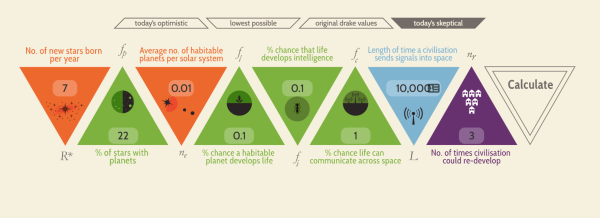
For both equations, the infographic lets you view various default options and also enables you to change the variables based on your beliefs.
For example, the skeptic’s default answer for Drake’s equation shows 0.0000062 communicating civilizations in our galaxy, which is still 924,000 in the Universe. The equivalent for Seager’s equation shows 0.0009000 planets with detectable life in our “galactic neighborhood” and 135,000,000 planets in our Universe.
Even with the “lowest possible” selection chosen, Drake’s equation still shows 42 communicating civilizations (Douglas Adams, anyone?) in the Universe.
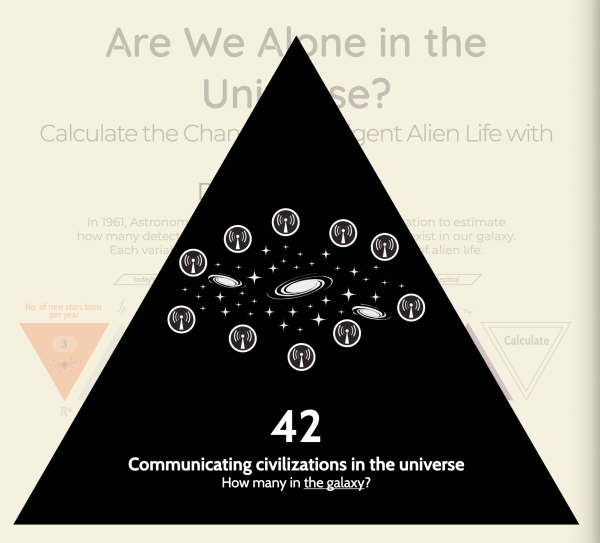
Even if the probability is tiny on any single planet, at scale it becomes almost inevitable — which is how many breakthrough bets work in markets as well.
One of the most interesting numbers (and potentially influential numbers for me) is the length of time a civilization sends signals into space. Conservative estimates are 420 years, but optimistic estimates are 10,000 or more.
One other thing to consider is that some scientists believe that life is most likely to grow on planets with very high gravity, which would also make escaping their atmosphere for space travel nigh impossible.
So, Where Are They?
The Universe is loud on paper, but quiet in practice.
So, if the math says it’s likely that there are aliens … why don’t we see them?
In 2020, I linked to an NBC News article claiming that a former Israeli space security chief says extraterrestrials exist, and Trump knows about it.
There are many stories (or theories) about how we have encountered aliens before and just kept them secret. Here are some links to things you might find interesting if you want to learn more about this.
- NewsNation Segment: UFO Whistleblower Jake Barber Shares Allegations and Will Testify to Congress About Non-human Craft Retrievals.
- NewsNation Segment: UFO whistleblower David Grusch: ‘We are not alone.’
- Dr. Diana Walsh Pasulka, Professor of Religious Studies, bridges the gap between religious studies, technological advancements, and the realm of UFO phenomena.
- Trailer for a film called “The Phenomenon.”
So, while some may still believe aliens don’t exist – I think it’s a more helpful thought experiment to wonder why we haven’t seen them. This matters not just to astronomers and conspiracy theorists, but to anyone thinking about risk, technology, and the fate of complex civilizations.
For example, the Fermi Paradox addresses the apparent contradiction between the lack of evidence for extraterrestrial civilizations and the high-probability estimates of their existence.
When considering the key factors for a spacefaring civilization capable of communication, we think about habitability, life, technological progress, and social interaction. However, it’s possible that most civilizations die of self‑inflicted wounds (war, engineered plagues, or environmental collapse) long before they can shout across the galaxy.
If that is true, perhaps the real question isn’t ‘Are we alone?’ but ‘Can we master our own trajectory before we join the list of civilizations that disappeared in silence?’
Not to mention, even forgoing the numerous roadblocks to intelligent and communicative life, it’s entirely possible that other planets that surpassed these roadblocks existed a long, long time ago, in a galaxy far away …
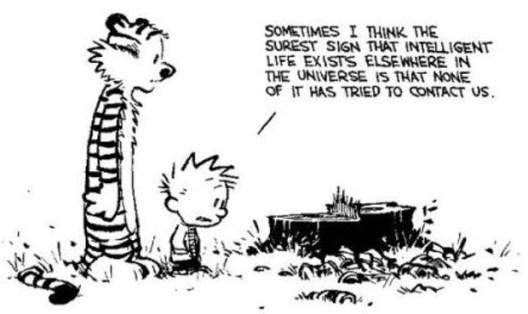
If any aliens are reading this … don’t worry, I won’t tell. But we will find out who you voted for in the last election.
What do you think?
Leave a Reply