
We Crave Simple Signals
With bombs dropping and policies whipsawing, it’s tempting to look for shortcuts.
The complexity and noise of markets is overwhelming. As a result, human nature seeks simple signals that promise clarity.
This is often an example of getting what you asked for, but not what you wanted.
In the past, I’ve shared my thoughts on various market “indicators” that are silly or just don’t make sense — like the Super Bowl Indicator. They remind us how much we crave order and look for patterns that make markets feel more predictable — even when they aren’t.
Wall Street is inundated with theories that attempt to predict the stock market and the economy. Unfortunately, even the good ones are dangerous if you over-trust or over-use them.
With that said, more people than you would hope (or guess) invest based on gut instinct, superstition, or even prayer.
While hope and prayer are good things … they aren’t good trading strategies.
What The Big Mac Index Really Measures
Today, I want to look at an out-there indicator that is actually useful, from an economics standpoint.
Remember, however, that the market ≠ the economy. So, while I do think it is useful, I don’t believe it should influence your trading decisions.
The Economist’s Big Mac Index seeks to make exchange-rate theory more digestible. They claim it is arguably the world’s most accurate financial indicator – based on a fast-food item.
The Big Mac Index turns burger prices into a simple lens on currency valuation and purchasing-power parity (PPP). In simple terms, PPP says a dollar should buy you roughly the same goods and services everywhere (once you account for exchange rates). Supposedly, then, the price difference between Big Macs, adjusted for exchange rates, indicates whether a currency is over- or undervalued.
What the Charts Reveal
Here’s a chart of Big Mac prices over the past 25 years by country, which highlights how far currencies can drift from ‘fair value’.
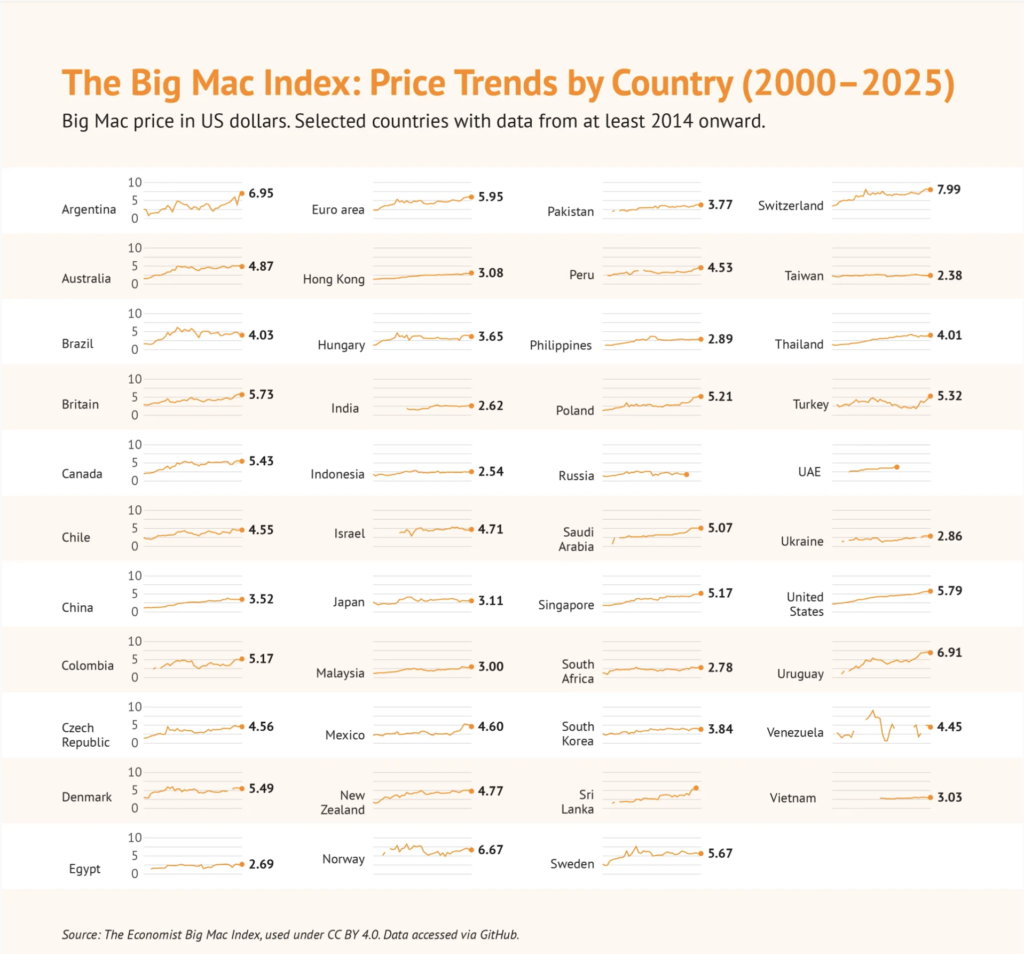
Chart: Big Mac prices by country, 2000–2025
via voronoi
This chart shows just how far — and how long — currencies can drift from ‘fair value’.
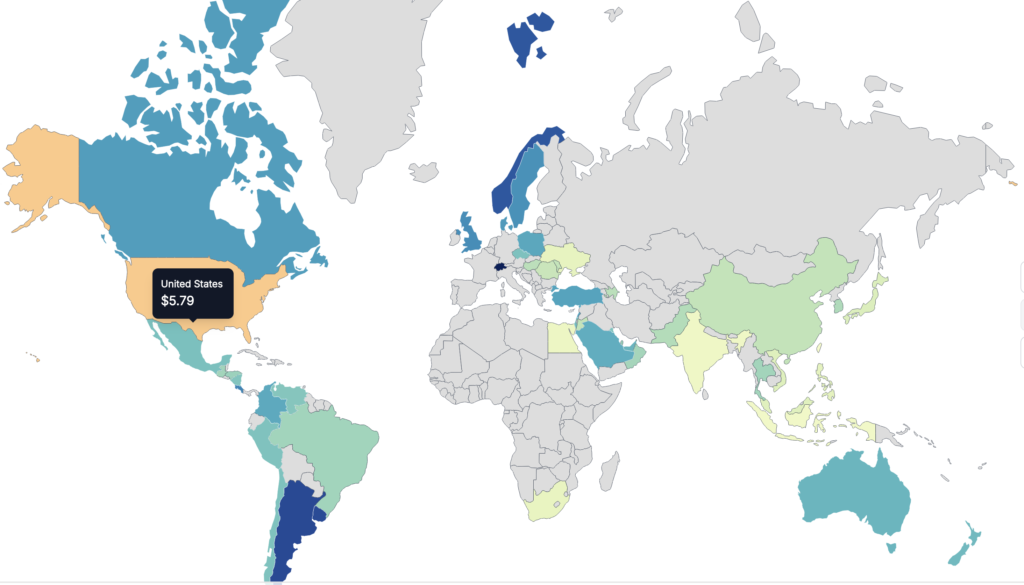
According to the Big Mac Index, the most overvalued major currency remains the Swiss franc. A Big Mac in Switzerland costs about $7.99, compared with about $5.79 in the United States. This implies a PPP exchange rate of roughly 1.19 francs per dollar, while the actual exchange rate is closer to 0.93 francs per dollar, suggesting the Swiss franc is about 38% overvalued relative to the dollar. Other starkly overvalued countries on this measure include Norway and Argentina.
Big Mac Index by Country 2026
via worldpopulationreview
For contrast, several currencies remain sharply undervalued, based on this measure. In countries like India, Indonesia, and Japan, Big Mac prices imply currencies are 40–60% undervalued relative to purchasing power parity.
Some Things Big Macs Can’t Tell You
One of the main limitations of the index is that the price of a Big Mac reflects non-tradable elements, such as rent and labor, which vary widely across countries and can distort the index’s accuracy. This means that the index is most useful when comparing countries that are at roughly the same stage of development and have similar economic structures and cost of living. So while the index offers useful insight into exchange rates and currency values, it’s only a rough guide — especially when comparing very different economies.
Another limitation of the index is that it does not consider factors such as taxes, trade barriers, and transportation costs, which can also affect the relative value of currencies. These factors can be especially important in countries highly dependent on imports or exports. They can lead to significant disparities in currency values that are not reflected in the Big Mac Index.
How Investors Should Use It
Despite its flaws, the Big Mac Index still sheds useful light on global economic trends and currency values. By using the index alongside other economic indicators and data sources, investors and economists can gain a more comprehensive understanding of the forces shaping the global economy and make more informed decisions about how to allocate capital.
Use it to understand which currencies look stretched – not to time trades. There are clearly more forces at work if a currency can look over- or undervalued for years without obvious consequences. Remember that political risk, capital flows, and policy can outweigh PPP for years.
It’s not meant to be precise, but it serves as a global yardstick because Big Macs are available everywhere and, for the most part, are made the same way.
You can read more about the Big Mac index here or read the methodology behind the index here.
Pair fun indicators with hard data and robust systems. As traders, we pay attention to these distortions, but we don’t bet on them directly. Instead, we build systems that adapt as reality changes — no burger‑based strategies required.
Leave a Reply