
Are you Happy?
Asking whether someone is happy seems like a simple question. But what does the question really ask, and what does ‘happy’ really mean?
Once you define happiness (for you), how, when, and for how long do you measure it?
These are some reasons why measuring happiness is harder and more complex than it might seem at first glance.
What Does Happiness Really Measure?
At its core, happiness means experiencing more positive emotions than negative ones. With a bit of reflection, you see that happiness is reinforced by comfort, freedom, financial security, and other things people aspire to.
Regardless of how hard it is to describe (let alone quantify) … humans strive for happiness.
Likewise, it is hard to imagine a well-balanced and objective “Happiness Report” because much of the data needed to compile it is subjective and relies on self-reporting.
Nonetheless, the World Happiness Report takes an annual look at quantifiable factors (such as health, wealth, GDP, and life expectancy) and more intangible factors (such as social support, generosity, emotions, and perceptions of local government and businesses). Below is an infographic highlighting the World Happiness Report data for 2026.
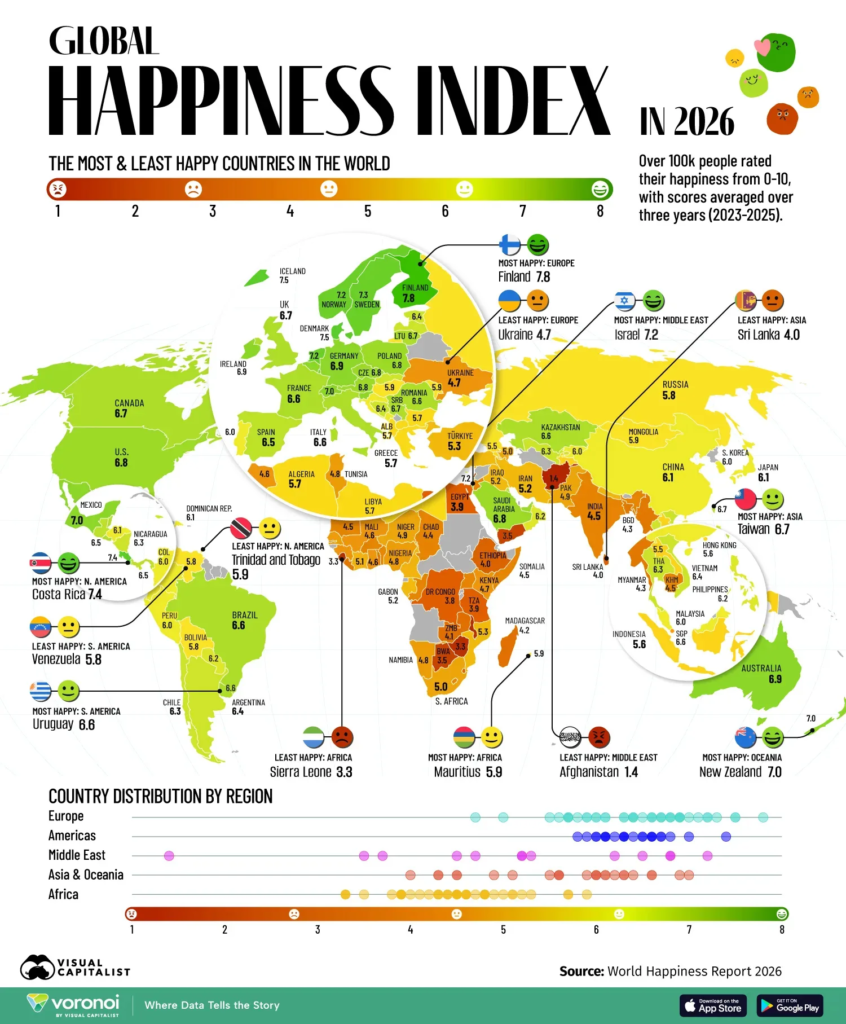
World Happiness Report via visualcapitalist
Despite the news, global happiness hasn’t collapsed – but it has become more uneven.
Click here to see a dashboard with the raw worldwide data.
In 2022, when I shared this, we were seeing the immediate ramifications of COVID-19 on happiness levels. There was a significant increase in negative emotions reported – specifically, worry and sadness. And yet, happiness scores are relatively resilient and stable, and humanity persevered in the face of economic insecurity, anxiety, and more.
In the 2025 report, one of the key focuses was the increase in pessimism about others’ benevolence. There seems to be a rise in distrust that doesn’t match the actual statistics on acts of goodwill. For example, when researchers dropped wallets on the street, the proportion of wallets returned was far higher than people expected.
Unfortunately, our well-being depends on both our perception of others’ benevolence and their actual benevolence.
The World’s Happiest Countries in 2026
Before we dive into the global trends, a surface-level view shows that Nordic nations (e.g., Finland and Denmark) boast the happiest people. Unfortunately, those represent a small fraction of the world’s population.
All of the top 10 nations have populations under 20 million. Interestingly, Mexico is a significant outlier, ranking #12 with a population of 131.9 million.
And despite what you may think, the US is also among the few large nations in the top 50.
Building a Case Against Social Media Usage
Diving deeper into the results, young people are significantly less happy than they were 15 years ago. You might assume war, economic anxiety, politics, or family structure are to blame — but much of the decline appears tied to social media use. While that may seem like a safe scapegoat or a simple hypothesis, the research supports it. While no single factor explains everything, the researchers estimate that always-available social media is a statistically significant contributor to rising mental illness among adolescents in Western nations.
Diving in a little deeper, the PISA study of 15-year-olds in 47 countries shows that those who use social media for over seven hours a day have much lower well-being than those who use it for less than one hour. In a sample of US college students, the majority wish that social media platforms did not exist.
These numbers are significantly worse in Western countries than in Eastern and African countries.
Based on their research, the Report argues that the rapid adoption of “always-available social media” by adolescents in the early 2010s is a statistically significant contributor to the population-level increases in mental illness in Western nations.
Social media is so toxic that it’s affecting the population at large … not just the most at-risk.
So, Why Do People Use It?
Many empirical studies cast doubt on whether social media makes people happy, affecting how we value, choose, and consider well-being. The main takeaway is that many individuals use social media mainly because others do. They don’t want to be left out. If social media use were decreased or eliminated, many people would benefit, and they are aware of this.
Last year, we talked about the importance of trust and social connections for well-being, but also how social media had created a very low-trust society, as evidenced by the political silos and online vitriol. Unsurprisingly, the estimated relationship between internet use and well-being differs significantly across generations, genders, and regions. It is highly negative for Gen Z, moderately negative for Millennials, near zero for Gen X, and slightly positive for Baby Boomers.
Older adults enjoy the benefits of stable trust, growing attachment, enhanced safety, and moderate digital engagement. In contrast, younger adults often experience a decline in these foundations within highly saturated digital environments.
Clearly, social media isn’t creating the healthy connections our younger generations need. Meanwhile, generations that grew up with less digital-centric relationships seem to be handling the changes more robustly.
Longer-term Trends
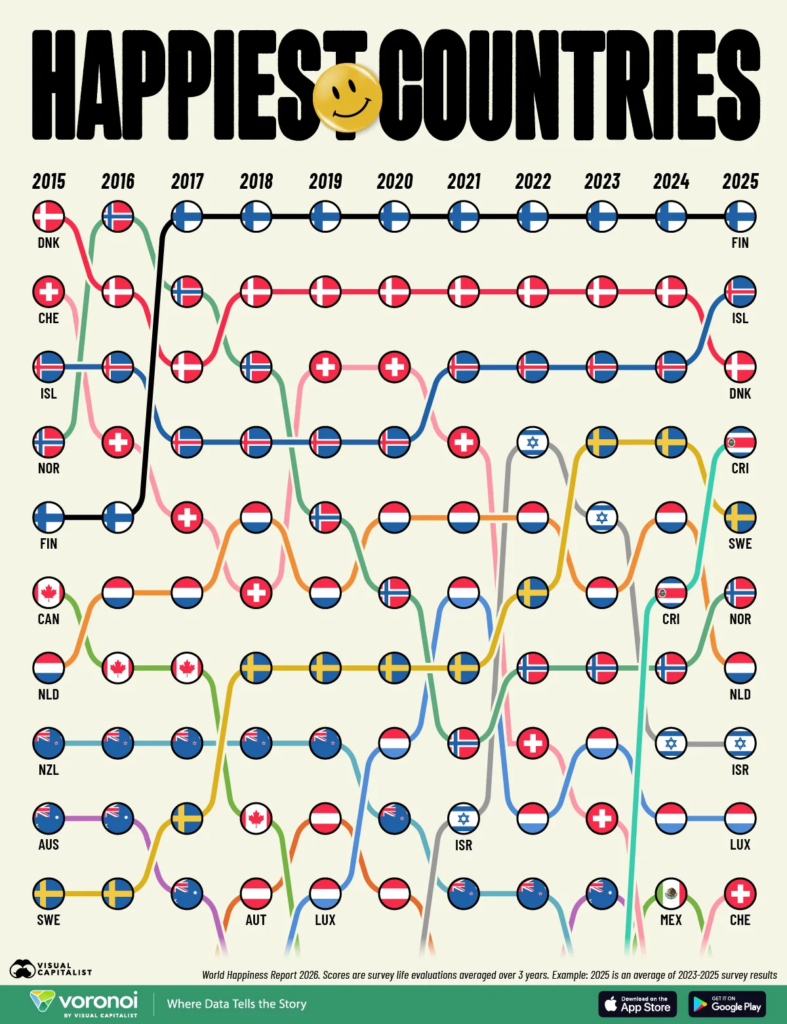
Over the last decade, the top of the world’s happiest countries list has remained remarkably consistent.
So have global happiness levels as a whole. The relative balance demonstrated in the face of such adversity may point towards the existence of a hedonic treadmill – or a set-point of happiness.
Large countries, like India, often bring down the averages, but even that has remained relatively consistent.
Despite that, the distribution of happiness has changed significantly. While life satisfaction is stable, how people feel day to day has shifted downward. Stress, worry, and sadness have increased globally, and younger generations are impacted to a larger degree.
Takeaways
Happiness hasn’t collapsed globally—but it’s become more uneven and, in some ways, more fragile.
In the US and a few other regions, the decline in happiness and social trust points to the rise in political polarisation and distrust of “the system”. As life satisfaction declines, anti-system votes rise.
Worsening the situation is our growing dependence on social media instead of face-to-face relationships. Although most people realize it’s harmful and don’t want to use it, many can’t imagine missing out. As a result, they spend time and energy passively consuming content instead of being active in their own lives.
As AI‑generated content and AI chatbot partners become more common, it will be interesting to see how they reshape this data.
Regardless, humanity has always proved resilient and enduring. Regardless of the circumstances, people can focus on what they choose, define what it means to them, and act accordingly.
Remember, throughout history, things have gotten better. There are dips here and there, but like the S&P 500 … we rally eventually.
The data show that happiness is surprisingly resilient but not guaranteed.
Younger generations are paying the price for a world built around screens, feeds, and algorithms — but they also have the most to gain from changing course.
We may not control global trends, but we do control how we spend our attention, who we spend time with, and what we build together. Those choices compound, just like returns in the S&P 500. Over time, they can move both our personal and collective happiness charts in the right direction.
Onwards!
Leave a Reply