February 15, 2026

  • How To Detect Baloney with Carl Sagan: Trust, Tests, and Tiny Bets

    Information can glitter like gold — and still turn out to be worthless fool’s gold.

    Too often, organizations chase compelling narratives, market buzz, or charismatic claims instead of rigorous evidence. Decisions that matter need more than persuasion … they need proof.

    Carl Sagan had a name for the tools that keep you from falling for fool’s gold. He called it the “Baloney Detection Kit.” Sagan originally outlined them in The Demon-Haunted World (and they were recently summarized in Big Think ).

    A photo of Carl Sagan on a black background

    Collectively, they are a set of critical thinking tools to help separate fact from fiction. These ideas aren’t just for science; they form a solid foundation for any high‑stakes business decision.

    This post shows how to turn Sagan’s Baloney Detection Kit into concrete workflows, metrics, and tiny bets that make your organization more trustworthy and anti-fragile.

    Here are the basics.

    The Baloney Detection Kit

    At its core, the baloney detection kit pushes you to:

    1. Demand independent confirmation. Check claims with sources that weren’t involved in making them, while encouraging debate by all relevant experts.
    2. Avoid reliance solely on authority or persuasion. Experts can be wrong; evidence matters more than credentials alone.
    3. Create multiple hypotheses and test them. Don’t fixate on the first explanation; try to disprove competing ideas.
    4. Be your own fiercest critic. The hypothesis you like most is often the one you must test hardest.
    5. Quantify where possible and ensure every link in a reasoning chain holds up.
    6. Favor simplicity (Occam’s Razor) and insist that ideas be falsifiable — that there is some way to test whether they are wrong. The simplest answer is often the truth.

    Sagan’s emphasis is clear: skepticism is not cynicism — it’s a disciplined, systematic evaluation of evidence. Countless cognitive biases make stories appealing, but rigorous scrutiny separates what’s reliable.

    That’s powerful when you’re evaluating a news story or a scientific claim. It’s even more powerful when you wire it into how your organization decides what to do next.

    From Personal Skepticism to Organizational Practice

    These ideas are powerful personal tools, but they’re also powerful organizational frameworks.

    1. Tag every substantive claim before it leaves the building.
    Each claim gets a status like:

    • VERIFIED — independently checked
    • PRELIMINARY — plausible but unconfirmed
    • UNVERIFIED — high uncertainty
      Require visible flags and named reviewers before high-impact claims go public.

    2. Ask the “Stop Question.”
    For every major decision, answer:

    “What single observation would make us reverse course?”

    If you can’t articulate that, treat the initiative as exploratory.

    3. Document provenance for numbers.
    Every quantitative claim must list source, method, scope, and uncertainty in one place. Without that, weight it less in decisions.

    4. Build a structured decision workflow.

    • Author fills verification details.
    • Reviewer assesses evidence quality.
    • Senior Approver signs off on high-stakes items.
    • Rotating External Reviewer audits samples regularly.

    Track metrics quarterly, such as: % verified vs. unverified claims, time to verification, and errors caught in adversarial review.

    Why You Need A Risk-First Lens

    Most businesses get so excited about what could go right that they ignore what is most likely to go wrong.

    What Could Go Wrong?“ is often a sarcastic throwaway, when it should be the most serious question you ask before any launch.

    We live in a speed-first world, but if speed is rewarded over accuracy, skepticism will be ignored.

    Culture and clear rules trump short‑term results, and prevent the attrition most ‘overnight successes’ experience.

    Can You Imagine …

    Imagine an organization where …

    Every bold claim carries its verified provenance …

    Where errors are corrected, not shamed, and publicly learned from …

    Where small but frequent probes guide larger tasks and keep them on the rails …

    Imagine the difference in the anti-fragility of that organization, or the longevity, or even just the trust and respect between employees.

    Ask yourself: What percentage of your important decisions are uncertain or unverified?

    The future rewards organizations that can quickly and reliably separate signal from noise.

    If you make testing basic, provenance visible, and tiny, reversible bets your default, you turn skepticism into a competitive edge — and persuasive stories into durable advantages.
  • Which Jobs Are The Most at Risk of AI Disruption?

    Everywhere you look, someone is predicting which jobs AI will eliminate or automate away next. For many people, the real question is more personal: Is my job safe — or will my company survive?

    To answer that, it helps to zoom out.

    Back in 2018, I asked a simple question: Which industries were most at risk of disruption? This was pre‑AI boom, so the focus was on digitization and automation (rather than large language models or copilots). That article identified the key signals that an industry was ripe for disruption. That simple framework still applies today.

    Here’s a brief summary of the findings.

    1. Digitization Level – Industries like agriculture, construction, hospitality, healthcare, and government were among the least digitized, yet they still accounted for 34% of GDP and 42% of employees.
    2. Regulation Intensity – In heavily regulated industries, companies that find ways to work around legacy rules can become effective competitors quickly (e.g., Lyft or Tesla).
    3. Number of Competitors – Crowded markets with excess capacity or wasted resources (like taxis waiting for fares or empty airplane seats) are vulnerable to new business models. 
    4. Automatability – Even in 2018, many industries and tasks were ready to be automated but hadn’t been due to the cost or labor of switching to new technologies.

    Ultimately, disruption was about relieving a customer’s headache while lowering costs for the producer, the customer, or both.

    Today, AI’s inexorable march is unmistakable as it takes over more tasks and more of the content we create.

    In 2024, the WEF evaluated which jobs were most prone to small or significant alteration by AI. IT and finance have the highest share of tasks expected to be ‘largely’ impacted by AI — which is not particularly surprising. Followed by customer sales, operations, HR, marketing, legal, and (lastly) supply chain.

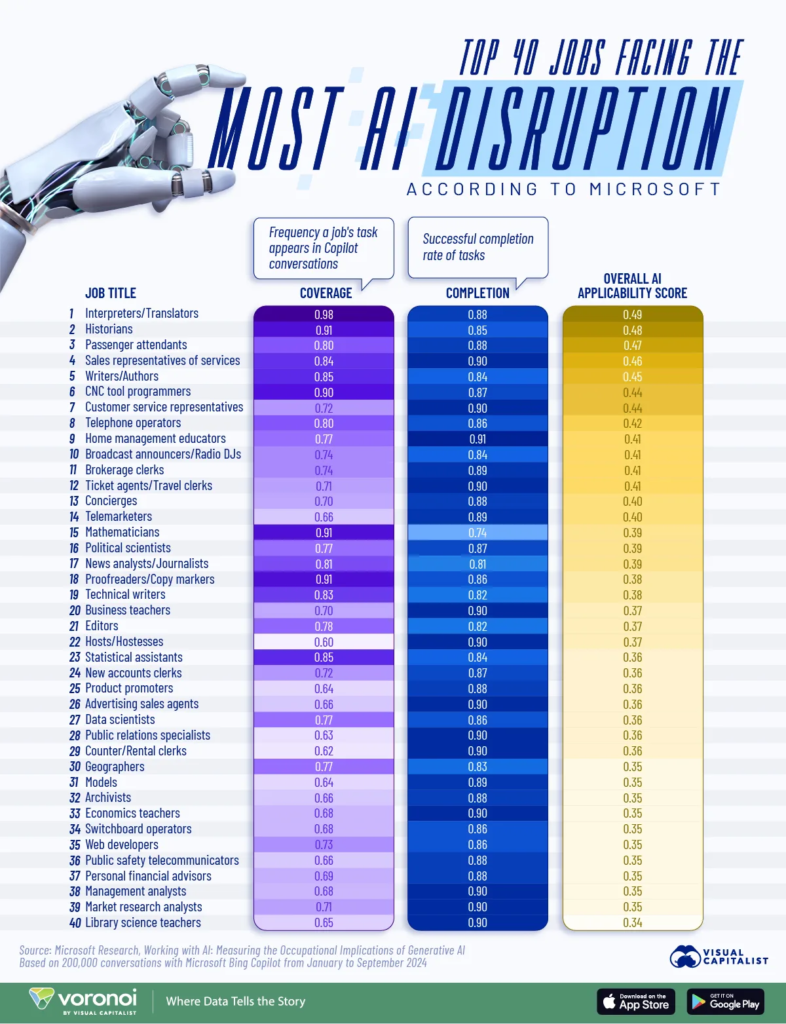
    Now, new Microsoft data takes a more granular look at which specific jobs are most exposed to generative AI.

    via visualcapitalist

    Microsoft assessed AI exposure using three indicators derived from Copilot usage:

    • Coverage: How often tasks associated with a job appear in Copilot conversations
    • Completion: Frequency of Copilot successfully completing those tasks
    • Overall AI Applicability Score: A combined metric indicating how well AI can support or execute tasks within a specific role.

    Language-heavy & research-based roles are at the highest risk of disruption. Think roles like interpreters, historians, writers, and customer service.

    But exposure does not automatically mean replacement. Augmenting roles with AI will become increasingly common.

    Even though creative and communication roles sit near the top, more technical roles will still feel a meaningful impact as well.

    Fear not … there is still a place for humans. In many cases, AI functions as a complement rather than a substitute, because these jobs still require judgment, creativity, and human interaction.

    Are you using AI in your daily process yet?

    At Capitalogix, we focus on amplifying intelligence. To us, that means the ability to make better decisions, take smarter actions, and continuously improve performance. In many ways, it comes down to better real-time decision-making. Practically, that means using technology to calculate, find, or know easy things faster … rather than predicting harder things better.

    You don’t have to predict every change. You do have to build the habit of experimenting with AI in the work you already do. The gap between winners and losers will be about learning speed, not job title.

    In the next few years, the biggest divide will not be between ‘AI jobs’ and ‘non‑AI jobs.’ It will be between people who learn to wield AI and people who pretend it is not their problem.

    A few years from now, when I write a follow‑up to this article, I suspect we will look back and clearly see the gap between winners and losers. It might come down to something as simple as this question:

    What are you doing to make sure that you ride the wave, rather than getting crushed by it?