
Most people assume Saudi Arabia sits on the world’s largest oil reserves.
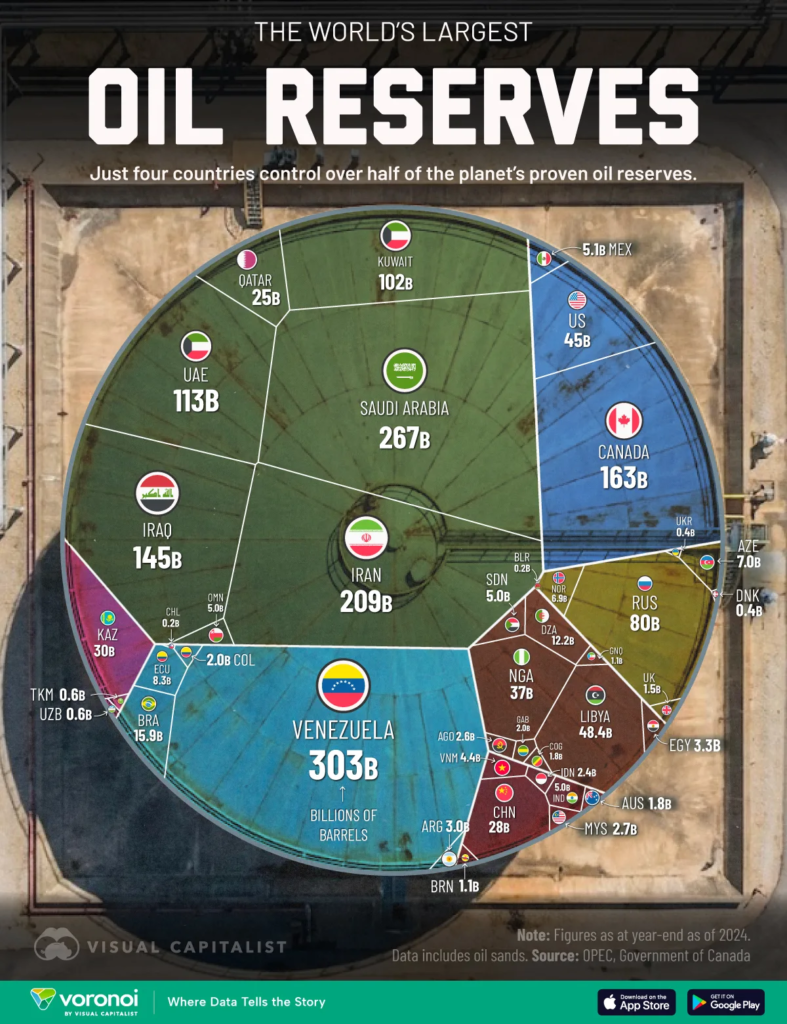
OPEC’s latest data – visualized in a recent chart from Visual Capitalist – tells a different story, with Venezuela at the top and just four countries controlling more than half of global reserves. In case you’re curious, the other three are Saudi Arabia, Iran, and Canada.
In a week when Venezuela is back at the center of international headlines, that concentration of energy power suddenly feels less like trivia and more like a fault line.
via visualcapitalist
The Concentration of Global Oil Reserves
Despite rapid growth in renewables, fossil fuels still supply roughly 70% of global energy demand.
As you might imagine, when oil reserves are this concentrated, political shocks in one country can reshape global power dynamics overnight.
Why Venezuela Matters Right Now
Well, in case you missed it, President Trump announced that the US captured Venezuela’s President Maduro because of concerns regarding the drug trade, and will seize Venezuela’s oil reserves. President Trump also declared that the US will ”run the country” until a “judicious transition” occurs.
While that news certainly captured headlines, it’s not hard to find lots of other explanations for what happened, including the hypothesis that it was an intentional strategy to shift news cycles away from the Epstein files or the price of groceries.
While Americans and much of the world have mixed feelings, many Venezuelans abroad are happy about the leadership change and hopeful that it marks the start of a positive regime shift. For a minor contrast, the opinion of those in Venezuela is mixed.
Whether this moment accelerates change in Venezuela, reshapes energy geopolitics, or nudges the world faster in other ways, it is another reminder of how tightly energy and power are intertwined. How do you expect this shift in control over reserves to affect the next few years of economics and politics?
Leave a Reply