
Generative AI has moved from novelty to necessity in under two years — and the data proves it.
What started as a curiosity is now quietly rewiring how we work, create, and consume information. The result is an invisible revolution happening inside our apps, our workflows, and our daily decisions.
The Invisible Revolution
Gen AI apps are increasingly a part of my day.
While I still supervise most AI tasks, these tools now touch nearly every aspect of my workflow.
Gen AI also works quietly in the background — organizing and filtering emails, files, and news stories — even in places I’ve forgotten to ask it to help.
That experience isn’t unique; it reflects a broad behavioral shift across age groups, industries, and geographies.
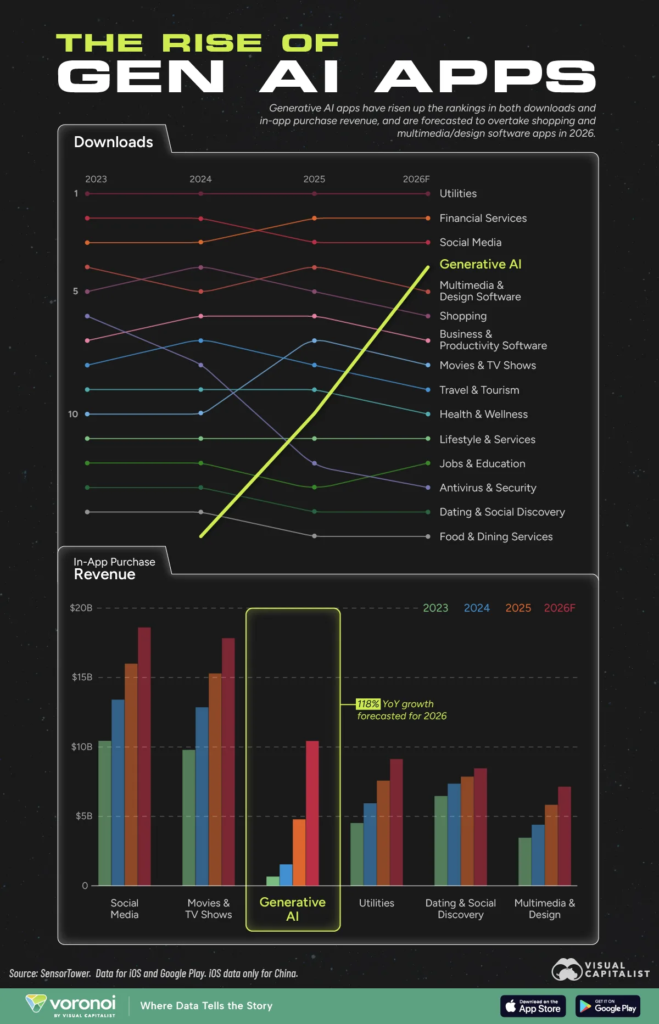
Here’s a chart that shows the rise of generative AI apps compared to other app categories on popular platforms. There’s a phrase that captures what this chart reveals:
One of these things is not like the others.
Take a look.
via visualcapitalist
THE DATA: Growth Unlike Any Other Category
While this data covers the iOS and Google Play stores — which represent the majority of consumer app downloads — it doesn’t capture enterprise or web-based AI usage, where adoption may be even higher.
AI‑generated text, images, and video have quickly become a major force in content creation and moderation. Many younger users may now consume a majority of their content through AI-mediated or AI-generated experiences (e.g., personalized feeds and AI‑curated playlists, as well as synthetic influencers and chat‑based companions).
The trajectory becomes even more striking when you examine the financial projections.
According to Sensor Tower, Generative AI apps are projected to reach 4 billion downloads, generate $4.8 billion in in-app purchase revenue, and account for 43 billion hours spent in 2025 alone. Generative AI applications are anticipated to reach over $10 billion in consumer spending by 2026. Additionally, by then, Gen AI is expected to be among the top five mobile app categories in terms of downloads, revenue, and user engagement.
THE BEHAVIOR SHIFT: From Tools to Workflows
Beyond installs and revenue, user engagement is accelerating, reflecting increased consumer willingness to pay for AI tools, subscriptions, and premium features as these apps become part of daily workflows.
Key insight: This isn’t just another app category — it’s infrastructure. And, learning to work with AI is quickly becoming a baseline skill. Just as spreadsheets and email became non‑negotiable skills in earlier eras, fluency with AI tools will soon be assumed rather than optional.
How to adapt, starting now
- Audit where AI already touches your workflows—email, content, customer interactions—and identify obvious gaps or redundancies.
- Pilot one or two Gen AI tools deeply rather than dabbling in many, and track the impact on time saved or output quality.
- Establish simple guardrails for accuracy, privacy, and human review so AI becomes a reliable partner, not a blind spot.
The momentum is undeniable. In the AI era, standing still means falling behind (but at an exponential pace). The question isn’t whether to adopt AI … it is how quickly you can adapt your workflows, teams, and strategies to use it well. Those who learn to partner with these tools now will define what ‘normal’ looks like in the years ahead.
Onwards!
Leave a Reply