
We’ve officially kicked off our annual planning for the upcoming year.
It’s something we’ve gotten better at over the years, largely because we lived through the pain of ‘planning by PowerPoint,’ siloed teams, and conflicting priorities.
Our method is simple: first, we define the company’s top three strategic priorities. Then each department (and manager) selects their “big three” — the key initiatives that support the company-level priorities. From there, we break things down into quarterly “Rocks,” SMART goals (Specific, Measurable, Attainable, Relevant, Time-bound), and detailed tactical steps that will drive progress.
The planning sessions have been productive. There is a lot of idea swapping, negotiation, and real prioritization.
History has shown that plans are more likely to fail at the level of conversation than in spreadsheets.
The Illusion of Communication
Still, I sometimes catch myself wondering whether what feels like a “dialogue” is actually several parallel monologues. The root issue?
People may share words but not the same underlying meaning.
That’s why shared language matters: two people might say the same word but interpret it entirely differently.
And, in a sign of the times, to combat this, I’ve been running my transcripts through several AI filters. I run preset prompts to identify areas where we seem aligned but might be unaware of hidden ambiguity, identify edge cases that call for clarity, and find topics where we’re misaligned.
Here’s one example of how these prompts helped surface a hidden issue that I missed in a recent session.
Potential Issue to Resolve
Quote: “So clearly I triggered her. She took my notes as my opinion, rather than raw material for other things.”
Intent: Clarify role and intentions around the notes provided so the collaboration can move forward smoothly.
Friction Type: Emotional, Communication
Impact: Medium
Root Cause: Notes interpreted as prescriptive opinion rather than time-saving input, causing defensiveness and relational tension.
Remediation: Ask directly, “How would you like me to format and position future notes so they feel like raw input for you rather than my opinion or direction?”
In a sense, it’s not enough to think and talk. You actually have to think about your thinking and think about the communication.
To help with that, I created these two short videos:
Thinking About Your Thinking
via YouTube
Watch this for a deeper exploration of the “Think, Feel, Know” framework. The premise: You might start with thoughts, but you need to acknowledge feelings before you can arrive at genuine knowing or clarity. It also encourages setting aside time after a task to reflect — often, real insights grow during that pause. It sounds simple, but I highly recommend watching the video.
Chunking Higher
The second video explains how to “chunk higher” to increase the likelihood of agreement and alignment.
via YouTube
Watch this to explore techniques to use when conversations stall or feel like people are talking past each other. Seek to “chunk higher” — clarify shared goals, assumptions, and definitions first. Once there’s proper alignment at that level, move down to specific plans and actions. This approach improves efficiency and decision quality.
From Big Hairy Goals to Daily Decisions
Personally, I’m a believer in selecting a big, hairy, audacious long-term goal (sometimes called a “BHAG”) and then aligning every step to it.
When long-term goals are clear, mapping out the steps is easier. Small wins accumulate, momentum builds — and what once seemed distant becomes attainable.
Admittedly, it’s natural to stumble or get stuck sometimes. What matters is recognizing where you are, what you’ve done so far, and taking the next step. Progress isn’t always smooth — but it’s almost always forward.
Short-term gratification can be tempting. And everywhere you look, messages push for speed — instant results, quick wins, fast growth. But those often lead to burnout, poor decisions, or shallow gains. Real, sustainable success tends to come from steady progress, patience, and discipline.
To put it in something of a blueprint, here are four key guideposts we keep returning to during our planning:
- Use a common language — make sure everyone means the same thing when they use the same words.
- Begin with the end in mind — define long-term goals before anything else.
- Start from a place of agreement at the highest level — make sure key stakeholders are aligned before diving into specifics.
- Then make clear distinctions as you work down into details — clarity in structure and purpose helps avoid confusion and misalignment.
Looking ahead, I’m excited about where we can take things over the next 25 years — the people we can impact, the goals we can hit, the legacy we might build. Building Capitalogix has never been easy, but it’s been deeply fulfilling. More than that: it’s been a labor of love, powered by knowing precisely what we want — and why.
I commissioned this image from GapingVoid to remind our team to keep shooting higher.
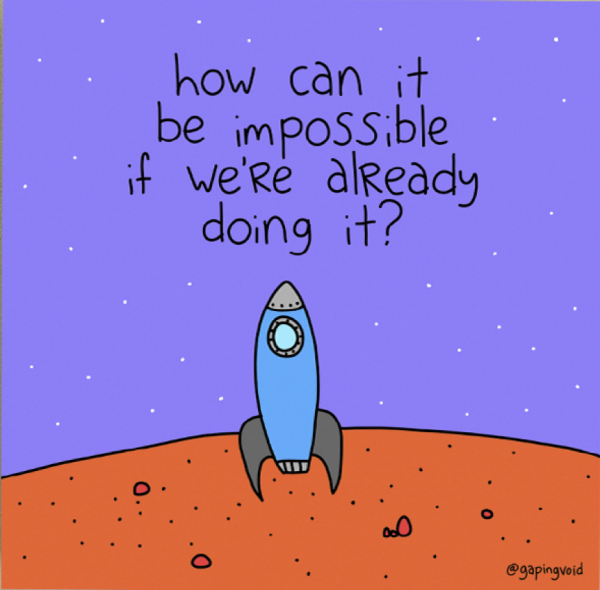
If you know what you want, it doesn’t just make the path clearer — it makes it possible.
Here’s to a powerful 2026 … and an even stronger 2050.
Leave a Reply