
“Prediction is hard, especially about the future.”
That quote is often attributed to physicist Niels Bohr or baseball legend Yogi Berra. Even though it sounds like a joke, it contains a real warning. In complex systems, the edge rarely comes from being right about the future. It comes from being ready when everyone else is wrong.
Why Prediction Isn’t an Edge
If you know predictions are flawed, is it still worth considering them carefully?
Predictions make me uneasy. On some level, they’re fun and sometimes accurate — but I’d much rather know things than guess them.
In my experience, there are simply too many variables and too much randomness in real‑world systems for prediction to be a reliable competitive edge. Instead, your edge often comes from how well you respond to surprises, not from calling them in advance. That is why signal‑finding and noise‑reduction are far more reliable to build around.
While I don’t put too much faith in predictions, I enjoy looking at them. Some are vague enough that they’re almost guaranteed to be directionally correct. Others are so specific that they force a fresh way of looking at a subject, even if they never come true.
Still, it is useful to know where the crowd is leaning. Consequently, seeing where smart people agree and disagree can be useful scaffolding for your own thinking, which is why this year’s prediction consensus is worth a look.
A Consensus View of 2026
Visual Capitalist puts out an infographic every year that tracks predictions from various publications. It’s fun to look at before the year starts, and revisit as the year comes to a close.
To make these forecasts, they analyzed over 2,000 predictions from articles, reports, podcasts, and interviews from a wide variety of sources, including Morgan Stanley, Goldman Sachs, the IMF, The Economist, Deloitte, Microsoft, and Gartner Group.
By mapping where these forecasts overlap, they distilled the noise into 25 high-conviction themes displayed in a “Bingo Card” format, with the number of color dabs reflecting the type and volume of supporting predictions.
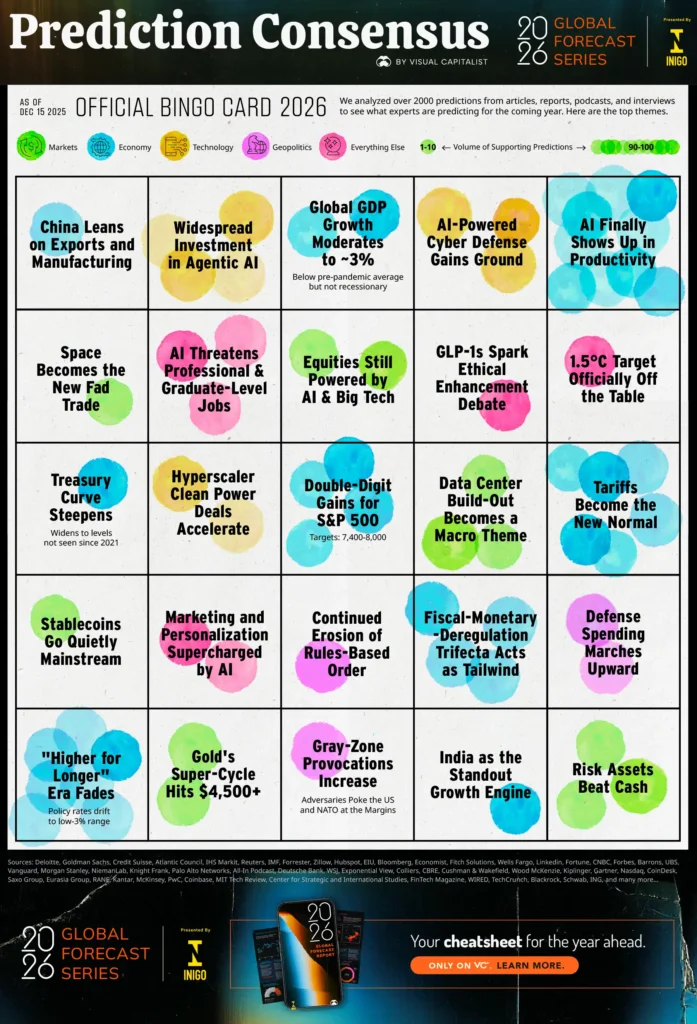
via visualcapitalist
This ‘bingo card’ shows where institutional predictions cluster — and where they are most likely to be wrong. Taken together, it is less a forecast and more a map of the assumptions currently shaping capital flows and corporate decisions.
Looking back, 2025 was a year of adjustment: markets recalibrated to higher rates, geopolitics reshuffled around a second Trump administration and new tariffs, and AI moved from hype to deployment. Looking forward, 2026 is shaping up as a year of consolidation – and consequence. Nonetheless, based on their research, 2026 predictions seem cautiously optimistic.
Their big takeaway? Risk assets may thrive, but the world beneath them remains turbulent.
The Big Issues
Unsurprisingly, AI is the dominant force in their prediction landscape. Their 2024 forecasts centered on whether AI hype was justified, and 2025 focused on deployment at scale. The 2026 conversation focuses on large-scale integration and its consequences.
The central question posed is: “What happens when AI becomes a colleague instead of a tool?”
People worry about what AI agents mean for workforces, yet the consensus is clear: markets are expected to benefit.
There are plenty of other themes on the card — from tariffs and gold to emerging markets.
Take time to consider this chart carefully. The themes it surfaces are significant, while the impact and meaning remain open to discussion.
Some of these themes will play out roughly as advertised; others will get blindsided by events no model had on its radar. Collectively, though, they outline the landscape that institutions, investors, and policymakers are navigating as they prepare for the year ahead.
This consensus does not tell you what will happen; it tells you what most institutions are currently betting on. Your edge comes from how you prepare for the tiles no one expected to light up.
The important questions do not change.
What are you focusing on? What do you think will happen? What do you think it means? And what do you intend to do?
As always, Onwards!
Leave a Reply