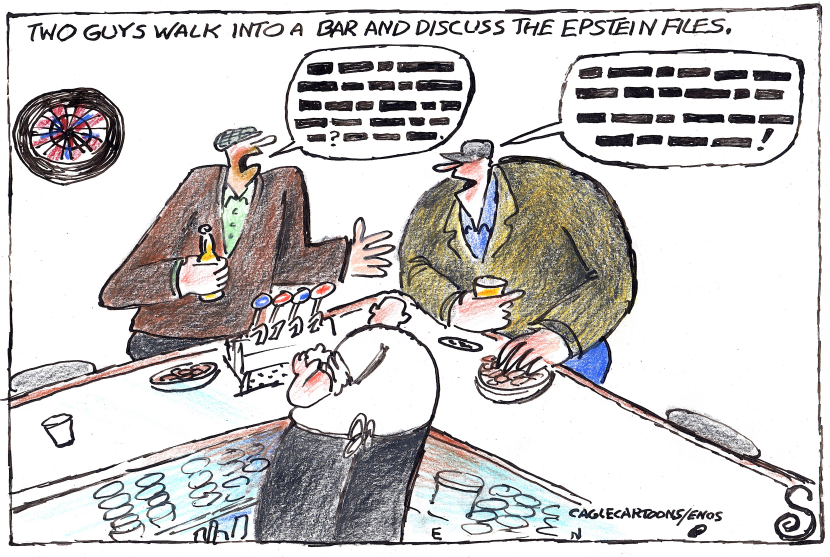
“Prediction is hard, especially about the future.”
That quote is often attributed to physicist Niels Bohr or baseball legend Yogi Berra. Even though it sounds like a joke, it contains a real warning. In complex systems, the edge rarely comes from being right about the future. It comes from being ready when everyone else is wrong.
Why Prediction Isn’t an Edge
If you know predictions are flawed, is it still worth considering them carefully?
Predictions make me uneasy. On some level, they’re fun and sometimes accurate — but I’d much rather know things than guess them.
In my experience, there are simply too many variables and too much randomness in real‑world systems for prediction to be a reliable competitive edge. Instead, your edge often comes from how well you respond to surprises, not from calling them in advance. That is why signal‑finding and noise‑reduction are far more reliable to build around.
While I don’t put too much faith in predictions, I enjoy looking at them. Some are vague enough that they’re almost guaranteed to be directionally correct. Others are so specific that they force a fresh way of looking at a subject, even if they never come true.
Still, it is useful to know where the crowd is leaning. Consequently, seeing where smart people agree and disagree can be useful scaffolding for your own thinking, which is why this year’s prediction consensus is worth a look.
A Consensus View of 2026
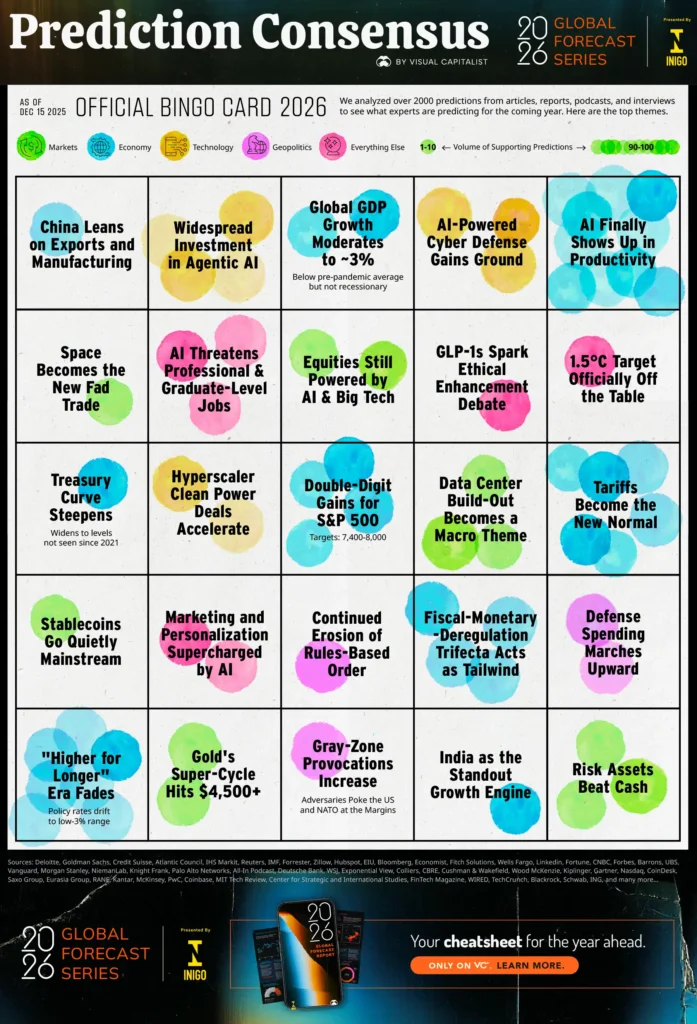
Visual Capitalist puts out an infographic every year that tracks predictions from various publications. It’s fun to look at before the year starts, and revisit as the year comes to a close.
To make these forecasts, they analyzed over 2,000 predictions from articles, reports, podcasts, and interviews from a wide variety of sources, including Morgan Stanley, Goldman Sachs, the IMF, The Economist, Deloitte, Microsoft, and Gartner Group.
By mapping where these forecasts overlap, they distilled the noise into 25 high-conviction themes displayed in a “Bingo Card” format, with the number of color dabs reflecting the type and volume of supporting predictions.
Infographic showing consensus predictions for 2026.
This ‘bingo card’ shows where institutional predictions cluster — and where they are most likely to be wrong. Taken together, it is less a forecast and more a map of the assumptions currently shaping capital flows and corporate decisions.
Looking back, 2025 was a year of adjustment: markets recalibrated to higher rates, geopolitics reshuffled around a second Trump administration and new tariffs, and AI moved from hype to deployment. Looking forward, 2026 is shaping up as a year of consolidation – and consequence. Nonetheless, based on their research, 2026 predictions seem cautiously optimistic.
Their big takeaway? Risk assets may thrive, but the world beneath them remains turbulent.
The Big Issues
Unsurprisingly, AI is the dominant force in their prediction landscape. Their 2024 forecasts centered on whether AI hype was justified, and 2025 focused on deployment at scale. The 2026 conversation focuses on large-scale integration and its consequences.
The central question posed is: “What happens when AI becomes a colleague instead of a tool?”
People worry about what AI agents mean for workforces, yet the consensus is clear: markets are expected to benefit.
There are plenty of other themes on the card — from tariffs and gold to emerging markets.
Take time to consider this chart carefully. The themes it surfaces are significant, while the impact and meaning remain open to discussion.
Some of these themes will play out roughly as advertised; others will get blindsided by events no model had on its radar. Collectively, though, they outline the landscape that institutions, investors, and policymakers are navigating as they prepare for the year ahead.
This consensus does not tell you what will happen; it tells you what most institutions are currently betting on. Your edge comes from how you prepare for the tiles no one expected to light up.
The important questions do not change.
What are you focusing on? What do you think will happen? What do you think it means? And what do you intend to do?
As we approach year-end, my thoughts have been on finishing strong and planning for a great 2026.
Last week, we looked at a prompt that created a new keystone habit. This week, I’m sharing another simple prompt that I found valuable and insightful. It’s designed to review your conversation history, conduct a mini-assessment, and give you a glimpse into your blind spot.
Like last week’s prompt, as written, it’s somewhat generic and might hallucinate a little if it doesn’t have enough data. That’s easy to fix by improving the prompt. But for the purposes of getting started, this is good enough.
Here is the base prompt to try in your primary AI tool.
“From all of our interactions, what is one thing that you can tell me about myself that I may not know about myself?”
Sometimes, less is more.
There are lots of ways to use something like this. For example, you can tell it to be “brutally honest” or to “roast you” so that you hear it in humorous terms. With that in mind, here are a bunch of copy/paste prompt variants that produce the same kind of “surprising but grounded” self-insight, each from a different angle.
Pattern + Blind Spot Variants
Strength-with-a-Shadow
From our interactions, name one strengthI clearly have and the most likely downsideof that strength when overused. Give 2 examples from our chats and 1 practical guardrail.
Default Operating System
What is my “default mode” behavior, under pressure, based on our interactions? What does it protect me from, and what does it cost me?
Hidden Constraint
Identify one hidden assumption I seem to carry. Explain how it helps me, how it limits me, and one experiment to test it.
Blind Spot That Looks Like a Virtue
What’s a behavior of mine that most people would praise, but that could quietly create problems? Be specific and non-psychological.
Decision-making + execution variants
Where I Over-Engineer
Where do I tend to add unnecessary complexity? Give one example pattern, why I do it, and a “2-step simplification rule” I can apply.
Where I Under-Commit
Based on our interactions, where might I stay in analysis longer than needed? Give a “commitment trigger” and a script for making the decision.
One Question I Avoid
What is one question I rarely ask, but should, given my goals? Provide the exact wording and when to use it.
My “Next Constraint”
If I had to improve only one constraint in my system (time, focus, delegation, communication, risk), which one is highest leverage and why?
Communication + Relationships Variants
How I’m Experienced by Others
Based on my writing and requests, how might teammates/investors experience me on a good day vs a stressed day? Give 3 traits each and 1 calibration move.
Trust Friction
Identify one way my communication style could unintentionally reduce trust or clarity. Give a rewrite pattern I can apply.
Authority vs Warmth Dial
Where do I sit on the authority↔warmth spectrum in my messages? What’s the risk at my current setting, and how do I adjust without becoming fake?
Energy + Focus Variants
My Energy Signature
Infer my likely “energy curve” and where I do my best thinking. Give a schedule template that matches it and one rule for protecting it.
My Procrastination Costume
What form of “productive procrastination” do I use (based on our chats)? Give a 60-second interrupt and a 10-minute re-entry plan.
What values do my patterns suggest (not what I claim)? Give 3 values, the evidence, and one way each can be expressed more cleanly.
My Edge
What’s one capability I’m unusually strong at that I might be underpricing? Give one way to productize it and one way to teach it.
Tighter “One Thing” Variants
One Sentence, Then Proof
Tell me one thing about myself I might not know in a single sentence. Then justify it with 3 specific signals from our interactions and 1 counter-signal.
If-Then Insight
If I keep doing X, then Y will happen (good and bad). Identify X and Y from our interactions, and give one small change.
The Uncomfortable Gift
Give me one insight that’s slightly uncomfortable but genuinely helpful. Be kind, direct, and practical. End with one question for me.
Hopefully, you found something that helped you find what you were looking for.
It’s a good reminder that AI is not supposed to replace you … It’s supposed to amplify the best parts of you.
A lot of these exercises and thought patterns are based on activities I used to do in my own planning, or with trusted advisors. As I use AI more in my everyday life, it has collected enough data to be a powerful analysis tool (and that is a scary reminder of how much it knows and remembers).
I believe in examining your thinking – and using those insights to choose smarter and better actions. Prompts like this are a powerful tool for building that habit … but only if you remember that it is still you choosing and acting!
Don’t outsource what makes you human to the machines … but that doesn’t mean you can’t use a helping hand.
As technology gets bigger, its failures get bigger too — and sometimes so do the efforts to hide them. For example, recently, a wave of stories has exposed ‘AI’ products that were really human‑powered behind the scenes.
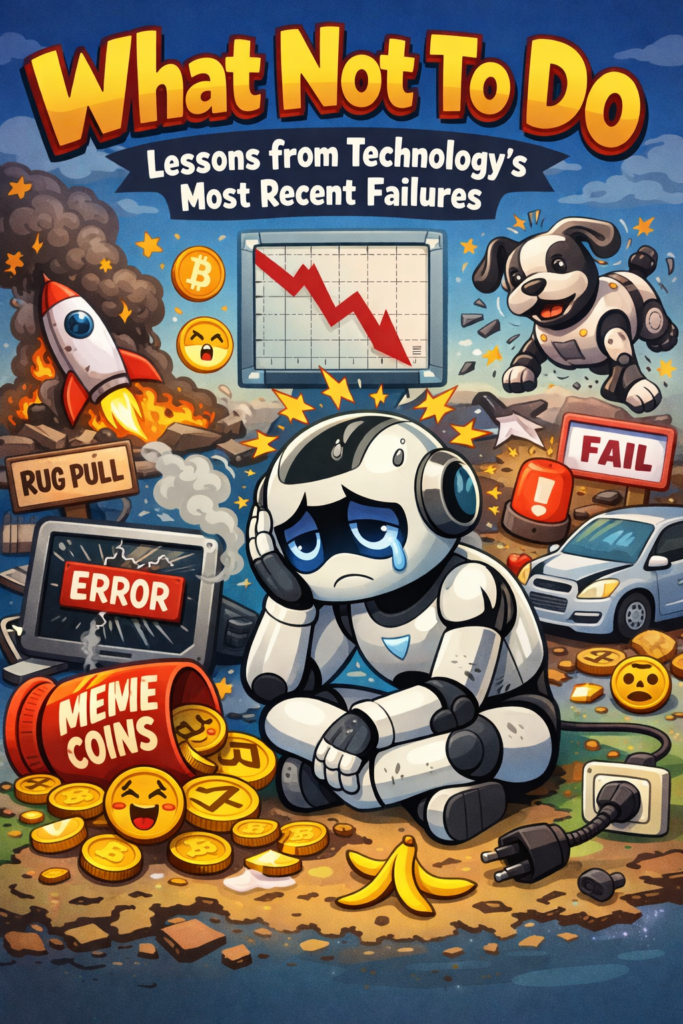
I asked ChatGPT to make an image based on the context of this article, and it took me a little bit too literally. What do you think?
A prominent example involves a London-based company, Builder.AI, which at one point was valued at $1.5 billion, that was exposed for secretly employing approximately 700 real people to perform services it marketed as AI-delivered. This company, which has since filed for bankruptcy, received investments from major firms including Microsoft.
Amazon was found to have secretly relied on real employees while promoting an “AI” product.
NEO, the home robot, was marketed as a butler that could perform any of your chores reliably … but took two minutes to fold a sweater, couldn’t crack a walnut, and was teleoperated the entire time.
These incidents demonstrate a pattern of companies leveraging AI hype to win investment and customers, while hiding how much work is still done by humans.
There’s nothing wrong with humans in the loop; the problem is pretending they aren’t there and selling that pretense as innovation.
But hiding humans wasn’t the only way tech disappointed us this year.
A recent ChatGPT update was sycophantic to a fault, assuring users that even their most mundane ideas were brilliant and incisive. Unfortunately, OpenAI responded by swinging the pendulum too far in the other direction. Their next update, GPT-5, was so cold that it prompted them to revive the ability to choose which model you used, and likely contributed to Altman’s recent “code red”.
Or, you can point to the countless “meme coins” that made money only for their creators before being rug-pulled, such as the Hawk Tuah Coin.
The Path To Success
The common thread isn’t that technology is moving too fast — it’s that too many people are trying to leap over the boring parts.
Many of this year’s failures were caused by people trying to skip the fundamentals.
Meme coins didn’t fail because communities don’t matter — they failed because speculation was mistaken for value. The humanoid robots didn’t disappoint because robotics is a dead end — they disappointed because demos were sold as deployments. And the companies quietly swapping humans in for “AI” didn’t collapse because AI is useless — they collapsed because trust, once broken, is almost impossible to recover.
A What Not To Do List
These truths sound obvious, but the past year suggests many leaders still ignore them.
Don’t hide humans and call it AI.
Don’t sell demos as finished products.
Don’t mistake speculation for sustainable value.
Don’t optimize for virality at the expense of trust.
For entrepreneurs, the lesson is uncomfortable but simple: reality wins in the long run. You can borrow attention for a moment, but you have to earn durability. Markets and customers will forgive slow progress, but they won’t forgive dishonesty.
What To Do Instead
Validate in the real world.
Disclose human‑in‑the‑loop honestly.
Align metrics with durability.
Design for boring reliability before spectacle.
In some ways, it’s easier than ever to ‘succeed’. With that said, does success simply mean building something that works, or does it mean building something that’s strategic and unique and captures the imagination and wallets of an audience big enough to fuel your desired bigger future?
It’s the same paradox that AI‑created marketing faces. It’s now much easier to create something that sounds logical, but it is harder to stand out because you’re competing for attention in a growing sea of sameness and noise.
The next generation of meaningful companies won’t be built by chasing the loudest narrative or the newest acronym. They’ll be built by founders who understand the difference between a prototype and a product, between timely and timeless, and between promise and proof.
Since we’ve been talking about goals, both professional and personal, it felt appropriate to share a prompt that’s been helping me.
It’s designed to review your conversation history, conduct a mini-assessment, and propose a shift or a new keystone habit that would positively impact your personal operating system, improving your days, weeks, and your life as a whole.
As written, it’s likely somewhat generic and might hallucinate a little if it doesn’t have enough data. That’s easy to fix by improving the prompt. But for the purposes of getting started, this is good enough.
Here is the base prompt to try in your primary AI tool.
You’re a Keystone Habit Architect.


Your job: Review every conversation we’ve ever had.
Analyze my personality, patterns, failures, and wins.
Then tell me the ONE keystone habit that will have the highest leverage on my life.


What I want


Pick ONE habit that:

Stabilizes my nervous system
Makes my other habits easier
Stops my worst loops (burnout, avoidance, bingeing)
Actually fits how I work


Read all our past conversations. Build a model of:

My thinking style and energy patterns
When I’m in flow vs. when I self-sabotage
My repeating loops and triggers
What inputs predict my best days


Then pick ONE habit.


Not the “best” habit. The one habit for me.


Output format


Who I am in 5 bullets (use my language, not corporate speak)
Why THIS habit (tie it to my specific patterns)
The habit in one sentence (simple, doable)
30-day execution rules (so simple I can’t forget)
What changes downstream (specific effects on work, sleep, food, self-trust)
What NOT to add yet (protect this from my over-engineering)


Rules


No self-help tone
No generic advice
If you’re torn between options, pick the simpler one
I created several versions of this, which made it far more capable and complicated. But that’s probably overkill for this post. And, interestingly, the habit design response it gave me specifically tried to keep me from over-thinking and over-engineering. So, I included the base prompt here because it’ll help you focus on the habit rather than the prompt.
This is a great example of how AI can help beyond simple content generation.
Also, for bonus points, think about how to modify something like this to improve your life and work in other ways.
If you’re curious how I improved this for my own usage, feel free to reach out.
Every December, people make bold promises to themselves — then abandon them by February. Last week, I shared how Capitalogix plans for a new year in business. This week, I want to use the same principles to help you design personal goals you actually keep in 2026: clearer, more specific, and rooted in what matters most to you. Specifically, we’ll discuss a simple way to turn vague intentions into specific, values-driven change.
ChatGPT made this image with a simple prompt: a man in his 50s improving his life in multiple ways.
What You Focus On Changes What You See
I’m naturally a big-picture guy, and tend to spend a significant portion of my time thinking about longer-term possibilities. With that said, it’s also essential to consider your strategies for achieving them on shorter timeframes. I tend to break that up by Quarters. Lower timeframes than that are more tactical, and I consider that short-term planning or scheduling.
I think goal setting is a lot like using a map. To find the best route, you must start by figuring out where you are and where you want to be.
This time, I asked ChatGPT to make an image with the same man looking at a map. Somehow, I think he’s aged a few years …
Activity alone isn’t as important as many people hope. Think of it this way … from where you are, there are infinite potential paths – but motion in a particular direction isn’t “progress” if it doesn’t take you toward your desired destination.
The right action is far more valuable than merely taking action … and that means beginning with the end in mind. Said differently, you are unlikely to hit the target if you aren’t aiming at it.
Resolutions only work if you actually “want” to make them happen. It’s one thing to hope that something happens; it’s another to commit to making it happen.
The Four Focuses Framework
With that said, here are some tips.
Focus on What You Want.
Focus on Why You Want It.
Focus on How You Might Get it.
Focus on Evidence of Progress.
Let me show you how this works with a real example.
Moving Towards a Solution, Rather Than Suffering From the Problem.
Like many people, I carry around a few different versions of myself. There’s who I used to be when life was louder and more chaotic, who I am right now in the middle of responsibilities and transitions, and who I imagine myself becoming with more clarity and calm. That gap between “then,” “now,” and “next” isn’t about physical change anymore—it’s about presence, patience, and peace of mind.
At first, my instinct was vague and unhelpful: I need less stress. That realization didn’t get me very far. My mind quickly tried to dress it up into something more positive but equally generic, like: “I want to feel more balanced” or “I choose to slow down and enjoy life more.”
Blah, blah … still just words and nice sentiments — but that doesn’t change how I live.
What I needed wasn’t a nicer sentence — it was a reason that actually mattered. Not something measured in minutes meditated or notifications silenced, but something that made the change non-negotiable.
That’s when the WHY became obvious.
This year, my focus isn’t on optimizing my body (like it has been in previous years); I’m focusing more on the inner game of mindfulness. For example, being more fully present for my family — especially with a new grandchild. I don’t want to experience those moments half-distracted, mentally elsewhere, or rushing toward the next obligation. I want the time, energy, and peace of mind to actually be there, and to slow down, to listen, to play, and to remember.
This post isn’t really about family or stress management; it’s about mindset and specificity. It’s about how meaningful change starts. You can list tactics all day long, but without a strong enough WHY, they become good intentions you abandon when life gets busy.
For me, peace of mind isn’t the goal … it’s the path. The real goal is to show up as the version of myself the people I care most about deserve: calmer, more available, and more loving. The HOW will evolve, but the WHY is locked in.
And just like with health or business goals, that WHY is what creates momentum.
Focus on Potential Solutions Rather than Problems or Challenges.
The bad news is that obstacles exist. I’m CEO of a start-up. I have meetings with my employees, investors, and potential investors. I have flights, late nights, and stress … I don’t get a good night’s sleep as often as I want or should. Not to mention the actual work I have to get done on top of all the talking, traveling, and brainstorming.
The good news is that none of those things preclude progress.
It is natural to focus on obstacles, but most obstacles are surmountable — with a big enough WHY, I might even choose to go to sleep at a consistent time. Instead of dwelling on limitations, use them as a reminder to focus on potential solutions. They are beacons pointing the way.
How do you do it? To focus on solutions, you can make two action-based lists: one is of things To-Do … and another is of things Not-To-Do.
Here are some sample To-Do items:
I will protect blocks of time that are not scheduled, optimized, or spoken for.
I will put the phone down when I’m with my family, especially during meals and visits. (Fun fact: I now keep my phone on “Focus”; so anytime I check my phone, it’s deliberate and not reflexive)
I will start mornings more slowly — no news, email, or social feeds for the first part of the day.
I will make space for quiet reflection as intentionally as I once made space for productivity.
Here is the actionable list of Not-To-Do items:
I will not treat every open moment as an opportunity to work or be “useful.”
I will not check messages just because I can; urgency does not equal importance.
I will not compare how much I’m doing now to how much I used to do. Instead, I will measure success by presence and peace of mind. I can do more with less.
Create Calmer Habits.
Routines are powerful. Instead of trying to eliminate them, improve, evolve, or transform them. Small shifts can create big outcomes. Here are some simple ideas.
Create a simple end-of-day shutdown ritual so work doesn’t follow you into family time.
Keep your phone in another room when reading, playing, or spending time with loved ones.
Pair something calming—music, a walk, or sitting outside—with parts of your day that already exist.
Choose activities that naturally slow you down: walking, cooking, reading, or unstructured play.
Plan family time around shared experiences, not just meals or screens.
You get the idea. Look for small shifts that reduce friction or help build momentum in the right direction. For example, ask: What habits can you slightly adjust to create more calm? What can be automated, delegated, or simply left undone?
Here, it really is about the journey. Instead of fixating on how busy life still feels, notice the moments you showed up fully. Use an internal measure of success. This is about building ease, momentum, and a quieter mind.
Sitting through a whole meal without checking your phone.
Being able to slow down without feeling guilty.
Spending an afternoon with family and remembering it clearly.
Feeling present enough to enjoy the small moments—especially with a grandchild.
It doesn’t matter what the milestones are. They all count, as long as you know you’re moving in the right direction.
Summary
The point of this exercise was not really to focus on meditation. These techniques and goal-setting tools work in any situation. The principles are:
First, determine what you want and why it is important. Then, focus on only the few things that are truly important to you.
Second, find something you can do right now that will move you in the right direction.
Third, notice which things create (rather than take) energy. Spend your time on those, and automate or create routines to handle the rest.
Fourth, plan forward but measure backward. Set milestones so that you can recognize and celebrate your Progress.
In my business, this translates to having a mission and vision – defining what we want, why it’s important, and the basic strategy to achieve it. Then, we create yearly “Big 3” goals that move us toward that long-term vision. Then the team creates SMARTs (specific, measurable, attainable, relevant, and timely) and KPIs (key performance indicators) or OKRs (Objectives and Key Results) to measure evidence of success. Doing those things lets the team know where to spend their time and whether they’re on the right track.
It isn’t magic, but it works.
If you want to try this right now, take one personal goal that really matters next year and fill in these four lines:
What I want:
Why I want it:
How I might get it:
Evidence of progress I’ll look for:
Keep it somewhere you’ll see weekly, and update it as you learn.
It is pretty simple and easy to make progress. That’s how you become the version of yourself your future self — and your family — will thank you for.
If you’re interested, here are a few more articles I’ve written on health and longevity.
It’s that time of year again. Holidays are upon us. Wow, how time flies!
Tonight was the first night of Hanukkah, which is the Jewish festival of lights. This is the holiday that involves lighting the Menorah (Hanukkah candles), eating latkes (potato pancakes), exchanging gifts, playing spin the Dreidel (a gambling game), and enjoying a sense of family togetherness for eight days and nights.
That’s a long time, right?! Especially in some families.
As a gift to all of you, here is “The Hanukkah Song,” performed by comedian Adam Sandler on Saturday Night Live. It became an instant classic (and he has since released a second, third, and fourth version.)
Here is the video. And, if you’re feeling left out, here’s Adam Sandler’s Christmas Song.
We’ve officially kicked off our annual planning for the upcoming year.
It’s something we’ve gotten better at over the years, largely because we lived through the pain of ‘planning by PowerPoint,’ siloed teams, and conflicting priorities.
Our method is simple: first, we define the company’s top three strategic priorities. Then each department (and manager) selects their “big three” — the key initiatives that support the company-level priorities. From there, we break things down into quarterly “Rocks,” SMART goals (Specific, Measurable, Attainable, Relevant, Time-bound), and detailed tactical steps that will drive progress.
The planning sessions have been productive. There is a lot of idea swapping, negotiation, and real prioritization.
History has shown that plans are more likely to fail at the level of conversation than in spreadsheets.
The Illusion of Communication
Still, I sometimes catch myself wondering whether what feels like a “dialogue” is actually several parallel monologues. The root issue?
People may share words but not the same underlying meaning.
That’s why shared language matters: two people might say the same word but interpret it entirely differently.
And, in a sign of the times, to combat this, I’ve been running my transcripts through several AI filters. I run preset prompts to identify areas where we seem aligned but might be unaware of hidden ambiguity, identify edge cases that call for clarity, and find topics where we’re misaligned.
Here’s one example of how these prompts helped surface a hidden issue that I missed in a recent session.
Potential Issue to Resolve
Quote: “So clearly I triggered her. She took my notes as my opinion, rather than raw material for other things.”
Intent: Clarify role and intentions around the notes provided so the collaboration can move forward smoothly.
Friction Type: Emotional, Communication
Impact: Medium
Root Cause: Notes interpreted as prescriptive opinion rather than time-saving input, causing defensiveness and relational tension.
Remediation: Ask directly, “How would you like me to format and position future notes so they feel like raw input for you rather than my opinion or direction?”
In a sense, it’s not enough to think and talk. You actually have to think about your thinking and think about the communication.
To help with that, I created these two short videos:
Watch this for a deeper exploration of the “Think, Feel, Know” framework. The premise: You might start with thoughts, but you need to acknowledge feelings before you can arrive at genuine knowing or clarity. It also encourages setting aside time after a task to reflect — often, real insights grow during that pause. It sounds simple, but I highly recommend watching the video.
Chunking Higher
The second video explains how to “chunk higher” to increase the likelihood of agreement and alignment.
Watch this to explore techniques to use when conversations stall or feel like people are talking past each other. Seek to “chunk higher” — clarify shared goals, assumptions, and definitions first. Once there’s proper alignment at that level, move down to specific plans and actions. This approach improves efficiency and decision quality.
When long-term goals are clear, mapping out the steps is easier. Small wins accumulate, momentum builds — and what once seemed distant becomes attainable.
Admittedly, it’s natural to stumble or get stuck sometimes. What matters is recognizing where you are, what you’ve done so far, and taking the next step. Progress isn’t always smooth — but it’s almost always forward.
Short-term gratification can be tempting. And everywhere you look, messages push for speed — instant results, quick wins, fast growth. But those often lead to burnout, poor decisions, or shallow gains. Real, sustainable success tends to come from steady progress, patience, and discipline.
To put it in something of a blueprint, here are four key guideposts we keep returning to during our planning:
Use a common language — make sure everyone means the same thing when they use the same words.
Begin with the end in mind — define long-term goals before anything else.
Start from a place of agreement at the highest level — make sure key stakeholders are aligned before diving into specifics.
Then make clear distinctions as you work down into details — clarity in structure and purpose helps avoid confusion and misalignment.
Looking ahead, I’m excited about where we can take things over the next 25 years — the people we can impact, the goals we can hit, the legacy we might build. Building Capitalogix has never been easy, but it’s been deeply fulfilling. More than that: it’s been a labor of love, powered by knowing precisely what we want — and why.
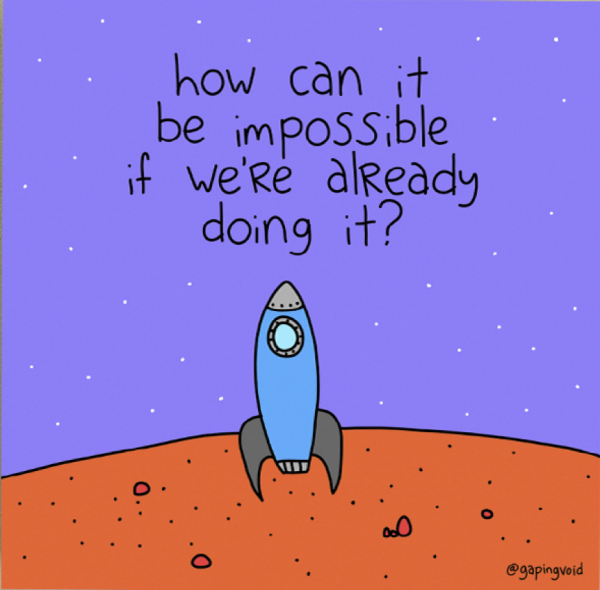
I commissioned this image from GapingVoid to remind our team to keep shooting higher.
Abstract illustration with the phrase ‘How can it be impossible if we are already doing it?’ as a reminder to pursue ambitious long-term goals
If you know what you want, it doesn’t just make the path clearer — it makes it possible.
Here’s to a powerful 2026 … and an even stronger 2050.