
Here are some of the posts that caught my eye recently. Hope you find something interesting.
Lighter Links:
Trading Links:

Here are some of the posts that caught my eye recently. Hope you find something interesting.
Lighter Links:
Trading Links:
I am often amazed at how little human nature has changed throughout recorded history.
Despite the exponential progress we’ve made in health, wealth, society, tools, and understanding … we still struggle to find meaning, purpose, and happiness in our lives and our existence.
Last month, I shared an article on Global Happiness Levels in 2025. Here are a few bullets that summarize the findings:
Upon reflection, that post didn’t attempt to define happiness. This post will focus on how to do that.
While it seems like a simple concept, happiness is complex. We know many things that contribute to and detract from it; we know humans strive for it, but it is still surprisingly challenging to put a uniform definition on it.
A few years ago, a hobbyist philosopher analyzed 93 philosophy books, spanning from 570 BC to 1588, in an attempt to find a universal definition of Happiness. Here are those findings.
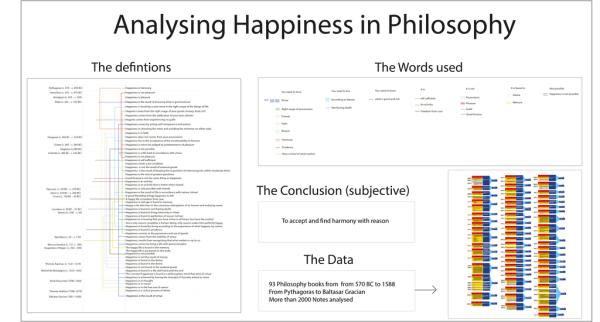
via Reddit.
It starts with a simple list of definitions from various philosophers. It does a meta-analysis to create some meaningful categories of definition. Then it presents the admittingly subjective conclusion that:
Happiness is to accept and find harmony with reason.
My son, Zach, pointed out that while “happiness” is a conscious choice, paradoxically, the “pursuit of happiness” often results in unhappiness. Why? Because happiness is a result of acceptance. However, when happiness is the goal, you often focus on what you’re lacking instead of what you already have. You start to live in the ‘Gap’ instead of the ‘Gain’.
So, it got me thinking – and that got me to play around with search and AI, a little, to broaden my data sources and perspectives. If you would like to view the raw data, here are the notes I compiled (along with the AI-generated version of what this article could have been, had it been left to AI, rather than me and Zach).
Reach out – I’m curious to hear what you think!
Billion-dollar startups are becoming increasingly common with VC funding surging, and an increased focus on exponential technologies.
VisualCapitalist put together an infographic based on May's PitchBook that highlights the newest Unicorns.
If you are curious, PitchBook defines Unicorns as venture-backed companies valued at $1 billion or more after a funding round, until they go public, get acquired, or drop below that valuation.
Here is the list for 2025.
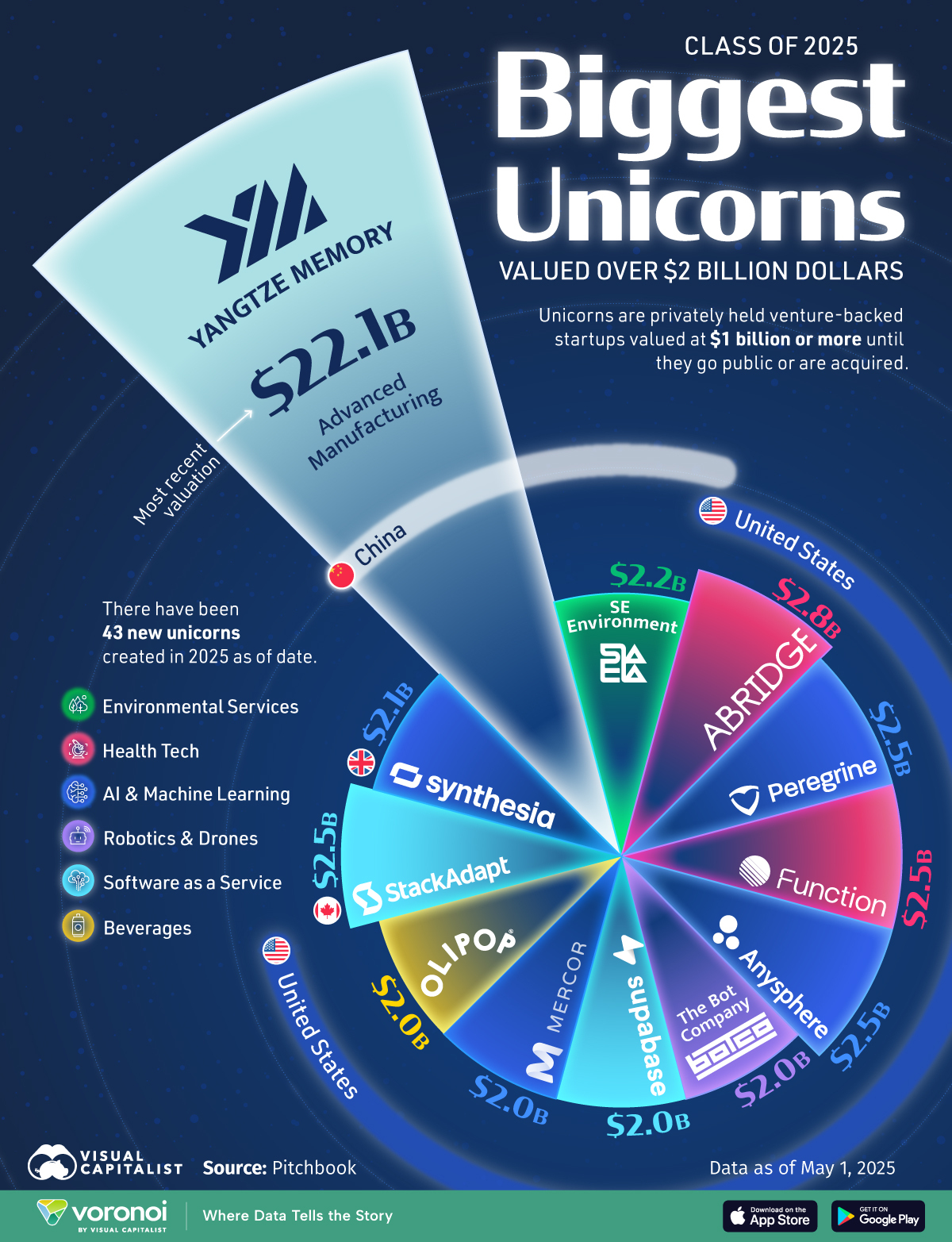
Pitchbook via visualcapitalist
Topping the list (and eclipsing every other company on the list) is Yangtze Memory out of China. They're focused on flash memory and solid-state drives. Yup, that's still a thing.
Also high on the list is Abridge, an American AI startup focused on turning doctors' conversations with patients into documentation. If you've ever talked with a clinician of any sort, you know how time-consuming documentation currently is. The combination of AI and longevity—or age reversal—is likely to become an increasingly hot area for investment.
Meanwhile, a rising tide floats many boats … and with the continuing rise of funding in AI, you'll also find a growing list of AI unicorns, like Peregrine, Synthesia, AnySphere, Mercor, and The Bot Company.
Although these individual companies are interesting, the larger trend is probably more significant.
There have been 43 new unicorns in 2025 alone. And while the most profitable unicorns from 2024 are still OpenAI, ByteDance, and SpaceX, their competition is on the rise.
I've been a tech entrepreneur for decades, so I'm used to the constant march of progress. But this feels different. The pace is quickening!
We certainly live in interesting times!

Here are some of the posts that caught my eye recently. Hope you find something interesting.
Lighter Links:
Trading Links:
The U.S. Treasury is ceasing production of pennies – as they cost more to make than they’re worth.
According to a 2024 report from the U.S. Mint, we lose $85M a year minting pennies, as they cost 3.69 cents to make.
That makes the phrase “penny wise and pound foolish” officially passé – at least in America.

Many phrases like this still exist. It’s an interesting example of the power of language. Words take on meaning beyond their original usage … and often remain relevant long after their origin has become irrelevant.
For example:
Until recently, technologies (and the phrases they spawned) lasted for decades, if not longer. As technology evolves at an ever-accelerating pace, new tools, platforms, and ways of communicating emerge almost daily. With these innovations come fresh slang, buzzwords, and cultural references that often catch on quickly—think “DM me,” “ghosting,” or “cloud computing.” Yet just as rapidly as they rise, many of these terms fade into obscurity, replaced by the next wave of trends. What was once cutting-edge can become outdated in a matter of years, if not months. This cycle of innovation and obsolescence is a hallmark of the modern digital era.
However, much like these old idioms, the fleeting nature of these technologies and jobs doesn’t mean they lack value or impact. Some expressions endure because they capture something universally human—emotion, conflict, humor—even if the context changes. Similarly, technologies may evolve, but their core functions or purposes often remain. The fax machine gives way to email, and email to instant messaging—but the need for communication is constant.
This principle also applies to work and tools. While job titles and methods may change, the underlying skills — such as critical thinking, collaboration, and creativity — remain timeless. A carpenter today might use laser-guided saws instead of hand tools, just as a marketer might use data analytics instead of intuition alone, but the essence of their work persists. Innovation reshapes how we do things, not always what we do.
Just as enduring phrases carry forward old meanings in new settings, so too will jobs, tools, and skills adapt and survive.
Onwards!