Back in the 1960s, Illinois Senator Everett Dirksen famously quipped, "A billion here, a billion there — pretty soon, you're talking real money."
To get a sense of how Trillions currently are discussed in Congress, watch this.
How quaint … Recently, Trillion has become the new billion; especially when we're talking about government debt, government budget, and the budget deficit.
What follows are a few creative ways to look at the U.S. government budget and what's happening to our national debt.
1. The U.S. Government Budget Compared to an American Household
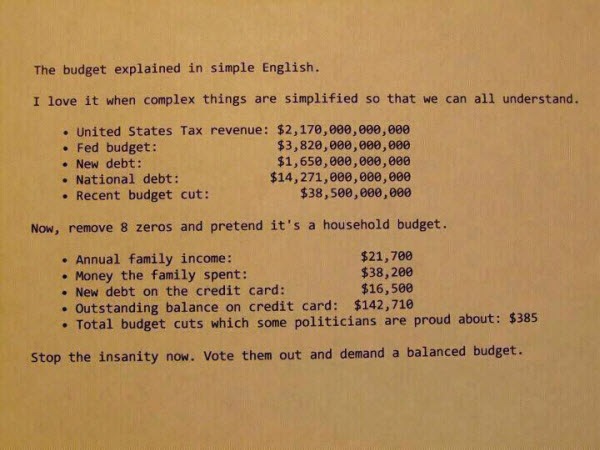
This has been making the rounds. I saw several copies on social media sites, and it puts things in a format most of us can understand easily.
I'm not sure of its source, but you can also see a version of it in this video showing CNBC correspondent, Rick Santelli, explaining the government budget and the budget deficit.
2. U.S. Government Debt Illustrated in Pictures
The national debt clock continues ticking.
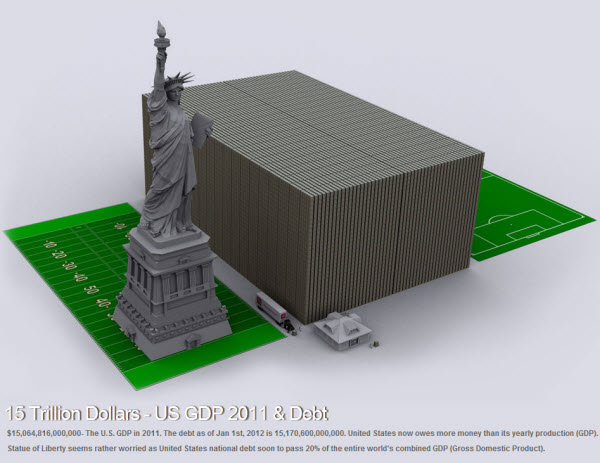
Here is what the $15 trillion U.S. debt looks like when it is piled up in stacks of $100 bills.
Do you see the the tiny-in-comparison tractor trailer? Squint, and you can see the barely visible human in front of it.
These are some big numbers. But as Nicholas Vardy points out, the focus on U.S. debt ignores once crucial factor — the value of the balance sheet or accumulated wealth of the United States. That figure probably stands between $150 trillion and $200 trillion. That amount is 10- to 13-times the size of the current U.S. government debt.
In other words, the U.S. is not going to the poor-house anytime soon. But the trends are sobering, nonetheless.