April 2009

  • It Is Only A Problem Until You Know The Solution

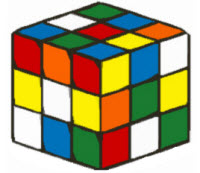
    090410 Rubik's Cube

    Some challenges seem tough to solve … until you know the solution.

    When I was younger, I spent hours twisting and turning a Rubik's Cube.  It seemed random or even impossible until I found the solution. 

    Then it got a lot more fun.

    Want to solve it yourself?

    Here is the direct link to the video.

  • It Is Only A Problem Until You Know The Solution

    090410 Rubik's Cube

    Some challenges seem tough to solve … until you know the solution.

    When I was younger, I spent hours twisting and turning a Rubik's Cube.  It seemed random or even impossible until I found the solution. 

    Then it got a lot more fun.

    Want to solve it yourself?

    Here is the direct link to the video.

  • Capitalogix Commentary 04/05/09

    The U.S. Markets moved higher for the fourth week in a row. This is just the fifth positive week for these indices in 2009.

    The public notices!  I had a guy approach me at the gym to ask if I thought he should start buying again.  He said he knew it could go back down, some, but isn't that "dollar-cost-averaging"?  And I got an e-mail from a friend asking me to recommend a trading course for his wife to take because she is starting to day-trade.  Those things whisper that sentiment is changing.  Hope the market does too.

    Rally Symmetry.

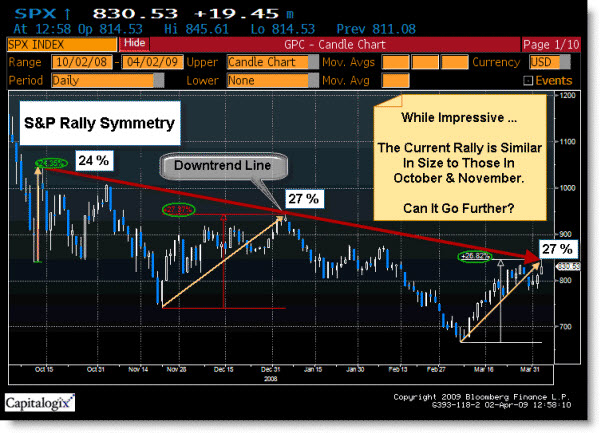
    While we are still in a downtrend on the longer timeframes, the size of the short-term rally is impressive.  This chart shows that the S&P 500 Index has rallied 27% off its March lows.

    090403 Rally Symmetry

    This is surprisingly similar to the size of the bear rally swings we saw in October and November.

    Is Rising On Bad News a Good Sign?

    The latest report on job losses showed that the American economy shed another 663,000 jobs in March and that unemployment rose to 8.5 percent. 

    While the Dow Jones Industrial Average initially fell on the news, it quickly shrugged-off the data, and closed back above 8,000 for the first time since early February.

    Bad news everywhere, and the Markets continued higher.  I thought it was an April Fool's joke.  It still may turn out that way?  In my book, though, that is a bullish sign.

    Another Bullish Sign, Markets Are Above Their 50-Day Moving Averages.

    For me, most notable is that our major indices are now above their 50-day moving averages for the first time in a very long time.  Even better, tech is leading the way. So until the 50-day is broken back to the downside, this market deserves some respect.

    Yes, shorter term, markets are overbought … but they have been overbought for more than a week. I can't believe I'm saying this … remember that overbought can also be a sign of strength.

    Recession Length.

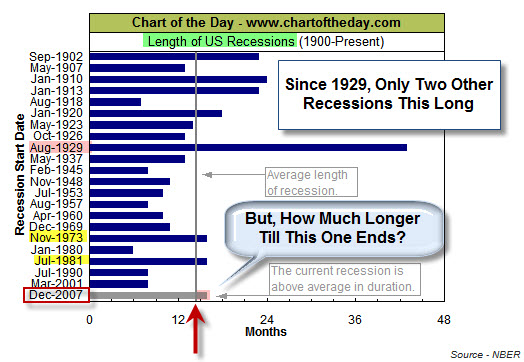
    While the stock market has rallied nicely since bottoming on March 9th, the economy continues to struggle. For some perspective on the current economic recession, the chart below illustrates the duration of all US recessions since 1900.

    The five longest recessions all began prior to 1930. The length of the current recession (now entering its 16th month) is above average, and equal to the longest recessions (1973 & 1981) since the Great Depression.

    090403 Recession Length

    Since it is unlikely that the Recession is over, the question is how much longer till it ends?

    In addition, something I'm paying more attention to is the amount of talk I'm hearing about the inevitable devaluation of the dollar.  Let me know what you think about it.

    Business Posts Moving the Markets that I Found Interesting This Week:

    • How Can Small Investors Get In on the Bailout? (NYTimes)
    • A Few Drops Don't Make the Glass Half Full. (Barrons)
    • Have We Nationalized Banks in response to the current economic crisis? (Duke)
    • Credit bubble looms as investors rush to credit, distressed debt and CTA's. (Reuters)
    • G-20 Expands IMF Lending Powers to $1 Trillion to reignite world growth. (WSJ)
    • More Posts Moving the Markets.

    Lighter Ideas and Fun Links that I Found Interesting This Week

  • Capitalogix Commentary 04/05/09

    The U.S. Markets moved higher for the fourth week in a row. This is just the fifth positive week for these indices in 2009.

    The public notices!  I had a guy approach me at the gym to ask if I thought he should start buying again.  He said he knew it could go back down, some, but isn't that "dollar-cost-averaging"?  And I got an e-mail from a friend asking me to recommend a trading course for his wife to take because she is starting to day-trade.  Those things whisper that sentiment is changing.  Hope the market does too.

    Rally Symmetry.

    While we are still in a downtrend on the longer timeframes, the size of the short-term rally is impressive.  This chart shows that the S&P 500 Index has rallied 27% off its March lows.

    090403 Rally Symmetry

    This is surprisingly similar to the size of the bear rally swings we saw in October and November.

    Is Rising On Bad News a Good Sign?

    The latest report on job losses showed that the American economy shed another 663,000 jobs in March and that unemployment rose to 8.5 percent. 

    While the Dow Jones Industrial Average initially fell on the news, it quickly shrugged-off the data, and closed back above 8,000 for the first time since early February.

    Bad news everywhere, and the Markets continued higher.  I thought it was an April Fool's joke.  It still may turn out that way?  In my book, though, that is a bullish sign.

    Another Bullish Sign, Markets Are Above Their 50-Day Moving Averages.

    For me, most notable is that our major indices are now above their 50-day moving averages for the first time in a very long time.  Even better, tech is leading the way. So until the 50-day is broken back to the downside, this market deserves some respect.

    Yes, shorter term, markets are overbought … but they have been overbought for more than a week. I can't believe I'm saying this … remember that overbought can also be a sign of strength.

    Recession Length.

    While the stock market has rallied nicely since bottoming on March 9th, the economy continues to struggle. For some perspective on the current economic recession, the chart below illustrates the duration of all US recessions since 1900.

    The five longest recessions all began prior to 1930. The length of the current recession (now entering its 16th month) is above average, and equal to the longest recessions (1973 & 1981) since the Great Depression.

    090403 Recession Length

    Since it is unlikely that the Recession is over, the question is how much longer till it ends?

    In addition, something I'm paying more attention to is the amount of talk I'm hearing about the inevitable devaluation of the dollar.  Let me know what you think about it.

    Business Posts Moving the Markets that I Found Interesting This Week:

    • How Can Small Investors Get In on the Bailout? (NYTimes)
    • A Few Drops Don't Make the Glass Half Full. (Barrons)
    • Have We Nationalized Banks in response to the current economic crisis? (Duke)
    • Credit bubble looms as investors rush to credit, distressed debt and CTA's. (Reuters)
    • G-20 Expands IMF Lending Powers to $1 Trillion to reignite world growth. (WSJ)
    • More Posts Moving the Markets.

    Lighter Ideas and Fun Links that I Found Interesting This Week

  • A Breath of Fresh Air

    Do gadgets that help you focus on conscious breathing work?  I found three that worked for me: Resperate, Helicor's StressEraser, and Heart Math's emWave.

    My biggest complaint is that once I learned the relaxation techniques each of these devices teach,  I didn't need the device to get the results.  That also is a positive, isn't it?

    I think, feel, and communicate better when I'm calm.  Learning to access that state at will is an important skill … in business and personal life. 

    So, with that in mind, here are my impressions and experience with each.
    090403 Resperate
    Resperate
    .

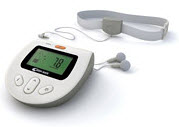
    The Resperate unit is a little bigger than a portable CD-ROM player, with a built-in elastic strap that goes around your ribcage to monitor your breathing.  The concept behind this tool is very simple.  It relaxes you by helping you slow your breathing down. 

    Resperate starts by pacing your in-and-out breaths with higher and lower pitched sound cues.  Over time it moves these tones farther apart, leading you to breathe slower and more deeply.

    How did it work?  It helped me move easily from 6 to 10 breaths-per-minute, down to two or three breaths-per-minute.  This promotes much deeper breathing and relaxes the body and mind.  I find that I enjoy using this tool for about 10-minutes at a time; and I definitely feel relaxed after using it.  

    While Resperate provided the most relaxation, it is the one I use least.  Perhaps because it is a little bigger and requires the belt.  Not big hurdles; but apparently big enough.
    090403 StressEraser
    Helicor's StressEraser

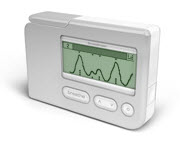
    The StressEraser is a portable biofeedback device, smaller than a deck of cards.  On the top, there is a hinged slot to put your finger.  The finger reader measures your pulse and galvanic skin response. There is also an LED screen on this device that helps you pace your breathing, and shows your level of stress or relaxation.

    Without focusing, the line is erratic and jagged.

    However, with only a little bit of training, it's easy to create a very smooth sign wave that indicates a steady breathing and a healthy heart rate pattern.

    With this tool, I get the best (most relaxing) results with an
    in-breath of about five seconds and an out-breath of about the same length. I like doing this for five minutes or so; it is a nice break in the middle of the day, before an important phone call, or a decision-making session. 

    I
    find that it
    helps me focus. Of the three tools, this is the one I find myself using most often.  This might be because I like the graph and how it gives me instantaneous feedback about my breathing and focus.
    090403 emWave
    HeartMath's emWave
    .

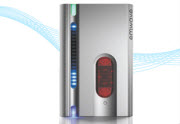
    This is the smallest of the tools.  The emWave relies on either a thumb sensor or, my preference, a clip that attaches to your earlobe. The technique is very similar to what you learn with the StressEraser. It involves steady breathing and a focus on reducing heart beat variability.  It has four levels of challenge.

    It sounds strange, and I don't claim to understand the science behind it, however focusing your attention on your heart while doing the breathing exercise seems to make a difference.  Somehow, when you focus your attention on your heart, that is when the machine changes color to indicate that there is "coherence". And, in my experience, this is the most relaxing part of the exercise. More coherence equals less stress.

    I tend to use this tool less than five minutes at a time to feel calm and refreshed.  It was also the easiest for me to have success with (in this case, to get the "green light" to come on).  So, the emWave is the smallest, easiest and quickest of the three … and it works.  I'm going to use this more often.

    So why did I use one that is more challenging?  Habit, or perhaps that defines part of the reason I need to relax?
  • A Breath of Fresh Air

    Do gadgets that help you focus on conscious breathing work?  I found three that worked for me: Resperate, Helicor's StressEraser, and Heart Math's emWave.

    My biggest complaint is that once I learned the relaxation techniques each of these devices teach,  I didn't need the device to get the results.  That also is a positive, isn't it?

    I think, feel, and communicate better when I'm calm.  Learning to access that state at will is an important skill … in business and personal life. 

    So, with that in mind, here are my impressions and experience with each.

    090403 Resperate
    Resperate
    .

    The Resperate unit is a little bigger than a portable CD-ROM player, with a built-in elastic strap that goes around your ribcage to monitor your breathing.  The concept behind this tool is very simple.  It relaxes you by helping you slow your breathing down. 

    Resperate starts by pacing your in-and-out breaths with higher and lower pitched sound cues.  Over time it moves these tones farther apart, leading you to breathe slower and more deeply.

    How did it work?  It helped me move easily from 6 to 10 breaths-per-minute, down to two or three breaths-per-minute.  This promotes much deeper breathing and relaxes the body and mind.  I find that I enjoy using this tool for about 10-minutes at a time; and I definitely feel relaxed after using it.  

    While Resperate provided the most relaxation, it is the one I use least.  Perhaps because it is a little bigger and requires the belt.  Not big hurdles; but apparently big enough.

    090403 StressEraser
    Helicor's StressEraser

    The StressEraser is a portable biofeedback device, smaller than a deck of cards.  On the top, there is a hinged slot to put your finger.  The finger reader measures your pulse and galvanic skin response. There is also an LED screen on this device that helps you pace your breathing, and shows your level of stress or relaxation.

    Without focusing, the line is erratic and jagged.

    However, with only a little bit of training, it's easy to create a very smooth sign wave that indicates a steady breathing and a healthy heart rate pattern.

    With this tool, I get the best (most relaxing) results with an
    in-breath of about five seconds and an out-breath of about the same length. I like doing this for five minutes or so; it is a nice break in the middle of the day, before an important phone call, or a decision-making session. 

    I
    find that it
    helps me focus. Of the three tools, this is the one I find myself using most often.  This might be because I like the graph and how it gives me instantaneous feedback about my breathing and focus.

    090403 emWave
    HeartMath's emWave
    .

    This is the smallest of the tools.  The emWave relies on either a thumb sensor or, my preference, a clip that attaches to your earlobe. The technique is very similar to what you learn with the StressEraser. It involves steady breathing and a focus on reducing heart beat variability.  It has four levels of challenge.

    It sounds strange, and I don't claim to understand the science behind it, however focusing your attention on your heart while doing the breathing exercise seems to make a difference.  Somehow, when you focus your attention on your heart, that is when the machine changes color to indicate that there is "coherence". And, in my experience, this is the most relaxing part of the exercise. More coherence equals less stress.

    I tend to use this tool less than five minutes at a time to feel calm and refreshed.  It was also the easiest for me to have success with (in this case, to get the "green light" to come on).  So, the emWave is the smallest, easiest and quickest of the three … and it works.  I'm going to use this more often.

    So why did I use one that is more challenging?  Habit, or perhaps that defines part of the reason I need to relax?