Warren Buffett is a legend for many reasons. Foremost among them might be that he's one of the few investors who clearly has an edge … and has for a long time.
While many people consider Buffett to be an investor, I also consider him to be an entrepreneur.
At the age of six, he started selling gum door to door. Obviously, selling gum wasn't the key to his path to riches. So, how did he make his first million? Here's a video that explains it.
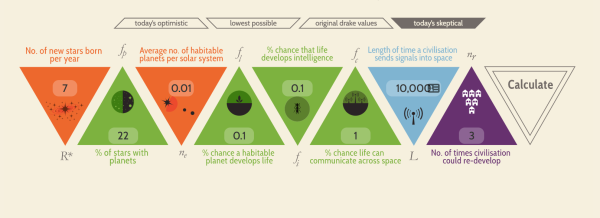
Information Is Beautiful has an interactive data visualization to help you decide if we're alone in the Universe.
As usual, for them, it is well done, fun, and informative.
For the slightly geeky amongst us, the model lets you adjust the estimate by playing with two equations: the Drake equation and the Seager equation.
The Drake equation estimates how many detectable extraterrestrial civilizations exist in our galaxy and then in the Universe based on factors like habitable planets, change of life, and then intelligent life, and then the amount of time a civilization sends signals into space.
The Seager equation is a modern take on the equation focusing on bio-signatures of life that we can currently detect – for example, the number of observable stars/planets, what % have life, and then % chance of detectable bio-signature gas.
For both equations, Information Is Beautiful lets you look at various default options – but also to play with your own choices to adjust the outcomes.
For example, the skeptical default answer for Drake's equation shows 0.0000062 communicating civilizations in our galaxy (which is still 924,000 in the Universe). The equivalent for Seager's equation shows 0.0009000 planets with detectable life in our "galactic neighborhood" and 135,000,000 planets in our Universe.
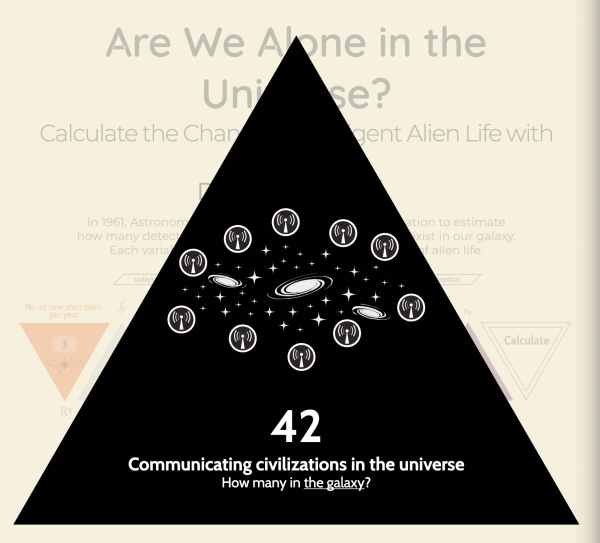
Even with the "lowest possible" selection chosen, Drake's equation still shows 42 communicating civilizations (Douglas Adams, anyone?) in the Universe.
One of the most interesting numbers (and potentially significant numbers for me) is the length of time a civilization sends signals into space. Conservative numbers are 420 years, but optimistic numbers are 10,000+.
If any aliens are reading this … don't worry; I won't tell. But, we will find out if you voted in the last election.
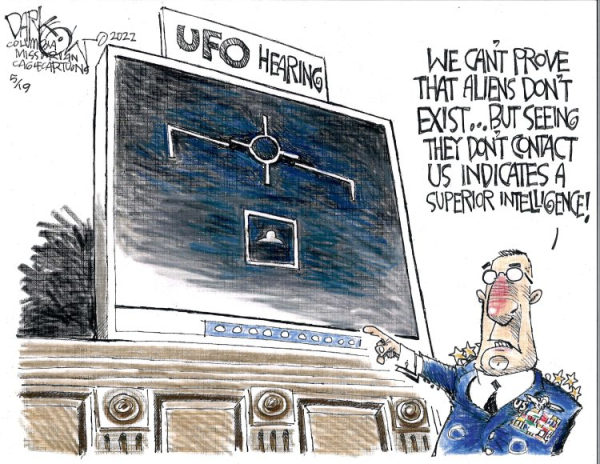
This week, there was a U.S. congressional hearing on the existence of UFOs. While there wasn't any proof of aliens, they did admit to phenomena that they couldn't explain with their current information.
There are many stories (or theories) about how we have encountered aliens before and just kept them secret. For example, in 2020, a former senior Israeli military official proclaimed that Aliens from a Galactic Federation have contacted us - and that not only is our government aware of this, but they are working together.
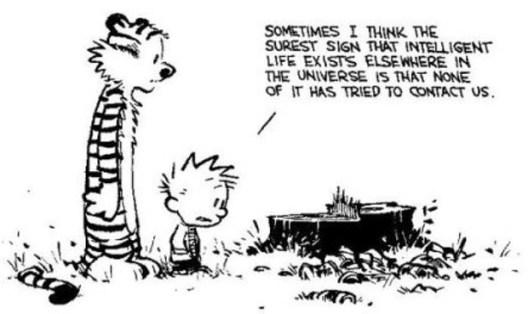
In contrast, I have found it more realistic and thought-provoking to consider theories about why we haven't seen aliens until now.
For example, the Fermi Paradox considers the apparent contradiction between the lack of evidence for extraterrestrial civilizations and the various high probability estimates for their existence.
Let's simplify the issues and arguments in the Fermi Paradox. There are billions of stars in the Milky Way galaxy (which is only one of many galaxies). Each of these stars is similar to our Sun. Consequently, there must be some probability of some of them having Earth-like planets. Further, it isn't hard to conceive that some of those planets should be older than ours, and thus some fraction should be more technologically advanced than us. Even if you assume they're only looking at evolutions of our current technologies – interstellar travel isn't absurd. Thus, based on the law of really large numbers (both in terms of the number of planets and the length of time we are talking about) … it makes the silence all the more deafening and curious.
If you are interested in the topic "Where are all the aliens?" Stephen Webb (who is a particle physicist) tackles that in his book and in this TED Talk.
In the TED talk, Stephen Webb covers a couple of key factors necessary for communicative space-faring life.
Habitability and stability of their planet
Building blocks of life
Technological advancement
Socialness/Communication technologies
But he also acknowledges the numerous confounding variables, including things like imperialism, war, bioterrorism, fear, moons' effect on climate, etc.
Essentially, his thesis is that there are numerous roadblocks to intelligent life – and it's entirely possible we are the only planet that has gotten past those roadblocks.
What do you think?
Here are some other links I liked on this topic. There is some interesting stuff you don't have to be a rocket scientist to understand or enjoy.
Just because something is overhyped, doesn’t mean it’s bad. Gartner's hype cycle is a great example of this. Every technology goes through inflated expectations and a trough of disillusionment, regardless of whether they're a success or failure. Sometimes a fad is more than a fad.
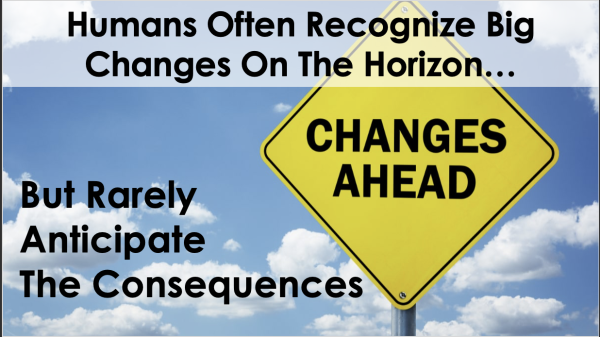
Humans are pretty bad at exponential thinking. We're not bad at recognizing periods of inflection, but we're very bad at recognizing the winners and losers of these regime changes.
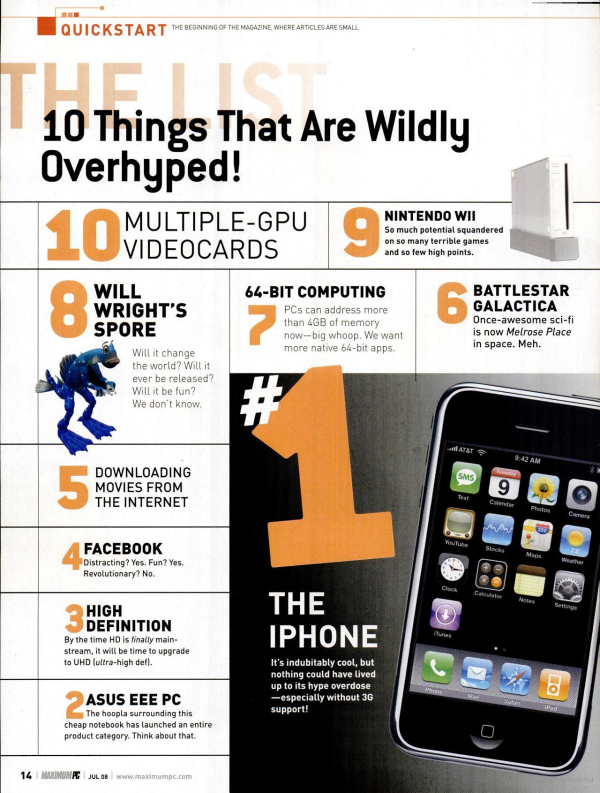
There are countless examples. Here's a funny one from Maximum PC Magazine in 2008. It shows that hype isn't always a sign of mistaken excess. This list purported to show things that were getting too much attention in 2008. Instead of being a list of has-beens and failures, many of these things rightfully deserved the attention.
It's been 14 years since this came out. How did the predictions hold up?
Facebook has become Meta, and is one of the big five. The iPhone has sold more than 2.2 billion phones, and accounts for more than half of Apple's total revenue. And the list keeps going. Multiple GPU video cards, HD, 64-bit computing, and downloading movies from the internet …
It's hard to believe how poorly this image aged.
The trend is your friend while it continues. Just because something is overhyped – doesn't mean you shouldn't be excited about it.
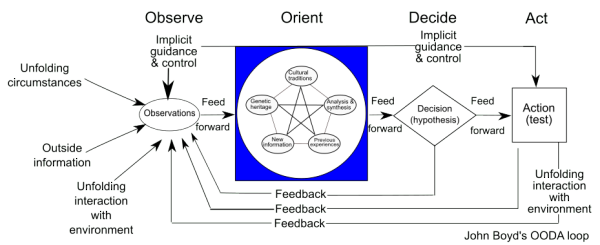
It is an iterative feedback model designed by Colonel John Boyd that serves as a foundation for rational thinking in chaotic situations like dogfights.
Why do people use decision models? Obviously, to make better decisions. But really, they use models to create a process that avoids many of the mistakes or constraints that prevent good decisions.
You make countless decisions every day – and at a certain point, you reach decision fatigue. It can be harder to make decisions when you are tired, after you've made too many, or when the intensity of the environment distracts or drains you.
It's one of the reasons I rely on artificial intelligence. Here are some others.
Best practice becomes standard practice.
It accounts for signal and noise.
It attempts to quantify or otherwise make objective assessments, comparisons, and choices.
And, it often gives you a better perspective by letting you apply and compare different models or decision techniques to achieve the desired outcome.
Nonetheless, many algorithms are dynamic and adaptive automation of processes or strategies that humans have used successfully before.
So, let's take a closer look at the OODA Loop, which stemmed from analyzing many interactions between and among fighter pilots during battle and training.
Observe
The first step is to observe the situation to build the most accurate and comprehensive picture possible. The goal is to take in the whole of the circumstances and environment. It's not enough to observe and collect information, you must process the data and create useful meaning.
It's the same with data collection for an AI system. Ingesting or collecting data isn't enough. You have to be able to apply the data for it to become useful.
Orient
This step is less intuitive but very important. When you orient yourself, you're recognizing strength, weakness, opportunity, and threat to identify how changing the dimensionality or perspective alters the outcome.
It's reconnecting with reality in the context of your cognitive biases, your recent decisions, and more. Have you received new information since starting?
I think of this as carrying a map and pulling out a compass while exploring new lands. Sometimes you need to remember where you started, and sometimes you need to make sure you're going where you think you are.
Decide
The last two steps provide the foundation for taking action. When there are multiple decisions in front of you, observing and orienting help you choose wisely.
In business and with AI, you can go through these loops multiple times.
Act
The best-made plans mean nothing if you don't act on them. Once you've taken action, you can reobserve, reorient, and keep moving forward.
Conclusion
Like most good mental models, The OODA loop works in many situations and industries.
Speed is often a crucial competitive advantage. For example, knowing (and taking decisive action) while others are still guessing (and taking tentative action) is something I call time arbitrage.
Said another way, you make progress faster by walking in the right direction than by running in the wrong direction.
These processes (and technology) also help us grow more comfortable with uncertainty and uncomfortableness. Markets are only getting more volatile. Uncertainty is increasing. But, when you have the ability to adapt and respond, you can survive and thrive in any climate.
At the beginning of the pandemic, I participated in a series of webinars for IBM. The focus was on building smart and secure financial services. My talk was about advanced computing and the new world of trading.
Challenging times drive advancement – and what better time to talk about advancements in technology (and their applications) than in the midst of a global pandemic.
You can watch a replay of the Fintech webinar here. There are several interesting presentations. If you just want to watch my presentation, it starts at the 5:16 mark.
In addition, I've uploaded a different version of just my talk that you can watch directly here.
In the past, trading used to be about people trading with people. Markets represented the collective fear and greed of populations. So, price patterns and other technical analysis measures represented the collective fear and greed of a population. If you could capture that data and figure out certain statistical probabilities, you might have had an edge. The keywords are "might have".
If you had more information than your competitors – meaning, an information asymmetry – you had an amazing edge. At one time, that was being able to print out reports on stocks from that new-fangled technology called the internet. As time passed, it became harder to gain an asymmetric information advantage (because people had access to more and better data).
Each generation of traders finds new ways to play the game and generate "Alpha" (the excess return generated by manager skill, rather than luck or excess risk). As soon as enough people adopt a strategy (or figure out a way to combat it), the edge begins to decay.
When computerized data became available, simply understanding how to download and use it generated Alpha. The same could be said for each later evolution – the adoption of complex algorithms, access to massive amounts of clean data, or the adoption of AI strategies.
Each time a new shift happens, traders pivot or fail – it's not that active trading stopped working – it's that the tools, speed, and styles necessary to play that game evolved.
Said another way, the rules, the players, and the game (itself) have all changed. Today, technological asymmetry is a significant factor, and your edges come from things like bigger and faster servers, low latency connections to markets, or the ability to calculate the odds better or faster than others.
In the future, I see those edges combining as artificial intelligence starts to leverage exponential technologies and new data sources (like alternative data and metadata feedback loops). It is easy to imagine a time when information is the "fuel," but your ability to digest and parse that information is the "engine."
Playing a New Game
Historically, most active traders don't beat the S&P in any given year … and even less beat it with any semblance of consistency. But those that do – the ones that have been doing it for long enough that it's not chance … exercise a willingness (and a skill) to adapt quickly.
One of Charles Darwin's best-known concepts is: It is not the strongest species that survive, nor the most intelligent, but the ones most responsive to change.
While computers have made information accessible to everyone, they've also created a massive asymmetric information advantage for those who have both the access and the skill to best use the massive amounts of data now available. This is more complicated than it seems. You need the information, the technology, the process, and the people. There is so much data available now that figuring out what to ignore is probably more important than what to use. Likewise, the ability to ingest, clean, validate and curate the data is a huge hurdle that most can't clear.
I talk about much more in the video but boiling down the main points, ask yourself (in business, in trading, in life) are you separating the "signal" from the "noise?"
A technological advantage doesn't mean anything if you're plugging in inaccurate or biased data into it … just like with the news.
But, even with those skills, it's harder than ever to take advantage of inefficiencies (edges) than ever before. The edges are smaller, more fleeting, and surrounded by more volatility and noise. It's like finding a needle in a haystack. That being said – finding a needle in a haystack is easy when you have a metal detector.
That's where A.I. has come in for us. We use A.I. to develop algorithms, analyze markets, and create meaning where humans can't find any.