
Thoughts about the markets, automated trading algorithms, artificial intelligence, and lots of other stuff

  • Hope, As Something to Hope For

    Regime Change Political Cartoon
    It doesn't matter if you've read "The Audacity of Hope."  Tuesday, change will come.

    I'm pretty sure that President Obama will not have these lines in his Inauguration Speech.

    "Most of all, I want to thank the Republicans for making this historic occasion possible. Of course, I must also thank you, President Bush, for years of angering the American people. Without your efforts, none of this would have been possible. You have shown the world that  "change" is not only something we can believe in again, but something we demand."

    What Obama won't say on Tuesday … is being said with cartoons or gadgets like this Obama Inauguration Speech Generator.
    Click the image below to make your own.

    090117 Obama Inauguration Speech Generator 600p

    I found it at Mashable, and enjoyed remembering playing MadLibs as a little kid.

    Also, Esquire had an interesting piece that generated two links on this topic.

  • Hope, As Something to Hope For

    Regime Change Political Cartoon
    It doesn't matter if you've read "The Audacity of Hope."  Tuesday, change will come.

    I'm pretty sure that President Obama will not have these lines in his Inauguration Speech.

    "Most of all, I want to thank the Republicans for making this historic occasion possible. Of course, I must also thank you, President Bush, for years of angering the American people. Without your efforts, none of this would have been possible. You have shown the world that  "change" is not only something we can believe in again, but something we demand."

    What Obama won't say on Tuesday … is being said with cartoons or gadgets like this Obama Inauguration Speech Generator.
    Click the image below to make your own.

    090117 Obama Inauguration Speech Generator 600p

    I found it at Mashable, and enjoyed remembering playing MadLibs as a little kid.

    Also, Esquire had an interesting piece that generated two links on this topic.

  • Three Simple Questions To Help Make This Your Best Year Ever

    Financial Audit Image 250p
    We are preparing for our yearly audit. On one hand, this is a task that is hard to like. It reeks of administrivia; and it seems like the best that happens is that nothing happens.

    On the other hand, this is a great opportunity for us to review aspects of our business that rarely get primary focus. It reminds me of putting together a business plan. The actual plan isn't nearly as important as the thought and effort that went into creating it.

    So, as we start the new year, I challenge you to look at some aspects of your business or life that you know need a little bit more of your focus. To borrow from the Strategic Coach (which is one of my favorite sources), you can start by asking yourself three questions.

    1. What do I want to do more of?
    2. What do I want to do less of?
    3. What do I want to start doing?

    Be honest with yourself, and recognize that there's a difference between data-driven tactics, things that emotionally charge you, and the things you just know are true.

    You have a clean slate and open field, realize you can fill it with anything. Choose wisely.

  • Three Simple Questions To Help Make This Your Best Year Ever

    Financial Audit Image 250p
    We are preparing for our yearly audit. On one hand, this is a task that is hard to like. It reeks of administrivia; and it seems like the best that happens is that nothing happens.

    On the other hand, this is a great opportunity for us to review aspects of our business that rarely get primary focus. It reminds me of putting together a business plan. The actual plan isn't nearly as important as the thought and effort that went into creating it.

    So, as we start the new year, I challenge you to look at some aspects of your business or life that you know need a little bit more of your focus. To borrow from the Strategic Coach (which is one of my favorite sources), you can start by asking yourself three questions.

    1. What do I want to do more of?
    2. What do I want to do less of?
    3. What do I want to start doing?

    Be honest with yourself, and recognize that there's a difference between data-driven tactics, things that emotionally charge you, and the things you just know are true.

    You have a clean slate and open field, realize you can fill it with anything. Choose wisely.

  • Capitalogix Commentary 01/09/09

    Economist Chart of Stock Market Returns shows 2008 as second worst year since 1825.

    This was the first full week of trading in 2009.  While the markets pulled-back a bit, most defended their technically-important 50-day moving averages.

    Two Steps Forward, One Step Back:  This week started with 80% of the S&P 500 stocks sitting above their 50-day moving averages.  That is stat-geek-speak for "there has been a significant rally off the November bottom." Moreover, people are feeling good about the market's progress. Investors Intelligence
    readings show people are more
    bullish now than they were during the rally off the July low.

    Regardless of my analysis or opinions, we rely on mechanical trading models to determine our market posture. Still, I follow the markets closely, and the market's consistently negative bias surprised me this past week.  That might be good though.  We worked-off a lot of the overbought condition and put things in place for a more natural Obama Inauguration Rally.

    How Bad Was 2008?  The chart on the right is from The Economist, and shows the distribution of US Stock Market Returns Since 1825.  One of the things it shows is that 2008 was the second-worst year of performance.

    So as awful as 2008's performance was, historically, remember that it ended with a 20% rally off the bottom to end the year. 

    The real question is whether you think the rally will last?  Is it a Bear-Market
    Rally sucker play, or a real opportunity to put some capital back to
    work?

    I predict big changes are coming (not hard to do with the economy where it is and a new President about to take office).  So, here are some data to help point the way.

    Here are a Few of the Posts I Found Interesting This Week:

    • Cover your eyes, then check-out these 2008 Year-End Returns for World Markets.(Bespoke)
    • US Unemployment Back to 1945 Levels; 2.6MM Jobs Lost in 2008. (Citywire)
    • Oxymoron? A relatively sane Elliott Wave market
      prediction for 2009. (Yelnick)
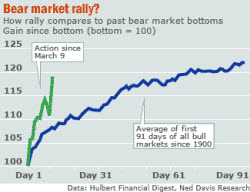
    • Bear Rally or Bull Market?  Are too many people too bullish too quickly? (Hulbert)
    • The Fed is Flooding the Markets with Cash. (Clusterstock)
    • WSJ's "The End of Wall Street" video series (Click to Watch)
    • The End of the Financial World As We Know It? (NYTimes Part 1 & Part 2)
    • Ironic that Satyam (which means Truth) didn't outsource Fraud, they did it themselves. (FT)

    And, a little bit extra:

    • Putting tongues firmly in cheeks, Porn Industry seeks $5BB Federal Bailout. (CNN)
    • Obama Fighting for his Blackberry.  This may be a fight he loses. (TechDirt)
    • Why do Investment Swindles continue to work? (WSJ)
    • Can Risk Be Adequately Quantified? (Naked Capitalism)
    • This year China's
      Internet users will surpass the entire population of the U.S. (Kedrosky)
    • The Bull and Bear Cases for Hedge Funds. (Bull: Seeking Alpha and Bear: Yahoo Finance)
    • Balanced Commentary on the Middle East's Hundred Year War (Economist)
    • Funny list of "Stuff White People Like" – and I do like most of it. (Blog)
  • Capitalogix Commentary 01/09/09

    Economist Chart of Stock Market Returns shows 2008 as second worst year since 1825.

    This was the first full week of trading in 2009.  While the markets pulled-back a bit, most defended their technically-important 50-day moving averages.

    Two Steps Forward, One Step Back:  This week started with 80% of the S&P 500 stocks sitting above their 50-day moving averages.  That is stat-geek-speak for "there has been a significant rally off the November bottom." Moreover, people are feeling good about the market's progress. Investors Intelligence
    readings show people are more
    bullish now than they were during the rally off the July low.

    Regardless of my analysis or opinions, we rely on mechanical trading models to determine our market posture. Still, I follow the markets closely, and the market's consistently negative bias surprised me this past week.  That might be good though.  We worked-off a lot of the overbought condition and put things in place for a more natural Obama Inauguration Rally.

    How Bad Was 2008?  The chart on the right is from The Economist, and shows the distribution of US Stock Market Returns Since 1825.  One of the things it shows is that 2008 was the second-worst year of performance.

    So as awful as 2008's performance was, historically, remember that it ended with a 20% rally off the bottom to end the year. 

    The real question is whether you think the rally will last?  Is it a Bear-Market
    Rally sucker play, or a real opportunity to put some capital back to
    work?

    I predict big changes are coming (not hard to do with the economy where it is and a new President about to take office).  So, here are some data to help point the way.

    Here are a Few of the Posts I Found Interesting This Week:

    • Cover your eyes, then check-out these 2008 Year-End Returns for World Markets.(Bespoke)
    • US Unemployment Back to 1945 Levels; 2.6MM Jobs Lost in 2008. (Citywire)
    • Oxymoron? A relatively sane Elliott Wave market
      prediction for 2009. (Yelnick)
    • Bear Rally or Bull Market?  Are too many people too bullish too quickly? (Hulbert)
    • The Fed is Flooding the Markets with Cash. (Clusterstock)
    • WSJ's "The End of Wall Street" video series (Click to Watch)
    • The End of the Financial World As We Know It? (NYTimes Part 1 & Part 2)
    • Ironic that Satyam (which means Truth) didn't outsource Fraud, they did it themselves. (FT)

    And, a little bit extra:

    • Putting tongues firmly in cheeks, Porn Industry seeks $5BB Federal Bailout. (CNN)
    • Obama Fighting for his Blackberry.  This may be a fight he loses. (TechDirt)
    • Why do Investment Swindles continue to work? (WSJ)
    • Can Risk Be Adequately Quantified? (Naked Capitalism)
    • This year China's
      Internet users will surpass the entire population of the U.S. (Kedrosky)
    • The Bull and Bear Cases for Hedge Funds. (Bull: Seeking Alpha and Bear: Yahoo Finance)
    • Balanced Commentary on the Middle East's Hundred Year War (Economist)
    • Funny list of "Stuff White People Like" – and I do like most of it. (Blog)
  • WSJ’s “End of Wall Street” Videos

    Explains how easy money led to the collapse of Wall Street's biggest firms.

    Chapter One: What Happened? In the first of this three-part series, Journal reporters explain how the housing bubble inflated and burst, and why easy money led to the collapse of Wall Street’s biggest financial institutions.

    Direct link for Chapter One.

    Chapter Two: Why Did it Happen? What was going through the minds of CEOs, corporate boards, fund managers and mortgage lenders as they created hard-to-understand derivatives Warren Buffett once called ‘weapons of financial mass destruction’.

    Direct link for Chapter Two.

    Chapter Three: What Happens Next? This final chapter of the crisis on Wall Street tells the story of the $700-billion bailout, as seen through a reporter’s eyes, and looks at what’s ahead for the global economy.

    Direct link for Chapter Three.

  • WSJ’s “End of Wall Street” Videos

    Explains how easy money led to the collapse of Wall Street's biggest firms.

    Chapter One: What Happened? In the first of this three-part series, Journal reporters explain how the housing bubble inflated and burst, and why easy money led to the collapse of Wall Street’s biggest financial institutions.

    Direct link for Chapter One.

    Chapter Two: Why Did it Happen? What was going through the minds of CEOs, corporate boards, fund managers and mortgage lenders as they created hard-to-understand derivatives Warren Buffett once called ‘weapons of financial mass destruction’.

    Direct link for Chapter Two.

    Chapter Three: What Happens Next? This final chapter of the crisis on Wall Street tells the story of the $700-billion bailout, as seen through a reporter’s eyes, and looks at what’s ahead for the global economy.

    Direct link for Chapter Three.

  • Shift Happens

    Here is the newest version of a great presentation.  Click to watch.  It includes new and updated statistics, thought-provoking questions and a fresh
    design. 

    090109 Did You Know
    Here is the direct link to the YouTube video.
    Here is a link to the presentation file.
    Here is a link to the Shift Happens Project.

    We are moving forward quickly.  What you thought you knew about the economy, technology, innovation, and the world are probably out-of-date. I can't wait to see what comes next.