Watch a soldier being greeted by his dogs after returning home after 14 months in Iraq. I suspect even cat people will be touched by this.
I learned something from the dogs, and the man. Hope you enjoy it too.

Thoughts about the markets, automated trading algorithms, artificial intelligence, and lots of other stuff
This is a compelling book. The title refers to a change in the environment, so startling that we have no choice but to re-group and re-think the future.
When it happens, everything changes and the old trusted rules of the road to go out the window.
The book hype says: The Web 3.0 world of “pandemic economics” is a new economy that will
function outside the traditional laws of commerce, free from today's
impediments to business growth, and in a world where every person is
connected to each other. Jump Point will help you to challenge old assumptions, re-think your business
models, and take advantage of this fast-moving, unfettered, and
fiercely competitive environment.
When Does It Happen?
The economic history of the world is punctuated by Jump Points. The tricky part has been identifying them at the right time.
Very often, we mistake the arrival of a stunning new invention for the Jump Point. It is easy to get mesmerized by a new innovation, and to think the world has changed the day a new technology leaves the lab. But that is rarely, if ever, the case. That is not the Jump Point.
Instead, technology revolution is a fitful process. New technologies take time to be absorbed, diffused and adopted. We are a curious species; it is human nature to tinker, and experiment, test, and play. And most inventions improve with application, adoption, and time. Therefore, most Jump Points occur well after the enthusiasm settles and the parade has passed.
Real Jump Points most often arrive after we grow complacent about that invention, when the technology becomes routine and unremarkable, after the novelty has worn off and the technology has gone mainstream. It is then that rapid change finally happens. Interesting.
This is a compelling book. The title refers to a change in the environment, so startling that we have no choice but to re-group and re-think the future.
When it happens, everything changes and the old trusted rules of the road to go out the window.
The book hype says: The Web 3.0 world of “pandemic economics” is a new economy that will
function outside the traditional laws of commerce, free from today's
impediments to business growth, and in a world where every person is
connected to each other. Jump Point will help you to challenge old assumptions, re-think your business
models, and take advantage of this fast-moving, unfettered, and
fiercely competitive environment.
When Does It Happen?
The economic history of the world is punctuated by Jump Points. The tricky part has been identifying them at the right time.
Very often, we mistake the arrival of a stunning new invention for the Jump Point. It is easy to get mesmerized by a new innovation, and to think the world has changed the day a new technology leaves the lab. But that is rarely, if ever, the case. That is not the Jump Point.
Instead, technology revolution is a fitful process. New technologies take time to be absorbed, diffused and adopted. We are a curious species; it is human nature to tinker, and experiment, test, and play. And most inventions improve with application, adoption, and time. Therefore, most Jump Points occur well after the enthusiasm settles and the parade has passed.
Real Jump Points most often arrive after we grow complacent about that invention, when the technology becomes routine and unremarkable, after the novelty has worn off and the technology has gone mainstream. It is then that rapid change finally happens. Interesting.
Goldman Sachs lost money trading only
one day last quarter, and only two days the prior quarter.
Come on, how could that be? Their boss does say that banks “Do God’s work.” I’m not sure that is a sufficient explanation. When a firm’s trading performance challenges not only all preconceptions of realistic trading, but also of statistical distributions, it’s worth looking into.
Here’s what ZeroHedge has to say about it. Here is a chart that demonstrates Goldman’s YTD trading track record: out of 194 trading days in 2009, the firm has made over $100 million on 116 occasions! This alone accounts for at least $11.6 billion in revenue (and is likely much more).
Yves Smith, at Naked Capitalism, adds: maybe I am just hopelessly out of touch, or perhaps more accurately, the
Fed has created such a ridiculously favorable environment for banks and traders
that if you are moderately competent, making money is like shooting fish in a
barrel. But a winning streak this consistent looks like a rigged game. Is this
just, ahem, “information advantages”? Greater ease in pushing markets around
that have fewer players? Just a function of those monstrously wide bid-asked
spreads? I’m curious for a sanity check from people closer to the action.
The party line comes in the Financial
Times:
The performance – revealed on Wednesday in a regulatory filing – compares
with two losing trading days in the previous quarter and confirms that the
authorities’ drive to revive markets after the crisis is yielding huge windfalls
for some banks.Before the crisis, banks regularly recorded trading losses on several days in
a quarter.Goldman made more than $100m in profits on 36 of the 65 days in the three
months to September and recorded more than $50m in profit on more than eight out
of 10 trading days, the filing shows.These figures were down from the second quarter, when Goldman reported record
trading revenues and had 46 days with $100m-plus in profits. The smaller number
of days with $100m-plus profits in the third quarter partly reflects the bank’s
decision to rein in risk-taking in areas such as interest rates and
equities.
There is a suggestion here that banks like Goldman might be taking advantage
of the Fed and Treasury (although that might be by design, yet another hidden
subsidy).
Let me know what you think about this.
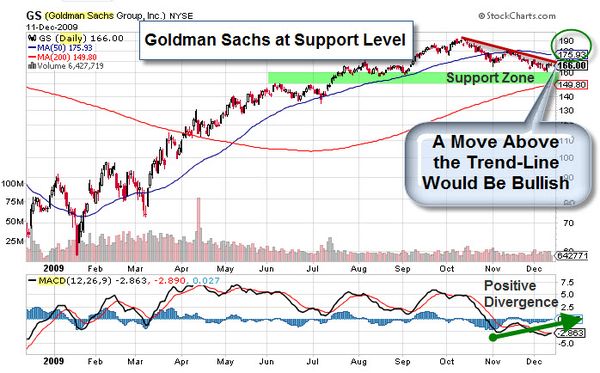
Here is a how there stock is doing.
Here is a link to a prior Goldman Sachs article worth checking-out.
Goldman Sachs lost money trading only
one day last quarter, and only two days the prior quarter.
Come on, how could that be? Their boss does say that banks “Do God’s work.” I’m not sure that is a sufficient explanation. When a firm’s trading performance challenges not only all preconceptions of realistic trading, but also of statistical distributions, it’s worth looking into.
Here’s what ZeroHedge has to say about it. Here is a chart that demonstrates Goldman’s YTD trading track record: out of 194 trading days in 2009, the firm has made over $100 million on 116 occasions! This alone accounts for at least $11.6 billion in revenue (and is likely much more).
Yves Smith, at Naked Capitalism, adds: maybe I am just hopelessly out of touch, or perhaps more accurately, the
Fed has created such a ridiculously favorable environment for banks and traders
that if you are moderately competent, making money is like shooting fish in a
barrel. But a winning streak this consistent looks like a rigged game. Is this
just, ahem, “information advantages”? Greater ease in pushing markets around
that have fewer players? Just a function of those monstrously wide bid-asked
spreads? I’m curious for a sanity check from people closer to the action.
The party line comes in the Financial
Times:
The performance – revealed on Wednesday in a regulatory filing – compares
with two losing trading days in the previous quarter and confirms that the
authorities’ drive to revive markets after the crisis is yielding huge windfalls
for some banks.Before the crisis, banks regularly recorded trading losses on several days in
a quarter.Goldman made more than $100m in profits on 36 of the 65 days in the three
months to September and recorded more than $50m in profit on more than eight out
of 10 trading days, the filing shows.These figures were down from the second quarter, when Goldman reported record
trading revenues and had 46 days with $100m-plus in profits. The smaller number
of days with $100m-plus profits in the third quarter partly reflects the bank’s
decision to rein in risk-taking in areas such as interest rates and
equities.
There is a suggestion here that banks like Goldman might be taking advantage
of the Fed and Treasury (although that might be by design, yet another hidden
subsidy).
Let me know what you think about this.
Here is a how there stock is doing.
Here is a link to a prior Goldman Sachs article worth checking-out.
The best thing I can say about the market is that the current lack of sellers is giving investors a good long chance to take their bullish bets off the table.
Unemployment is above 10%, and at its highest level since 1983. Here are a few economic signs.
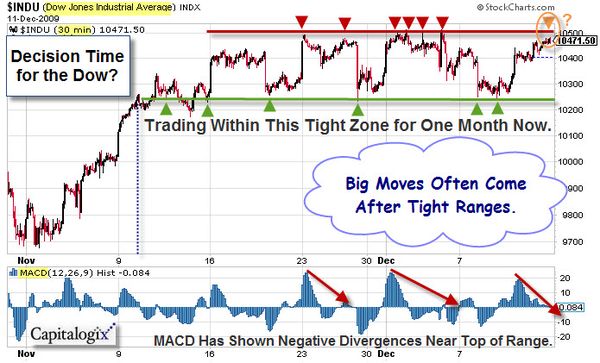
The chart below shows an upwards sloping trend channel on a chart of the S&P 500 Index.
On the other hand, jumping back into the upward sloping channel would be a bullish sign.
Bob Prechter Calls a Major Top Using the Elliott Wave Pattern.
If you are looking for Top-Calls, then Bob Prechter is not shy. He says: "Stocks are topping out, commodities are topping out and the dollar is making a bottom".
Prechter is a high profile market commentator who uses Elliott Wave as a framework for understanding the market. So, I thought this might be an interesting time to re-visit this technique.
The premise is that the market doesn't affect sentiment. Rather, it is the other way around; collective sentiment affects the market. And that while markets change, human nature doesn't … consequently, predictable patterns play out over and over again. Prechter calls this "Socionomics".
While I now look at Elliott Wave more as a way of understanding what the market has done (rather than a great predictor of what it will do next), I do believe it is helpful in getting a sense of the next likely swing.
Here is a chart that shows the basic sequence and an example of the sentiment causing the move.
The next chart shows that a similar sequence often happens in both directions.
All this reminded me that I have a piece of software called the Advanced GET, which uses a pretty clever algorithm for identifying some of the simpler Gann and Elliott Wave trading patterns. So I dusted-it-off, fired-it-up, and started playing around.
Looking at a weekly chart of the Russell 2000 Index, it's very easy to envision
a five wave sequence as follows.
Note that the wave five target
is beneath the recent bear market lows. And that the wave four pullback takes us back to the top of the downwards sloping trendline … and seems to have pretty clean Elliott Wave size,
slope, and timing.
Again, I don't trade
the Elliott Wave. Yet it fascinates me, and is something
that I do pay attention to as a framework. Add to all this that the daily chart of many US equity indices are stalled at their 50-day moving averages and kissing the bottom of their recently broken up-trendlines, and I'm certainly going to be wary of a pull-back here.
Business Posts Moving the Markets that I Found Interesting This Week:
Lighter Ideas and Fun Links that I Found Interesting This Week
The best thing I can say about the market is that the current lack of sellers is giving investors a good long chance to take their bullish bets off the table.
Unemployment is above 10%, and at its highest level since 1983. Here are a few economic signs.
The chart below shows an upwards sloping trend channel on a chart of the S&P 500 Index.
On the other hand, jumping back into the upward sloping channel would be a bullish sign.
Bob Prechter Calls a Major Top Using the Elliott Wave Pattern.
If you are looking for Top-Calls, then Bob Prechter is not shy. He says: "Stocks are topping out, commodities are topping out and the dollar is making a bottom".
Prechter is a high profile market commentator who uses Elliott Wave as a framework for understanding the market. So, I thought this might be an interesting time to re-visit this technique.
The premise is that the market doesn't affect sentiment. Rather, it is the other way around; collective sentiment affects the market. And that while markets change, human nature doesn't … consequently, predictable patterns play out over and over again. Prechter calls this "Socionomics".
While I now look at Elliott Wave more as a way of understanding what the market has done (rather than a great predictor of what it will do next), I do believe it is helpful in getting a sense of the next likely swing.
Here is a chart that shows the basic sequence and an example of the sentiment causing the move.
The next chart shows that a similar sequence often happens in both directions.
All this reminded me that I have a piece of software called the Advanced GET, which uses a pretty clever algorithm for identifying some of the simpler Gann and Elliott Wave trading patterns. So I dusted-it-off, fired-it-up, and started playing around.
Looking at a weekly chart of the Russell 2000 Index, it's very easy to envision
a five wave sequence as follows.
Note that the wave five target
is beneath the recent bear market lows. And that the wave four pullback takes us back to the top of the downwards sloping trendline … and seems to have pretty clean Elliott Wave size,
slope, and timing.
Again, I don't trade
the Elliott Wave. Yet it fascinates me, and is something
that I do pay attention to as a framework. Add to all this that the daily chart of many US equity indices are stalled at their 50-day moving averages and kissing the bottom of their recently broken up-trendlines, and I'm certainly going to be wary of a pull-back here.
Business Posts Moving the Markets that I Found Interesting This Week:
Lighter Ideas and Fun Links that I Found Interesting This Week
Microsoft released Windows 7 last week.
Being an early adopter, I found this exciting, challenging, and frustrating all in the same week.
Speaking of Windows 7, I saw an interesting ad where Microsoft was promoting the launch in Japan through a cross-promotion with Burger King. Here's the ad.
Who knew that the best way to promote a new operating system and your expected user experience was with seven congealing meat patties and the smell of onions?
Maybe Apple took out that ad?
This is almost as funny as their Songsmith ads.
Microsoft released Windows 7 last week.
Being an early adopter, I found this exciting, challenging, and frustrating all in the same week.
Speaking of Windows 7, I saw an interesting ad where Microsoft was promoting the launch in Japan through a cross-promotion with Burger King. Here's the ad.
Who knew that the best way to promote a new operating system and your expected user experience was with seven congealing meat patties and the smell of onions?
Maybe Apple took out that ad?
This is almost as funny as their Songsmith ads.
Two business thought leaders that I highly recommend are Verne Harnish and Jim Collins.
They both wrote books I love. Verne' "Rockefeller Habits" is terrific. And Jim's "Good to Great" and "Built to Last" are both classics.
Recently, I heard Jim Collins talk about his new book, "How the Mighty Fall – And Why Some Companies Never Give In". It's a quick read makes a lot of sense.
Before I talk about the book, here are three things he said that caught my attention. Even out of context they are worth repeating:
The Point of the Book: Keep-Up the Disciplines that Make You Great.
One of the key points was to be terrified of your success. Not because success is bad, in-and-of-itself. Rather, because success often takes you away from the disciplines of building greatness.
The difference between good and great is often a culture of discipline and a focus on having the right people filling the key seats in the company.
It is One Thing to Have the Right People On the Bus … How Well Are Your "Key Seats" Filled?
How many "Key Seats" are there in your company? Perhaps more importantly, ask yourself what percent of these Key Seats do you have empirical proof, and confidence, that the right people are already in-place, doing the right job? Then, ask yourself whether the percentage is increasing, decreasing, or holding steady?
If this is important to your company … what are you going to do about it? And how often are you going to focus on this?
Most Companies Measure and Manage the Wrong Things.
Another point he stressed was that what gets measured, gets managed. However, one of the disciplines of greatness is to get beyond measuring what's easy, to define what needs measurement and management. Recognizing the key performance indicators in the key measures of success go a long way towards moving in the right direction, together, as a company.
Agree to A Committed Action.
He reminds that great companies are not without disagreement. Instead, they use it as a catalyst to see issues from different perspectives, to get tough conversations out into the open, and then commit to a course of action. Not everyone has to agree with the course of action; yet, everyone should have clarity about what they are agreeing to and what course of action will be.
"How the Mighty Fall – And Why Some Companies Never Give In"?

One of the main points of his new book is the downturns are predictable and to some extent, inevitable; however, it doesn't have to be fatal. In fact, it can be the catalyst to the next round of growth on the path to greatness.
He asks the question: "Why do truly great companies limit growth and set absolute minimum standards, which must be exceeded?" Here is a high-level view of the answer.
Bottom Line: Stay disciplined … and keep the Main Thing, the main thing.