Here is a link to short video by Mac Anderson of Simple Truths.

It is a collection of quotes and simple truths set to music. Hope you have a good week.
![Reblog this post [with Zemanta]](http://img.zemanta.com/reblog_c.png?x-id=9593af3c-6600-4142-849b-4c6ee6f94fcd)


Thoughts about the markets, automated trading algorithms, artificial intelligence, and lots of other stuff
Here is a link to short video by Mac Anderson of Simple Truths.
It is a collection of quotes and simple truths set to music. Hope you have a good week.
Breadth Continues to Expand.
The Markets are showing signs of health and strength. These charts, from Stockcharts.com, show the internal strength and breadth powering the move higher and supporting the current rally.
Here is an intra-day chart of the S&P 500 Index for the past three weeks. It is a modified version of something I saw on Breakpoint Trades' site. It shows the decision-point; price has pulled-back to the trend-line.
In bull markets, this is where Buyers tend to appear. In contrast, Sellers probably see the bearish wedge and negative divergence as signs of waning momentum. Add the potential sell-signal from over-bought stochastics, and we have an interesting set-up for next week.
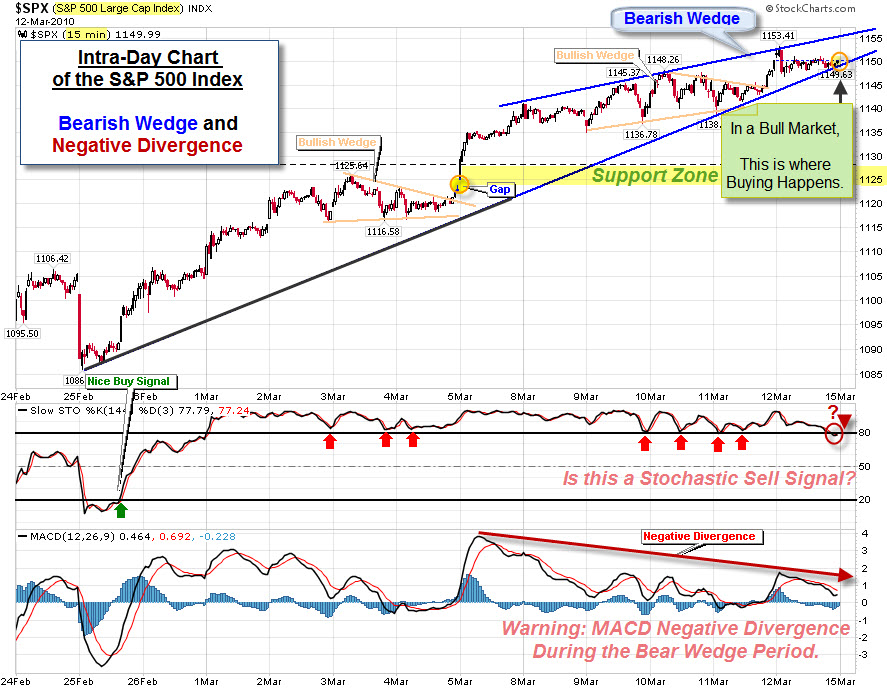
Even if the markets sell-off from here, there are now a number of support levels close by.
The markets have continued to do well, what about the economy? I think the Employment situation is a primary indicator.
We Stand Out – With Respect to the Severity of our Under-Employment Situation.
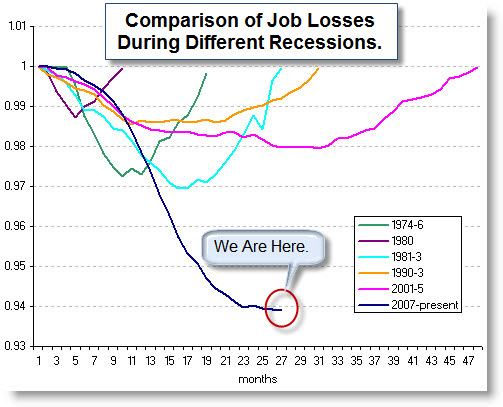
There is disagreement about whether the recent jobs number was a positive sign. Some are focusing on the slowing decline; others are focusing on the continued weakness … still others are focusing on the continued downwards adjustments. Nonetheless, this chart makes something clear. Compared to other recessions, the job losses (and lack of job gains), of this Recession are truly unprecedented.
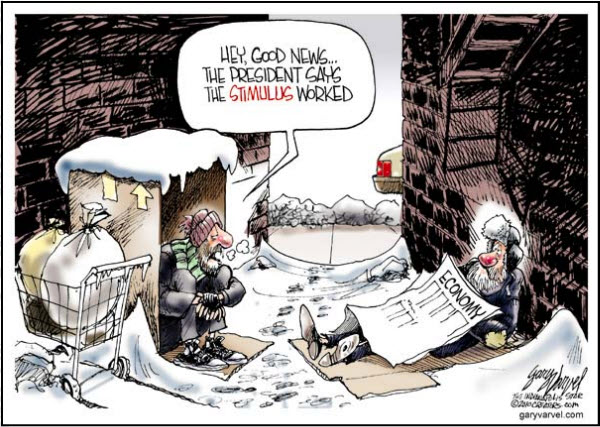
Here is a different way to look at what that chart means.
Business Posts Moving the
Markets that I Found Interesting This Week:
Lighter Ideas and
Fun Links
that I Found Interesting This Week
![Reblog this post [with Zemanta]](http://img.zemanta.com/reblog_c.png?x-id=2a510835-2afd-456c-8621-305859fb21a7)
Breadth Continues to Expand.
The Markets are showing signs of health and strength. These charts, from Stockcharts.com, show the internal strength and breadth powering the move higher and supporting the current rally.
Here is an intra-day chart of the S&P 500 Index for the past three weeks. It is a modified version of something I saw on Breakpoint Trades' site. It shows the decision-point; price has pulled-back to the trend-line.
In bull markets, this is where Buyers tend to appear. In contrast, Sellers probably see the bearish wedge and negative divergence as signs of waning momentum. Add the potential sell-signal from over-bought stochastics, and we have an interesting set-up for next week.
Even if the markets sell-off from here, there are now a number of support levels close by.
The markets have continued to do well, what about the economy? I think the Employment situation is a primary indicator.
We Stand Out – With Respect to the Severity of our Under-Employment Situation.
There is disagreement about whether the recent jobs number was a positive sign. Some are focusing on the slowing decline; others are focusing on the continued weakness … still others are focusing on the continued downwards adjustments. Nonetheless, this chart makes something clear. Compared to other recessions, the job losses (and lack of job gains), of this Recession are truly unprecedented.
Here is a different way to look at what that chart means.
Business Posts Moving the
Markets that I Found Interesting This Week:
Lighter Ideas and
Fun Links
that I Found Interesting This Week
 When I was a kid, Jet-Packs were a part of science fiction … and
cartoons.
If you always wanted one, it appears that your
wait is almost over.
On a side note, in the rush to the future, sometimes it makes
sense to appreciate the things we are already "got right" and want to
protect.
![Reblog this post [with Zemanta]](http://img.zemanta.com/reblog_c.png?x-id=ee000da8-7f2f-4188-8e38-a56c89011e3d)
When I was a kid, Jet-Packs were a part of science fiction … and
cartoons.
If you always wanted one, it appears that your
wait is almost over.
On a side note, in the rush to the future, sometimes it makes
sense to appreciate the things we are already "got right" and want to
protect.
 Back to a Simpler Time … and Sound.
I miss real music. Recently, a lot of what's popular seems technologically-enhanced, over-produced, and auto-tuned.
That's why I like VH-1's Unplugged site. It is showcases talent stripped of the pyrotechnics and glossy production. What's left are the artist and the art.
Here are a couple examples.
![Reblog this post [with Zemanta]](http://img.zemanta.com/reblog_c.png?x-id=7b0b0454-a97d-4c1d-80af-c435a84df48e)
Back to a Simpler Time … and Sound.
I miss real music. Recently, a lot of what's popular seems technologically-enhanced, over-produced, and auto-tuned.
That's why I like VH-1's Unplugged site. It is showcases talent stripped of the pyrotechnics and glossy production. What's left are the artist and the art.
Here are a couple examples.
In this video, Gary Flake demos Pivot, a new way to browse and arrange massive amounts of images and data online. Built on breakthrough Seadragon technology, it enables spectacular zooms in and out of web databases, and the discovery of patterns and links invisible in standard web browsing.
The big idea that this video demonstrates so well is that the whole of the data in which we consume is greater that the sum of the parts. And, instead of inducing information overload, new tools enable us to use information so that patterns pop and we can see trends that would otherwise be invisible.
If we can do that, then, instead of being trapped in data, we might
actually extract information. And, instead of dealing just with
information, we can tease out knowledge. And if we get the knowledge,
then maybe even there's wisdom to be found.
Click here to view the transcript.
This tool, and others like it, will have massive impact on businesses
and the scale of projects they undertake.
![Reblog this post [with Zemanta]](http://img.zemanta.com/reblog_e.png?x-id=c5b72ae6-3900-478e-840d-4214d3ce686d)
In this video, Gary Flake demos Pivot, a new way to browse and arrange massive amounts of images and data online. Built on breakthrough Seadragon technology, it enables spectacular zooms in and out of web databases, and the discovery of patterns and links invisible in standard web browsing.
The big idea that this video demonstrates so well is that the whole of the data in which we consume is greater that the sum of the parts. And, instead of inducing information overload, new tools enable us to use information so that patterns pop and we can see trends that would otherwise be invisible.
If we can do that, then, instead of being trapped in data, we might
actually extract information. And, instead of dealing just with
information, we can tease out knowledge. And if we get the knowledge,
then maybe even there's wisdom to be found.
Click here to view the transcript.
This tool, and others like it, will have massive impact on businesses
and the scale of projects they undertake.
 You know Unemployment is becoming part of the cultural zeitgeist when Spider-Man gets fired.
Last week's employment report showed a fair number of other people got fired too.
Apparently, though, not many people cared, because the markets rallied anyway.
If you are interested, Barry Ritholtz put together a big picture look at employment charts.
Signs of Strength.
The markets put on a show of strength this week, blasting through overhead resistance. The chart below shows the S&P 500 Index is approaching its recent highs, and now has two nice levels of support beneath it (marked by the light and dark green lines).
As long as price is above these levels, it seems prudent to use
bull-market techniques. That means to expect buying on dips.
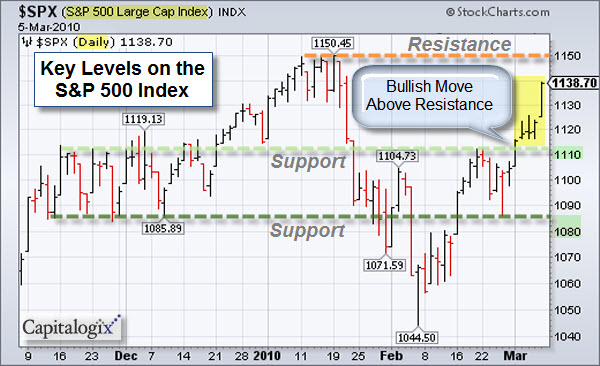
On the other hand, trading often induces paranoia. So, there is some part of me looking for the next areas that would trigger the most stop-losses. Coincidentally, this weekend I talked to a money manager who told me they were going to exit their short positions if the markets get above the recent highs (marked by the orange line). That seems like a pretty widely followed level. So, a spike above that … followed by a sharp reversal, might find some of the selling volume we've been missing lately.
Could We Possibly Still Be in a Bear Market?
A fresh view is often helpful. The next chart is not designed to be predictive. Instead, it simply provides an alternative context to view the recent price action in relation to historic market cycles.
Below is an inflation-adjusted overlay of three secular bear markets put together by Doug Short. It aligns the current S&P 500 from the top of the Tech Bubble in March 2000, the Dow in of 1929, and the Nikkei 225 from its 1989 bubble high.
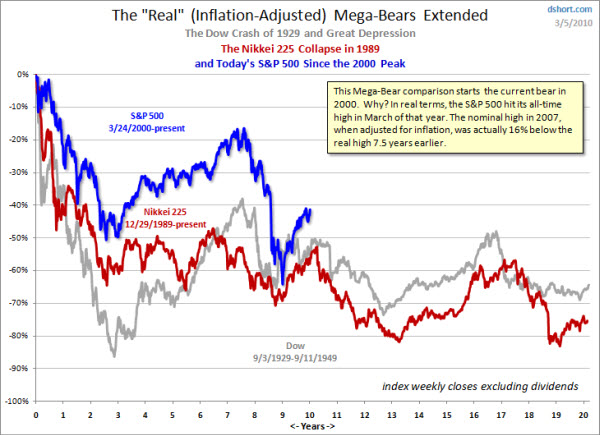
The nominal all-time high in the index occurred in October 2007, but when adjusted for inflation, the "real" all-time high for the S&P 500 occurred in March 2000.
There is a Lot of Deal-Making Going On.
Increased merger and acquisition activity and the freeing-up of corporate assets (usually measured by increased corporate spending) are both typically bullish signs. Why? Both indicate that decision-makers are optimistic (or at least projecting optimism). There's been quite a bit of evidence showing that this is happening on a global corporate scale and all the way down to the local level.
One thing holding-back the optimism is the lack of lending. Here is a look at that.
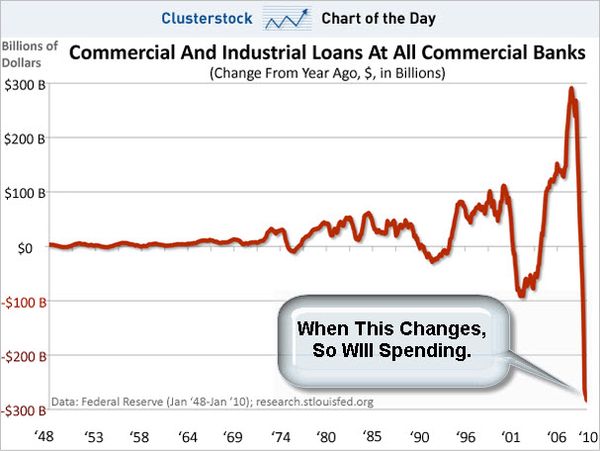
Nonetheless, companies with cash are starting to use it.
Here's a story that is a bit humorous, though still shows those green shoots of growth.
In Kansas, the city of Topeka changed its name to Google. Supposedly part of a local effort to convince Google to make Topeka a test site for an ultra-fast Internet connection and set Topeka apart from other cities vying for Google's attention.

Hope you have a good week, even if you used to live in Topeka.
Business Posts Moving the
Markets that I Found Interesting This Week:
Lighter Ideas and
Fun Links
that I Found Interesting This Week
![Reblog this post [with Zemanta]](http://img.zemanta.com/reblog_e.png?x-id=423cd613-8cb8-4eb0-a0d0-df9fd1b47c3d)