Somehow, with nothing more than animated bubble charts, Hans Rosling has become quite famous.
This four-minute clip shows Rosling presenting world development in the context of income versus lifespan. Rosling uses Gapminder, the software he and others had developed, to show multiply varying statistics as animations.
The material is more or less the same as his TedTalks; but this time around, the motion chart isn't projected on a screen. The data is CGI'd into the air where Rosling can pluck and grasp at points as he highlights the significance of specific points in history.
Until you’ve seen Hans Rosling in action you can have no idea just how moving a bunch of blue bubbles moving down a screen can be.
The BBC writes that:
Despite its light and witty touch, the film nonetheless has a serious message – without statistics we are cast adrift on an ocean of confusion, but armed with stats we can take control of our lives, hold our rulers to account and see the world as it really is. What’s more, Hans concludes, we can now collect and analyse such huge quantities of data and at such speeds that scientific method itself seems to be changing.
"I kid you not, statistics is now the sexiest subject on the planet" says Hans Rosling, presenter of The Joy of Stats.
Somehow, with nothing more than animated bubble charts, Hans Rosling has become quite famous.
This four-minute clip shows Rosling presenting world development in the context of income versus lifespan. Rosling uses Gapminder, the software he and others had developed, to show multiply varying statistics as animations.
The material is more or less the same as his TedTalks; but this time around, the motion chart isn't projected on a screen. The data is CGI'd into the air where Rosling can pluck and grasp at points as he highlights the significance of specific points in history.
Until you’ve seen Hans Rosling in action you can have no idea just how moving a bunch of blue bubbles moving down a screen can be.
The BBC writes that:
Despite its light and witty touch, the film nonetheless has a serious message – without statistics we are cast adrift on an ocean of confusion, but armed with stats we can take control of our lives, hold our rulers to account and see the world as it really is. What’s more, Hans concludes, we can now collect and analyse such huge quantities of data and at such speeds that scientific method itself seems to be changing.
"I kid you not, statistics is now the sexiest subject on the planet" says Hans Rosling, presenter of The Joy of Stats.
The interactive graphic tree map, below, indicates the relative popularity of the top 20 charts. Such maps are handy for showing a large number of data values that would visually overcomplicate a pie chart. Coloring groups subsets within the data, as in this case, to create a heat map.
So, goodbye to 2010; I look forward to sharing 2011 with you.
The interactive graphic tree map, below, indicates the relative popularity of the top 20 charts. Such maps are handy for showing a large number of data values that would visually overcomplicate a pie chart. Coloring groups subsets within the data, as in this case, to create a heat map.
So, goodbye to 2010; I look forward to sharing 2011 with you.
You never know where a spark of inspiration will come from. Sometimes you get it from a quote or a story; other times it might come from a question …
The truth is that sources of inspiration are always there for you. The question is whether you are looking for them or notice them when they show up.
Here's a source that I value for its practical wisdom and insights.
"Today Is Your Day to Win" is a series of 99 daily lessons, delivered by e-mail. On more than a few occasions, it brought me a message right when I needed it.
It is written by Mike Brescia of Think Right Now, and it doesn't cost a cent. Of course, to get the benefit, you will have to invest some time and mental cycles to consider the content.
Here is a sample from one of the messages.
Good Things Will Come To Me When I …
—————————— Today's Empowering Quote ——————————
"The best preparation for good work tomorrow is good work today." –Elbert Hubbard
—————————— Today's Empowering Question ——————————
"What can I do now that will prepare me for tomorrow?"
—————————— Today's Fast Session ——————————
Often the most frustrating thing that any of us feel on a regular basis is to want something really bad, and not be able to get it right away.
Yes, it's frustrating. But it's usually not realistic, is it? …
It's getting so that it's increasingly rare to find people who are truly willing to put in the requisite time necessary to get the traits or items they want. Our world today is trying to teach us that we must get what we want immediately; that it's our right. And that's why so many of us are jealous, smoke or drink, are overweight, use drugs, etc. …
Life is NOT like school.
In school, you can trick yourself into thinking you're doing great if you cram for exams and get decent scores. It is possible to get fairly good grades for a while that way.
But you don't learn it. You're likely to just remember it until the exam is over… maybe.
That's why new college graduates often find it difficult to find a decent paying job. Companies like successful work experience. In college, you can fool the system and yourself. In the professional world and in most other areas of life, it's a lot tougher. Almost impossible.
Real life is truly like a farm.
On the farm, you must move the rocks, buy seeds and all the other stuff, plant the seeds, buy and maintain the equipment, pull weeds, keep the pests away, water the crops, buy and sell the animals, feed them, nurse the sick ones back to health, fertilize, etc. And you need to keep up with it all everyday…
Or you won't have a crop at the end of the season.
Life is like this, too. Just like a farm, you can't "cram" in life. Don't be fooled. Don't believe the lies that others want you to believe. You want to believe it. I know you do. But think.
The people who have the things you want earned them. And don't believe they just got lucky. Luck takes work.
Put the effort in today and you'll get luckier and luckier. Will it be immediately? Probably not. Beat this into your head… Anything worth having takes time to get it.
When I'm tempted to believe that I should have something (before I've earned it), I think of my grandparents.
They owned a farm.
And I realize that life can be long and that I can't put tomorrow before today.
Then I look at my goal, put my shoulder down and keep going…
With a smile on my face.
—————————— Today's Winning Beliefs ——————————
— I'm at peace with my responsibilities. — I'm preparing myself for tomorrow today.
You never know where a spark of inspiration will come from. Sometimes you get it from a quote or a story; other times it might come from a question …
The truth is that sources of inspiration are always there for you. The question is whether you are looking for them or notice them when they show up.
Here's a source that I value for its practical wisdom and insights.
"Today Is Your Day to Win" is a series of 99 daily lessons, delivered by e-mail. On more than a few occasions, it brought me a message right when I needed it.
It is written by Mike Brescia of Think Right Now, and it doesn't cost a cent. Of course, to get the benefit, you will have to invest some time and mental cycles to consider the content.
Here is a sample from one of the messages.
Good Things Will Come To Me When I …
—————————— Today's Empowering Quote ——————————
"The best preparation for good work tomorrow is good work today." –Elbert Hubbard
—————————— Today's Empowering Question ——————————
"What can I do now that will prepare me for tomorrow?"
—————————— Today's Fast Session ——————————
Often the most frustrating thing that any of us feel on a regular basis is to want something really bad, and not be able to get it right away.
Yes, it's frustrating. But it's usually not realistic, is it? …
It's getting so that it's increasingly rare to find people who are truly willing to put in the requisite time necessary to get the traits or items they want. Our world today is trying to teach us that we must get what we want immediately; that it's our right. And that's why so many of us are jealous, smoke or drink, are overweight, use drugs, etc. …
Life is NOT like school.
In school, you can trick yourself into thinking you're doing great if you cram for exams and get decent scores. It is possible to get fairly good grades for a while that way.
But you don't learn it. You're likely to just remember it until the exam is over… maybe.
That's why new college graduates often find it difficult to find a decent paying job. Companies like successful work experience. In college, you can fool the system and yourself. In the professional world and in most other areas of life, it's a lot tougher. Almost impossible.
Real life is truly like a farm.
On the farm, you must move the rocks, buy seeds and all the other stuff, plant the seeds, buy and maintain the equipment, pull weeds, keep the pests away, water the crops, buy and sell the animals, feed them, nurse the sick ones back to health, fertilize, etc. And you need to keep up with it all everyday…
Or you won't have a crop at the end of the season.
Life is like this, too. Just like a farm, you can't "cram" in life. Don't be fooled. Don't believe the lies that others want you to believe. You want to believe it. I know you do. But think.
The people who have the things you want earned them. And don't believe they just got lucky. Luck takes work.
Put the effort in today and you'll get luckier and luckier. Will it be immediately? Probably not. Beat this into your head… Anything worth having takes time to get it.
When I'm tempted to believe that I should have something (before I've earned it), I think of my grandparents.
They owned a farm.
And I realize that life can be long and that I can't put tomorrow before today.
Then I look at my goal, put my shoulder down and keep going…
With a smile on my face.
—————————— Today's Winning Beliefs ——————————
— I'm at peace with my responsibilities. — I'm preparing myself for tomorrow today.
It is a slow day in a damp little Irish town. The rain is beating down, and the streets are deserted.
Times are tough. Everybody is in debt and everybody lives on credit.
On this particular day, a rich German tourist is driving through the town, stops at the local hotel and lays a €100 note on the desk, telling the hotel owner he wants to inspect the rooms upstairs in order to pick one to spend the night.
The owner gives him some keys and, as soon as the visitor has walked upstairs, the hotelier grabs the €100 note and runs next door to pay his debt to the butcher.
The butcher takes the €100 note and runs down the street to repay his debt to the pig farmer.
The pig farmer takes the €100 note and heads off to pay his bill at the supplier of feed and fuel.
The guy at the Farmers' Co-op takes the €100 note and runs to pay his drinks bill at the pub.
The bar owner slips the money along to the local prostitute drinking at the bar, who has also been facing hard times and has had to offer him "services" on credit.
The hooker then rushes to the hotel and pays off her room bill to the hotel owner with the €100 note.
The hotel proprietor then places the €100 note back on the counter so the rich traveler will not suspect anything. At that moment, the traveler comes down the stairs, picks up the €100 note, states that the rooms are not satisfactory, pockets the money and leaves town.
No one produced anything. No one earned anything. However, the whole town is now out of debt and looking to the future with a lot more optimism.
And that, ladies and gentlemen, is how the bailout package works.
It is a slow day in a damp little Irish town. The rain is beating down, and the streets are deserted.
Times are tough. Everybody is in debt and everybody lives on credit.
On this particular day, a rich German tourist is driving through the town, stops at the local hotel and lays a €100 note on the desk, telling the hotel owner he wants to inspect the rooms upstairs in order to pick one to spend the night.
The owner gives him some keys and, as soon as the visitor has walked upstairs, the hotelier grabs the €100 note and runs next door to pay his debt to the butcher.
The butcher takes the €100 note and runs down the street to repay his debt to the pig farmer.
The pig farmer takes the €100 note and heads off to pay his bill at the supplier of feed and fuel.
The guy at the Farmers' Co-op takes the €100 note and runs to pay his drinks bill at the pub.
The bar owner slips the money along to the local prostitute drinking at the bar, who has also been facing hard times and has had to offer him "services" on credit.
The hooker then rushes to the hotel and pays off her room bill to the hotel owner with the €100 note.
The hotel proprietor then places the €100 note back on the counter so the rich traveler will not suspect anything. At that moment, the traveler comes down the stairs, picks up the €100 note, states that the rooms are not satisfactory, pockets the money and leaves town.
No one produced anything. No one earned anything. However, the whole town is now out of debt and looking to the future with a lot more optimism.
And that, ladies and gentlemen, is how the bailout package works.
The S&P 500 Index has had quite a run. On Wednesday, Bespoke noted that it has been up 14 out of 16 days. Since 1990, the S&P has only been up 14 out of 16 trading days two other times — once in September 1995 and once in May 1990.
So, You Might Guess That Bullish Sentiment is High.
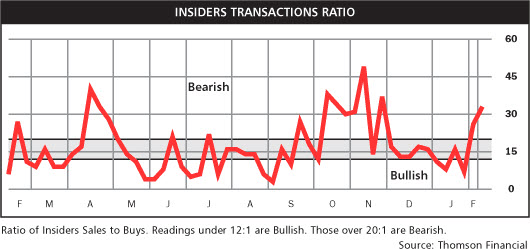
Well, it is probably higher than you realize. We haven't seen readings like this in a long time. The American Association of Individual Investors poll had the highest percentage of bulls (63) since October 2004, and the lowest percentage of bears (16) since October 2005.
Carl Swenlin, from DecisionPoint, reminds that while high levels of bullish sentiment among advisors, investors, and money managers usually occur at market tops, market tops do not always occur when sentiment is very bullish. Sometimes people respond to the obvious and correctly align their market posture with the price trend. In situations like this we have to wonder whether or not they are wrong.
In other words, an excess of bullish sentiment is a caution sign and should cause concern because such sentiment peaks are often followed by price corrections, if not bull market tops. However, that doesn't mean it is safe to use sentiment as a timing tool. Perhaps sentiment is better used as a simple indicator to help paint a picture of the market environment. So far we have no indication from our trend-following models that there are major problems ahead.
Another Measure Brims With Confidence.
Here is a slightly different take on perceived risk. The Barron’s Confidence Index is a confidence indicator calculated by dividing the average yield on high-grade bonds by the average yield on intermediate-grade bonds. The discrepancy between the yields is indicative of investor confidence. For example, a rising ratio indicates investors are demanding a lower premium in yield for increased risk and thus are showing confidence in the economy.
As shown below, there has been a solid improvement in the ratio since its all-time low in December 2008. This indicates that bond investors have grown significantly more confident, opting for more speculative bonds over high-grade bonds. The ratio is back at levels last seen in October 2007, before the financial crisis.
The S&P 500 Index has had quite a run. On Wednesday, Bespoke noted that it has been up 14 out of 16 days. Since 1990, the S&P has only been up 14 out of 16 trading days two other times — once in September 1995 and once in May 1990.
So, You Might Guess That Bullish Sentiment is High.
Well, it is probably higher than you realize. We haven't seen readings like this in a long time. The American Association of Individual Investors poll had the highest percentage of bulls (63) since October 2004, and the lowest percentage of bears (16) since October 2005.
Carl Swenlin, from DecisionPoint, reminds that while high levels of bullish sentiment among advisors, investors, and money managers usually occur at market tops, market tops do not always occur when sentiment is very bullish. Sometimes people respond to the obvious and correctly align their market posture with the price trend. In situations like this we have to wonder whether or not they are wrong.
In other words, an excess of bullish sentiment is a caution sign and should cause concern because such sentiment peaks are often followed by price corrections, if not bull market tops. However, that doesn't mean it is safe to use sentiment as a timing tool. Perhaps sentiment is better used as a simple indicator to help paint a picture of the market environment. So far we have no indication from our trend-following models that there are major problems ahead.
Another Measure Brims With Confidence.
Here is a slightly different take on perceived risk. The Barron’s Confidence Index is a confidence indicator calculated by dividing the average yield on high-grade bonds by the average yield on intermediate-grade bonds. The discrepancy between the yields is indicative of investor confidence. For example, a rising ratio indicates investors are demanding a lower premium in yield for increased risk and thus are showing confidence in the economy.
As shown below, there has been a solid improvement in the ratio since its all-time low in December 2008. This indicates that bond investors have grown significantly more confident, opting for more speculative bonds over high-grade bonds. The ratio is back at levels last seen in October 2007, before the financial crisis.