Inspiring and Fun! Seems appropriate for the start of the Holiday Season.
Beware, these three short videos may encourage you to travel, learn something new, move your body, or create something.
3 guys, 44 days, 11 countries, 18 flights, 38 thousand miles, an exploding volcano, 2 cameras and almost a terabyte of footage… all to turn 3 ambitious linear concepts based on movement, learning and food.
Inspiring and Fun! Seems appropriate for the start of the Holiday Season.
Beware, these three short videos may encourage you to travel, learn something new, move your body, or create something.
3 guys, 44 days, 11 countries, 18 flights, 38 thousand miles, an exploding volcano, 2 cameras and almost a terabyte of footage… all to turn 3 ambitious linear concepts based on movement, learning and food.
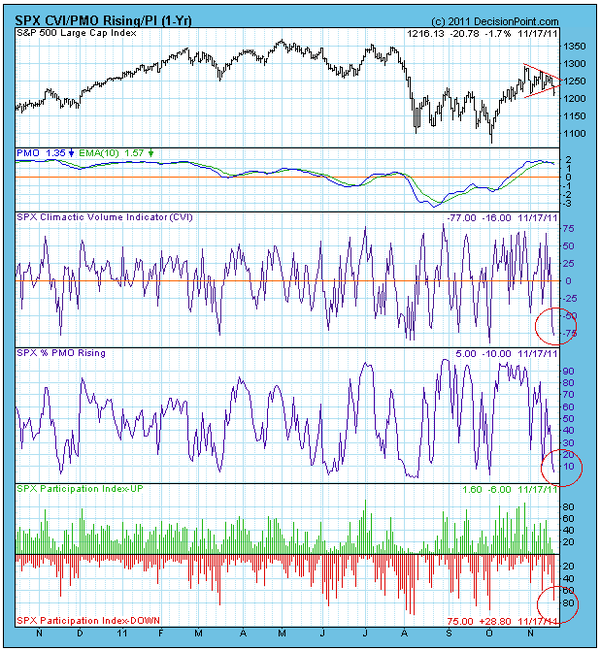
From a chartist's perspective, the S&P 500 Index broke out of its recent triangle pattern by moving lower. This was an unpleasant surprise for bulls, because triangles are most often considered a continuation pattern. As such, when the pattern ends, prices are normally expected to continue in the direction they were trending before the continuation pattern (consolidation) began.
In this case, the breakdown casts a bearish pall on a picture that been bullish since the October low.
A positive aspect to the price breakdown is that a number of ultra-short-term indicators hit climactic oversold readings the same day. On the chart, above, we can see how these oversold spikes generally coincide with the start of rallies of at least short-term duration.
Carl Swenlin at DecisionPoint explains that climaxes are often a sign of either initiation or exhaustion. An initiation climax signals that price will begin moving in the direction of the climax, while an exhaustion climax occurs at the end of a move. Immediately following a climax, prices can chop around for a day or two before the follow-through begins.
So, was the breakdown actually a shakeout, intended to turn people bearish just ahead of a rally?
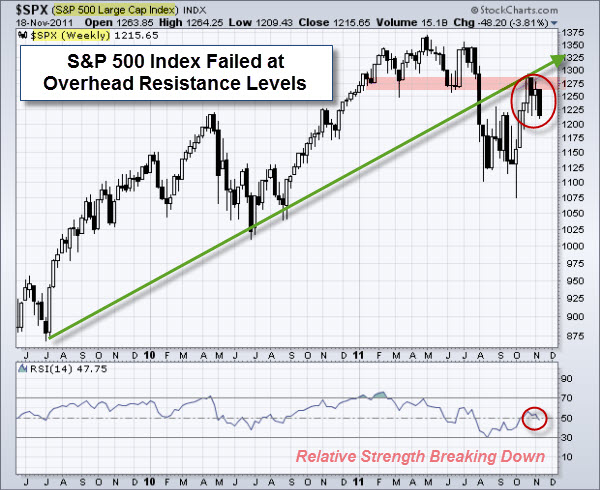
Unfortunately, we are still on a longer-term sell signal, which means things could be about to get nasty again. The following chart shows a weekly view of the S&P 500 Index. Notice that price could not get back above the up-trend line (marked by the green arrow) or the overhead support-resistance line (marked by the pink highlight).
Other clues? Historically, this is a seasonally bullish time. And trader talk is that markets may pop on a significant government intervention we are likely to see.
All-in-all, it points to another interesting week.
From a chartist's perspective, the S&P 500 Index broke out of its recent triangle pattern by moving lower. This was an unpleasant surprise for bulls, because triangles are most often considered a continuation pattern. As such, when the pattern ends, prices are normally expected to continue in the direction they were trending before the continuation pattern (consolidation) began.
In this case, the breakdown casts a bearish pall on a picture that been bullish since the October low.
A positive aspect to the price breakdown is that a number of ultra-short-term indicators hit climactic oversold readings the same day. On the chart, above, we can see how these oversold spikes generally coincide with the start of rallies of at least short-term duration.
Carl Swenlin at DecisionPoint explains that climaxes are often a sign of either initiation or exhaustion. An initiation climax signals that price will begin moving in the direction of the climax, while an exhaustion climax occurs at the end of a move. Immediately following a climax, prices can chop around for a day or two before the follow-through begins.
So, was the breakdown actually a shakeout, intended to turn people bearish just ahead of a rally?
Unfortunately, we are still on a longer-term sell signal, which means things could be about to get nasty again. The following chart shows a weekly view of the S&P 500 Index. Notice that price could not get back above the up-trend line (marked by the green arrow) or the overhead support-resistance line (marked by the pink highlight).
Other clues? Historically, this is a seasonally bullish time. And trader talk is that markets may pop on a significant government intervention we are likely to see.
All-in-all, it points to another interesting week.
When you interview someone for a job, what are you trying to find out?
I've seen and used models that assess how someone likely will fit the Culture, and whether they are Organized, Competent, and Motivated?
Seth Godin often has an interesting perspective on business. Here is what he shared about this topic.
What good interview questions are actually trying to discover.
How long are you willing to keep pushing on a good project until you give up?
How hard is it to get you to change your mind when you're wrong?
How much do you learn from failing?
How long does it take you to learn something new?
How hard is it for you to let someone else take the lead?
How much do you care?
The rest is merely commentary, either that or they're interviewing someone for a job that's not as good as they deserve. For those jobs, the only question they're really focusing on is, "will they fit in around here?"
If you like that, you might like this too.
What Matters Now – eBook from Seth Godin
The book highlights more than seventy big thinkers, each sharing an idea for you to think about. From bestselling author Elizabeth Gilbert to brilliant tech thinker Kevin Kelly, from publisher Tim O'Reilly to radio host Dave Ramsey, there are some important people riffing about important ideas here.
When you interview someone for a job, what are you trying to find out?
I've seen and used models that assess how someone likely will fit the Culture, and whether they are Organized, Competent, and Motivated?
Seth Godin often has an interesting perspective on business. Here is what he shared about this topic.
What good interview questions are actually trying to discover.
How long are you willing to keep pushing on a good project until you give up?
How hard is it to get you to change your mind when you're wrong?
How much do you learn from failing?
How long does it take you to learn something new?
How hard is it for you to let someone else take the lead?
How much do you care?
The rest is merely commentary, either that or they're interviewing someone for a job that's not as good as they deserve. For those jobs, the only question they're really focusing on is, "will they fit in around here?"
If you like that, you might like this too.
What Matters Now – eBook from Seth Godin
The book highlights more than seventy big thinkers, each sharing an idea for you to think about. From bestselling author Elizabeth Gilbert to brilliant tech thinker Kevin Kelly, from publisher Tim O'Reilly to radio host Dave Ramsey, there are some important people riffing about important ideas here.
The good news is that the Markets have responded well to much uncertainty. Moreover, without committed sellers, it has been easier for prices to get pushed higher. The bad news is that the uncertainty comes from real issues.
I'm reminded of the phrase: "Just because you are paranoid, doesn't mean people aren't out to get you." Here are two things that to watch.
The Continued Risk of Default in Europe.
So far, none of the European austerity and bailout plans have not managed to stem the European debt crisis.
Some would claim that the severity of the crisis has only increased over time, given that Italy (the world's eighth largest and the euro zone's third largest economy) is now becoming the latest European nation threatening to require a bailout.
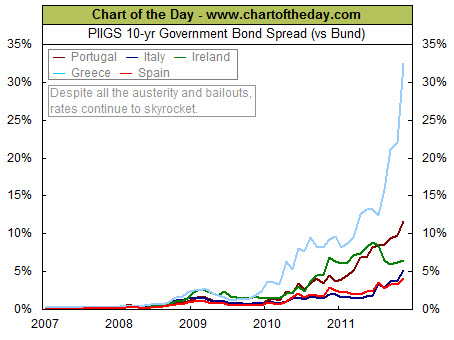
The following chart helps illustrate the risk of European debt by plotting out the 10-year government bond spread for all the PIIGS (i.e. Portugal, Italy, Ireland, Greece, and Spain) from 2007 to the present (versus the German Bund).
For example, (at the time this chart was constructed) the Greek 10-year government bond yield (light blue line) is currently a whopping 32.5 percentage points greater than that of the relatively stable German Bund. That is a far cry from where it was back in the summer of 2009 and shows the risk premium imposed based on the perceived likelihood of default.
Perhaps more important, however, is the status of Italy (dark-blue line). Italy has €1.9 trillion ($2.6 trillion) of debt outstanding. This level of debt is greater than that of all the other PIIGS combined. Due to the severity of the situation, the European Central Bank may ultimately be forced to do unpleasant things (like deciding to print a significant amount of euros – something they are very much ideologically opposed to doing).
The Relatively Poor Performance of Banks.
Banks often lead rallies higher. The logic is that banks make more money when they are lending, doing deals, and helping companies go public. In 2011, investors have been hesitant to buy into further gains in this sector.
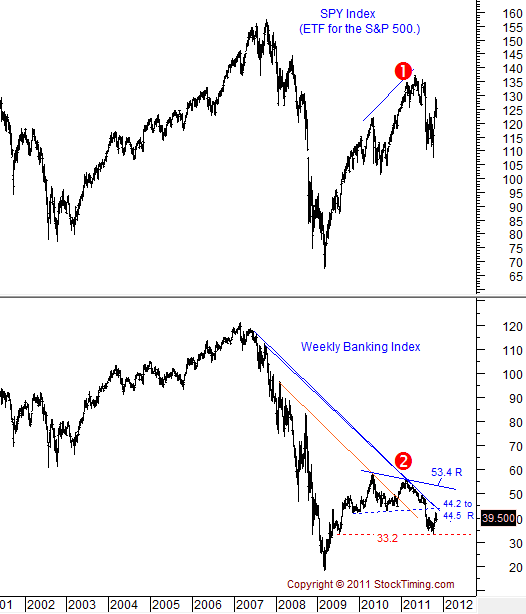
Looking at the chart, below, notice that the S&P 500 Index (symbol: SPY) has been trending up since April 2010, while the Banking Index (symbol: $BKX) has been trending down since April 2010.
What Else Is Wrong With That Picture?
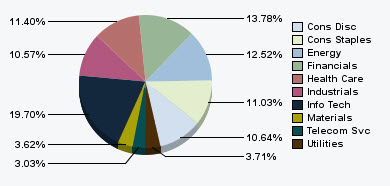
According to StockTiming.com, the Financials component on the S&P 500 is the second largest component representing 13.78% of the index.
Consequently, this chart implies that the "other components" (as a group) have been strong enough to overcome the huge weakness in the Banking sector.
Negative divergences like this cannot go on forever. For the S&P to continue trending up in the future, the non-financial sectors will have to stay strong, and stay strong enough for the Financials to start reversing its down trend.
So, while the markets have held up well through the recent negative sentiment and external risk factors, there are still some big challenges ahead. Perhaps all that means is that this is a more a trader's market than an investor's market. On the other hand, diversification seems like a good goal here.
The good news is that the Markets have responded well to much uncertainty. Moreover, without committed sellers, it has been easier for prices to get pushed higher. The bad news is that the uncertainty comes from real issues.
I'm reminded of the phrase: "Just because you are paranoid, doesn't mean people aren't out to get you." Here are two things that to watch.
The Continued Risk of Default in Europe.
So far, none of the European austerity and bailout plans have not managed to stem the European debt crisis.
Some would claim that the severity of the crisis has only increased over time, given that Italy (the world's eighth largest and the euro zone's third largest economy) is now becoming the latest European nation threatening to require a bailout.
The following chart helps illustrate the risk of European debt by plotting out the 10-year government bond spread for all the PIIGS (i.e. Portugal, Italy, Ireland, Greece, and Spain) from 2007 to the present (versus the German Bund).
For example, (at the time this chart was constructed) the Greek 10-year government bond yield (light blue line) is currently a whopping 32.5 percentage points greater than that of the relatively stable German Bund. That is a far cry from where it was back in the summer of 2009 and shows the risk premium imposed based on the perceived likelihood of default.
Perhaps more important, however, is the status of Italy (dark-blue line). Italy has €1.9 trillion ($2.6 trillion) of debt outstanding. This level of debt is greater than that of all the other PIIGS combined. Due to the severity of the situation, the European Central Bank may ultimately be forced to do unpleasant things (like deciding to print a significant amount of euros – something they are very much ideologically opposed to doing).
The Relatively Poor Performance of Banks.
Banks often lead rallies higher. The logic is that banks make more money when they are lending, doing deals, and helping companies go public. In 2011, investors have been hesitant to buy into further gains in this sector.
Looking at the chart, below, notice that the S&P 500 Index (symbol: SPY) has been trending up since April 2010, while the Banking Index (symbol: $BKX) has been trending down since April 2010.
What Else Is Wrong With That Picture?
According to StockTiming.com, the Financials component on the S&P 500 is the second largest component representing 13.78% of the index.
Consequently, this chart implies that the "other components" (as a group) have been strong enough to overcome the huge weakness in the Banking sector.
Negative divergences like this cannot go on forever. For the S&P to continue trending up in the future, the non-financial sectors will have to stay strong, and stay strong enough for the Financials to start reversing its down trend.
So, while the markets have held up well through the recent negative sentiment and external risk factors, there are still some big challenges ahead. Perhaps all that means is that this is a more a trader's market than an investor's market. On the other hand, diversification seems like a good goal here.