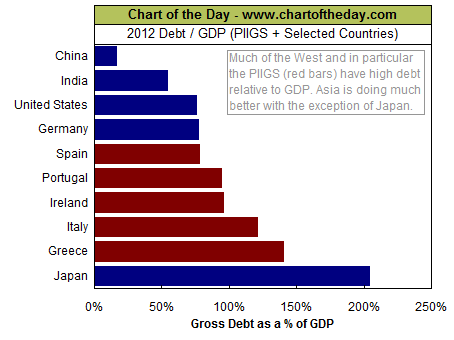
For some perspective on the European sovereign debt crisis, this chart illustrates the forecasted 2012 debt to GDP ratio for each of the PIIGS (red bars) plus a handful of today's major economies (blue bars).
While the PIIGS are currently enduring relatively high debt loads, it is noteworthy how some of the relatively safe nations/bond markets (e.g. United State and Germany) are not far behind.
These relatively high debt loads are of concern as they could lead to higher taxes sometime in the future and can risk fiscal crises if bond holders sense an increasing risk of default.
The current crisis in Europe provides a clear example of the bond market's reaction (i.e. higher bond yields) to increased default fears.
This leads to a very interesting case study that is Japan. With a debt to GDP ratio of over 200%, the Japanese 10-year bond yield is a relatively low 0.83%. Why? At the moment, the bond market feels that the Japanese have the ability to repay their debts — in part due to Japan's perceived ability to raise taxes. To that end, Japanese Prime Minister Yoshiko Noda just won opposition support for the doubling of the nation's sales tax to 10% by 2015.
So it's not just the amount of debt but also convincing your banker that you are good for it.
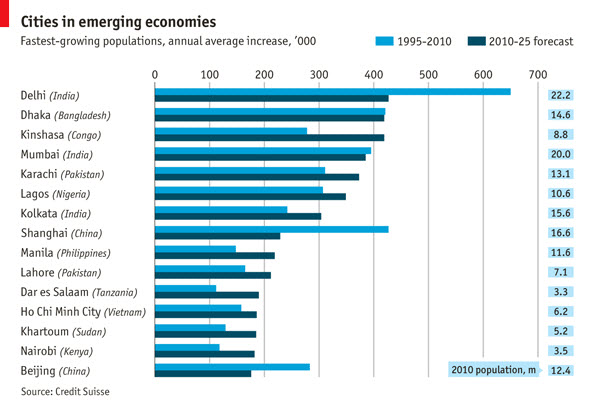
According to the Economist, currently, 52% of the world’s population currently live in urban areas. By 2025, this should increase to 58%. Nearly all this growth will take place in emerging-market economies, particularly Asia, as migrants from the countryside move in search of jobs.
Today, these emerging-market city-dwellers account for more than 60% of the world’s GDP growth.
In the past 15 years Delhi’s population has grown by 10m; it will add another 6m (a Miami's worth) in the next 15.
Over the next two decades urban areas in emerging economies will account for about two-thirds of worldwide infrastructure spending. Most will go on building homes. China and India together will add 16 trillion square meters of housing over this period, to accommodate half a billion extra people.
On a related note, here is an interesting video about India's growth.
Enounce is updating their terrific video and audio accelerator again.
They just released a beta of the 4.0 version of their MySpeed plug-in for Flash, YouTube and other video sites.
Think how much content you consume over the Internet. From news stories to seminars to training videos … the amount of streaming media use is skyrocketing.
Now imagine how much time you could save by watching at 1.5x to 2x the normal speed.
Use MySpeed to adjust the content to your preferences.
Take control and watch video at the speed you choose. The Enounce MySpeed plug-in adds a speed control slider that will allow you to change the playback rate of Audio/Video content. Patented Signal Processing keeps audio sounding natural (not "chipmunked") at all speeds; and allows listeners to comprehend and remember the information.
Here is a demo.
MySpeed is a great time-saver. More importantly, it makes things more exciting and easier to remember. It makes sense. You probably read a lot faster than most people talk. Well, after getting comfortable watching at 1.5x, going back to "normal" is painful.
I've used their products for years. MySpeed works great for audio and video. If you listen to business or training sessions, then this is a must-have. Check it out at Enounce.
In the first part of this series, we discussed that a Market is a collection of separate traders, and much of the analysis done to get a trading edge is really just a way to identify "who is in control" and what they are doing … rather why they are trading.
Here we will examine why some traders rely on certain patterns to identify favorable trading conditions.
Some Patterns Are Logical.
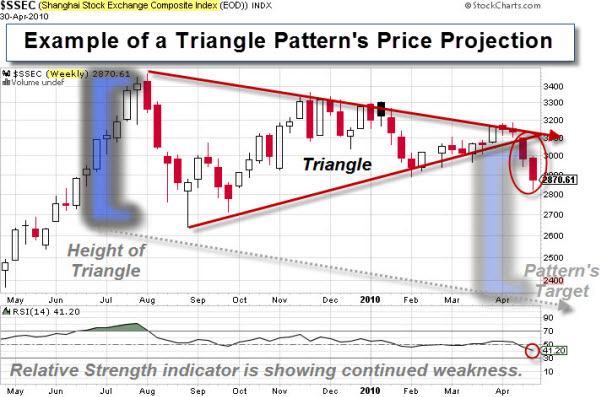
Let's look at a common trading pattern, called a "Triangle". You can think of the Triangle as a well-contested battle between the bulls and the bears. It is almost like an arm-wrestling match. Inside the pattern, neither side gives-up much ground. However, when one side loses conviction, the market surges in the direction the winners push it.
Here is a picture of a Triangle and the pattern's likely price projection.
Triangles are an example of a logical pattern. It is easy to see, and easy to understand. In addition, for a trader, it is easy to use a setup, like this, to define the likely risk and reward of a trade they are considering.
Why Do Patterns Form in Markets Repeatedly? The Answer is Human Nature.
Markets are not always logical. Some would argue that Markets are rarely logical.
On some level, markets represent the collective thoughts and emotions of its participants. So, even though conditions change, the collective response to fear and greed remains reasonably similar.
As a result, many patterns show up in market price data.
In General, Here's What Is Happening.
A move up of a certain degree will be met with some people who are afraid the move won't go higher … so they decide to sell. Meanwhile, others will believe the move will trigger a whole different group of people to recognize an opportunity … so they decide to buy.
The same thing happens with a big move down. At first, it triggers fear and selling. But at some point, to a certain group of traders, the move down will look like a discounted buying opportunity.
At its core, price is the primary indicator of investors' willingness to buy or sell. Things like velocity or slope are secondary, and show the intensity of their motivation.
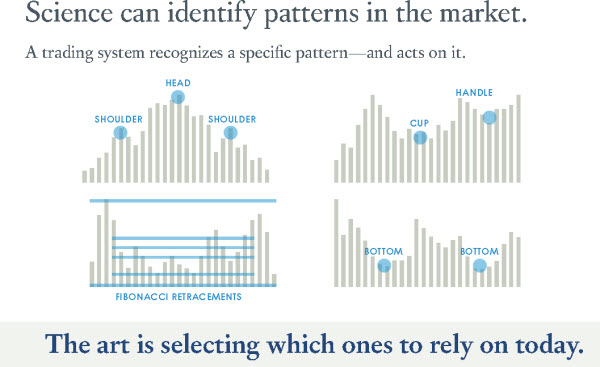
So, many of the patterns that you read in books or magazines (with names like "head and shoulders", or "cup and handle", or "double bottoms") are all really just ways of explaining the natural response to certain conditions.
There is science involved in recognizing a specific pattern; and there is art involved in selecting which pattern to rely on today.
But You Don't Have to Predict Anyone's Action – All It Takes Is An Intelligent Response.
It's the law of large numbers. An insurance company doesn't have to accurately predict when any individual will die; their actuaries just have to figure out a reasonable estimate of how many people will die during a certain time period. Likewise, in the market, patterns don't predict what an individual will do, only what the majority is likely to do.
So now that you understand patterns, the rest is easy … right?
Fractals and Holograms.
Of course it's not as easy as it sounds, because these patterns are being played out across every market, and happen on different time frames as well. That means some people are responding to the market using a much longer time horizon than someone else. A pattern for them may be noise at a different level of focus.
The patterns occur similarly whether you're looking at be minute by minute chart of the S&P, or a weekly chart of gold.
Since there are many patterns happening on many markets at any given time, it's impossible for a human to identify, validate, and trade all of them in real-time.
That's where technology comes in. And that is what we'll look at in the next article in this series.
Hope it helped. Let me know if you have questions or comments.
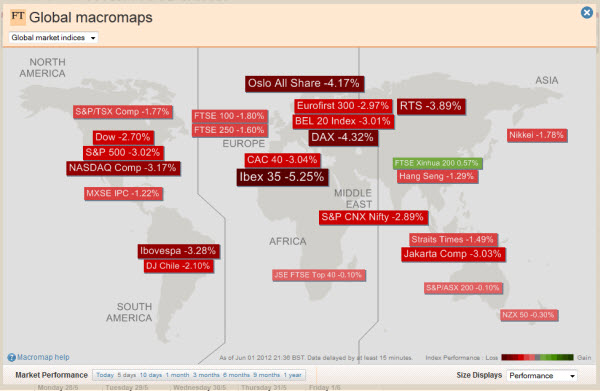
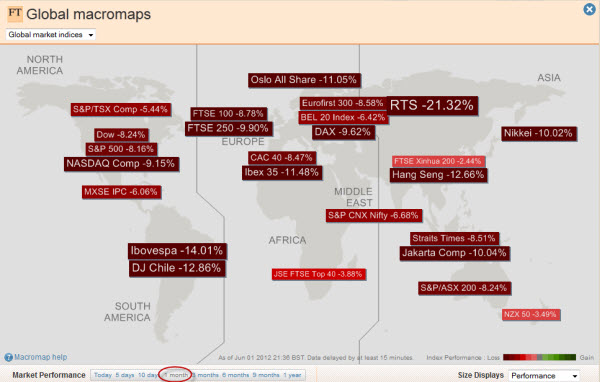
Taking a global view, many markets around the world went down last week. Notably, Spain's IBEX was down 5%, Germany's DAX was down 4%, and the NASDAQ was down over 3%.
The Month Was Worse!
Taking a macro view, last month was tough all over the globe. Notably, Russia's RTSI was down 21%, Hong Kong's Hang Seng dropped 12.55%, and the NASDAQ tumbled over 9%.
While some people believe that markets are random, others make money by using rule-based trading systems that rely on certain patterns to identify favorable trading conditions.
Traders, at every level, search for a tradable edge. Some find it in fundamental analysis; others find it in technical analysis or chart-based patterns; still others find an algorithmic or execution-based edge.
So, is there some magic unifying equation that defines the Market? Personally, I doubt it. However, there is always "something" working in the markets. The challenge is to identify what that is and to ignore the rest.
Though many many patterns work, from time-to-time, when a particular pattern comes into play may seem random; and here is why.
Understanding the Markets.
There is no such thing as a "Market" … It is really just a collection of separate traders.
One of the reasons that markets experience great volatility is that different groups buy or sell for different reasons at different times.
Consequently, even if one group trades using a consistent set of rules, a strategy that effectively combats it only works until that group stops trading those rules.
However, when they're done, some other group's strategy becomes the dominant force.
Experienced traders recognize that it is important to understand "who is in control" … not necessarily why they are trading.
That means you don't have to figure out every bit of information or rationale behind their strategy in order to make money. For example, if you were about to walk into a movie theater, but were suddenly confronted with hundreds of people running in the other direction screaming, you don't have to understand exactly why it's happening in order to respond intelligently.
On a superficial level, that's the basis of trend following. It is also an example of pattern recognition.