On September 28th, 1997 (almost exactly 17 years ago today), Apple released perhaps one of the most recognizable commercials of all time. I remember being mesmerized the first time I saw Apple Computer's iconic "Crazy Ones" video as part of their Think Different campaign.
The 34th Annual Ig Nobel Prize ceremony took place last Thursday at MIT. Every year since 1991, around the time the recipients of the genuine Novel Prizes are announced, the Ig Nobel Prize awards the ten achievements that "first make people laugh, and then make them think. They're meant to celebrate the imaginative and encourage more interest in the sciences.
And in 2017, Marc-Antoine Fardin earned the honor for using fluid dynamics to finally answer the eternal question: "Can a cat be both a solid and a liquid?" In case you are squeamish, no blender was involved in that experiment.
While these are funny examples, they're rooted in real science. As is the focus of this article, this year's Ig Nobel Prize for Demography.
In my circles, it is becoming more common to discuss how to live past 100 — and not just how to live beyond that number … but to do so with a high quality of life.
A popular concept around that subject is Blue Zones – areas where people seem to live longer and healthier. There's even a Netflix documentary on the subject. Notable places include Sardinia, Italy; Okinawa, Japan; and Ikaria, Greece.
Saul Justin Newman challenged that belief with his research, which found that extreme age records tend to come from areas with no birth certificates, rampant clerical errors, pension fraud … and even short life spans.
While longevity in the zones has primarily been attributed to diet, community, and genetics, Newman found that many of these claims were based on errors – or outright fraud. Instead, these regions are actually characterized by the opposite of what you would expect … low incomes, low literacy, high crime, and short lifespans.
To a certain extent, it makes sense. In areas where you're struggling to make ends meet … why wouldn't you commit pension fraud? In fact, in 2010, the Japanese government realized that over 80% of the people aged over 100 were actually dead. Part of what made this possible was that America bombed the halls of records in that area during the war.
Here's an interview with Saul Justin Newman on the subject. He's tracked over 80% of the people aged over 110 worldwide. Almost none of them have a birth certificate. Only about 10% have a death certificate.
What does this mean for human longevity?
While the stories of these 110-year-olds may mostly be fake – as mentioned in my recent article – longevity is on the rise, and there are many modalities to increase your lifespan.
The goal isn't just to stay alive longer; it's to live life to its fullest for as long as possible.
There are people living to 100, and there are plenty of people living healthily into their 70s, 80s, and 90s.
We're taking steps in the right direction. Technology and medicine are both evolving quickly.
But, like with longevity data, improvements in any space need to be met with a grain of salt.
If it sounds too good to be true … it generally is. Not always. But, generally.
Over the past century, life expectancies have soared while birth rates have declined. This unusual combination of population dynamics creates significant demographic and socioeconomic challenges for societies worldwide.
Getting old is tough, and it gets tougher the older you get. As a result, finding your 'reasons for being' and joy in life becomes even more important … it may also be the secret to living longer and healthier.
Many people (all over the world) struggle to get up in the morning.
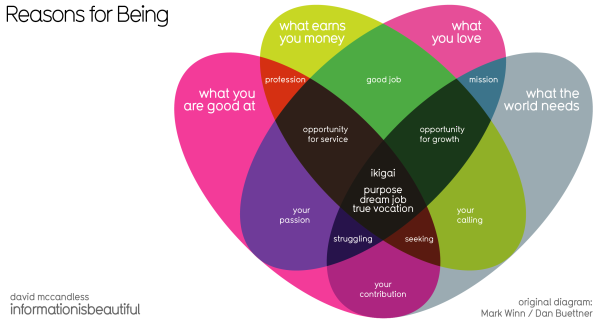
There's a Japanese concept called Ikigai that may help.
Ikigai centers around finding purpose as you grow older. Paradoxically, it makes sense to start the process as early as possible.
Finding your "reason to be" and living with purpose is a key to making the most of your time.
The graphic highlights something interesting (yet almost counter-intuitive) … When two areas intersect, it creates something positive (e.g., a passion or a mission). However, where three areas intersect, it creates a pain point (for example, it could be what you're good at, you love doing it, the world needs it … but it doesn't make you any money – so now you're struggling).
It's worth examining and thinking about for a bit.
On a related note, here is a TEDx talk about the nine common diet and lifestyle habits that help people live past 100 … whether or not they take you past 100, they're probably a good place to start.
And here is a link to Dan Sullivan's e-book, My Plan for Living to 156. That may sound outrageous, but it's worth reading because Dan shares surprisingly valuable insights in this book. It doesn't matter whether you actually live to be 156; what matters is living as if it were true. Someone who believes they're approaching the end often looks for excuses or an off-ramp rather than seeking purpose, meaning, and a Bigger Future. By shifting your perspective, you can create a more purposeful and fulfilling life, regardless of your actual lifespan.
The same is true in business. Opportunity draws a crowd … but the best opportunities are often in areas of less competition.
For entrepreneurs, oversaturation can turn products into commodities, reducing profit potential. Conversely, many shy away when a challenge seems insurmountable, creating unexpected opportunities for those willing to take the risk.
As an entrepreneur, I’m drawn to projects others might dismiss as science fiction. These are the challenges that often lead to the most groundbreaking and rewarding outcomes.
Moonshot Projects
Moonshot projects offer a unique advantage. While they may seem daunting, their audacious nature often means less competition and greater potential for transformative impact and extraordinary profits.
A moonshot project is a highly ambitious, transformative endeavor that seeks to solve a significant problem or create a revolutionary innovation. These projects are characterized by:
Audacious Goals: They aim for breakthroughs that seem nearly impossible to achieve.
Disruptive Impact: They strive to create solutions that are vastly superior to existing offerings, often by introducing entirely new paradigms.
High-Risk, High-Reward: These projects embrace the potential for failure in pursuit of groundbreaking results.
Long-Term Focus: They prioritize long-term impact over short-term gains.
Technological Advancements: They leverage cutting-edge or even nascent technologies.
Paradigm Shifts: They challenge conventional wisdom and industry norms.
Moonshot projects are inherently challenging. They demand significant resources, interdisciplinary collaboration, and a willingness to venture into the unknown. This perceived difficulty often deters potential competitors, creating a unique opportunity for those willing to take the risk.
When successful, they push the boundaries of what is possible and redefine the landscape of their respective fields.
In part, that is why a 10X mindset is particularly well-suited for Moonshot projects. By aiming for a tenfold improvement over existing solutions, you’re essentially operating in a space with little to no competition or opposition. This allows you to redefine the rules of the game and establish a sustainable competitive advantage.
Our strategy of creating a unique, sustainable competitive advantage aligns perfectly with the Moonshot approach. By choosing to play a different game (with an asymmetric edge), we’re not just competing; we’re fundamentally changing the playing field.
I’m not interested in going head-to-head with tech giants on their turf. Instead, the goal is to carve out our own niche, focused on using our unique abilities to push boundaries and extend our edge. Being slightly ahead of the competition can be a powerful attractor. It often leads potential competitors to seek collaboration rather than confrontation. They might approach you with ideas, money, or opportunities, aspiring to share in your advanced position and capabilities. This dynamic can create unexpected partnerships and accelerate progress in ways that benefit everyone involved.
When interviewing potential team members, I often share a crucial insight: if you’re seeking a job where you work 9-to-5 solving problems so you can go home feeling satisfied, this might not be the right fit.
We tackle challenges of a different magnitude. Our projects rarely have quick solutions. Instead, we focus on making steady progress towards ambitious goals.
I sometimes joke that our motto should be: “We suck less.” Nevertheless, the underlying truth is more profound. It’s about understanding your ultimate objective and recognizing that each step moves you in the right direction, no matter how small.
This approach aligns with our belief in playing a different game. We don’t just compete; we redefine the rules of engagement, creating our own metrics for success and pushing boundaries in ways that traditional thinking often overlooks. Kind of like this quote:
“I have not failed. I've just found 10,000 ways that won't work.” - Thomas Edison
It doesn’t make sense to challenge a bigger and better-funded competitor in an area where they have an asymmetric advantage. In other words, don’t compete with giants at their own game.
Choose to play a game you expect to win.
Playing a different game is a theme at Capitalogix. We believe that you control the game you’re playing, the rules, how you keep score, and even how you evaluate success. These things inform where to spend time, where to invest money, and even what looks like an opportunity to you.
Wouldn’t you rather compete in areas where you can create a unique, sustainable competitive advantage? Personally, I want to invest in the things that extend the edges that let us win.
Why? Because … Mediocrity Is Expensive!
What you lack in size or computer power, you can make up for in creativity, agility, and innovation.
We sought to create a niche in the investment industry, not through computing power, but through unique approaches to age-old problems. We use AI and data science to enhance decision-making.
We have an incredibly narrow and consistent focus. Within that area, we are willing to take on problems others avoid and pursue goals that others say are impossible.
Our niche limits risk and lets us fail faster … and learn faster. This allows us to take confident action while others are tentative.
Most big companies – and most of our competitors – are afraid to be wrong. They have to protect their infrastructure, cash cows, and short-term performance metrics. It makes sense (from their perspective) that playing it safe means they’re secure. – but that’s not how it works.
You can’t challenge the status quo when you are the status quo.
10x Improvement Is Often Easier To Achieve Than 10%
Incremental change is hard – it’s finding new ways to do the same thing, and you often end up competing in very red oceans – saturated markets where you’re competing on price.
Moonshots sound harder, but you create your own niche, and the constraints of a new idea force creativity and energy. If you’re going after a goal that no one has accomplished before, it’s impossible to be in a red ocean, and it’s easier to mobilize a team around something exciting and new than decreasing some arbitrary metric by 2%.
There are a couple of important lessons to keep in mind when pursuing the unknown.
Forget what you know – self-reported “experts” are limited by their worldview. If you’re trying to get a different result, you won’t do it by playing by the same rules your predecessors followed. Heuristics are great for making life easier – but they’re very limiting when trying to create something new.
Attack the hardest problems first – your biggest problems are your biggest opportunities. If you don’t deal with the big problems now, you’ll never get around to it, and you’ll waste time, energy, and potentially realize you have to pivot much too late.
Be comfortable being uncomfortable – Most people find failure taboo, and they’re deathly afraid of it. Tony Robbins talks about our tendency to avoid pain more actively than we pursue pleasure, and it’s true in business. But failure is a part of business. The people I consider most successful got there through incredible pain tolerance and increasingly intense problems that they continued to conquer.
Have a short memory for pain – Focus on the gain, not the pain. People often focus on not having enough money, not enough time, or simply not having enough. That scarcity mindset is dangerous and can lead to getting lost in pain and fear. Acknowledging the pain/fear and moving forward from a place of abundance and opportunity helps create opportunities.
As well, a clear identity is important. You have to understand what you’re pursuing and how you want to attack the problem. At Capitalogix, we’ve gotten very in tune with our goals.
We invent techniques that identify and adapt to what happens in markets. We apply the lessons learned from past experiences, data science breakthroughs, and hard work to eliminate the fear, greed, and discretionary mistakes that are the downfall of most traders and decision-makers.
Small businesses don’t have a monopoly on these mindsets and these opportunities, but companies like Y Combinator, X(and no, I don't mean the company formerly known as Twitter), or HeroX are few and far between … Elon Musk is famous for moonshots like Tesla, SpaceX, Starlink, Neuralink, Xai, etc. Google and Microsoft pursue moonshots as well.
Good news … the future is big enough for them and you.
Choose something that lights you up and leverages what you already know and who you already are.
Studying historical changes in human population trends offers valuable insights into the factors that have propelled or hindered human development throughout time.
From ancient civilizations to modern metropolises, population dynamics have influenced everything from economic prosperity to social structures.
A Window Into Our Past Gives Us a Glimpse at Our Future.
By studying this critical aspect of human history, we can gain valuable insights into the past, present, and future of societies.
Population growth is a complex and multifaceted phenomenon with far-reaching implications. It offers a fascinating glimpse into the demographic trends that have shaped our world and continue to influence our trajectory.
Historically, human populations grew steadily but relatively slowly … until something changed that.
Scientists estimate that humans have existed for over 130,000 years. However, it took until 1804 for us to reach 1 Billion. We doubled that population by 1927 (123 years later) and then doubled it again only 47 years later (which was 1974).
Looking back, early population growth was driven by the agricultural revolution. Since 1804, the Industrial Revolution, health and safety advances, along with technology, have significantly improved quality of life, spurring the rapid population growth. Here is a quick overview of some of the key factors.
Shaping the Future
It’s hard to predict some things accurately. So, one goal in data science is to figure out what we can “know” in order to “guess” less.
Population growth is a prime example. One of the easiest ways to predict how many 60-year-olds there will be in 40 years is to look at how many 20-year-olds there are today. Obviously, the number won’t be exact, but it’s a pretty good head start.
This principle of using known data to make educated predictions applies to many aspects of future planning, including urban development and resource allocation. By leveraging current demographic information, we can better prepare for the challenges and opportunities that will likely impact the cities of tomorrow.
Economic Implications: A growing population can expand the workforce, fueling economic growth. However, it can also strain resources, requiring increased investment in infrastructure, education, and healthcare.
Social and Environmental Pressures: Demographic shifts, such as aging populations or youth bulges, can profoundly affect social structures, healthcare systems, and the environment.
Why It Matters
Population growth is more than just a numerical metric. It is a fundamental lens through which we can analyze:
Historical Development: By understanding past population trends, we can better appreciate the factors that have shaped human civilizations.
Future Planning: Governments, businesses, and organizations can use population data to make informed decisions about resource allocation, infrastructure development, and social policies.
Have World Population Growth Numbers Peaked?
World population growth rates peaked in the late 1960s and have declined sharply in the past four decades, but we’re still on a positive trend. We’re expected to reach 9 billion people by 2050, but a lot of that growth comes from developing countries – they also almost exclusively come from urban areas.
In the 1800’s, about 10% of the population lived in urban areas. Since 2014, over 50% of the world’s population has lived in urban areas – today it’s approximately 55%. That number is growing.
Ironically, as we grow more digitally connected, our world is shrinking, and our populations are concentrating.
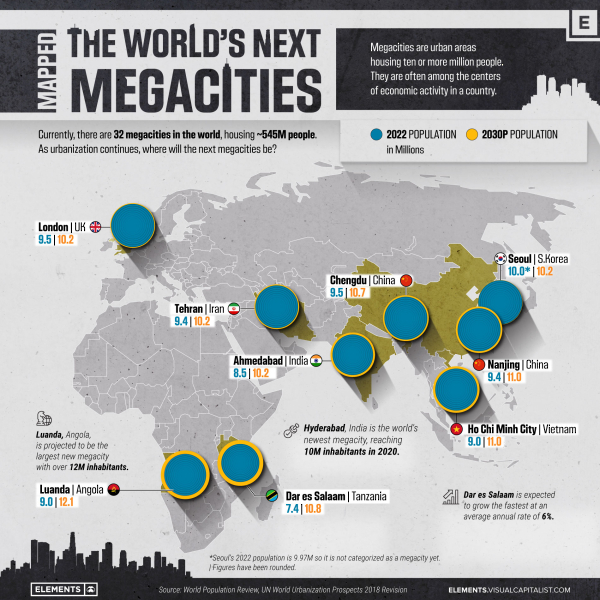
An interesting consequence of this rapid urbanization and population growth in developing countries has been the increased development of Megacities – defined as cities with populations greater than 10 million. Today, there are 33 megacities – more than triple the number in the 1990s.
This creates a set of interesting opportunities and challenges.
For example, how will these cities deal with infrastructure – sanitation, transportation, etc?
Today, in most high-income countries, about 80% of the population lives in urban areas – contrasting the primarily rural populations of lower-income countries.
As a result, we see many of these megacities forming in developing countries. As a side note, we’re also seeing countries like China making substantial investments and alliances in these developing areas. This is likely done to profit from the expected growth and also to shift the future balance of power in their favor. Sometimes, it makes sense to focus on the marathon and not just the sprint.
It’s interesting how the world can become more decentralized – and more globalized – amidst a contraction of where people live.
Each of the 32 teams has an active roster of 53 players. That is 1,696 active roster players. Add the practice squad and account for injuries, and in a typical season, you end up with about 2,100 players per season.
Now that the NFL Football season is officially underway, I thought it would be interesting to look at each position’s composite player.
As you might expect, different sports have a different ratio of ethnicities, builds, and features. The same is true for different positions on a football team. For example, you might expect more Pacific Islanders in Rugby or Asians in Badminton. You expect NBA players to be taller, swimmers to have longer arms, and football players to have more muscle.
Here is a visualization that shows what happens when you average the top players’ faces in various positions.
While you may be thinking, “This player must be unstoppable,”… statistically, he’s average.
The “composite” NFL player would be the 848th-best player in the league. He’s not a starter, and he plays on an average team.
We found the same thing with our trading bots. The ones that made it through most filters weren’t star performers. They were the average bots that did enough not to fail (but failed to make the list as top performers in any of the categories). The survivors were generalists, not specialists.
In reality, you need both.
In an ideal world with no roster limits, you’d want the perfect lineup for each granular situation. You’d want to evaluate players on how they perform under pressure, on different downs, against other players, and with various schemes.
On a related but slightly different note, I recently read a post called “Why Generalists Own the Future.” It says that, in the age of AI, it’s better to know a little about a lot than a lot about a little. But part of that rationale is that it is easy to find or create digital specialists to do the things people used to do.
That’s what technology lets you do with algorithms. You can have a library of systems that communicate with each other … and you don’t even have to pay their salary (but you will need data scientists, researchers, machines, data, alternative data, electricity, disaster recovery, and a testing platform).
You won’t find exceptional specialists if your focus is on generalized safety. Generalists are great, but you also have to be able to respond to specific conditions.
With the NFL starting its regular season this week, I was thinking about the talent and effort it takes to compete as a professional athlete.
Take a second to reflect on the journey required to become a pro. In general, the top players from a youth league became standouts in high school and then were star players in college before eventually making it to a professional team. But here's the kicker … in any other context, they're elite, but unless they're superstars in the NFL, they're considered average or worse. Think about it. By definition, half of the players are below average.
Meanwhile, I recently came across an example from the NBA that illustrates this concept in a funny but profound way.
"I'm way closer to Lebron (James) than you are to me!" – Brian Scalabrine
For context, as a USC Trojans men's basketball player, Scalabrine was the top scorer and a leader in field goals and rebounds. He then played 11 years in the NBA … but at no point in that time was he a star. He didn't put up great (or even good) stats, he wasn't a household name (though he did pick up the nickname "White Mamba"), and he is nowhere near the caliber of player that Lebron James is. In fact, throughout his career, he averaged just 3.1 points, 2.0 rebounds, and .8 assists a game. But, remember, he was good enough to play at a pro level for 11 years.
As a result, many unprofessional (weekend warrior) athletes thought he was an easy target. One day, Brian was playing a rec league game where he dropped 60 points. He tweeted about it, and a bunch of people started tweeting back to the now 40+ years old former NBA player that they could beat him. There are funny YouTube videos about this.
Brian responded by replying:
"Listen. I may suck for an NBA player. Those guys are pretty good. But I don't suck compared to you. You suck compared to me." – Brian Scalabrine
He then accepted their challenge by asking them to send in videos of their play and committed that he would go 1-on-1 against the best of them.
Scalabrine then went on to play 4 of the best players who responded, with one of them having NCAA D1 experience.
The end result?
He outscored them 44-6 – with two of the players scoring 0 points.
It should be self-explanatory, but it seems to be a concept many people struggle with. Any given pro player has been the best of the best throughout their journey. They're the 1% of the 1%.
But that is probably true for you too. If you're reading this article, you're likely killing it compared to the average Joe.
Many of us are in rooms with phenomenal business owners and operators. When you meet people like Peter Diamandis, Ray Dalio, or Richard Branson, it's easy to focus on the distance between you and them.
Recognize that it is still a huge accomplishment to be a Brian Scalabrine rather than a Joe Schmo.
They don't recognize what you and me do recognize. When you're in the NBA, there's all kinds of tells, right? Like if a guy puts his hand like that, you know what he's gonna do. If a guy does a hesitation, you know what he's gonna do. All that stuff is like in real time in the NBA, you got to be so on top of the reads. It's not speed. You can't look at me and say my brain is slow. My brain is fast. My body might be slow, but I have to read whether a guy's gonna shoot, drive, go to the middle, pass. If you're not reading those things, you're not playing in the NBA. – Brian Scalabrine