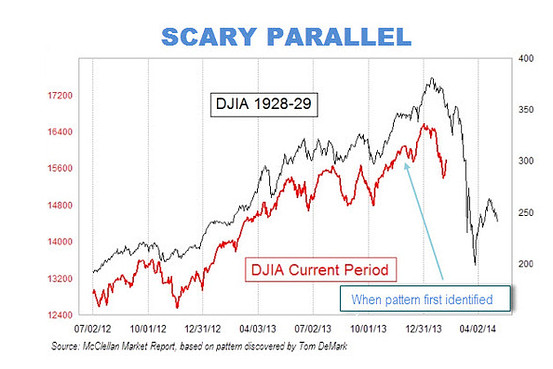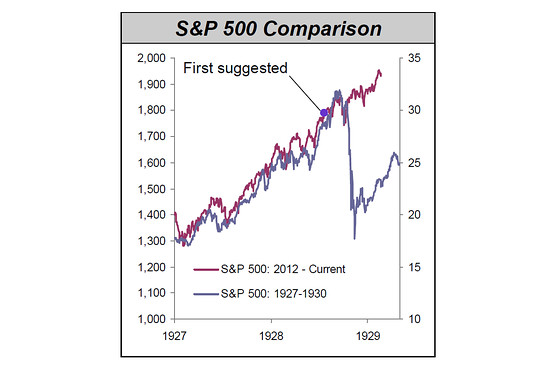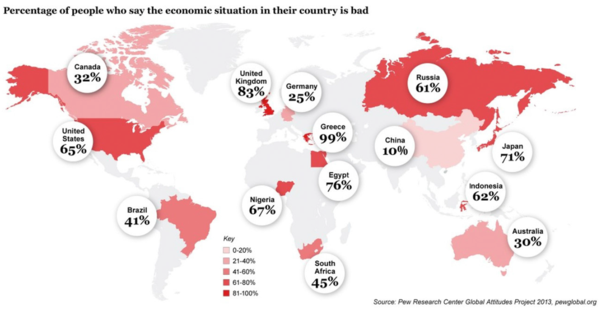

Here is a comilation of views from global experts. They consider things like whether the U.S. will still be the one of the top global economies in 25 years … and who else will share that stage?
As the Olympics unfold in Sochi, countries continue to compete in the global economy. This chart, by the Economist, shows how ‘thin’ the Emerging markets really are. For example, the market cap of Google equals the market cap of all 379 Brazilian stocks.
Here are some of the posts that caught my eye. Hope you find something interesting.
The Bloomberg Billionaires Index is a daily ranking of the world's richest people.
The site is interactivie and lets you look at the imformation from different perspectives (e.g., who made or lost the most money today? … Or, last year?). Click to launch Bloomberg Billionaires.
Each Billionaires profile contains a detailed analysis of how that person's fortune has been tallied.
Big Data is like teenage sex: everyone talks about it, nobody really knows how to do it, everyone thinks everyone else is doing it, so everyone claims they are doing it.
Here are some of the posts that caught my eye. Hope you find something interesting.
Conference calls are often mind-numbing and frustrating. ConferenceCall.Biz is a site that captures that brand of white collar existential tension and dread … as performance art.
It is a simulated conference call in which the participants seem perpetually talking at cross purposes, coming into the conversation late, and expressing frustration that they’re discussing material they’ve already covered. Lucky you, it even has distracting background sounds, like a dog barking.
The audio and images are randomized so that each conference call proceeds in a new way.
It's kind of like the Eagles' song "Hotel California" … you can check-in any time you like, but you can never leave (at least until you close the browser window). From the sound of it, the ConferenceCall.Biz participants have been attempting to get the deliverables to management for a long time.
According to IFI Claims, IBM was assigned a record 6,809 patentsin the United States last year, marking the 21st straight year that IBM has topped the unofficial U.S. patent ranking.
Google and Apple, often considered the most innovative companies in the world, were ranked 11th and 13th, respectively, both breaking into the Top 20 for the first time.
Just read a pretty good analysis of "Global Risks" (where Global Risk is defined as an occurrence that causes significant negative impact for several countries and industries over a time frame of up to 10 years).
A key characteristic of global risks is their potential systemic nature – meaning that they have the potential to affect an entire system, as opposed to individual parts and components.
Here are the Top 5 Global Risks, based on likelihood and severity of impact.
So, the big issues are: Financial Crisis caused by or in conjunction with … Social Problems (employment levels and income disparity), Environmental Issues (e.g., climate and weather), and/or Cyber Threats. Surprise, Surprise, Surprise …
The WEF article is much more nuanced and worth reading if you are interested.
It is a little funny to think about a group of the world's wealthiest people gathering in an secluded mountain enclave to discuss concerns over income inequality.