Here is an interesting video about automation and what it will do to jobs and humanity.
via YouTube.
The point is to anticipate (and be prepared) for what is coming.


Thoughts about the markets, automated trading algorithms, artificial intelligence, and lots of other stuff
Here is an interesting video about automation and what it will do to jobs and humanity.
via YouTube.
The point is to anticipate (and be prepared) for what is coming.
Here is an interesting video about automation and what it will do to jobs and humanity.
via YouTube.
The point is to anticipate (and be prepared) for what is coming.
Tokyo is the undisputed champion of mega-cities. With a population of 37.8 million, it dwarfs second-place Delhi. The Japanese capital has such a big lead in population that even though it’s expected to lose about half a million people over the next 16 years, it will still be the world’s biggest metropolis in 2030, according to a new report by the United Nations:
Here is a list of the Top 10 "mega-cities" by population in 2014 and projected in 2030.
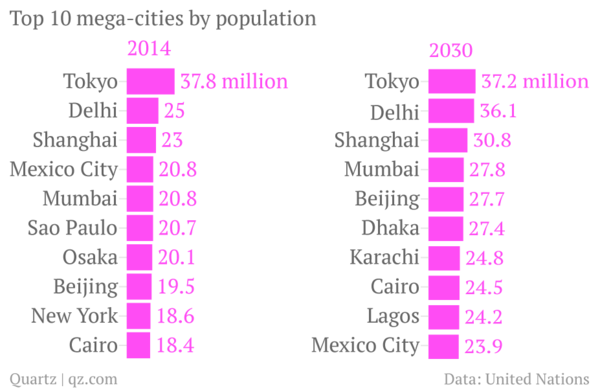
Some of the mega-cities on the 2014 list aren't projected to rank as high in 2030 … For example, New York, Osaka, and Sao Paulo will no longer make the top 10, and Mexico City will barely hang on as the sole representative outside of Asia and Africa.
This projection reflects the major shift driven by the urbanization in Asia and Africa, particularly in India (404 million projected new city dwellers by 2030), China (292 million), and Nigeria (212 million).
Why is the balance shifting so radically? Mostly because the rest of the world is already highly urbanized, while Africa and Asia are home to nearly 90% of the world’s remaining rural population.
Tokyo is the undisputed champion of mega-cities. With a population of 37.8 million, it dwarfs second-place Delhi. The Japanese capital has such a big lead in population that even though it’s expected to lose about half a million people over the next 16 years, it will still be the world’s biggest metropolis in 2030, according to a new report by the United Nations:
Here is a list of the Top 10 "mega-cities" by population in 2014 and projected in 2030.
Some of the mega-cities on the 2014 list aren't projected to rank as high in 2030 … For example, New York, Osaka, and Sao Paulo will no longer make the top 10, and Mexico City will barely hang on as the sole representative outside of Asia and Africa.
This projection reflects the major shift driven by the urbanization in Asia and Africa, particularly in India (404 million projected new city dwellers by 2030), China (292 million), and Nigeria (212 million).
Why is the balance shifting so radically? Mostly because the rest of the world is already highly urbanized, while Africa and Asia are home to nearly 90% of the world’s remaining rural population.
Imagine when robots read the news …

Here are some of the posts that caught my eye. Hope you find something interesting.
Imagine when robots read the news …
Here are some of the posts that caught my eye. Hope you find something interesting.
All trades result from a disagreement. Someone wants to buy, while someone else wants to sell.
The Dow Jones Industrial Average has given back all 2014 gains.

So, is that a major trend-line break to sell? Or, is it a buying opportunity?

It is a matter of perspective. What matters is what happens next.
All trades result from a disagreement. Someone wants to buy, while someone else wants to sell.
The Dow Jones Industrial Average has given back all 2014 gains.
So, is that a major trend-line break to sell? Or, is it a buying opportunity?
It is a matter of perspective. What matters is what happens next.
As of this month, the world’s population is now 7.2 billion.
According to U.N. data, half of the people around the globe (3.6 billion) live in just a half-dozen countries. China has the world’s largest population (1.4 billion), followed by India (1.3 billion). The next most-populous nations – the United States, Indonesia, Brazil and Pakistan – combined have less than 1 billion people.
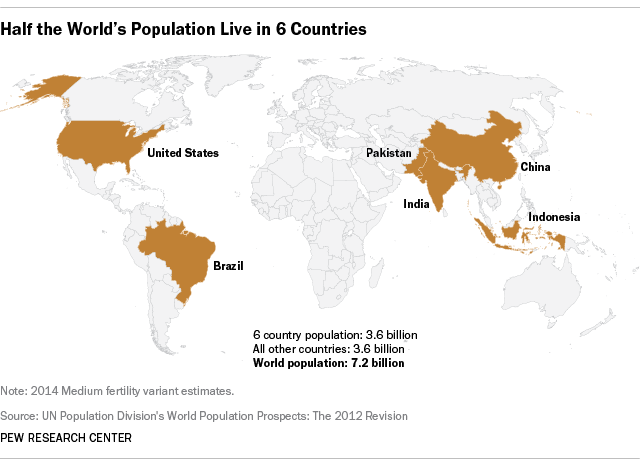
via Pew Research.
The demographic future for the U.S. and the world looks very different than the recent past.
For example, the U.N. projects that during this century, the number of people living to at least age 100 will increase more than 100-fold, from 181,000 in the year 2000 to over 20 million in the year 2100.
There is always something working. It still surprises me how often it changes.
For example, take a look at Coffee's rise.
The chart below shows the top-and-bottom performing markets so far this year. The data is color coded based on sector. The first column shows year-to-date performance, followed by six columns of the most recent yearly market performances.
Click the image to jump to the full chart.
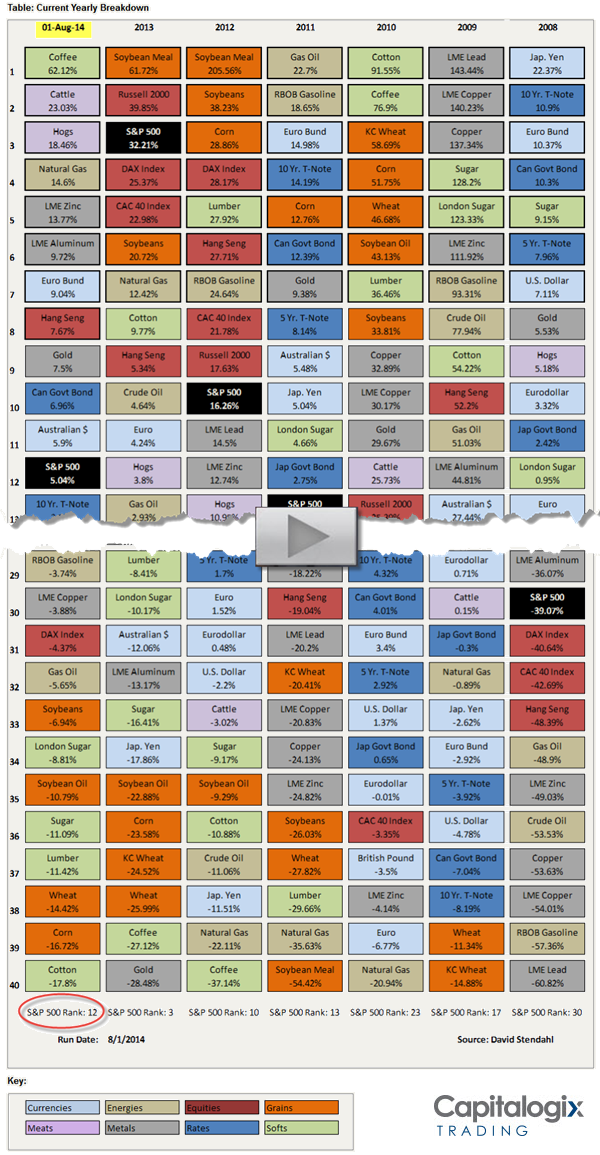
Click this link to view weekly, monthly, quarterly, and yearly views of this data.
So, how does that compare to other markets around the world? Here is an interactive chart to answer that question.