Thoughts about the markets, automated trading algorithms, artificial intelligence, and lots of other stuff

  • Are We Alone In The Universe?

    Last week, Astronomers announced the discovery of the most promising "hints" of life on an exoplanet, K2-18, 124 light years away. 

    While it would only be signs of phytoplankton and other microscopic marine life, it would still be a massive finding. 

    I tend to read a lot across a wide variety of sources. Recently, I've noticed a significant uptick in stories about aliens, UFOs, non-human intelligence, and non-human technology. In addition, several of my seemingly sane friends claim to have direct knowledge of projects and groups (funded by well-known billionaires) close to making very public announcements about missions, research, and discoveries in these areas, they hope will result in discontiguous innovations and asymmetric capabilities.

    I'm an astronomer and I think aliens may be out there – but UFO sightings  aren't persuasive

    While I believe it's naive to assume that there's no other form of life in a universe as vast as what we understand … I'm also highly skeptical of anyone who claims that they have specific knowledge or proof. With that said, I have seen enough stuff from people I trust to expect that our beliefs about these issues will shift massively in the very near future. As an example, check out Skywatch.ai, some of its videos, or this NewsNation broadcast.

    Since we live in a time where technologies are rapidly advancing, I thought it might be interesting to test out an AI-powered chatbot designed to debunk conspiracy theories through evidence-based conversations. It is a spin-out project with roots at MIT and other top universities. Research shows that many people doubted or abandoned false beliefs after a short conversation with the DebunkBot

    I first heard of this tool through these two articles: Meet DebunkBot, The AI Chatbot that Will Debunk Any Conspiracies You Believe and AI Chatbot Shows Promise in Talking People Out of Conspiracy Theories.

    Here is a link to the conversation I had with it about the belief  "Life likely exists elsewhere in the Universe due to its vastness and the repeated conditions that can give rise to life.To my surprise, this tool concluded that the belief is not a conspiracy theory and reminded me that:

    Science for the sake of knowing is one thing. Belief for the sake of hope, curiosity, or imagination is another. The search for "life" might actually help us discover something more valuable than what we thought we were searching for in the first place.

    You can test your beliefs against DebunkBot's AI. Let me know how it goes and whether you changed your mind.

    Meanwhile, Information Is Beautiful has an interactive data visualization to help you decide if we're alone in the Universe. 

    As usual, it's well done, fun, and informative. 

    For the slightly geeky amongst us, the model lets you adjust the estimate by playing with the Drake and Seager equations.

    The Drake equation estimates the number of detectable extraterrestrial civilizations in our galaxy and the universe. It factors in variables such as habitable planets, the likelihood of life, intelligent life, and the duration of time a civilization sends signals into space. 

    The Seager equation is a modern take on the equation, focusing on bio-signatures of life that we can currently detect – for example, the number of observable stars/planets, the % have life, and the % chance of detectable bio-signature gas. 

    Click here to play with the Are We Alone in the Universe infographic


    Screen Shot 2020-12-13 at 2.49.56 PMvia Information Is Beautiful

    For both equations, the infographic lets you look at various default options, but also enables you to change the variables based on your beliefs. 

    For example, the skeptic's default answer for Drake's equation shows 0.0000062 communicating civilizations in our galaxy, which is still 924,000 in the universe. The equivalent for Seager's equation shows 0.0009000 planets with detectable life in our "galactic neighborhood" and 135,000,000 planets in our universe. 

    Even with the "lowest possible" selection chosen, Drake's equation still shows 42 communicating civilizations (Douglas Adams, anyone?) in the universe.


    Screen Shot 2020-12-13 at 2.54.27 PMvia Information Is Beautiful

    One of the most interesting numbers (and potentially influential numbers for me) is the length of time a civilization sends signals into space. Conservative estimates are 420 years, but optimistic estimates are 10,000 or more. 

    One other thing to consider is that some scientists believe that life is most likely to grow on planets with very high gravity, which would also make escaping their atmosphere for space travel nigh impossible.

    If any aliens are reading this … don't worry, I won't tell. But we will find out who you voted for in the last election.

  • The Value of Masterminds – And the Decision to Stop Attending Them

    I have always valued masterminds for introducing me to new ideas, fresh perspectives, and individuals with diverse backgrounds and experiences.

    For as long as I can remember, my calendar has been filled with the spaced repetition of a multitude of events. I am a fan of the rhythm of conferences, which gets you out of the office and away from day-to-day activities, gives you a chance to think about what you really want, and (perhaps most importantly) shifts what you believe is possible.

    I also enjoy the intensity of live events and being in a “solution space” for concentrated periods of time.

    In addition, I believe that a “different perspective” is an important part of creating extraordinary things.

    Looking back, I got productive things done and benefitted from innovative new mutations that wouldn't have happened except by being outside of my default path (the rut that tricks us into feeling like we're thinking, even though we're simply running habitual processes on habitual stimuli that produce okay, but predictable, results).

    The truth is that I liked and valued all the groups I attended regularly. Even if there was an event that didn't meet my expectations, the benefits and value I got from those groups made them easily worth the cost of attending (not only in terms of money … but also in time, time away from other things I cared about, and the lost opportunity cost of not being able to do other things while I was doing those things).

    Nonetheless, as an experiment, I decided to stop going to Masterminds last year. I even called it a “Sabbatical

    The Power of Conscious Choice.

    Here are a few of the reasons I made that decision.

    To start, I wasn’t looking forward to going to events anymore … and often felt overwhelmed or constrained by my schedule.

    Sometimes, less is more.

    I've flown over 6 million actual butt-in-seat airline miles and averaged between 150 and 250 flights a year for decades.

    However, upon reflection, even though most of what I was doing was stuff I started because I liked the community or the thought process … my schedule had become almost a habit, ritual, or superstition – rather than a choice.

    And I wasn't thinking about the opportunity cost of going to these events anymore. 

    How Do You Figure Out What to Keep and What to Abandon?

    When I talk to entrepreneurs about their businesses, part of my assessment process is to look at their teams and determine if there are weak performers or people who otherwise shouldn't be there. For example, people that may be high-performing but are bad for the culture. Even in great companies, there are a couple of people like that. But for the most part, high-performing teams have high-performing team members. And because the leaders don't want to lose capability, they leave things the way they are.

    Perspective matters.

    Instead of asking, “Who am I willing to cut? Try the opposite. Ask, “If I were in a boat and it capsized, who's the first person I would try to save?” Then ask yourself, “Why?”

    The same technique works with product lines and time commitments.

    So, last year, I decided not to attend any event unless I was speaking. Why? Because I wanted to free my time and take a break …. and I figured it would create a force function to highlight the things I felt compelled to add back faster than the year I gave myself.

    I thought of it as an energy-based meritocracy.

    However, a strange thing happened. For the most part, I haven’t missed anything enough to pull it back into the boat.

    That doesn't mean that I don't miss some of the groups or people from time to time – and it certainly doesn't mean that I didn't find them valuable … But, there's a time and a place for everything (and it isn’t the Season for those things, for me, right now).

    I'm spending my time and focus working on a different set of things right now that need intensity and priority.

    Photo-by-Steven-Lelham-on-Unsplash-scaled-e1577083753705-1920x960

    There Is an Exception to Every Rule

    Meanwhile, I started attending some personal development and coaching programs from Brendan Burchard this year. Part of my rationale was that I believed the content would help me deal with some significant issues I'm dealing with (or foresee dealing with).

    I sense huge upside potential … as long as I'm in the right place in terms of mind, body, spirit, and strategy.

    I already have so many tools in my toolbox that time away from certain other programs doesn't really deprive me of tools that I use regularly.

    I saw the clearing as an opportunity to add a new set of tools and a different perspective that I hoped would kickstart other things.

    The Decision to Attend a High-Intensity Conference

    I've been on a hard sprint towards some massive goals. It's been exhausting on many levels.

    The idea of a four-day, high-intensity conference that involved thinking, feeling, connection, communication, questions, focus, attention, and participation felt overwhelming.

    I had to leave Dallas early in the afternoon to get to the conference destination in time to get a good night's sleep, which was important because I had to be prepared for the 7.30 a.m. start time and the 12-plus hours of events every day.

    When it came time to leave for the event, I didn't want to go.

    The truth is, I really didn't want to go.

    But a part of me also realizes that a professional stands and delivers when it's time to stand and deliver.

    Staying Home vs Going Out

    I know that almost any time I've been in a situation like this, after going to the event, I call my assistant, wife, or somebody on the team and say, “Wow, I'm really glad I went. Clearly, I was supposed to be here. I met this person … or it reminded me of something that I've always known, but for some reason I haven't been applying … or I got this new perspective that really makes sense, which I think will make this other thing easier.”

    I came up with a phrase to describe that feeling: “Good things happen when I'm in motion!

    Too often, when you're under stress, your self-preservation instinct is to find a quiet place to isolate yourself and wait for the storm to pass. But that’s not what you really need.

    So, when I was going to miss the event, everyone basically said the same things to me …

    "You should reconsider because good things happen when you're in motion. And, remember, you always tell me that you were supposed to be there when you get back."

    There and Back Again

    Now that I've finished the conference, I'm dictating this in the car on my way back from the event.

    Once again, I feel silly for thinking about not going.

    It's one thing to know what you know, but it's another not to know what you don't know. Sometimes, you can't imagine what you're going to get when what you're trying to get is something that's hard to imagine.

    I encourage you all to think about:

    • Some things that would be worth spending time on.
    • Some of the things you deny yourself because of Maslow's Hierarchy of Needs.
    • Some of your more basic needs are taking too many cycles, but part of what makes us extraordinary is to think extraordinary things, and that doesn't happen as often under ordinary circumstances.

    So, make time for things that make extraordinary things more likely.

    Just something to think about.

    Don't get me wrong – while I've taken a brief sabbatical from events, I'm still a massive fan and plan on adding some back to my schedule. Precisely for the reasons mentioned in this article. But, it's not going to be because it's my routine, but because I'm being deliberate and intentional about where I spend my time. 

    Onwards!

  • To Rebirth & Spring Cleaning

    Next Sunday is Easter, but yesterday was the first night of Passover – an 8-day long Jewish holiday that recounts the story of Exodus

    The overlap can be seen in DaVinci's Last Supper, depicting a Passover Seder and Jesus's last meal before his crucifixion. 


    110417-DaVinci_LastSupper


    Part of the Passover Seder tradition involves discussing how to share the story in ways that connect with different types of people, recognizing that everyone understands and relates to things differently.

    To do this, we examine the Passover story through the lens of four archetypal children — the Wise Child, the Wicked Child, the Simple Child, and the Child Who Does Not Know How to Ask.

    The four children reflect different learning styles — intellectual (Wise), skeptical (Wicked), curious (Simple), and passive (Silent) — and highlight how we must adapt communication to the diverse personalities and developmental stages of our audience.

    This seems even more relevant today, as we struggle to come to a consensus on what to believe and how to communicate with people who think differently. 

    6538fc30-f156-4228-b2da-cc706cba5d68


    On a lighter note, one of the memorable phrases from Exodus is when Moses says, "Let my people go!"  For generations, people assumed he was talking to the Pharoah about his people's freedom.  But after a week of eating clogging food like matzohmatzoh balls, and even fried matzoh … for many Jews, "Let my people go" takes on a different meaning.

    After Passover, and as we enter a new season, it's a great time for a mental and physical 'Spring Cleaning,' and delve into your experiences to cultivate more of what you desire and less of what you don't.

    Here is to Spring, Re-Birth, and Spring Cleaning.

    Hope you had a great weekend.

  • Are Billionaires Popular?

    We live in an interesting time. Many billionaires aren’t just business leaders – they’re also influencers, personalities, and public figures. 

    While countless billionaires go under the radar, several of today’s billionaires have become controversial figures – like Elon Musk. So, how do the top 10 richest Americans rank in this so-called “popularity contest?”

    This infographic ranks the 10 richest Americans by how popular they are, based on a nationwide survey of 4,415 U.S. adults.

    via visualcapitalist

    It’s interesting how many of the 10 wealthiest people in America are still flying relatively under the radar. In my head, names like Sergey Brin or Larry Page should still be household names. 

    On the other side of this scale, the three richest billionaires have primarily unfavorable ratings … with Mark Zuckerburg being the most disliked of the bunch. 

    Meanwhile, Warren Buffett and Bill Gates have predominantly positive ratings – though Bill is more polarizing than Buffett. 

    As an aside, the world’s richest lost over $200 billion in a single day as news of Trump’s tariffs rocked markets. For context, that drop is the fourth-largest one-day decline in the Bloomberg Billionaires Index’s 13-year history.

  • How Are You Feeling About The Tariffs?

    Trump announced his reciprocal tariffs this week, and the world went into an uproar and the market into a tailspin. As an immediate result, JP Morgan switched its economic prediction from "Solid Growth" to "Recession Risk"

    My take: Actions Have Consequences. More importantly,  we don't know all the actions … and we certainly haven't recognized all the consequences. This is the beginning of something bigger than it seems, and many of the outcomes are beyond our current expectations or comprehension.

    Sure, we saw some fundamental shifts last week … but know that we are in for more.

    The moves were big and fast enough that most people I know haven't had the time or brain cells to ponder things long and deep enough to form a well-reasoned opinion.

    The only thing I "know" is that I expect more volatility and big moves.

    With that in mind, here are some charts to help keep you informed as the consequences unfold. 


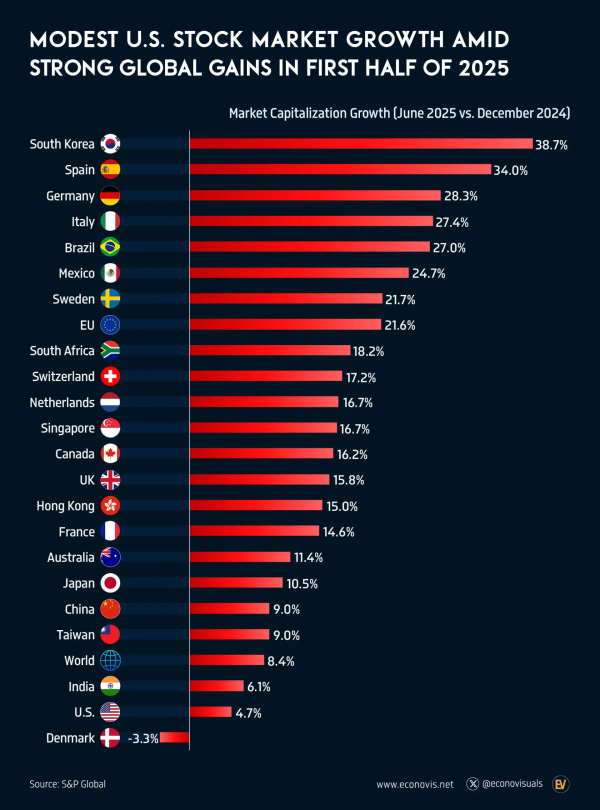
    Chart #1 – Global Stock Market Returns in Q1 of 2025

    via visualcapitalist

    Chart #2 – Trump's Reciprocal Tariffs on Major Nations

    Chart of U.S. President Trump's Reciprocal Tariffs on Countries

    via visualcapitalist

    Chart #3 – Tariff Shock Wipes $5.3 Trillion Off S&P 500: Index Falls 10.5% in Two Days

    📈 Tariff Shock Wipes $5.3 Trillion Off S&P 500: Index Falls 10.5% in Two Days

    via visualcapitalist

    Looking at the first chart, it's clear that prior to this announcement, there was a U.S. sell-off, perhaps caused by concerns about inflation and slower GDP growth. As a result, more investment was moving toward Chinese and European stocks. 

    After Trump's announcement, many things happened, including a joint response from China, Japan, and Korea – something I never thought I'd see. Also, many internet netizens started to plug questions into AI LLMs and receive similar results as Trump's tariffs. Contrary to a more complex equation, it appeared as if the tariff rates were calculated by dividing the deficit and imports of a country. Ultimately, this math was confirmed by the White House Deputy Press Secretary, Kush Desai. 

    It will be interesting to see what is walked back and what is doubled down on over the next few weeks. 

    Do you have faith?  Do you have an opinion?  I'd love to hear it!

  • Understanding the Shape of Change

    Change is the only constant in life, yet it rarely unfolds in ways we expect. While we sense its approach, its shape — whether sudden and disruptive or slow and subtle — often defies our predictions. As the pace and scale of change accelerate, understanding its patterns becomes more crucial than ever.

    The World Government Summit put together a helpful interactive website where you can test your knowledge on the trajectory of key statistical indicators for the development of society over the past decade. Here is the text from their opening screen.


    Can we estimate how much the world has changed in a decade? Or do our own experiences impact the perception of progress? This work challenges the assumptions we make about how key statistical indicators regarding Health, the Environment, or Education evolve through the years. 

    The Shape of Change via the World Government Summit

    The first part of the process was designed to be like a guessing game where you try to predict the direction and the rate of change of key issues shaping the world (like oil dependency, pollution,  literacy, economic freedom, etc.) by answering some questions at "The Shape of Change." It is simple, easy-to-use, and has a nice interface … but answering the questions was more challenging than expected. Try it here


    Screen Shot 2023-05-19 at 2.34.04 PM

    The Shape of Change via the World Government

    The second part of the experiment lets you explore the year-over-year changes in key statistics regarding health, education, economy, and other topics.


    Screen Shot 2023-05-19 at 2.38.55 PM
    The Shape of Change via the World Government

    If you want to explore this further, I asked Perplexity to give me a broad overview of the project and its key insights. Here is the link.

    The data is interesting. But, perhaps, your reaction to the data is more important. 

    Were there any numbers that surprised you?

  • Taking Lessons on AI from my Grandmom

    Almost every event I go to nowadays ends up focused on AI. At a recent event, conversations ranged from use cases for generative AI (and the ethics of AI image creators) to the long-term effects of AI and its adoption.

    Before I could chime in, the conversation had gone to the various comparisons from past generations. When electricity was harnessed, articles claimed that it would never catch on, it would hurt productivity – and woe be unto the artisans it would potentially put out of business if it were to gain traction. 

    When the radio or TV was released, the older generation was sure it would lead to the death of productivity, have horrible ramifications, and ultimately lead to the next generation's failure. 

    People resist change. We're wired to avoid harm more than to seek pleasure. The reason is that, evolutionarily, you have to survive to have fun. 

    On the other hand, my grandmother used to say: "It's easy to get used to nice things.


    My Little Corner of the World: Grandma's Hands


    Here's a transcript of some of my comments during that discussion: 


    With AI, getting from "Zero-to-One" was a surprisingly long and difficult process.  Meaning, getting AI tools and capabilities to the point where normal people felt called to use it because they believed it would be useful or necessary was a long and winding road.  But now that everybody thinks it's useful, AI use will no longer be "special".  Instead, it will become part of the playing field.  And because of that, deciding to use AI is no longer a strategy.  It becomes table stakes.

    But that creates a potential problem and distraction.  Why?  Because, for most of us, our unique ability is not based on our ability to use ChatGPT or some other AI tool of the day.  As more people focus on what a particular tool can do, they risk losing sight of what really matters for their real business.

    Right now, ChatGPT is hot!  But, if you go back to the beginning of the Internet, MySpace or Netscape (or some other tools that were first and big) aren't necessarily the things that caught on and became standards.

    I'm not saying that OpenAI and ChatGPT aren't important.  But what I believe is more important is that we passed a turning point where, all of a sudden, tons of people started to use something new.  That means there will be an increase of focus, resources, and activity concentrated on getting to next in that space.

    You don't have to predict the technology; it is often easier and better to predict human nature instead.  We're going to find opportunities and challenges we wouldn't because of the concentration of energy, focus, and effort.  Consequently, AI, business, and life will evolve.

    For most of us, what that means is that over the next five years, our success will not be tied to how well we use a tool that exists today, but rather on how we develop our capabilities to leverage tools like that to grow our business and improve our lives. 

    Realize that your success will not be determined by how well you learn to use ChatGPT.  It will be determined by how well you envision your future and recognize opportunities to use tools to start making progress toward the things you really want and to become more and more of who you really are.  Right?

    So, think about your long-term bigger future.  Pick a time 5, 10,  or even 20 years from now.  What does your desired bigger future look like?  Can you create a vivid vision where you describe in detail what you'd like to happen in your personal, professional, and business life?  Once you've done that, try to imagine what a likely midpoint might look like.  And then, using that as a directional compass, try to imagine what you can do in this coming year that aligns your actions with the path you've chosen.


    Ultimately, as you start finding ways to use emerging technologies in a way that excites you, the fear and gloom fade.

    The best way to break through a wall isn't with a wide net … but with a sharp blow. You should be decisive and focused. 

    Commit to using AI in ways that give you energy, which may be entirely different from how you use it now. 

    So much of what we do now is anchored in the past. This is an opportunity to transcend the old ways you did things and to shape and transform your future (and perhaps even what you believe is possible).

    I was an entrepreneur in the late 90s (during the DotCom Bubble). And I remember watching people start to emulate Steve Jobs … wearing black faux-turtlenecks and talking about how they were transforming their business to be in an Internet company – or which Internet company would be the "next big thing." Looking back, an early sign that a crash was coming was that seemingly everybody had an opinion about what would be hot, and too many people were overly confident in their views because seemingly everyone was saying the same things. 

    Human nature has remained stubbornly consistent through many waves of technology. 

    The point is that almost nobody talks about the Internet with the focus and intensity they did in the late 90s … in part because the Internet is now part of the fabric of society. At this point, it would be weird if somebody didn't use the Internet. And you don't really even have to think about how to use the Internet anymore because there's a WHO to do almost all those HOWs (and many of them are digital WHOs that do those HOWs for you without you even knowing they were needed or being done). 

    The same is going to be true for AI. Like with any technology, it will suffer from all the same hype-cycle blues of inflated expectations and then disillusionment. But, when we come out the other side, AI will be better for it … and so will society. 

    Understanding the Possibility Scale

    It helps to understand how we bring things into existence. To start, it's nearly impossible to manifest something you can't first imagine. And there is a moment just before something happens – when it becomes inevitable. 

    I created this Possibility Scale to help envision the stages of becoming.


    20250329 HMG Possibility Scale


    As an aside, before today, I would not have attempted to create an image for a post like this. While I love thinking and writing, image creation was outside my area of expertise or unique ability. But now things are different. Today, I simply asked ChatGPT to create that image. Yes, it took me four tries … each retry starting with "that was great, now help me improve the prompt to (fix the thing I wanted done differently)."  At the end, I asked it to give me the complete prompt I could reuse. Contact me if you want the prompt.

    Earlier, I mentioned how long it took to get from "Zero-to-One" with AI. But don't fret; things are speeding up, and we're just at the beginning of the process. If I created a scale to show the capabilities of AI, and set the endpoint at 100 to represent AI's potential when I die – even though I'm in my early 60s, I'd put us at only a 3 or 4 on that 100-point scale. Meaning, we are at the beginning of one of the biggest and most asymptotic curves that you can imagine. That also means that you're not late. You're early! Even the fact that you're thinking about stuff like this now means that you are massively ahead of most.

    Better Wealth, Health and Self Through Exponential Relationships — Just  Start Go

    The trick isn't to figure out how to use AI or some AI tool. The trick is to keep the main thing the main thing. Build your ability to recognize when and how to use these new capabilities to bring the future forward faster.

    Investing resources into your company is one thing. Realize that there are 1000s of these tools out there, and many more coming. You don't have to build something yourself. It is often faster and better to acquire a tool than it is to spend money on developing and building it.

    Think of the Medici family. They invested in people, which in turn triggered the Renaissance. A key to moving forward in the Age of AI will be to invest in the right WHOs, seeking to create the kind of world you want to see or the types of capabilities you desire. Think of this as a strategic investment into creators and entrepreneurs with a vision or who are on a path that aligns with yours.

    As you get better and better at doing that, you'll see increasing opportunities to use tools to engage people to collaborate with and create joint ventures. Ultimately, you will collaborate with technology (like it's your thought partner and then your business partner). We are entering exciting times where AI, automation, and innovation will make extraordinary things possible for people looking for opportunities to do extraordinary things.

    As my grandmother said, it's easy to get used to nice things.

    Onwards!