
I love stuff like this.
To juggle five balls at once is quite a difficult task. To do it on your back is even harder. Then to incorporate your legs and feet into the juggling … well, that would seem impossible.
What do you think makes it possible?

Thoughts about the markets, automated trading algorithms, artificial intelligence, and lots of other stuff
I love stuff like this.
To juggle five balls at once is quite a difficult task. To do it on your back is even harder. Then to incorporate your legs and feet into the juggling … well, that would seem impossible.
What do you think makes it possible?
The shape of the world's demography is changing.
The traditional way of visualizing and explaining the age structure of a society has been a pyramid.
If you draw a chart with each age group represented by a bar, and each bar ranged one above the other—youngest at the bottom, oldest at the top—a pyramid is the shape you would get.
This was true because, with shorter lifespans and higher mortality rates, there were always more young people than old people.
Now the shape of the global population is changing.

Between 1970 and 2015 the dominating influence on the global population was the fertility rate (the number of children a woman would typically bear during her lifetime). It fell dramatically over the period, meaning that the world shifted from having larger to smaller families.
Between 2015 and 2060 the biggest influence upon the population will be aging. Fertility rates are slowing, and now almost everyone is living longer than their parents—dramatically so in developing countries.
The result will be a larger, and growing, older population. This will drive massive infrastructure projects and business opportunities.
via The Economist.
Read the full article from The World In 2015.
The shape of the world's demography is changing.
The traditional way of visualizing and explaining the age structure of a society has been a pyramid.
If you draw a chart with each age group represented by a bar, and each bar ranged one above the other—youngest at the bottom, oldest at the top—a pyramid is the shape you would get.
This was true because, with shorter lifespans and higher mortality rates, there were always more young people than old people.
Now the shape of the global population is changing.

Between 1970 and 2015 the dominating influence on the global population was the fertility rate (the number of children a woman would typically bear during her lifetime). It fell dramatically over the period, meaning that the world shifted from having larger to smaller families.
Between 2015 and 2060 the biggest influence upon the population will be aging. Fertility rates are slowing, and now almost everyone is living longer than their parents—dramatically so in developing countries.
The result will be a larger, and growing, older population. This will drive massive infrastructure projects and business opportunities.
via The Economist.
Read the full article from The World In 2015.
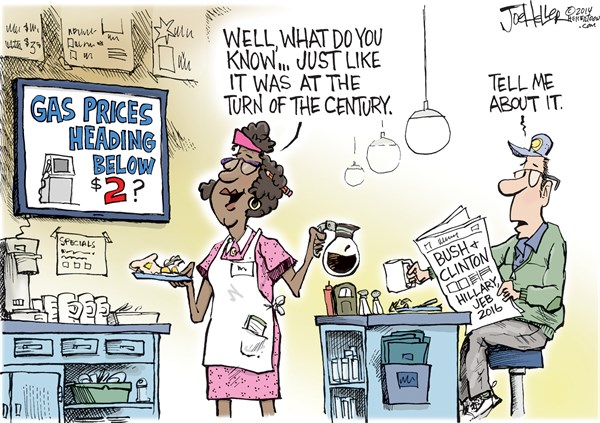
This cartoon made me chuckle. Perhaps you know someone like this?
Here are some of the posts that caught my eye. Hope you find something interesting.
This cartoon made me chuckle. Perhaps you know someone like this?
Here are some of the posts that caught my eye. Hope you find something interesting.
There was an opinion piece on MarketWatch about how information flow influences how often you should trade.
As part of it, there was a video that explained how algorithms effect trading (using a jazz quartet).
via Marketwatch.
A higher-frequency market is more responsive to new information.
The optimal trading frequency depends on how the benefit and cost balance each other.
The more frequently the market allows investors to transact, the stronger their incentive to split orders over time to avoid price impact.
From my perspective, faster trading is inevitable. However, as more traders gain access to it, speed for the sake of speed will lose its appeal. What will continue to matter is the speed at which a trader can identify an edge and capture its profit opportunity.
There was an opinion piece on MarketWatch about how information flow influences how often you should trade.
As part of it, there was a video that explained how algorithms effect trading (using a jazz quartet).
via Marketwatch.
A higher-frequency market is more responsive to new information.
The optimal trading frequency depends on how the benefit and cost balance each other.
The more frequently the market allows investors to transact, the stronger their incentive to split orders over time to avoid price impact.
From my perspective, faster trading is inevitable. However, as more traders gain access to it, speed for the sake of speed will lose its appeal. What will continue to matter is the speed at which a trader can identify an edge and capture its profit opportunity.
Apple figured out what caused some early iPhone 6 Plus phones to bend.
Here are some of the posts that caught my eye. Hope you find something interesting.
Apple figured out what caused some early iPhone 6 Plus phones to bend.
Here are some of the posts that caught my eye. Hope you find something interesting.