Here are some of the posts that caught my eye recently. Hope you find something interesting.
Lighter Links:
- Tourists are Flocking to a Chinese Megacity That’s Straight Out of Sci-Fi. (Wall Street Journal)
Trading Links:
Thoughts about the markets, automated trading algorithms, artificial intelligence, and lots of other stuff
Here are some of the posts that caught my eye recently. Hope you find something interesting.
Lighter Links:
Trading Links:
Thursday was Yom Kippur, which translates to “Day of Atonement” and is one of the High Holy Days in the Jewish religion. This year, as I sat in synagogue, I found myself reflecting on my own challenges deeply. While tradition calls for communal prayers and rituals, I realized how much these ancient practices are really about the individual journey to become better.
Ancient prayers can reveal timeless struggles.
As part of the atonement process, participants read a list of sins (available here), apologize for those committed, and ask for forgiveness. I would encourage you to read that list and use it to think about your life and the impact you have on those around you. These issues are likely to be both timely and timeless. The list is thousands of years old, yet it’s still surprisingly relevant.
As I went through the list, two things struck me. First, regardless of the changes in the world over time (technology, geopolitics, urbanization, mobility, etc.), human nature remains relatively unchanged (otherwise, the issues on the list would seem quaint or outdated). Second, despite all that has changed in the World, these issues remain important. That suggests that these issues are more important than most people realize.
Even if you have managed to stay on the right side of the Ten Commandments and haven’t killed or stolen … you have most likely been frivolous, stubborn, hurtful, dismissive, or judgmental (I know I have …). It’s not just black and white or right and wrong … Frequency, intensity, and duration matter too.
This past year has brought its share of challenges. Yet, Yom Kippur isn’t a time for self-pity or blame — it is a call to look inward with honesty, to reflect, and to commit anew to becoming our best selves.
With that in mind, another prayer read on Yom Kippur is Unetaneh Tokef. This prayer paints a powerful image of judgment day, depicting the fate and destiny of every person — prompting deep introspection about our choices and actions.
To set some context, the theme of the High Holy Days is a Divine decree being written about your Life … think about it as a yearly judgment day. Supposedly, on Rosh Hashana, three books are opened in Heaven – one for the thoroughly wicked, one for the thoroughly righteous, and one for those in-between. The thoroughly righteous are immediately inscribed clearly in the Book of Life. The thoroughly wicked are immediately inscribed clearly in the Book of Death. The fate of those in-between is postponed from Rosh Hashana until Yom Kippur, at which time those who are deserving are then inscribed in the Book of Life, those who are undeserving are then inscribed in the Book of Death.
Below is a brief excerpt from the prayer that captures the spirit of the judgment each person faces.
Who will rest and who will wander, who will live in harmony and who will be harried, who will enjoy tranquillity and who will suffer, who will be impoverished and who will be enriched, who will be degraded and who will be exalted.
On one hand, you can read that and pray for Divine intervention (or perhaps favor), or you can recognize that we each have a choice about who we want to be, how we show up, and what we make things mean. Your choices about these things have real power to create the experience and environment you will live in next year.
This year’s sermon focused on connection. In past years, the message often centered on being present in the moment — acting with intention and living in alignment with your values. This year was no different at its core, but the Rabbi approached it from a fresh angle. He compared one’s connection to God with the connections we nurture — or neglect — with a spouse, a sibling, or a child. His point was that it’s not enough to be present in the moment; we must also be present with each other. I appreciated that distinction and found myself wondering where I might be “phoning it in.” Living in alignment internally is only half the work … we need to practice that alignment outwardly, too.
We can learn from many other cultures. For example, let’s look at Kintsugi. It is the Japanese art of repairing broken ceramics with lacquer dusted or mixed with powdered gold, silver, or platinum. This process highlights the object’s “scars” rather than concealing them. It is rooted in the philosophy that breakage and repair are part of an object’s history and can make it more beautiful and resilient. The artform can also serve as a metaphor for embracing flaws and past traumas as sources of strength and beauty.

This concept is an excellent reminder as we unpack the “trauma” of shootings, culture wars, actual wars, and more. Progress isn’t always linear — every setback is a part of our story, and even our scars can be sources of wisdom and strength. As we heal, we should also strive to help heal the world around us. In the Jewish faith, that concept is called Tikkun Olam.
One of the themes of Yom Kippur is that you’re only one good deed from tipping the scale towards good for yourself and others. As you recognize and repent for your sins, it’s also important to appreciate the good you did (and do) as well.
As I look at my year, atone, and look forward, I’m reminded of two definitions I heard recently.
One is that “intelligence” can be defined as the ability to get or move towards what you want … and the second is that “learning” is the ability to get a better result in the same situation.
I choose to look at going forward as a chance to clear the slate and Be and Do better … personally, professionally, in the business, and in relationships. I know that there’s lots of room for improvement, opportunities for growth, and the ability to simply put the past behind me and focus on a better future.
Initially, I looked at Capitalogix as a technology company that built trading and fund management capabilities. Over time, I realized that the team, our tools, and the things we do backstage are more valuable than the front-stage results that we produce. We can leverage these to amplify intelligence in virtually any industry.
The future is going to be about making better decisions, taking better actions, and continually improving performance. That won’t really change. Almost everything else will. So, the business is really about the things that don’t change.
I think this is probably true in life as well. Many parts of you change … but the part of you that doesn’t is really the core of who you are.
With roughly 80 days left in the year, it’s easy to get caught up in frustrations over politics or inflation, blaming outside forces for unmet goals. Yet, these remaining days are also a unique opportunity—a perfect time to sprint toward positive changes and finish the year strong.
There is plenty of time to make this your best year yet. What can you do? What will you do?
What could you do to make the life of someone around you better? Likewise, how can you let others know you’re thankful for them?
To reference a book by Ben Hardy and Dan Sullivan, transformational change is often easier than incremental change (because you don’t have to drag the past forward).
So, what can you do that would trigger 10X results? More importantly … Will you do it?
I hope you all experience growth in your mental state, your relationships, and your businesses. As you approach year’s end, remember you’re not just starting fresh – but integrating the “gold” from repaired experiences.
Best wishes for a great day and an even better year!
Is the American Dream still within reach for the average American today? For many Millennialsand Gen Z, it feels farther out of reach than ever.
In the 20th century, the American Dream centered on owning a home, securing a good job, and maintaining financial stability. But does that dream still match today’s financial realities? Recent maps comparing state incomes and living costs reveal just how far many Americans are from achieving financial comfort.
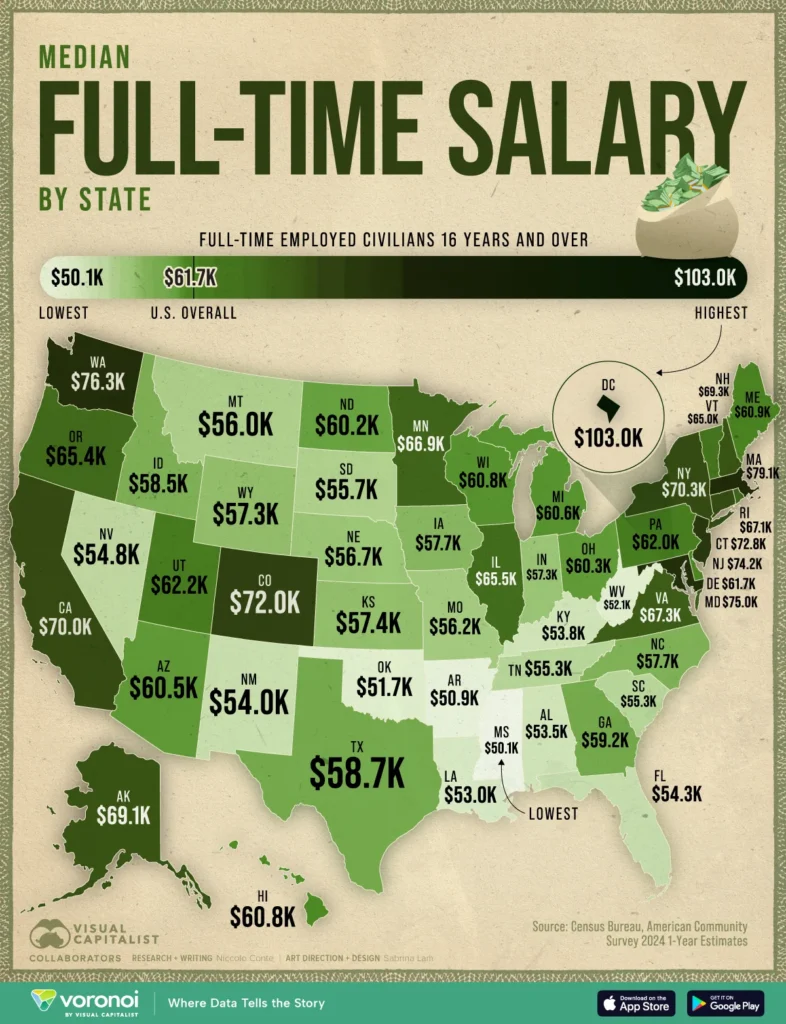
via visualcapitalist
The average full-time salary for all adults as of Q2 2025 is approximately $62K. Predictably, that figure rises in higher-cost metropolitan areas and dips in rural regions, with Washington, D.C., standing out as a notable high point.
However, income alone reveals little about the actual quality of life or whether someone can live ‘comfortably’. That’s why Visual Capitalist looked at how well individual needs are met across America using the classic 50/30/20 rule — allocating 50% of income to essentials,30% to discretionary spending, and 20% to saving or investing.
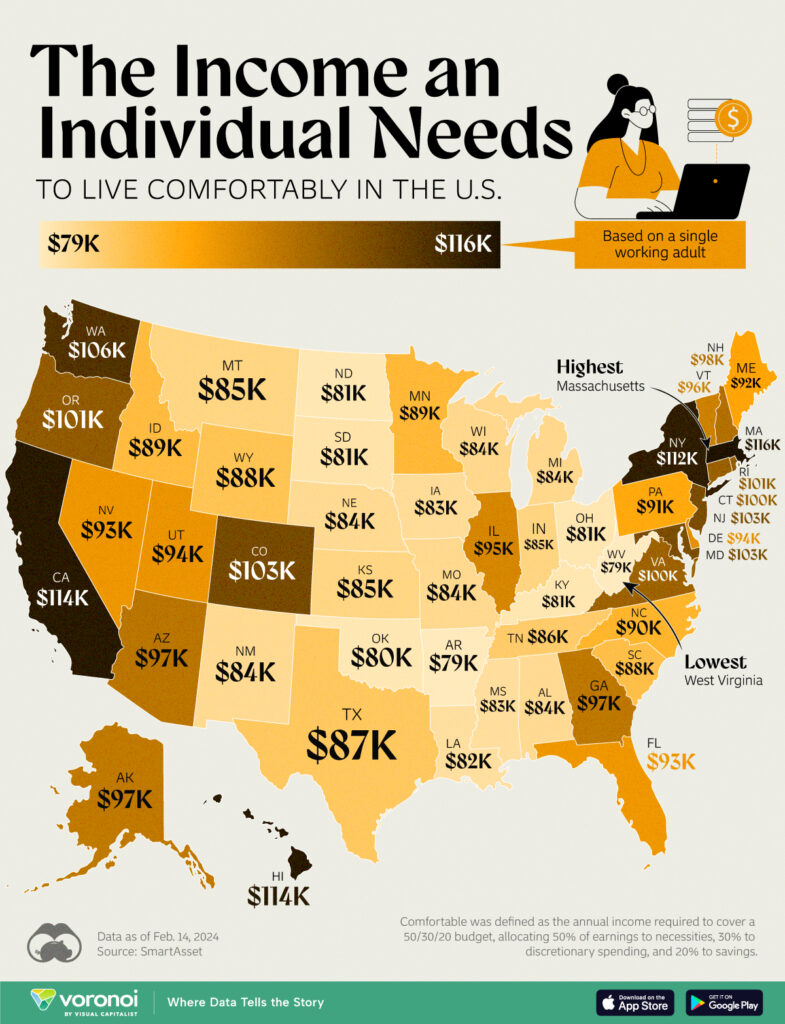
via visualcapitalist
In many states, single earners face a sizable gap between median pay and what’s needed for comfort. For families, the math becomes even more challenging.
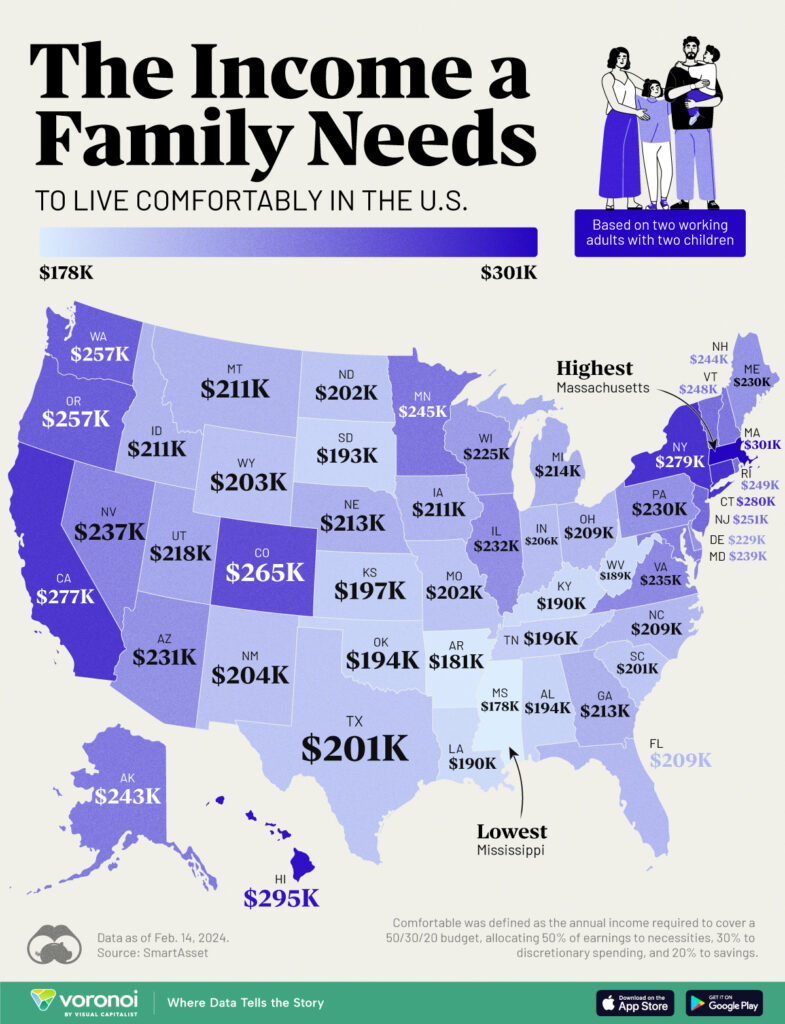
via visualcapitalist
For more context, see:
Clearly, being “middle class” doesn’t mean being “comfortable” in today’s economy. Households in the five most expensive states need nearly twice the average incomejust to meet basic comfort levels. Unsurprisingly, housing costs are a major part of this gap.
It raises important questions: How have these disparities changed since the 1980s or ’90s? Have wage increases failed to keep up with the rising costs of essentials, even as technology and living standards have advanced?
These charts also point to practical strategies. Decades ago, moving to a big city often meant earning higher wages and finding better opportunities. Today, for many workers, the opposite might be true: pursuing remote-friendly roles and relocating to more affordable areas can lead to a better standard of living. Likewise, developing skills in tech-related or future-proof fields can also give workers more leverage.
Ultimately, the data emphasizes the growing significance of location, flexibility, and early career choices — while highlighting a larger challenge: ensuring that economic growth and productivity gains turn into real purchasing power.
While innovation and economic growth have transformed our lives, they haven’t yet led to true financial security for the average American. To make the American Dream more accessible again, we need to address the widening gap between paychecks and the cost of living — even as our economy continues to expand. Recognizing this gap is the first step toward closing it.
The challenge: how do we turn today’s progress into tomorrow’s prosperity?
Onwards.
Here are some of the posts that caught my eye recently. Hope you find something interesting.
Lighter Links:
- Sam Altman Thinks AI Will Surpass Human Intelligence by 2030. His Rival AI Billionaires Say It’ll Be Even Sooner.(Fortune)
- Researchers Uncover Hidden Ingredients Behind AI Creativity.(LiveScience)
- Autism May Be the Price of Human Intelligence. (ScienceDaily)
- Microwave Weapon Downs 49 Drones With a Single Blast. (NewAtlas)
- Microsoft’s Kill Switch Threatens Israel’s National Security – The Push of a Button Can Blind Israel.(TimesOfIsrael)
Trading Links:
- The Lines Between Traditional and Alternative Asset Management Continue to Blur. (Institutional Investor)
- What are TikTok’s New Owners Buying? (Economist)
- Prediction Markets are Booming. Oversight is Barely There.(CitationNeeded)
- Is this the Start of the Tokenization Revolution? (TradersMagazine)
- The American Dream Now Costs $5 Million. Here’s a Breakdown.(USAToday)
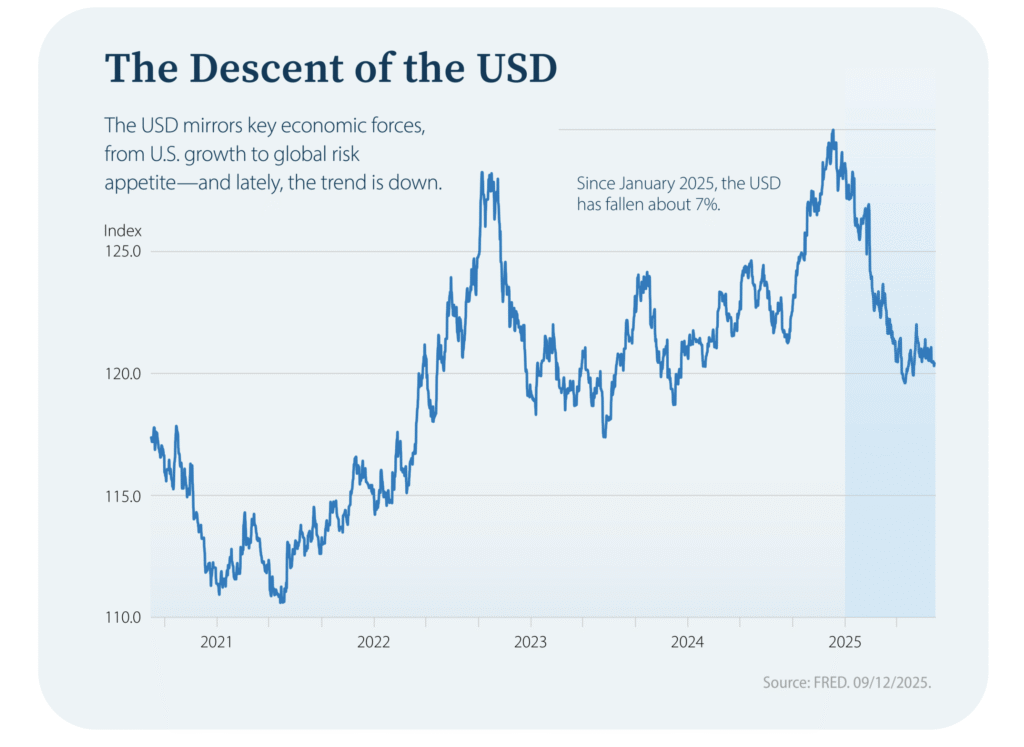
In 2025, the U.S. Dollar has experienced its biggest decline in over twenty years. A drop of more than 10% in a primary global currency is always significant — and this decrease is sending shockwaves through markets, policy discussions, and consumers’ budgets. But what’s truly driving this change, and what does it mean for you?
While substantial, the Dollar’s decline is just one of several significant moves among major currencies. For a broader perspective, here is a chart highlighting key global currency trends this year.
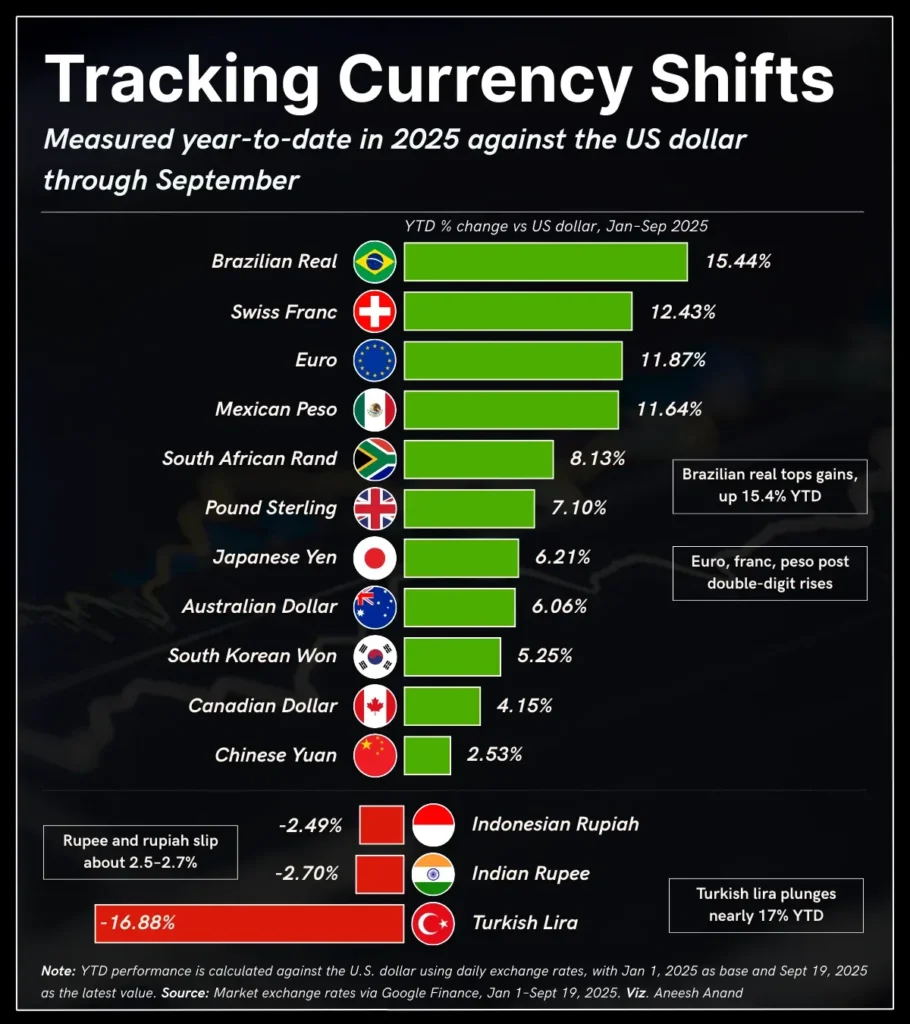
via voronoi
The Brazilian Real is up 15.4% YTD, while the Swiss Franc, the Euro, and the Mexican Peso have each gained more than 10% this year.
Nevertheless, the U.S. Dollar continues to assert its dominance as the world’s primary reserve currency, a status it has maintained since the 1944 Bretton Woods Agreement. This means it is the main currency held by central banks to support international transactions and reduce exchange rate risk. Additionally, it remains the global benchmark against which other currencies are measured.
So, why is the U.S. Dollar down, and why does it matter?
View Full Image via visualcapitalist
A strong currency benefits consumers by making imports more affordable and helping to keep inflation under control. A weaker currency, on the other hand, can be a tailwind for exporters by lowering the global price of their goods, but it also drives up import costs and can stoke inflationary pressures.
The Dollar’s movement reflects not only U.S. conditions but also global ones. As the world’s reserve currency, it responds more directly to worldwide economic forces than most others. This year, soft U.S. GDP projections, high inflation, and the Fed’s shift toward lower interest rates have all contributed to downward pressure on the dollar. But that’s not the whole story.
Of course, no single factor explains the market. The Dollar’s decline isn’t a death knell, just as a surge wouldn’t be proof of perfect health. It’s one signal among many in a complex economic picture.
When discussing negative indicators, it’s just as important to highlight the positive ones — including America’s historical resiliency. While headlines often focus on the dollar’s decline, history shows it has weathered many challenges and thus remains the world’s dominant reserve currency.
For investors and consumers, the lesson is: stay informed, understand the broader economic context, and avoid overreacting to short-term swings. Currency markets move in cycles, and the dollar’s influence won’t disappear overnight.
‘Intentional patience’ often outperforms impulsive action, in trading and in business. By tracking market trends, understanding the underlying factors, and recognizing how currency shifts impact trade, prices, and investments, you can respond strategically rather than reactively to the news cycle.
Chatbots have come a long way from the quirky digital curiosities of the early 2000s (like AOL Instant Messenger’s SmarterChild) to the sophisticated AI chatbots and agents we see today. They’ve become essential tools in both business and daily life.
These tools are having an increasingly global impact, answering customer service questions on retail sites, guiding patients through scheduling in healthcare, providing instant support in banking and insurance, and even acting as digital concierges for travel and hospitality. Inside companies, they streamline HR requests, provide IT troubleshooting, and deliver training. Beyond business, they power personal assistants on our phones, manage smart home devices, and help people learn new skills and appear more caring to those they care about. This widespread adoption reflects how quickly these tools have become part of our daily lives.
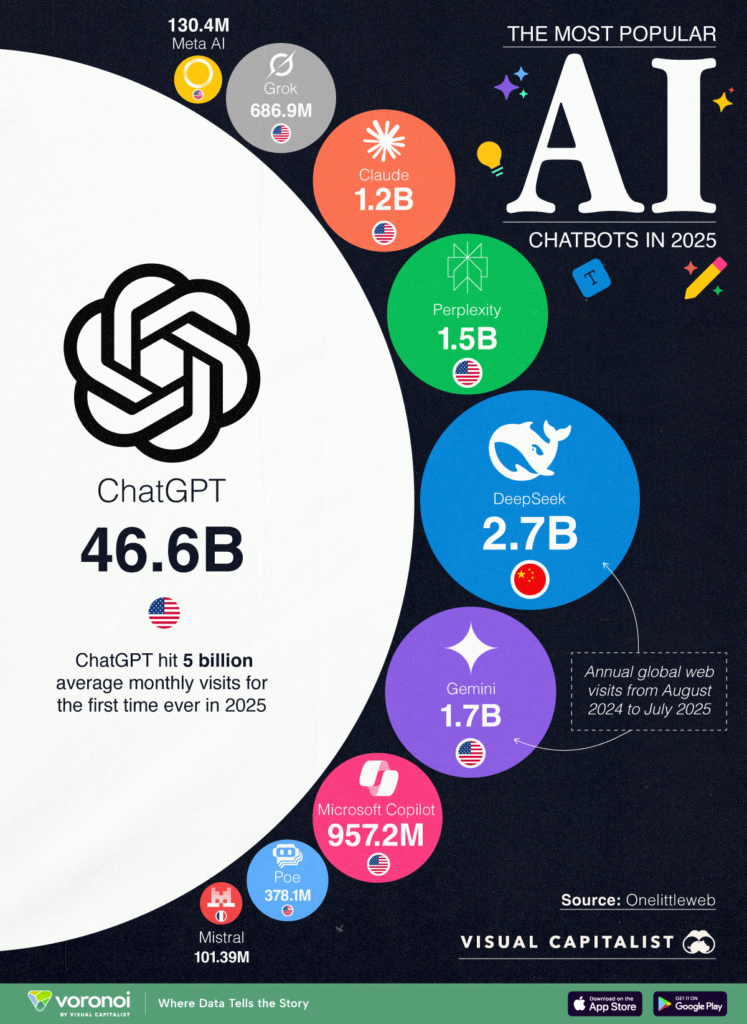
Chatbots have transformed how we interact with digital services, but their uptake varies significantly around the globe. What do current usage trends say about the future of this rapidly evolving technology? A recent chart from Visual Capitalist sheds light on “The 10 Most-Used AI Chatbots in 2025,” showcasing the swift adoption and dominance of major platforms.
via visualcapitalist
ChatGPT now averages over 5 billion monthly visits and accounts for nearly half of global chatbot traffic.
DeepSeek, Gemini, Peplexity, and Claudefollow relatively closely behind.
While Poe has experienced a significant decline in usage, Xai’s Grok, Meta, and Mistral are gaining steam.
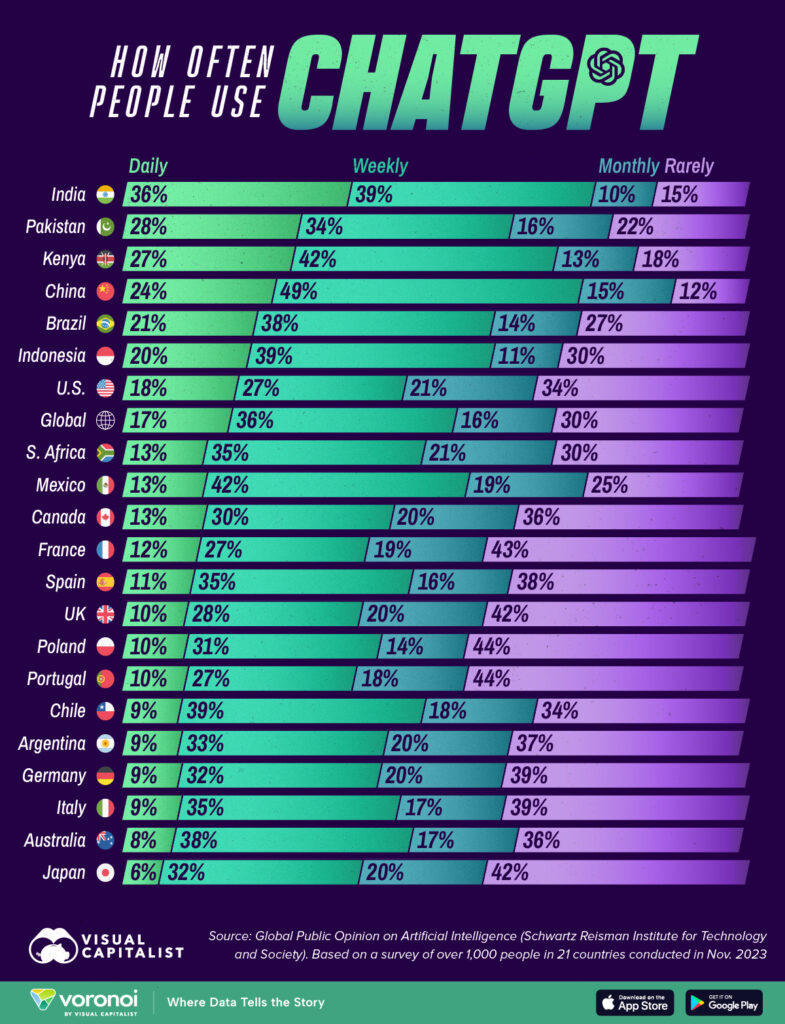
It’s also interesting to look at which countries are adopting the technologies, and which ones remain the most resistant. This chart shows “How Often People Use ChatGPT.”
via visualcapitalist
Today, in the US, fewer than 20% of citizens report using chatbots daily. Meanwhile, India, Pakistan, and Kenya all poll at over 25%.
At the lower end of the spectrum, countries like Chile, Argentina, Germany, Italy, and Australia all report daily chatbot use by fewer than 10% of the population. Japan has the lowest rate, with just 6% of people saying they use chatbots daily, and a notable 42% saying they hardly ever interact with the technology. These differences are probably due to factors such as cultural attitudes toward technology and how people report their own habits.
In contrast, “weekly usage” rates are notably more consistent across different countries, suggesting broader but less frequent interaction.
Just as search engines, social networks, and smartphones each converged on a few dominant players, the chatbot landscape is likely to consolidate, offering a clearer and more streamlined experience for users.
As chatbots advance, their impact will depend not just on technological advancements, but also on how well they build trust, integrate seamlessly, and adjust to different cultural norms. The question still stands: which platform will become the go-to digital companion?
Let’s turn this into a conversation. I’m curious about your favorite AI platforms and reasons why.
Here are some of the posts that caught my eye recently. Hope you find something interesting.
Lighter Links:
Trading Links:
Zoom CEO Eric Yuan recently suggested that artificial intelligence could usher in the era of a three-day workweek. He’s not alone … Bill Gates, Jamie Dimon, and many others have made similar projections. This vision of the future, powered by AI, holds the promise of a more balanced and fulfilling work-life dynamic.
Is the Three-Day AI Workweek a Realistic Future?
While tech leaders hint this is on the horizon, history suggests that reality is rarely so straightforward.
Progress tends to promise leisure, but often fuels increased expectations of acceleration and more output, rather than more downtime.
Technology is not destiny. We shape our tools and, in turn, our tools shape us.
Henry Ford’s assembly line often gets credited with cementing the “eight hours, five days” workweek. However, breakthroughs like the steam engine, electricity, typewriters, calculators, and even the personal computer drove greater output and higher expectations, rather than less time on the job.
I’m still not convinced that less work is better. It seems uncertain whether dramatically reduced work hours would truly improve individuals’ mental health and sense of purpose — or whether companies would support this shift.
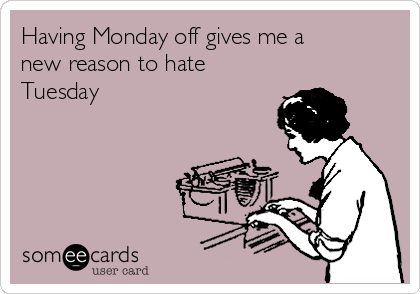
What do you think … Will AI deliver more free time, or simply reshape how we work?
Historical precedent suggests AI may paradoxically increase workplace demands rather than reduce them. In this scenario, freed from tedious tasks, employees find their new bandwidth quickly filled with additional responsibilities, tighter deadlines, and loftier goals. In this future, workers don’t clock out early; they do more in the same amount of time.
We’ve seen this pattern before. Email and smartphones made communication easier, speeding up tasks. Instead of creating more leisure time, they have blurred work-life boundaries, resulting in an increasingly demanding always-on culture.
Is the ultimate goal of AI making us richer or more fulfilled — and are these actually the same thing?
At the other extreme, AI could go further, making many roles wholly unnecessary. Humans might be relegated to the edges of the curve: overseeing AI systems, or handling the industries and exceptions AI still can’t get right. Just recently, Fiverr cut 30% of staff in an effort to be “AI-First”, and they’re not the only ones.
Such a shift would necessitate significant social and policy changes to support displaced workers and reevaluate the connection between income and employment purpose. Trials in places like Iceland and the U.K. suggest that shorter workweeks can boost well-being without hurting productivity. But scaling that globally would demand a fundamental reimagining of how we value work.
It also raises even bigger questions about global relations and the vast disparity in GDP between countries. Could AI become a great global equalizer?
Why the Middle Path Isn’t Guaranteed
The three-day week sounds like a reasonable compromise, but there’s nothing inevitable about it. Left to market forces, companies may prefer to capture the gains for growth rather than distribute them as leisure. On the other hand, rapid advances could push automation so far, so fast, that society is forced to adapt—whether by shrinking hours or by creating new safety nets.
I know many of my friends are using this as a force function to dream bigger and play harder, building new businesses and changing their legacies.
In other words, AI won’t decide our workweek for us. It’s the collective decisions of businesses, governments, and people that will shape our future workweek. Nonetheless, changes are coming!
The Real Choice Ahead
AI may offer new possibilities for work and leisure, but harnessing its benefits will require thoughtful planning, not passive hope.
What Yuan’s prediction highlights isn’t just a future of fewer days at the office — it’s the need to consider who benefits from AI, and how. It’s also a call to action for us to think deeply about the societal implications of AI’s promise and peril … and to use that to plan for a better future.
Do we use these tools to build more balanced lives, or do we let them push us toward more output and potentially more stress? Do we cling to structures designed for a bygone era, prepare for a world where human work is scarce, or do we dream of something bigger?
AI is powerful, but it won’t deliver a three-day weekend on its own. That future depends on choices we haven’t yet made … choices we should be thinking about now.
As most of you know, my son Zach and I co-write this newsletter.
Recently, while talking about articles, Zach opened up about what’s been going on in his life and how it’s affected him. I thought his story would make a great post, so I asked him to share his thoughts. Looking back, it’s easy to relate to where he’s at … Interesting how that happens.
Here it is:
If you asked me to describe myself, rugby would be one of the first words out of my mouth. Honestly, if you asked me about almost anything, I’d probably find a way to sneak in a rugby reference. More than my time in the gym, my love of books, or my penchant for word games, rugby has always been the anchor of my identity.
But life has layers. I’m now a 32-year-old husband, three ACL tears deep, working in the family business, and serving as President of the Dallas Harlequins — my rugby club. And while I still lace up, I know my time on the field is running short. Priorities change, bodies break down, and after 17 years of rugby, mine has plenty of miles on it.
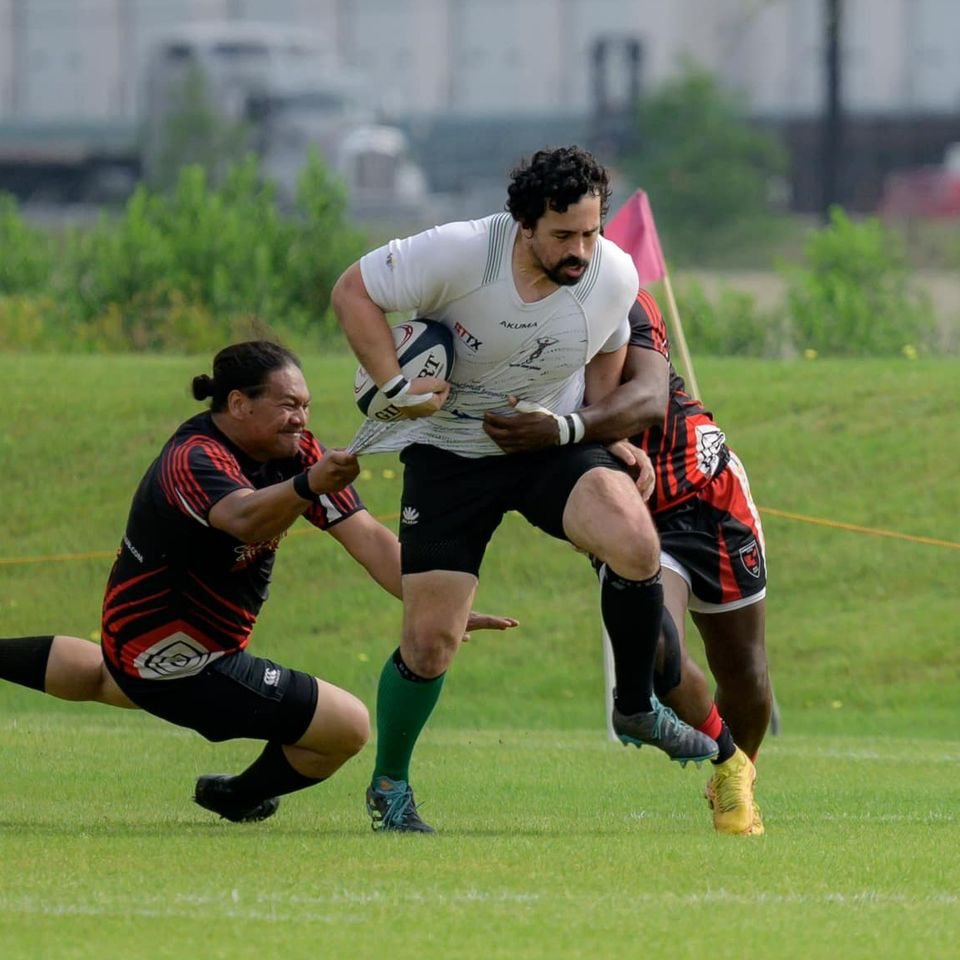
I actually thought I was done at 28. My body wouldn’t bounce back anymore. I’d wake up after practices or games barely able to walk. I had one more big tournament, where I was going to represent the USA, so I decided to fight through the pain, train for the following six months, and let that be my swan song.
Then I bought a Normatec, started drinking a protein shake after practice, and (shocker) started stretching more. Suddenly, I was young again.
Sure, kids learn to stretch in elementary school, but the Getsons have always been slow learners.
Since then, I’ve only gotten better. I’m running harder, tackling more, and understanding the game at a deeper level. My speed isn’t what it was at 21, and I’m definitely not the indestructible college kid I once thought I was. But I’m playing well, and not only are my coaches and teammates noticing, but even my competition is noticing. This past season, I was team MVP, “man of the tournament” at a 7s event, and earned another shot to represent the USA. My coach (who’s been with me since 2019) called it my best season yet.
Still, the signs are there. Recovery is slower, random injuries creep in (yes, even from sleeping wrong), and I know I’m gambling with my body. I’ve been here before: in 2015, fresh out of college, I tore my ACL for the third time while representing the USA in Chile. I “retired,” and it nearly broke me. I had to rebuild my sense of self without rugby, and by the time I returned in 2019, I thought I’d made peace with the idea of walking away.
But now that the day is actually approaching, it stings again. I lost rugby once — and it feels strange to know I’ll lose it again, this time for good. I’ll still be President, I’ll still have my team, and rugby will always be part of me. But I can feel the shift coming, and I know soon enough, these won’t be moments I’m living, but memories I carry.
Are you ever truly ready?
I have to remind myself that life is a gift, aging is a gift, and so is change. Rugby may be slipping away, but there are plenty of other mountains to climb. I might not compete in the same way, but that doesn’t mean I’ll stop being a competitor.
At the core, rugby wasn’t just about the sport — it was about pushing myself, playing through pain, and trying to outdo the person next to me. I’d love to say my only competition is with myself, but let’s be honest, I’m not that mature.
The truth is, I can still channel that drive anywhere: in the gym, at work, in writing, in my marriage, and in the everyday choices that make up my life. I can still choose to be better every day.
Hopefully that’s enough!
Watching Zach reflect on rugby reminds me that the lessons we learn in one arena often carry over to every part of life. The field may change, but the drive, discipline, and the will to turn possibility into reality remain — and those are the qualities that matter most. May your best thoughts become things.
Onwards!
Here are some of the posts that caught my eye recently. Hope you find something interesting.
Lighter Links:
Trading Links: