I was reading an article from James Clear that caught my eye. It describes how tiny improvements compound – and lead to transformative results.
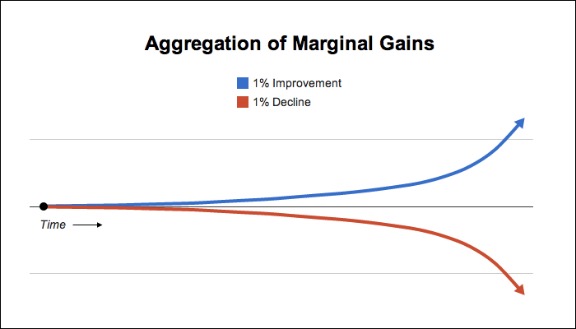
On the surface, it is a story about how British Cycling became a Winner. But the real story is the secret to this success. A surprisingly economic approach, known as the ‘aggregation of marginal gains’. Simply put, it’s about improving everything you do by 1%.
When he got hired in 2010, Dave Brailsford faced a tough job.
No British cyclist had ever won the Tour de France, but his job was to change that.
His approach was simple.
Brailsford believed in a concept that he referred to as the “aggregation of marginal gains.” He explained it as “the 1 percent margin for improvement in everything you do.” His belief was that if you improved every area related to cycling by just 1 percent, then those small gains would add up to remarkable improvement.
They started by optimizing the things you might expect: the nutrition of riders, their weekly training program, the ergonomics of the bike seat, and the weight of the tires.
But Brailsford and his team didn’t stop there. They searched for 1 percent improvements in tiny areas that were overlooked by almost everyone else: discovering the pillow that offered the best sleep and taking it with them to hotels, testing for the most effective type of massage gel, and teaching riders the best way to wash their hands to avoid infection. They searched for 1 percent improvements everywhere.
Brailsford believed that if they could successfully execute this strategy, then Team Sky would be in a position to win the Tour de France in five years time.
He was wrong. They won it in three years.
And now for the important question: what can we learn from Brailsford’s approach?
It’s so easy to overestimate the importance of one defining moment and underestimate the value of making better decisions on a daily basis.
Almost every habit that you have — good or bad — is the result of many small decisions over time.
And yet, how easily we forget this when we want to make a change.
So often we convince ourselves that change is only meaningful if there is some large, visible outcome associated with it. Whether it is losing weight, building a business, traveling the world or any other goal, we often put pressure on ourselves to make some earth-shattering improvement that everyone will talk about.
Meanwhile, improving by just 1 percent isn’t notable (and sometimes it isn’t even noticeable). But it can be just as meaningful, especially in the long run.
And from what I can tell, this pattern works the same way in reverse. (An aggregation of marginal losses, in other words.) If you find yourself stuck with bad habits or poor results, it’s usually not because something happened overnight. It’s the sum of many small choices — a 1 percent decline here and there — that eventually leads to a problem.
In the beginning, there is basically no difference between making a choice that is 1 percent better or 1 percent worse. (In other words, it won’t impact you very much today.) But as time goes on, these small improvements or declines compound … and you suddenly find a very big gap between people who make slightly better decisions on a daily basis and those who don’t. This is why small choices don’t make much of a difference at the time … but add up over the long-term.
In an interview with Harvard Business Review, Brailsford explains the power of the culture created by marginal gains. Everyone is looking for ways to improve, whether individually or as a group. If an entire organization is constantly striving to improve, it's going to create a positive and dynamic culture.
The Bottom Line
Success is a few simple disciplines, practiced every day; while failure is simply a few errors in judgment, repeated every day. —Jim Rohn
You probably won’t find yourself in the Tour de France anytime soon, but the concept of aggregating marginal gains can be useful all the same.
Most people love to talk about success (and life in general) as an event. We talk about losing 50 pounds or building a successful business or winning the Tour de France as if they are events. But the truth is that most of the significant things in life aren’t stand-alone events, but rather the sum of all the moments when we chose to do things 1 percent better or 1 percent worse. Aggregating these marginal gains makes a difference.
More recently, a 240-year-old doll was found that can write any custom text up to 40 letters long using a goose feather and has eyes that follow what it writes. Imagine what the creator of that gadget could do with the tools we have today.
Seems pretty simple in comparison to all the different applications of A.I. we have today.
But as smart as Artificial Intelligence has become, it doesn't take much to thwart its purpose.
For example, iRobot's Roomba seems like a pretty cool piece of technology, right? It'll vacuum for you, learn where your furniture is, etc.
Unfortunately, it's not smart enough to tell when your pet has left a "present" on the floor for you … in which case, it just might spread poop over your whole house.
Yup, that's a real Roomba story, worth a chuckle while you read it here.
This image shows A.I. isn't always a substitute for lack of the real thing.
People claim that they fear Artificial Intelligence … I think artificial stupidity is pretty scary too - even when it doesn't result in smearing poop across your carpet.
One of the biggest challenges in automated trading is how quickly we can recognize when things aren't going right, and get back to doing the right thing again. It isn't just about making money, it's about making and keeping money, consistently.
As for the iRobot, they are aware of the automated poop-spreading issue and are working on a fix.
Sometimes it helps to employ unconventional perspectives when thinking about the size of things.
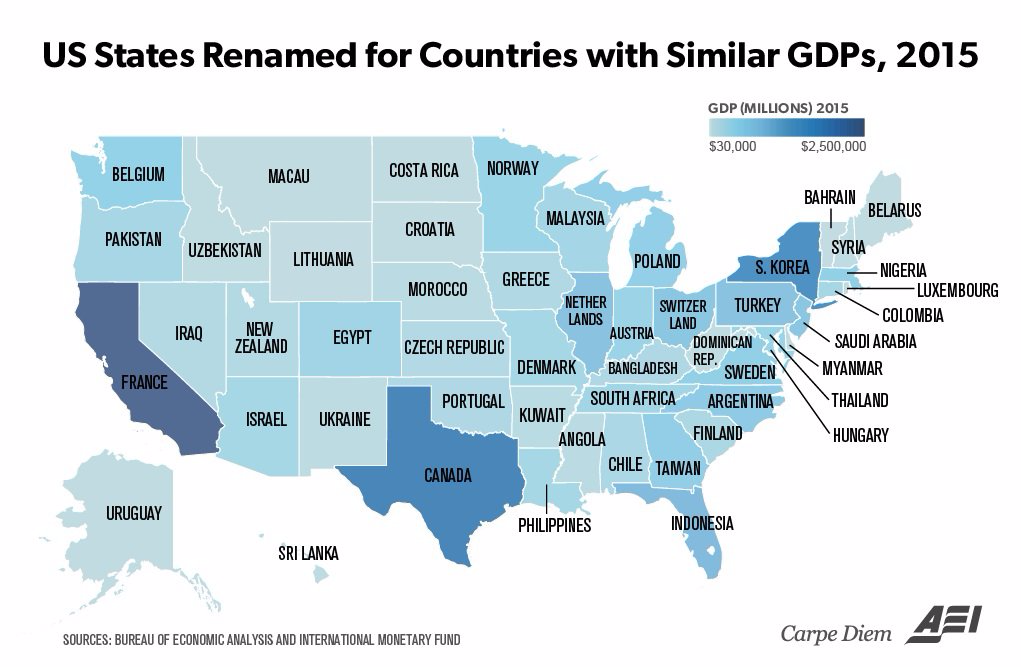
So here's an interesting map from the American Enterprise Institute that shows how massive and productive America's $18 trillion economy is on a global scale.
The map compares the gross domestic product of U.S. states with the national GDPs of other nations.
America's largest state economy is California. In 2015, the Golden State's GDP was about $2.46 trillion. As a separate country, California would have been the 6th largest economy in the world last year (just behind the U.K. and slightly above France's GDP of $2.42 trillion). But France's population is about 66.48 million, while California's is only about 39.14 million — meaning California produces about the same as France – with about 40% fewer people.
America’s second largest state economy is Texas. In 2015, the Lone Star state's GDP was about $1.59 trillion. This would have ranked Texas as the world’s 10th largest economy last year. To compare, Canada’s GDP last year was $1.55 trillion. However, to produce about the same amount of economic output as Texas required a workforce in Canada (18 million) that was 50% larger than employment in the state of Texas (12 million). That is, it required 6 million more workers in Canada to produce the same output as Texas last year.
Check out the rest of the states in the map below:
The map, below, is interesting in a different way. I'm sure you've heard that "a picture is worth a thousand words." Here, a couple dozen words capture the world.
So, how did this come to be? Hunt has been coaching gymnastics in Utah since 1974. While demonstrating a backflip for a female student, he realized the comic value of a man performing women's gymnastics.
The rest … Well, I guess you just shouldn't fight your Unique Ability.