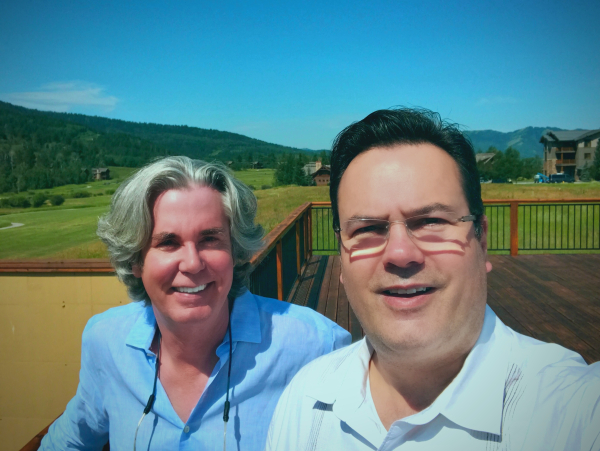
I just got back from an economic summit in Wyoming where I spent some time with Paul McCulley. He is an economist and former managing director at PIMCO.
As I get older, I've noticed how much more often my mental perception of myself, and the physical realities are incongruent.
I remember routinely being the youngest guy in the room. Obviously, that isn't true anymore (unless I'm at Denny's at 4pm).
I remember running around the park (without stopping). And I certainly remember enjoying working out with my son.
Things that used to be easy (or at least routine) now cause me stress.
But age affects everyone – and while my 24-year-old can still eat like a pig and lift heavily, those days are behind me.
I recently shared an article on "Conditioning Yourself To Take The Next Best Step," and I talked about getting back in shape … the mentality it takes, and the habits I carried with me from my days as an athlete
One of the hardest lessons for me to learn has been that I can't work out how I used to … or I injure myself.
It is not too far a leap to go from that – to thinking about mortality.
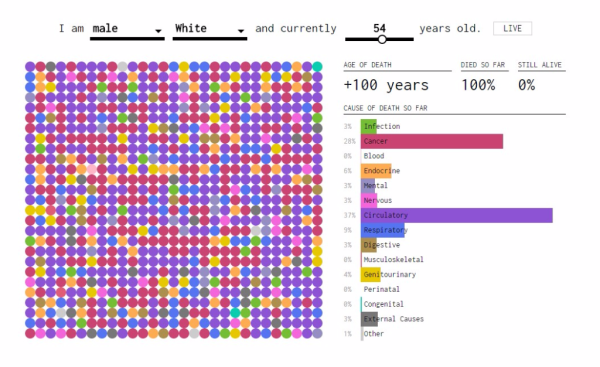
This interactive graphic, below, shows how people of different ages die. Click the image to try it yourself.
You can see what average mortality looks like (by plugging in "0" as your age) … or plug in your current age, sex, and race to see what's most likely to kill you (based on you having survived to now).
Unsurprisingly, congenital issues stop having high mortality around 10, and circulatory/respiratory issues become more prevalent as you get older.
Sure, this is based on averages – but it's interesting to see how locale and income play a role in your life expectancy.
According to a Harvard-run study, people live longer in more educated and affluent areas even if they're less well-off, and that's taking even after taking into account labor market, social connectedness, and other factors.
As well, the richest Americans live approximately 10-15 years longer than the other end of the spectrum as seen below.
When it comes to American pastimes, many people focus on the big 3 sports: Football, Basketball, and Baseball. Nevertheless, there are a lot of different ways people spend their time. It is interesting to see what they watch – and what they actually play.
Nevertheless, there are a lot of different ways people spend their time. It is interesting to see what they watch – and what they actually play.
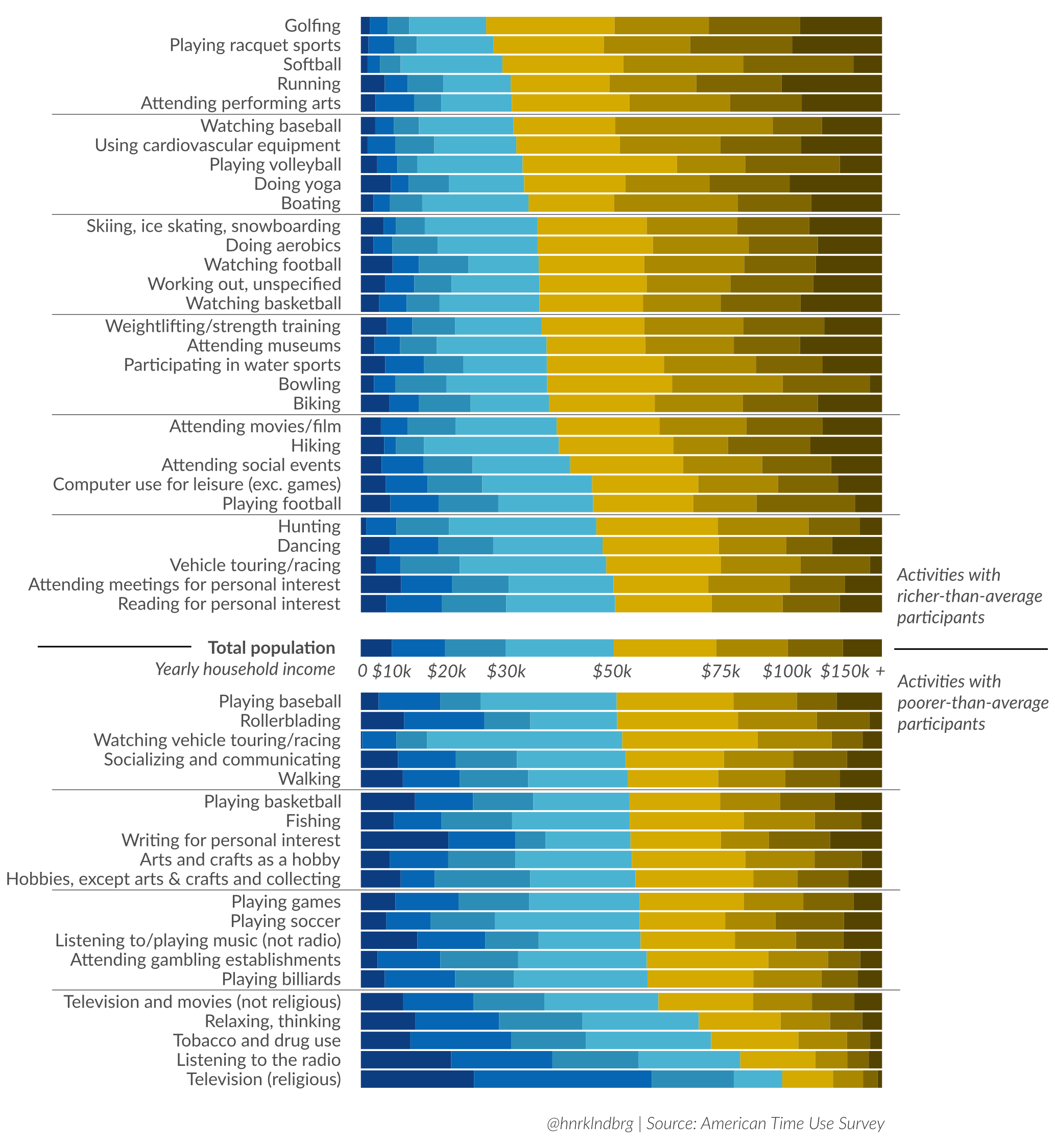
There is also a big difference based on income distribution. Here is an infographic.
Apparently, rich people like golfing, yoga and racquet sports … while poorer people disproportionately liked relaxing, writing for personal interest, and having hobbies.
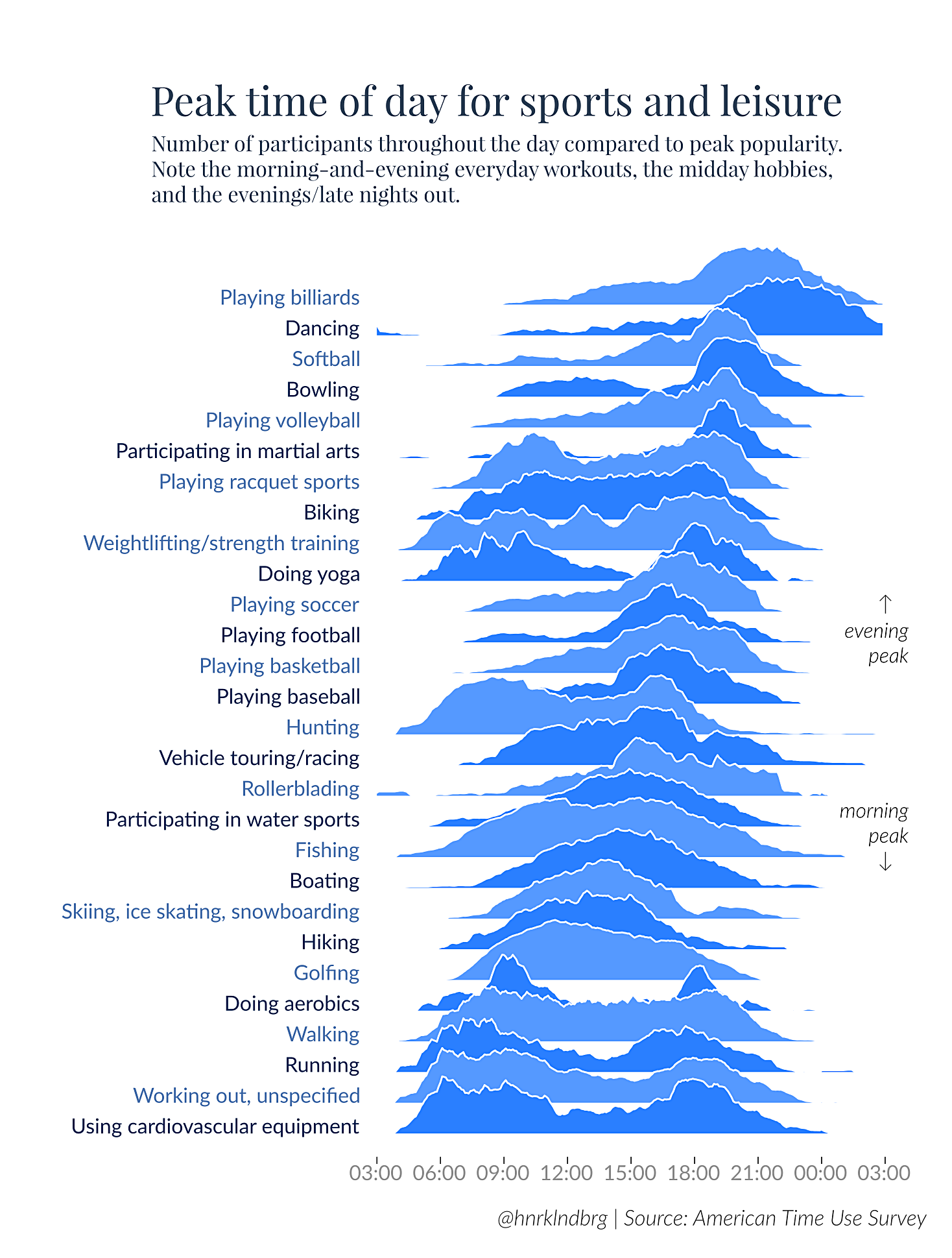
It is also kind of interesting to see when people tend to do certain activities. Here is a chart showing the peak time for various sports and activities.
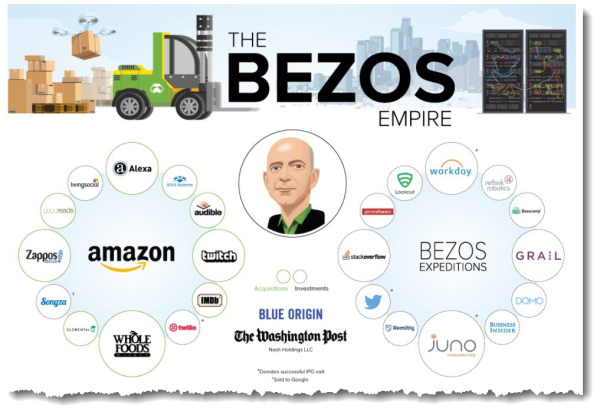
Despite minimal profits (literally less than a handful of profitable quarters since it started in 1994), Amazon has a market cap of roughly $470 billion in market capitalization. They've shown that there's a new algorithm for success – it's about vision and market domination. It is a long game with big stakes … and it looks like he's winning.
They've shown that there's a new algorithm for success – it's about vision and market domination. It is a long game with big stakes … and it looks like he's winning.
But You'd Still Call Them A Success
"Bezos recently told shareholders that the goal is to 'experiment patiently, accept failures, plant seeds, protect saplings, and double down when you see customer delight.'"
It's a similar idea to one that I've adopted – though on a different scale.
When people first look at Capitalogix they see a hedge fund – but that is just an application of our core capabilities. Internally, we know that we are an innovation engine that uses domain expertise in algorithmic trading, data science, and high-performance computing to generate something new.
Edges decay or disappear faster than ever before – that's what drives our pursuit of more ways to win.
When changing the way people play a game – you can't play by the same rules people used to.
My wife is from Indonesia, so we often go to visit her family.
As a result, I often have new and exotic experiences …
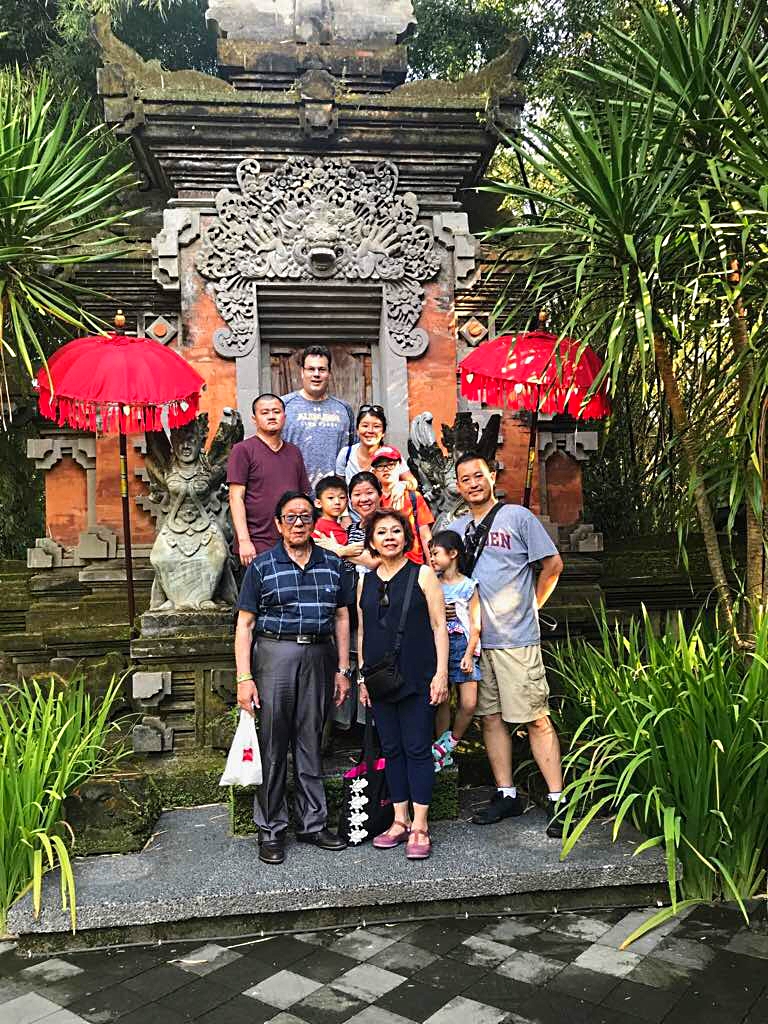
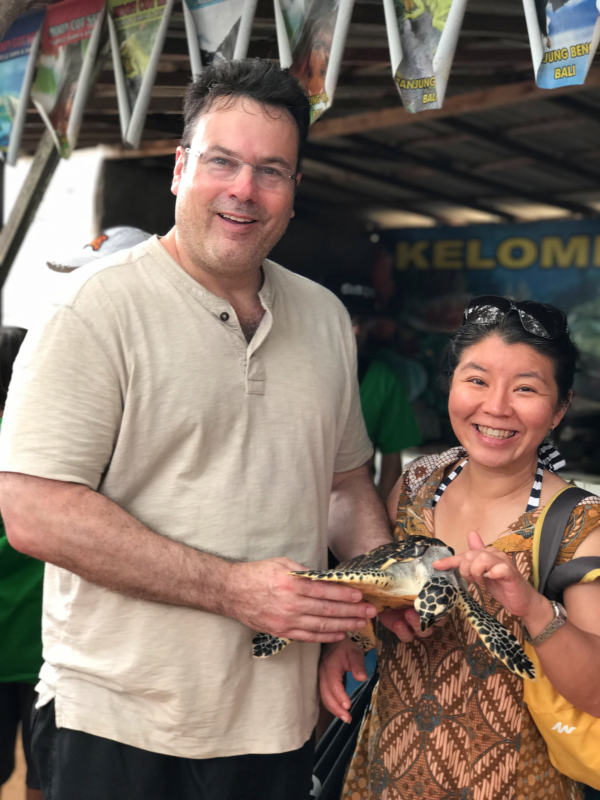
That picture was taken in Bali, where I first met my wife many years ago. Bali holds a lot of good memories for me, but Indonesia has more to offer than just Bali.
Indonesia is the largest Muslim country, but it also has famous Hindu and Buddhist temples as well – including the world's largest Buddhist temple – Borobudur in Java.
When you hear "Java" you think Coffee … and for good reason.
Indonesia is famous for coffee. For example, "Sumatra" is their biggest island – with “Java” coming in close behind.
They also make one of the most expensive coffees in the world … Kopi Luwak.
It's a "special" coffee … made using a very particular process.
In traditional coffee production, the cherries are harvested and the beans are extracted. The beans then get shipped to a roaster, ground into a pulp, and brewed by a barista at your local Starbucks.
In contrast, with Kopi Luwak, something different happens.
The coffee cherries are still harvested, but by wild animals.
Specifically, they’re harvested by the Asian Palm Civet, a small, cat-like animal that absolutely loves the taste of those cherries.
But,if the civets eat the cherries, how can they still be used to make coffee?
Well … that's the gross part.
The civets eat the coffee cherries, but their digestive tract can’t effectively process the beans, only the flesh surrounding them.
When the partially digested, partially fermented beans are eventually excreted, coffee producers harvest them. The beans are then cleaned, roasted, and used to make astonishingly expensive (“with retail prices reaching up to $700 per kilogram”) coffee.
Now is the coffee that mind-blowing to warrant a price north of $300 a pound?
No, not really. In fact, many critics will openly call it bad coffee, or as Tim Carman, food writer for the Washington Post put it, "It tasted just like…Folgers. Stale. Lifeless. Petrified dinosaur droppings steeped in bathtub water. I couldn't finish it."
To be fair, the Luwak coffee industry is an experience. When I toured a plantation near Ubud, Bali, a smiling tour guide greeted and led me on an in-depth exploration of the forested property, where I was allowed to immerse myself in the various spices, roots, beans, and civets used to produce this one-of-a-kind coffee. Here is a video I shot of the process.
If you think about it, I paid a premium to drink exotic cat poop coffee, but I certainly wouldn't drink coffee made from people poop (or even domestic cat poop).
So, why would I buy the coffee then?
It’sthe story that allows this not so awesome coffee to fetch awesome prices. People are paying for the experience, not the commodity itself.
The same is true when you buy Starbucks. The coffee at 7-Eleven is cheaper – and Consumer Reports tell us that McDonalds coffee is better.
While the official language is Indonesian (also known as Bahasa Indonesia), a variant of Malay, most Indonesians speak other languages, such as Javanese, as their first language. More than 700 regional languages are spoken in Indonesia's numerous islands.
While American's tend to think English is the most prevalent language, we actually come in third behind Chinese and Spanish.
While based on population density, and reproduction, it seems like Chinese (Mandarin) will only widen its lead, it's worth noting that its influence wanes greatly outside of Asia.
How long will that last?
When I was younger, English was the language of business, but it may be time for you to brush up on your Chinese.